


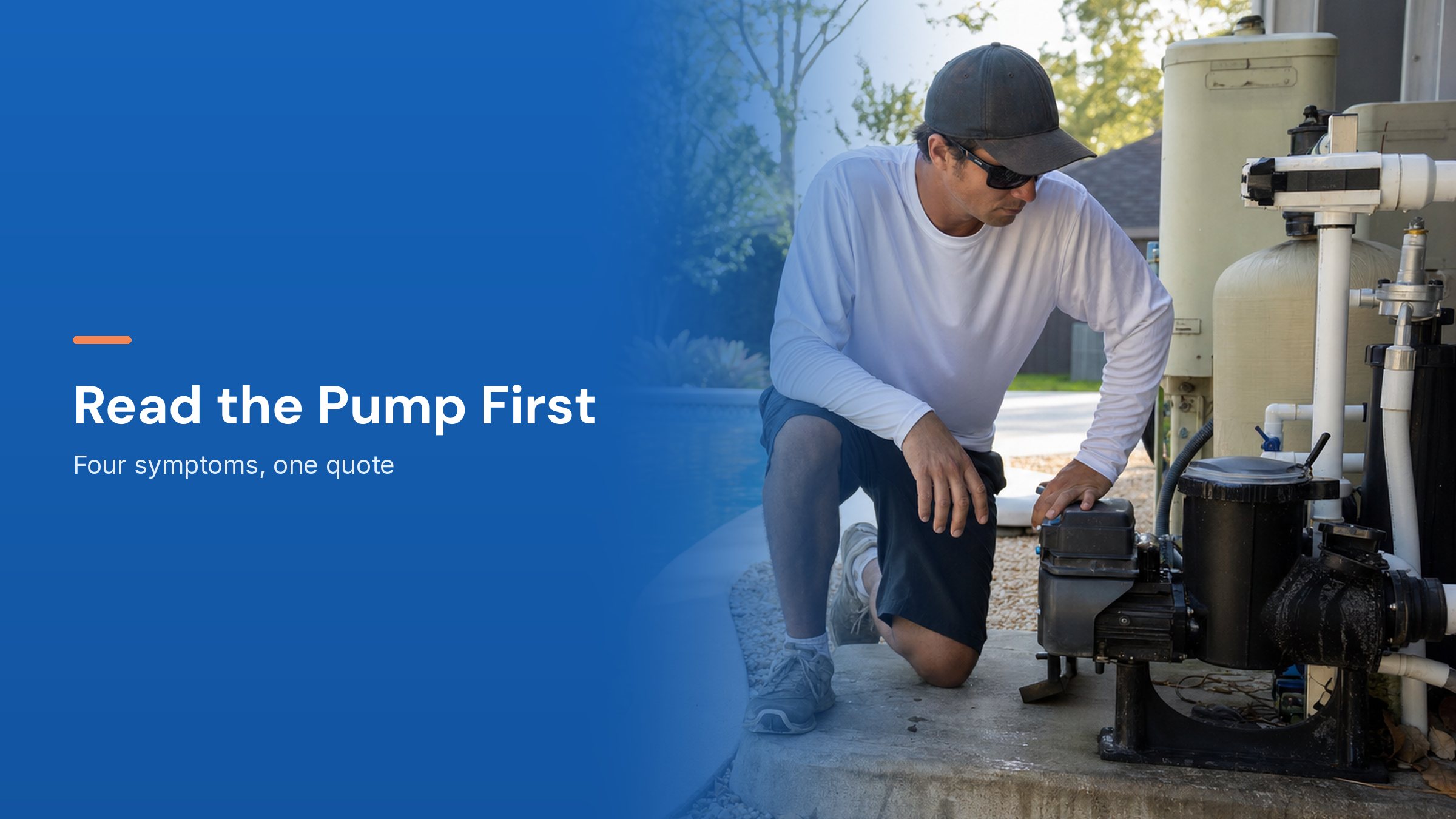
A pump call usually starts with one of four complaints. It is leaking. It got loud. The returns are weak. Or it keeps tripping the breaker. Each one has a short list of usual causes, and most of them cost a lot less than a new pump.
This guide gives you that list for each symptom, the order to check things in, and what to quote once you know the cause. It is written for the person standing at the pad: the tech, or the owner who has to price the job.
Some of these symptoms already have their own step-by-step pages on our site. Where that is true, we link to them and stay brief here.
Key Takeaways
- Find the first wet spot. Water runs downhill along the pump. The drip on the pad is rarely where the leak starts.
- A seal leak is urgent. Hayward says a seal leak can let chlorinated water into the motor bearings and make them whine. It says seal leaks should be fixed at once.[1]HaywardSuper Pump Series Owner's Manual, IS26001 Rev-B: start-up notices and the Troubleshooting pages (motor will not start, motor shuts off, motor hums, low flow, noisy pump). Read November 28, 2026.hayward.com
- Sort noise by sound. A tumbling, rocky sound points to the suction side. A shake points to the mount. A steady whine usually points to bearings.[1]HaywardSuper Pump Series Owner's Manual, IS26001 Rev-B: start-up notices and the Troubleshooting pages (motor will not start, motor shuts off, motor hums, low flow, noisy pump). Read November 28, 2026.hayward.com
- Read the filter gauge on weak flow. High pressure points past the pump. Low pressure points before it or at the impeller.[1]HaywardSuper Pump Series Owner's Manual, IS26001 Rev-B: start-up notices and the Troubleshooting pages (motor will not start, motor shuts off, motor hums, low flow, noisy pump). Read November 28, 2026.hayward.com
- A trip is an electrical call. Note which device tripped and reset it once. Testing wires and motors is a job for a licensed electrician.
The short answer, by symptom
Start every pump call with the cheap checks. Look at the baskets, the water level, the valves and the filter gauge before you open anything. Then use the table below to pick the likely cause.
| Symptom | Check first | Usual causes | What it often ends up as |
|---|---|---|---|
| Leaking | Dry the pump, run it, watch for the first wet spot | Lid o-ring, unions, drain plugs, shaft seal, seal plate, cracked housing | O-ring or gasket, seal kit, seal plate, or a housing |
| Loud | Baskets, water level, pump pot full of water, base bolts | Cavitation, air leak, debris in the pump, loose mount, worn bearings | Fix the suction side, or a motor |
| Weak flow | Baskets, filter gauge, valve positions, pump speed | Dirty filter, clogged impeller, air leak, blocked suction line | Filter clean, impeller clean, air leak fix |
| Trips the breaker | Which device tripped, and does the shaft turn freely with power off | Water in the motor, wet or damaged wiring, stuck shaft, failed motor or drive | Electrician, motor, drive or pump |
Two of these symptoms often show up together. A leaking shaft seal can lead to noisy bearings. It can also lead to a trip if water gets into the motor. So when you see more than one, look for the leak first.
Leaking: find where the water starts
A pump can leak from six or seven places, and they all drip onto the same pad. So the first job is to find where the water starts, not where it lands.
Turn the pump off. Wipe the pump dry, including the gap between the wet end and the motor. Then run it and watch with a light. The first spot that turns wet is your leak. If the pad sits below the pool's water level, be ready to close valves. Jandy warns that a leak on equipment below the water line can drain a lot of water or flood the area.[2]Jandy (Zodiac Pool Systems)Variable-Speed Pumps, DV/DVS Models, Installation and Operation Manual, H0719301 Rev A: safety warnings, Section 6 Troubleshooting and Repair, and 6.1.1 Blocked Impeller. Read November 28, 2026.Jandy manual
| Where it is wet first | Likely part | Notes |
|---|---|---|
| Around the clear lid | Lid o-ring, or a lid that is cracked or not seated | While the pump runs, this spot is usually under suction, so it pulls air. It drips when the pump is off. |
| At a union or threaded fitting | Union o-ring, cracked adapter, worn threads | Hayward says to use PTFE tape on threads and not pipe dope, which can crack plastic.[1]HaywardSuper Pump Series Owner's Manual, IS26001 Rev-B: start-up notices and the Troubleshooting pages (motor will not start, motor shuts off, motor hums, low flow, noisy pump). Read November 28, 2026.hayward.com |
| At a drain plug | Drain plug o-ring | Cheap and fast. Check it before you blame the seal. |
| Under the motor, from the gap between the wet end and the motor | Shaft seal | Treat it as urgent, because water can reach the bearings.[1]HaywardSuper Pump Series Owner's Manual, IS26001 Rev-B: start-up notices and the Troubleshooting pages (motor will not start, motor shuts off, motor hums, low flow, noisy pump). Read November 28, 2026.hayward.com |
| Around the edge of the seal plate | Seal plate o-ring or gasket, or a warped seal plate | A plate that got hot from running dry may never seal again. |
| At a seam or the outlet port | Cracked housing or volute | Hairline cracks can be hard to see from outside. |
Why shaft seals fail
The most common cause is running dry. Hayward and Jandy both say never to run the pump without water. Hayward explains that water cools and lubricates the mechanical seal, and that running dry can damage the seal, cause leaks and void the warranty.[1]HaywardSuper Pump Series Owner's Manual, IS26001 Rev-B: start-up notices and the Troubleshooting pages (motor will not start, motor shuts off, motor hums, low flow, noisy pump). Read November 28, 2026.hayward.com[2]Jandy (Zodiac Pool Systems)Variable-Speed Pumps, DV/DVS Models, Installation and Operation Manual, H0719301 Rev A: safety warnings, Section 6 Troubleshooting and Repair, and 6.1.1 Blocked Impeller. Read November 28, 2026.Jandy manual Ask the customer if the water got low, a valve got closed or the pump lost prime lately. If that cause is still there, a new seal will fail the same way.
Hayward also warns against adding chemicals right in front of the pump suction, because strong chemicals can damage the pump.[1]HaywardSuper Pump Series Owner's Manual, IS26001 Rev-B: start-up notices and the Troubleshooting pages (motor will not start, motor shuts off, motor hums, low flow, noisy pump). Read November 28, 2026.hayward.com If you see crusty buildup around a seal leak, look at the water balance too. Our page on whether salt damages pool equipment covers what corrosive water does to metal parts.
Tell the customer before you open an old pump
On an old pump, a long, slow seal leak can rust the seal plate bolts in place. You will not know until you put a wrench on them. So say it before you start: the seal job may turn into a seal plate, or a new pump.
“Now, when I take on new jobs, I kind of look at what the potential is to this repair. Is this gonna open up a can to a whole array of issues?”
Turn off the power at the breaker before you take the pump apart, as both manuals say.[1]HaywardSuper Pump Series Owner's Manual, IS26001 Rev-B: start-up notices and the Troubleshooting pages (motor will not start, motor shuts off, motor hums, low flow, noisy pump). Read November 28, 2026.hayward.com[2]Jandy (Zodiac Pool Systems)Variable-Speed Pumps, DV/DVS Models, Installation and Operation Manual, H0719301 Rev A: safety warnings, Section 6 Troubleshooting and Repair, and 6.1.1 Blocked Impeller. Read November 28, 2026.Jandy manual For seized bolts, a seal that still leaks after you replace it, and how to inspect the seal plate and housing, see Pool Pump Still Leaks After a New Shaft Seal. We do not repeat those steps here.
Loud: is it bearings, cavitation or something else?
A loud pump does not prove a bad motor. Hayward lists four kinds of noise causes, and only one is the motor.[1]HaywardSuper Pump Series Owner's Manual, IS26001 Rev-B: start-up notices and the Troubleshooting pages (motor will not start, motor shuts off, motor hums, low flow, noisy pump). Read November 28, 2026.hayward.com
| What it sounds like | Hayward's cause | What you end up quoting |
|---|---|---|
| Rocks tumbling through the wet end, getting worse at high speed | Cavitation or an air leak: blocked or undersized suction, low water, returns with no restriction | A suction side fix, or a lower speed. No motor. |
| A buzz or shake you can feel in the pad | Vibration from a pump that is not level or not bolted down | Level and secure the pump.[2]Jandy (Zodiac Pool Systems)Variable-Speed Pumps, DV/DVS Models, Installation and Operation Manual, H0719301 Rev A: safety warnings, Section 6 Troubleshooting and Repair, and 6.1.1 Blocked Impeller. Read November 28, 2026.Jandy manual |
| Clicking or knocking inside the pump | Stones or other debris hitting the impeller | Clean the pump. Replace a broken basket. |
| A steady whine or screech | Worn bearings, often from a seal leak that let chlorinated water wash out the grease | A motor and a shaft seal |
One quick test on a variable speed pump: turn the speed down. If the tumbling sound fades, the pump is short on water from the suction side, and the motor is fine.
“They always wonder, you know, I plug in my vacuum hose and all of a sudden I hear sounds like a choo-choo train coming down the track. Well, probably not being able to supply it with enough water is your biggest downfall.”
Bearings or a motor swap? Most service pros do not rebuild small pool motors. They quote a new motor, or a whole pump on an old unit, because it comes with a warranty. Bearing work usually goes to a motor shop and pays off mainly on large commercial motors. Either way, fix the seal leak that ruined the bearings first.[1]HaywardSuper Pump Series Owner's Manual, IS26001 Rev-B: start-up notices and the Troubleshooting pages (motor will not start, motor shuts off, motor hums, low flow, noisy pump). Read November 28, 2026.hayward.com For the full noise check, see Pool Pump Making a Loud Noise?.
Weak flow at the returns
Weak returns are often blamed on the impeller. Sometimes that is right. But Hayward's low flow list starts with other causes: a clogged strainer or suction line, undersized pipe, a dirty filter or partly closed valve, an air leak on the suction side, and then a plugged or damaged impeller.[1]HaywardSuper Pump Series Owner's Manual, IS26001 Rev-B: start-up notices and the Troubleshooting pages (motor will not start, motor shuts off, motor hums, low flow, noisy pump). Read November 28, 2026.hayward.com
The filter gauge tells you which way to look.
| Gauge and returns | Likely meaning | Check next |
|---|---|---|
| Weak returns, high filter pressure | Something past the pump is blocked | Clean the filter. Check return valves and the heater bypass. |
| Weak returns, low filter pressure, basket full of water | The pump is not getting or moving enough water | Check baskets, suction valves and the impeller. |
| Weak returns, air in the pump basket, bubbles at the returns | An air leak on the suction side | Hayward notes that suction air leaks show up as bubbles at the returns.[1]HaywardSuper Pump Series Owner's Manual, IS26001 Rev-B: start-up notices and the Troubleshooting pages (motor will not start, motor shuts off, motor hums, low flow, noisy pump). Read November 28, 2026.hayward.com |
| Normal returns, gauge reads zero | The gauge itself | Swap the gauge. |
A zero reading with dead returns is a pump problem, not a filter problem. A shop owner put it simply:
“If you've genuinely got 0 PSI on the gauge and nothing coming out of the return jets, I'd be looking at the pump before the filter. A dirty glass media filter will usually give you high pressure, not zero.”
Checking for a clogged impeller
Jandy's manual gives a simple order for a blocked impeller. Turn the pump off and switch off the breaker. Remove the lid and basket. Reach in and pull out any debris. If you cannot clear it that way, take the pump apart to reach the impeller.[2]Jandy (Zodiac Pool Systems)Variable-Speed Pumps, DV/DVS Models, Installation and Operation Manual, H0719301 Rev A: safety warnings, Section 6 Troubleshooting and Repair, and 6.1.1 Blocked Impeller. Read November 28, 2026.Jandy manual Jandy warns that you can be badly hurt if the pump starts while your hand is inside, so the breaker comes first, every time.[2]Jandy (Zodiac Pool Systems)Variable-Speed Pumps, DV/DVS Models, Installation and Operation Manual, H0719301 Rev A: safety warnings, Section 6 Troubleshooting and Repair, and 6.1.1 Blocked Impeller. Read November 28, 2026.Jandy manual
A clogged impeller almost always has a reason. Look for a cracked or missing pump basket. Jandy says that if you find a lot of debris, check the strainer basket for breaks and replace it.[2]Jandy (Zodiac Pool Systems)Variable-Speed Pumps, DV/DVS Models, Installation and Operation Manual, H0719301 Rev A: safety warnings, Section 6 Troubleshooting and Repair, and 6.1.1 Blocked Impeller. Read November 28, 2026.Jandy manual Also look for parts that should not be loose, like a wear ring that broke apart and ended up inside the impeller.
Other weak flow causes pros run into:
- A variable speed pump set too slow for what the pool needs, or a schedule someone changed. See what to do when a customer changes the pump schedule.
- A worn impeller or diffuser on an old pump.
- A heater bypass part or a broken part from another device stuck in a line.
- A collapsed flex hose on the suction side.
To explain the parts to a new tech, our page on how a pool pump works and the impeller glossary entry cover the basics. If air is the problem, Air in the Pool Pump Basket? walks the whole call.
Why a pump trips the breaker
A trip is where a pool tech stops early. You can look, gather facts and make the call on what to quote. Testing wiring and live parts belongs to a licensed electrician.
Pool pump circuits should have ground fault protection. Hayward and Jandy both say the pump must be on a GFCI-protected circuit, in line with the National Electrical Code.[1]HaywardSuper Pump Series Owner's Manual, IS26001 Rev-B: start-up notices and the Troubleshooting pages (motor will not start, motor shuts off, motor hums, low flow, noisy pump). Read November 28, 2026.hayward.com[2]Jandy (Zodiac Pool Systems)Variable-Speed Pumps, DV/DVS Models, Installation and Operation Manual, H0719301 Rev A: safety warnings, Section 6 Troubleshooting and Repair, and 6.1.1 Blocked Impeller. Read November 28, 2026.Jandy manual Pentair says its GFCI breakers meet NEC standards for pool pumps from 2008 on.[4]PentairGFCI Circuit Breakers product page. Read November 28, 2026.pentair.com OSHA explains that a GFCI cuts power when the current going out and coming back differ by about 5 milliamperes.[3]U.S. Occupational Safety and Health AdministrationConstruction eTool, Ground-Fault Circuit Interrupters page. Read November 28, 2026.osha.gov So a GFCI trip means current is leaking where it should not. That is a shock risk, not a nuisance.
What the tech decides
- Reset once, then refer. Note which breaker or GFCI tripped and reset it one time. If it trips again, stop and refer the testing to a licensed electrician. Never bypass a GFCI.
- Look for water in the motor. A seal leak, rust at the back of the motor or water tracking down a wire points toward a motor or a pump.
- Check the shaft with power off. Hayward lists checking that the shaft turns freely. Jandy describes turning it with an Allen wrench through the fan housing, with all power off.[1]HaywardSuper Pump Series Owner's Manual, IS26001 Rev-B: start-up notices and the Troubleshooting pages (motor will not start, motor shuts off, motor hums, low flow, noisy pump). Read November 28, 2026.hayward.com[2]Jandy (Zodiac Pool Systems)Variable-Speed Pumps, DV/DVS Models, Installation and Operation Manual, H0719301 Rev A: safety warnings, Section 6 Troubleshooting and Repair, and 6.1.1 Blocked Impeller. Read November 28, 2026.Jandy manual A stuck shaft is debris or seized bearings.
- Hot, off, then back on is not the breaker. Hayward says its motor has a thermal overload that shuts it off and restarts it once cool, and that voltage more than 10 percent off the nameplate can cause overload tripping.[1]HaywardSuper Pump Series Owner's Manual, IS26001 Rev-B: start-up notices and the Troubleshooting pages (motor will not start, motor shuts off, motor hums, low flow, noisy pump). Read November 28, 2026.hayward.com That is an electrician's voltage check.
Capacitor, motor or drive
On older single speed motors, a capacitor that fails again soon after you replace it usually means the motor is going. Pros treat the second failure as a motor quote. On older variable speed pumps, a failed drive can cost close to a new pump, and some drives are no longer made. Show both prices and expect most customers to pick the pump.
If the pump is silent instead of tripping, follow the power in Pool Pump Not Turning On?. If the light is the culprit, see Pool Light Trips the GFCI?.
When to quote a seal, a motor or a whole pump
Once you know the cause, the quote comes down to three things: how old the pump is, what else is worn, and how close the repair gets to the price of a new pump.
| What you found | What pros usually quote |
|---|---|
| Lid, union or drain plug leak on a sound pump | O-rings or gaskets. A small job. |
| Shaft seal leak, motor quiet, seal plate in good shape | A seal kit: shaft seal plus the gaskets and o-rings you disturb |
| Seal leak with seized bolts, a warped plate or a worn impeller | Seal kit plus seal plate, and impeller or diffuser if worn |
| Bearings whine, wet end in good shape | A motor, with a new shaft seal |
| Cracked housing on a pump still under warranty | A warranty claim for the housing |
| Old pump, parts hard to find, or repair cost near half of a new pump | A new pump, with the repair price shown next to it |
If you replace a motor, put in a new shaft seal too. A motor swap opens the seal anyway.
“A motor replacement isn’t shipped with a shaft seal. A whole new pump is. If the guy replaced the motor he should have put a new shaft seal in as well.”
Many pros use a rough rule: when parts and labor reach about half the cost of a new pump, they show the customer both prices and let them pick. On an old single speed pump, a new pump also brings a new warranty, and the motor and wet end parts are all fresh.
“I make the seal plate mandatory. No motor I’m usually at around $450-500 maybe a bit more and then with a motor about $1200, goal is to make the repair cost about half of the replacement and get them to buy the replacement instead.”
Not every pro agrees. Others say a seal job on a younger pump is the honest fix, and that selling a whole pump for a worn seal loses trust. Both views come down to the same test: is the rest of the pump worth keeping?
Is the rest of the pump worth keeping?
Before you pick a side, look at the whole pump while it is open. These are the things pros weigh:
- Age. On an old single speed pump, the seal is rarely the only worn part.
- The wet end. Check the impeller, diffuser and seal plate. If they are worn too, a "motor job" becomes a motor plus most of the wet end.
- Parts. If the housing, drive or motor for that model is hard to find, the next repair may not be possible.
- The motor. A seal that leaked for months may have already put water in the bearings.[1]HaywardSuper Pump Series Owner's Manual, IS26001 Rev-B: start-up notices and the Troubleshooting pages (motor will not start, motor shuts off, motor hums, low flow, noisy pump). Read November 28, 2026.hayward.com Listen for a whine before you quote only a seal.
- The fit. A new pump may not line up with the old plumbing. Price the replumb too. Our pad replumbing guide covers what that involves.
Put both prices in writing
A two-option quote works well. Option one is the repair, with a note on what else is worn and that it is not a fix for those parts. Option two is the new pump, with its warranty. Let the customer pick, and keep their choice in the record. If they pick the repair and something else fails next month, you already told them in writing.
What to charge
Shaft seal labor varies a lot by area. Pros report prices from under $100 to over $300, with many near $150 to $200 in labor plus parts. Use your own service call and hourly numbers, then add parts.
For a market check, poolrates.fyi collects prices that pool pros report. In its January to October 2026 data, the average reported service call fee was about $162, the average hourly rate was about $139, and pros marked parts up by about 1.65 times their cost on average.[5]poolrates.fyiRepair prices data: service call fee (10 pro reports), hourly rate (12 pro reports) and parts markup (12 pro reports), January to October 2026. Averages of the reported values.poolrates.fyi For new pumps, it found 22 retail listings for variable speed pumps, with an average price of about $1,840 and a range of about $948 to $2,979.[6]poolrates.fyiEquipment prices: variable speed pool pumps, 22 retail listings collected October 12, 2026. Average of the listed prices.poolrates.fyi
A few more things to check before you send the quote:
- Warranty. A leak or noise on a pump only a few years old may be covered. See our pool equipment warranty guide for how claims and labor coverage work.
- Efficiency rules. A replacement pump may need to meet federal efficiency rules. Our DOE pump and motor guide explains which ones apply.
- The cause. Write the root cause on the quote: low water, a clogged basket, an oversized pump on small pipe. If it is not fixed, the new part will fail the same way.
- Safety items. If you see missing bonding, a missing GFCI or damaged wiring, write it on the quote and refer it to an electrician.
“Repairs are where every pool service company makes their money.”
For more on how to build the quote itself, see How to Quote Pool Repairs Accurately. If the customer shops your price, this guide on repair bids covers what pros do next.
What to write down on every pump call
A good pump record makes the next call faster and protects you if the customer later says nobody told them. Write down:
- The pump brand, model and serial number, and the motor or drive model.
- The install date, if you know it, and any past seal or motor work.
- The symptom in plain words, and a short video if it is a noise.
- Where the first wet spot was, with a photo.
- Filter pressure, pump speed, and the state of the baskets.
- Which breaker or GFCI tripped, and that you referred the electrical testing.
- What you quoted, what the customer picked, and what they declined.
Sources
- [1]Hayward, Super Pump Series Owner's Manual, IS26001 Rev-B: start-up notices and the Troubleshooting pages (motor will not start, motor shuts off, motor hums, low flow, noisy pump). Read November 28, 2026. hayward.com (PDF)
- [2]Jandy (Zodiac Pool Systems), Variable-Speed Pumps, DV/DVS Models, Installation and Operation Manual, H0719301 Rev A: safety warnings, Section 6 Troubleshooting and Repair, and 6.1.1 Blocked Impeller. Read November 28, 2026. Jandy manual (PDF)
- [3]U.S. Occupational Safety and Health Administration, Construction eTool, Ground-Fault Circuit Interrupters page. Read November 28, 2026. osha.gov
- [4]Pentair, GFCI Circuit Breakers product page. Read November 28, 2026. pentair.com
- [5]poolrates.fyi, Repair prices data: service call fee (10 pro reports), hourly rate (12 pro reports) and parts markup (12 pro reports), January to October 2026. Averages of the reported values. poolrates.fyi
- [6]poolrates.fyi, Equipment prices: variable speed pool pumps, 22 retail listings collected October 12, 2026. Average of the listed prices. poolrates.fyi