


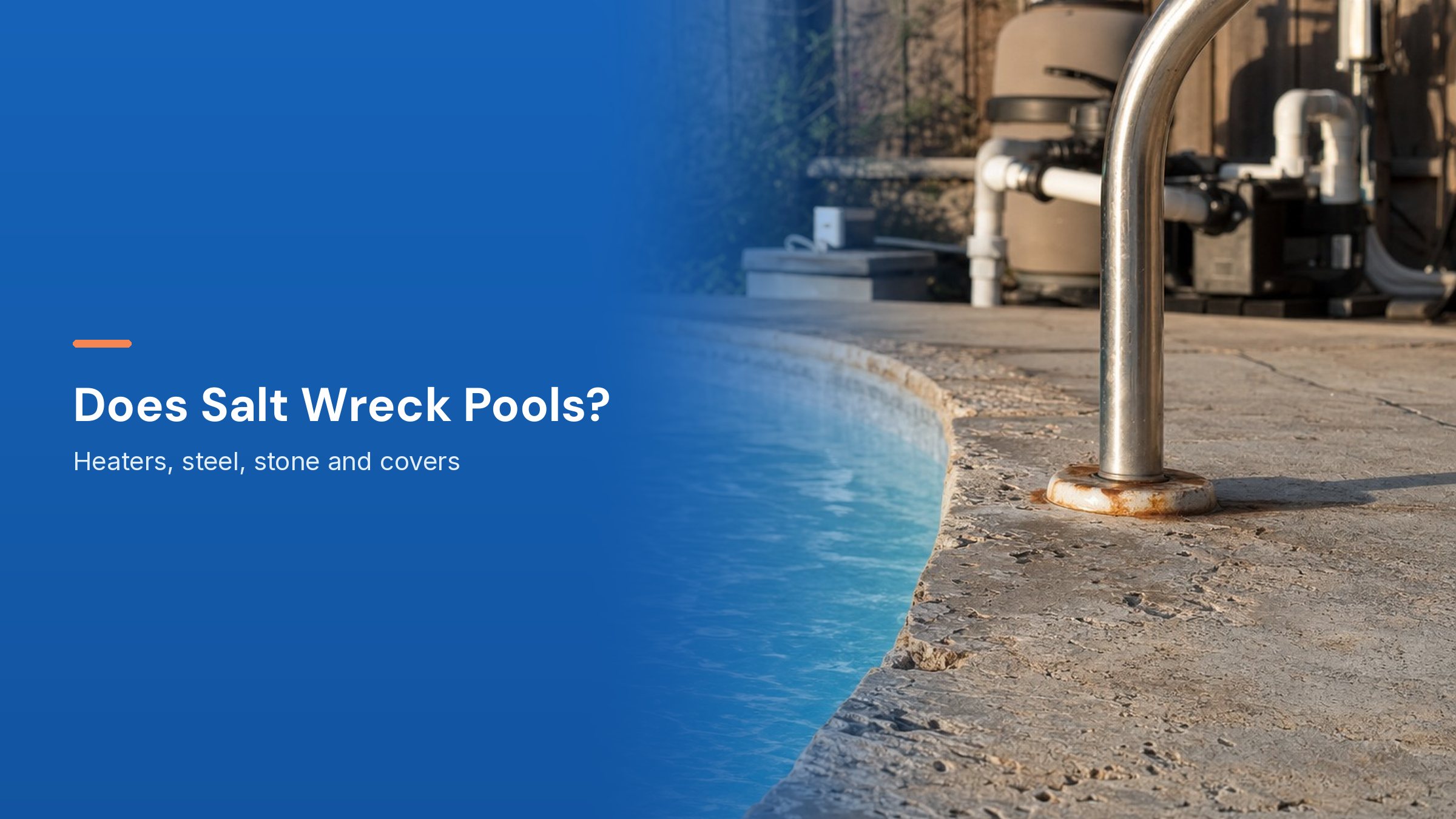
Yes, salt can damage things around a pool, but it is rarely the salt alone. Most of the damage blamed on salt comes from four other things: water that was out of balance, salt that was too high, splash water that dried on stone again and again, or metal parts that were never bonded together.
The makers say this in their own manuals. Pentair warns that salt is corrosive by nature and that adding any amount makes corrosion more likely.[1]PentairIntelliChlor Salt Chlorine Generator Installation and User's Guide, models IC15 to IC60, P/N 520589 Rev. R, August 7, 2023. Corrosion warning, steel pool caution, salt levels and covered pool notes.pentair.com Heater makers also write salt pools into their manuals, with limits on salt and water balance.[7]PentairMasterTemp Pool and Spa Heater Installation and User's Guide, P/N 472592 Rev. Q, July 30, 2023.pentair.com[4]RaypakDigital and Millivolt Gas Pool Heater Models 206A to 406A, Installation and Operation Manual, P/N 241236 Rev. 51, effective October 27, 2026. Water chemistry section and ProTek Shield Assembly.raypak.com Both things are true. Here is what the evidence shows for each part of the pool.
Key Takeaways
- Salt pools are chlorine pools with a little salt in them. Makers ask for about 3,000 to 3,600 ppm. Sea water is about 35,000 ppm.[2]Jandy (Zodiac Pool Systems)AquaPure and PureLink Installation and Operation Manual, H0325600 Rev F. Materials caution, masonry sealing and salt levels. Copy hosted by a pool retailer.royalswimmingpools.com[1]PentairIntelliChlor Salt Chlorine Generator Installation and User's Guide, models IC15 to IC60, P/N 520589 Rev. R, August 7, 2023. Corrosion warning, steel pool caution, salt levels and covered pool notes.pentair.com[3]NOAAJetStream, "Sea Water," read November 24, 2026.noaa.gov
- Gas heaters are built for salt pools, inside limits. Raypak and Jandy cap salt at 4,500 ppm. Hayward lists 2,700 to 5,000 ppm. All of them refuse to cover a heat exchanger hurt by bad water.[4]RaypakDigital and Millivolt Gas Pool Heater Models 206A to 406A, Installation and Operation Manual, P/N 241236 Rev. 51, effective October 27, 2026. Water chemistry section and ProTek Shield Assembly.raypak.com[6]Jandy (Zodiac Pool Systems)JXi Gas-Fired Pool and Spa Heater Installation and Operation Manual, H0574300 Rev M. Warranty notes and water chemistry section. The manual is listed on the JXi product page.jandy.com[5]HaywardUniversal H-Series Pool and Spa Heater Service and Installation Manual, 1301623301 Rev T. Maintaining proper water chemistry.hayward.com
- Steel walls are the real risk. Pentair says not to use its salt cell on steel pools. Some above-ground warranties end the day a salt system goes on.[1]PentairIntelliChlor Salt Chlorine Generator Installation and User's Guide, models IC15 to IC60, P/N 520589 Rev. R, August 7, 2023. Corrosion warning, steel pool caution, salt levels and covered pool notes.pentair.com[12]Above-ground pool maker warrantyThirty-year prorated wall and frame limited warranty, posted by retailer ProPools. Salt system clause.propools.com
- Soft, porous stone can flake. Salt water soaks in, dries, and leaves crystals that push the stone apart from inside.[16]Building Conservation DirectoryHeather Viles, University of Oxford, "Salt Crystallisation in Masonry."buildingconservation.com
- A zinc anode helps with one thing. It does not fix bad water, high salt or a missing bond wire.
- Rinsing and records do the most. Rinse rails, cover parts and stone with fresh water. Log salt, pH and chlorine at every visit.
First, what a salt pool really is
A salt system does not replace chlorine. It makes chlorine from salt in the water, so the pool still needs balanced water. Our glossary page on the salt cell explains how the cell works.
“People are often under the misconception that saltwater pools don’t have chlorine. That is not the case.”
The salt level is low. Jandy asks for 3,000 to 3,500 ppm in its AquaPure manual.[2]Jandy (Zodiac Pool Systems)AquaPure and PureLink Installation and Operation Manual, H0325600 Rev F. Materials caution, masonry sealing and salt levels. Copy hosted by a pool retailer.royalswimmingpools.com Pentair calls 3,600 ppm ideal and reads 2,800 to 4,500 ppm as good.[1]PentairIntelliChlor Salt Chlorine Generator Installation and User's Guide, models IC15 to IC60, P/N 520589 Rev. R, August 7, 2023. Corrosion warning, steel pool caution, salt levels and covered pool notes.pentair.com Sea water holds about 35 grams of salt in each liter, which is about 35,000 ppm.[3]NOAAJetStream, "Sea Water," read November 24, 2026.noaa.gov So a salt pool is about one tenth as salty as the ocean.
That does not make the salt harmless. Pentair's own guide says metal parts and some natural and man-made surfaces are the most at risk around salt pools.[1]PentairIntelliChlor Salt Chlorine Generator Installation and User's Guide, models IC15 to IC60, P/N 520589 Rev. R, August 7, 2023. Corrosion warning, steel pool caution, salt levels and covered pool notes.pentair.com
Use the salt calculator to work out how many bags a pool needs, because guessing is how pools end up too salty.
The quick answer for each part
| Part of the pool | What the evidence says | What protects it |
|---|---|---|
| Gas heater | Rated for salt pools. Hurt by low pH, scale, high chlorine and salt above the maker's limit. | Balanced water, salt in range, cell placed after the heater |
| Stainless rails, ladders, light rings | Salt wears down the thin layer that keeps stainless from rusting. | Fresh water rinse, good grade of stainless, a sound bond |
| Steel-wall above-ground pools | High risk. Some makers ban salt or void the warranty. | A pool sold for salt, with resin parts |
| Natural stone | Soft, porous stone can flake where splash water dries. | Dense stone, rinsing, the right sealer |
| Concrete and pavers | Experts disagree. Film sealers peel more often than the concrete fails. | Rinsing, a sealer that soaks in |
| Automatic covers | Salt dries on the track, pulleys and roller. | Rinsing, low cell output when closed |
| Aluminum and screen cages | Thin evidence. Aluminum can lose out when it touches another metal in salty water. | Rinsing, matching fasteners |
| Salt cell and pad | Too little salt hurts the cell. Too much can hurt the power unit. | A real salt test before adding bags |
Gas heaters and heat exchangers
This is the fight pros have most. One side says salt cuts heater life in half. The other side services salt pools with heaters that are 15 or 20 years old. Nobody has a real failure rate, and we will not make one up.
Here is what the makers say.
- Pentair says its MasterTemp heater is designed for chlorine, bromine or salt system pools.[7]PentairMasterTemp Pool and Spa Heater Installation and User's Guide, P/N 472592 Rev. Q, July 30, 2023.pentair.com
- Raypak lists salt at 4,500 ppm maximum. It says a pH under 7.2 will corrode the heat exchanger, and that heat exchanger damage from chemical imbalance is not covered. It also says free chlorine must not go over 5 ppm.[4]RaypakDigital and Millivolt Gas Pool Heater Models 206A to 406A, Installation and Operation Manual, P/N 241236 Rev. 51, effective October 27, 2026. Water chemistry section and ProTek Shield Assembly.raypak.com
- Jandy uses the same 4,500 ppm salt limit for the JXi. It says pH over 7.8 can coat the copper tubes with scale, and pH under 7.2 can dissolve them. It does not cover damage from corrosive water or scale.[6]Jandy (Zodiac Pool Systems)JXi Gas-Fired Pool and Spa Heater Installation and Operation Manual, H0574300 Rev M. Warranty notes and water chemistry section. The manual is listed on the JXi product page.jandy.com
- Hayward lists salt at 2,700 to 5,000 ppm. Its table says salt above that range is corrosive to the heat exchanger. Damage from unbalanced water is not covered.[5]HaywardUniversal H-Series Pool and Spa Heater Service and Installation Manual, 1301623301 Rev T. Maintaining proper water chemistry.hayward.com
So the makers do not say salt kills heaters. They say bad water does, and that salt has a ceiling. A pool at 3,200 ppm is inside every limit on that list.
Copper or cupronickel?
Cupronickel is copper mixed with nickel, and sellers often pitch it as the salt upgrade. Hayward builds its Universal H-Series heat exchanger from it.[5]HaywardUniversal H-Series Pool and Spa Heater Service and Installation Manual, 1301623301 Rev T. Maintaining proper water chemistry.hayward.com Raypak sells both copper and cupronickel models.[4]RaypakDigital and Millivolt Gas Pool Heater Models 206A to 406A, Installation and Operation Manual, P/N 241236 Rev. 51, effective October 27, 2026. Water chemistry section and ProTek Shield Assembly.raypak.com
But Hayward says its cupronickel exchanger still has to be kept away from harsh chemicals and unbalanced water, and it still will not cover that damage.[5]HaywardUniversal H-Series Pool and Spa Heater Service and Installation Manual, 1301623301 Rev T. Maintaining proper water chemistry.hayward.com Raypak gives one water chemistry table for the whole manual.[4]RaypakDigital and Millivolt Gas Pool Heater Models 206A to 406A, Installation and Operation Manual, P/N 241236 Rev. 51, effective October 27, 2026. Water chemistry section and ProTek Shield Assembly.raypak.com We found no maker manual that says cupronickel makes a heater safe from bad water. Treat it as extra margin.
Why salt pools still eat heaters
Three things tend to go wrong.
The pH climbs. Salt pools tend to drift toward high pH.[17]Concrete DecorSteven H. Miller, "Compatibility Issues Between Stained Concrete and Salt Chlorinated Swimming Pools," February/March 2014.concretedecor.net High pH plus heat lays scale in the hottest part of the system, and that part is the heater.[6]Jandy (Zodiac Pool Systems)JXi Gas-Fired Pool and Spa Heater Installation and Operation Manual, H0574300 Rev M. Warranty notes and water chemistry section. The manual is listed on the JXi product page.jandy.com Then someone adds a lot of acid, and the pH drops too far. Our post on why pool pH keeps rising covers the cause, and the LSI calculator and LSI balance guide show if the water leans toward scale or corrosion.
“one thing I would like to see builders change is be okay with a salt cell, a salt pool because it's more about the education of what is corrosive about salt, which is LSI.”
The chlorine runs high. A salt cell left at a high setting can push chlorine past what the heater maker allows. Raypak warns that salt chlorinators can lead to chlorine levels that damage the heater if they are not controlled.[4]RaypakDigital and Millivolt Gas Pool Heater Models 206A to 406A, Installation and Operation Manual, P/N 241236 Rev. 51, effective October 27, 2026. Water chemistry section and ProTek Shield Assembly.raypak.com Pentair's salt cell guide says chlorine above 4 ppm may corrode metal parts.[1]PentairIntelliChlor Salt Chlorine Generator Installation and User's Guide, models IC15 to IC60, P/N 520589 Rev. R, August 7, 2023. Corrosion warning, steel pool caution, salt levels and covered pool notes.pentair.com
The cell sits in the wrong place. Raypak says salt generators must be plumbed after the heater, and a check valve should sit between the heater outlet and any chlorinator.[4]RaypakDigital and Millivolt Gas Pool Heater Models 206A to 406A, Installation and Operation Manual, P/N 241236 Rev. 51, effective October 27, 2026. Water chemistry section and ProTek Shield Assembly.raypak.com Hayward says the same.[5]HaywardUniversal H-Series Pool and Spa Heater Service and Installation Manual, 1301623301 Rev T. Maintaining proper water chemistry.hayward.com Pentair wants its cell at least three feet from the heater outlet.[1]PentairIntelliChlor Salt Chlorine Generator Installation and User's Guide, models IC15 to IC60, P/N 520589 Rev. R, August 7, 2023. Corrosion warning, steel pool caution, salt levels and covered pool notes.pentair.com Pros argue about how much a check valve matters with a salt cell, since the cell stops when the flow stops. The safe rule is to do what the heater manual says. A warranty reviewer will look for it.
When an exchanger fails, the copper can end up as a stain on the pool finish. See our guides to telling metal stains from organic ones and to repairing or replacing a heater.
Unlike metals, anodes and what zinc can do
A pool has many metals in it, such as copper, stainless steel, brass and aluminum. Put two unlike metals in water that carries current, and a small current flows from one to the other. The weaker metal slowly dissolves. This is called galvanic corrosion.[8]Pool and Spa MarketingSteve Goodale, "Understanding the electromechanical process of galvanic corrosion," September 1, 2015.poolspamarketing.com
Salt makes the water a better path for that current, which is why salt pools see more of it.[8]Pool and Spa MarketingSteve Goodale, "Understanding the electromechanical process of galvanic corrosion," September 1, 2015.poolspamarketing.com
A sacrificial anode is a block of zinc. Zinc gives itself up more easily than the other metals in a pool. CMP, which makes one, says zinc corrodes faster than the other parts and so helps protect them. The maker says to swap the zinc after about half is gone, and that it lasts about three years.[9]Custom Molded Products (CMP)Pool Defender Sacrificial Zinc Anode instruction sheet and product brochure. Copies hosted by a pool retailer.royalswimmingpools.com Those are the maker's claims. We found no outside test of how much pool anodes help.
Some heaters now ship with one. Raypak's manual says its ProTek Shield protects the heat exchanger from galvanic corrosion when it is properly bonded, and should be replaced once it is down to about 40 percent of its starting weight.[4]RaypakDigital and Millivolt Gas Pool Heater Models 206A to 406A, Installation and Operation Manual, P/N 241236 Rev. 51, effective October 27, 2026. Water chemistry section and ProTek Shield Assembly.raypak.com
“Thank you for your service anode. Looks like we may be saluting the heat exchanger fairly soon.”
The joke makes a real point. Once the zinc is gone, the next metal in line is the heater.
What an anode does not do. It does not fix low pH. It does not remove scale. It does not bring high salt down. It does nothing for stone or concrete. The chemistry exclusions in the heater manuals stay the same with or without one.[4]RaypakDigital and Millivolt Gas Pool Heater Models 206A to 406A, Installation and Operation Manual, P/N 241236 Rev. 51, effective October 27, 2026. Water chemistry section and ProTek Shield Assembly.raypak.com[6]Jandy (Zodiac Pool Systems)JXi Gas-Fired Pool and Spa Heater Installation and Operation Manual, H0574300 Rev M. Warranty notes and water chemistry section. The manual is listed on the JXi product page.jandy.com
Stray current and bonding
Bonding means tying the metal parts around a pool together with a copper wire. The goal is to keep every part at the same voltage. An article in IAEI Magazine, written for electrical inspectors, says bonding is required to remove voltage differences in the pool area. It also says bonding is not the same as grounding.[10]IAEI MagazineKeith Lofland, "Taking the Mystery Out of Equipotential Bonding Requirements for Swimming Pools," March 14, 2017.iaeimagazine.org
Bonding is a safety rule first, but it matters for corrosion too. Jandy's heater warranty does not cover damage caused by failure to bond and ground the unit.[6]Jandy (Zodiac Pool Systems)JXi Gas-Fired Pool and Spa Heater Installation and Operation Manual, H0574300 Rev M. Warranty notes and water chemistry section. The manual is listed on the JXi product page.jandy.com And Raypak says its anode protects the heater when it is properly bonded.[4]RaypakDigital and Millivolt Gas Pool Heater Models 206A to 406A, Installation and Operation Manual, P/N 241236 Rev. 51, effective October 27, 2026. Water chemistry section and ProTek Shield Assembly.raypak.com
“Come to find out, it was not properly bonded, and there was a stray current between the salt cell, which was downstream, but the electrical current was going backwards against the flow of water to the heat exchanger, because that was the nearest anode that it could pull electrons from, and it did.”
Pros see the same pattern. New rails rust in weeks. A light ring pits while the water tests fine. When the chemistry checks out, a broken or missing bond is high on the list of suspects.
This is not a job for a pool tech or an owner. Checking a bond is electrical work. If you suspect stray current, or anyone feels a tingle in the water, keep people out and call a licensed electrician who knows pools.
Stainless rails, ladders and light rings
Stainless steel can still rust. It has a thin layer on the surface that protects it. S.R. Smith, which makes pool rails, says the chlorides from dissolved salt break that layer down. It rates salt pools as a highly corrosive setting, along with indoor pools and pools near the coast.[11]S.R. SmithRail Maintenance sheet, 06-417, April 2013.srsmith.com
S.R. Smith says rails on salt pools should be rinsed with fresh water every day and washed with mild soap and warm water each week. It warns against cleaners with chlorides, abrasive cleaners and steel wool.[11]S.R. SmithRail Maintenance sheet, 06-417, April 2013.srsmith.com Few owners rinse daily, but a quick hose-down after a swim is worth teaching.
Jandy says all metal parts around a salt pool should be a high grade of stainless.[2]Jandy (Zodiac Pool Systems)AquaPure and PureLink Installation and Operation Manual, H0325600 Rev F. Materials caution, masonry sealing and salt levels. Copy hosted by a pool retailer.royalswimmingpools.com Builder Jason Hughes of River Pools adds that galvanized deck anchors can corrode until the rail will not come out, and that brass anchors solve it.[15]River PoolsJason Hughes, "Top 5 Salt Water Chlorine Generator Problems," updated January 20, 2020.riverpoolsandspas.com
Steel-wall and above-ground pools
Pentair's salt cell guide says the unit is for permanently installed pools and says, in plain words, not to use it with storable or steel pools.[1]PentairIntelliChlor Salt Chlorine Generator Installation and User's Guide, models IC15 to IC60, P/N 520589 Rev. R, August 7, 2023. Corrosion warning, steel pool caution, salt levels and covered pool notes.pentair.com One 30-year above-ground wall and frame warranty says any salt chlorine system makes the warranty null and void, because it causes early rust on the metal parts.[12]Above-ground pool maker warrantyThirty-year prorated wall and frame limited warranty, posted by retailer ProPools. Salt system clause.propools.com The Del Rey pool warranty says it is null and void if a salt chlorine generator is used on a pool structure that is not resin.[13]CorneliusDel Rey above-ground pool warranty, posted by retailer The Pool Factory. Exclusion (u).thepoolfactory.com
Other pools are made for salt. The Pool Factory lists a salt line with resin ledges, tracks and plates and a stainless panel at the skimmer and return, and says the maker's warranty covers salt systems on those models.[14]The Pool Factory"Salt-Friendly Swimming Pools," read November 24, 2026.thepoolfactory.com
For in-ground vinyl pools with metal walls, River Pools warns buyers to avoid metal walls with a salt system. It notes that most new liner pools now use plastic walls.[15]River PoolsJason Hughes, "Top 5 Salt Water Chlorine Generator Problems," updated January 20, 2020.riverpoolsandspas.com For new vinyl pools, Pentair says to ask the liner maker before adding salt.[1]PentairIntelliChlor Salt Chlorine Generator Installation and User's Guide, models IC15 to IC60, P/N 520589 Rev. R, August 7, 2023. Corrosion warning, steel pool caution, salt levels and covered pool notes.pentair.com
Pros who replace rusted walls say the wall mostly fails where water got behind the liner, at a pinhole, a skimmer or a return. So on any steel pool, a small leak is urgent.
The rule: read the pool's warranty before a salt system goes on. If it bans salt, do not install one.
Natural stone coping and decks
Stone damage near salt pools is real, and it is uneven. One builder has travertine on every pool with no trouble. Another owner watches coping flake in two seasons. The stone and the splash explain most of the gap.
How salt breaks stone
Heather Viles, a professor at the University of Oxford, describes it in a guide for people who care for old buildings. Water carries salt into the pores of the stone. The water dries. The salt is left behind as crystals. Each wet and dry cycle adds more. The crystals press on the walls of the pores until the outer skin of the stone blisters and flakes.[16]Building Conservation DirectoryHeather Viles, University of Oxford, "Salt Crystallisation in Masonry."buildingconservation.com
White salt on the surface does no direct harm by itself. The harm comes from crystals that form just under the surface. Stone with lots of very small pores is hit hardest. That includes some limestones and sandstones.[16]Building Conservation DirectoryHeather Viles, University of Oxford, "Salt Crystallisation in Masonry."buildingconservation.com
At a pool, kids splash and the sun dries the water in minutes, all summer. This is why damage shows up first at the splash zones, the steps and the spa spillway.
Which stones are at risk
Jandy says the hardness and pore size of natural stone vary a great deal, and tells owners to ask the builder or stone supplier which stone suits a salt pool.[2]Jandy (Zodiac Pool Systems)AquaPure and PureLink Installation and Operation Manual, H0325600 Rev F. Materials caution, masonry sealing and salt levels. Copy hosted by a pool retailer.royalswimmingpools.com An article on the Natural Stone Institute's Use Natural Stone site quotes a pool designer who says soft marble breaks down fast around salt and pool chemicals. The same article names granite and quartzite as durable picks.[18]Use Natural Stone (Natural Stone Institute)Stephanie Vozza, "Why Natural Stone Is Your Best Choice for a Poolside Surface," March 22, 2017.usenaturalstone.org A defect expert told Concrete Decor he has seen sedimentary stone and flagstone wear out early in waterfalls, coping and patios near salt pools.[17]Concrete DecorSteven H. Miller, "Compatibility Issues Between Stained Concrete and Salt Chlorinated Swimming Pools," February/March 2014.concretedecor.net
Pros split on travertine and limestone, and some suppliers tell builders not to pair their soft limestone with salt at all. Get the supplier's answer in writing before the stone goes down.
Does sealing work?
Mostly, with limits. Jandy says to seal all masonry around a salt pool and to reseal on the sealer maker's schedule.[2]Jandy (Zodiac Pool Systems)AquaPure and PureLink Installation and Operation Manual, H0325600 Rev F. Materials caution, masonry sealing and salt levels. Copy hosted by a pool retailer.royalswimmingpools.com The stone article suggests cleaning and resealing every three to four years.[18]Use Natural Stone (Natural Stone Institute)Stephanie Vozza, "Why Natural Stone Is Your Best Choice for a Poolside Surface," March 22, 2017.usenaturalstone.org Sealer experts in Concrete Decor favor sealers that soak in over ones that sit on top as a film.[17]Concrete DecorSteven H. Miller, "Compatibility Issues Between Stained Concrete and Salt Chlorinated Swimming Pools," February/March 2014.concretedecor.net
But the Oxford guide adds a warning. Water repellents are unlikely to stop salt damage, and they can make it worse by pushing the crystals deeper under the surface.[16]Building Conservation DirectoryHeather Viles, University of Oxford, "Salt Crystallisation in Masonry."buildingconservation.com That guide is about buildings, not pools, so the fit is not exact. In short, sealing slows salt getting in. It is not a cure, and it will not save stone that is too soft for the job.
Rinsing is the step nobody argues about. A defect expert in Concrete Decor recommends rinsing pool decks often, so the salt washes away before it dries in place.[17]Concrete DecorSteven H. Miller, "Compatibility Issues Between Stained Concrete and Salt Chlorinated Swimming Pools," February/March 2014.concretedecor.net
Concrete and pavers
Here the experts openly disagree. Concrete Decor asked sealer makers and concrete pros about salt pools. Some said salt eats through acrylic sealers and makes them peel. Others said the salt does not hurt the sealer, and that poor upkeep and water getting under a weak sealer cause most of it. One expert said plainly that the damage cannot be blamed on every salt pool.[17]Concrete DecorSteven H. Miller, "Compatibility Issues Between Stained Concrete and Salt Chlorinated Swimming Pools," February/March 2014.concretedecor.net
They agreed on a few things. Trouble shows up where the deck gets wet and dries over and over, and it starts at cracks and joints. Film sealers need far more upkeep by a pool than on a patio, and frequent rinsing helps.[17]Concrete DecorSteven H. Miller, "Compatibility Issues Between Stained Concrete and Salt Chlorinated Swimming Pools," February/March 2014.concretedecor.net
We found no maker source on salt pool water and concrete pavers. Treat them like concrete, and ask the paver maker which sealer it backs for a salt pool.
Automatic covers and tracks
Auto covers and salt systems can live together with some care. Pool and Spa News asked pool builders about it. Water drains off the cover into the cover box when it rolls up. The water dries and leaves salt on the parts. The builders named the track, some hardware, the pulleys and the roller tube as the parts that wear. They said to rinse those parts with fresh water, anywhere from weekly to monthly.[19]Pool and Spa NewsLinda G. Green, "Automatic Pool Covers and Salt Systems Can Be a Perfect Marriage," September 10, 2013.poolspanews.com River Pools gives the same advice.[15]River PoolsJason Hughes, "Top 5 Salt Water Chlorine Generator Problems," updated January 20, 2020.riverpoolsandspas.com
The bigger risk under a cover is chlorine, not salt. A closed cover holds chlorine in. One builder warned that the chlorine level can climb very high, very fast, with the cover shut.[19]Pool and Spa NewsLinda G. Green, "Automatic Pool Covers and Salt Systems Can Be a Perfect Marriage," September 10, 2013.poolspanews.com Pentair says a covered pool needs less chlorine and tells owners to turn the cell output down while the cover is on.[1]PentairIntelliChlor Salt Chlorine Generator Installation and User's Guide, models IC15 to IC60, P/N 520589 Rev. R, August 7, 2023. Corrosion warning, steel pool caution, salt levels and covered pool notes.pentair.com Pros who replace vinyl liners blame this for liners that wrinkle and bleach near the waterline.
Our guide on when to close an auto cover after adding chemicals has more on this.
Aluminum, vinyl-pool coping and screen cages
The evidence here is thin. Aluminum is on the list of pool metals that can take part in galvanic corrosion.[8]Pool and Spa MarketingSteve Goodale, "Understanding the electromechanical process of galvanic corrosion," September 1, 2015.poolspamarketing.com Pentair's warning covers metal parts in general.[1]PentairIntelliChlor Salt Chlorine Generator Installation and User's Guide, models IC15 to IC60, P/N 520589 Rev. R, August 7, 2023. Corrosion warning, steel pool caution, salt levels and covered pool notes.pentair.com But we did not find a maker or trade group that has tested salt pool water on screen cages.
What pros report is narrow. Aluminum coping on vinyl pools can pit where salt water drips and dries in the same spot for years. Cage fasteners tend to rust before the frame does. Both are slow, and rinsing helps.
The salt cell and the rest of the pad
The salt level can hurt the salt system too. Jandy says salt under 2,000 ppm causes early cell failure. Salt over 4,000 ppm may damage the power center. Salt over 6,000 ppm may corrode pool fixtures.[2]Jandy (Zodiac Pool Systems)AquaPure and PureLink Installation and Operation Manual, H0325600 Rev F. Materials caution, masonry sealing and salt levels. Copy hosted by a pool retailer.royalswimmingpools.com Pentair says salt over 4,500 ppm raises the risk of corrosion to equipment and surfaces.[1]PentairIntelliChlor Salt Chlorine Generator Installation and User's Guide, models IC15 to IC60, P/N 520589 Rev. R, August 7, 2023. Corrosion warning, steel pool caution, salt levels and covered pool notes.pentair.com
High salt often comes from adding bags on a false low reading. Pentair says its built-in sensor is only accurate to within 500 ppm.[1]PentairIntelliChlor Salt Chlorine Generator Installation and User's Guide, models IC15 to IC60, P/N 520589 Rev. R, August 7, 2023. Corrosion warning, steel pool caution, salt levels and covered pool notes.pentair.com So test the water with a separate meter or kit before adding salt. Our list of salt and TDS meters can help. If the salt really is too high, the usual fix is to swap some water for fresh. Read how to drain a pool safely first.
“Lastly the way you did you heater bypass (from what I can see) technically gives the salt cell a clear path to the heater without going through the check valve if the system is off. This isn't as big of a deal as if it were a tablet feeder, but should still be avoided.”
A cell wears out even when all goes well. On poolrates.fyi, three prices that owners reported paying to replace one averaged $2,100.[20]poolrates.fyiRepair and one-time job prices shared by pool pros and owners, 2026.poolrates.fyi That is a small sample. The salt cell life calculator and our salt cell versus sun tool show what changes the wear. For faults, see the most common salt chlorinator problems and the salt chlorinator diagnostic workflow.
One caution on rinsing. Rinse rails, decks and cover parts. Do not hose down the heater. Pentair says to keep its heater away from long exposure to hoses, sprinklers and roof runoff.[7]PentairMasterTemp Pool and Spa Heater Installation and User's Guide, P/N 472592 Rev. Q, July 30, 2023.pentair.com
What actually prevents damage
- Keep salt in the maker's range. Stay under the heater's limit, and test before adding bags.[1]PentairIntelliChlor Salt Chlorine Generator Installation and User's Guide, models IC15 to IC60, P/N 520589 Rev. R, August 7, 2023. Corrosion warning, steel pool caution, salt levels and covered pool notes.pentair.com[4]RaypakDigital and Millivolt Gas Pool Heater Models 206A to 406A, Installation and Operation Manual, P/N 241236 Rev. 51, effective October 27, 2026. Water chemistry section and ProTek Shield Assembly.raypak.com
- Keep the water balanced. Watch pH most of all, and use the target in the heater manual.[6]Jandy (Zodiac Pool Systems)JXi Gas-Fired Pool and Spa Heater Installation and Operation Manual, H0574300 Rev M. Warranty notes and water chemistry section. The manual is listed on the JXi product page.jandy.com[5]HaywardUniversal H-Series Pool and Spa Heater Service and Installation Manual, 1301623301 Rev T. Maintaining proper water chemistry.hayward.com
- Keep chlorine in range. Turn the cell down when the pool is covered or little used.[1]PentairIntelliChlor Salt Chlorine Generator Installation and User's Guide, models IC15 to IC60, P/N 520589 Rev. R, August 7, 2023. Corrosion warning, steel pool caution, salt levels and covered pool notes.pentair.com
- Rinse with fresh water. Rails, ladders, cover tracks and stone in the splash zones.[11]S.R. SmithRail Maintenance sheet, 06-417, April 2013.srsmith.com[19]Pool and Spa NewsLinda G. Green, "Automatic Pool Covers and Salt Systems Can Be a Perfect Marriage," September 10, 2013.poolspanews.com[17]Concrete DecorSteven H. Miller, "Compatibility Issues Between Stained Concrete and Salt Chlorinated Swimming Pools," February/March 2014.concretedecor.net
- Pick stone that suits salt, and seal it with a sealer that soaks in.[2]Jandy (Zodiac Pool Systems)AquaPure and PureLink Installation and Operation Manual, H0325600 Rev F. Materials caution, masonry sealing and salt levels. Copy hosted by a pool retailer.royalswimmingpools.com[17]Concrete DecorSteven H. Miller, "Compatibility Issues Between Stained Concrete and Salt Chlorinated Swimming Pools," February/March 2014.concretedecor.net
- Check the anode and replace it by the maker's rule.[4]RaypakDigital and Millivolt Gas Pool Heater Models 206A to 406A, Installation and Operation Manual, P/N 241236 Rev. 51, effective October 27, 2026. Water chemistry section and ProTek Shield Assembly.raypak.com[9]Custom Molded Products (CMP)Pool Defender Sacrificial Zinc Anode instruction sheet and product brochure. Copies hosted by a pool retailer.royalswimmingpools.com
- Have a licensed electrician check the bond if metal is failing and the water tests fine.
- Read the pool's warranty before putting salt in any pool with steel walls.[12]Above-ground pool maker warrantyThirty-year prorated wall and frame limited warranty, posted by retailer ProPools. Salt system clause.propools.com[13]CorneliusDel Rey above-ground pool warranty, posted by retailer The Pool Factory. Exclusion (u).thepoolfactory.com
Where pros disagree
Some pros will not sell a salt system after too many scaled cells and warranty fights.
“Salt is not necessarily the way that people go mostly today. So, you still have your diehards and the people that definitely have a reason to want salt. But with just all the other corrosive stuff, that's a dying piece of the business.”
Other pros put salt on every pool they build, and say the damage stories trace back to poor water care. Both camps describe what they see. The salt level is the same in both, and the care is what differs.
How to talk to a customer who blames salt
The heater leaks, or the coping is flaking, and the owner says the salt did it. Here is a way through that call.
Do not argue salt against no salt. The real question is what failed and why.
Bring the records. Pull the salt, pH, chlorine and alkalinity readings for the life of the part. If the pH held and the salt stayed in range, you can prove it. If the readings show months of high pH, it is better that you find it first.
For a failed heater, walk the short list out loud. Water balance. Salt level against the heater's limit. Chlorine level and cell setting. Where the cell and check valve sit. Then the bond, which an electrician checks. Tell the owner the maker decides the warranty, and that makers exclude damage from water chemistry.[4]RaypakDigital and Millivolt Gas Pool Heater Models 206A to 406A, Installation and Operation Manual, P/N 241236 Rev. 51, effective October 27, 2026. Water chemistry section and ProTek Shield Assembly.raypak.com[5]HaywardUniversal H-Series Pool and Spa Heater Service and Installation Manual, 1301623301 Rev T. Maintaining proper water chemistry.hayward.com Our pool equipment warranty guide covers how those claims go.
For flaking stone, show the pattern. Point out that it is worst where water splashes and dries. Then give choices. Rinse, seal and watch it. Replace the worst pieces with a denser stone. Or take the pool off salt. The owner picks.
Do not promise what you cannot know. The makers do not say salt never hurts anything, so you should not either.[1]PentairIntelliChlor Salt Chlorine Generator Installation and User's Guide, models IC15 to IC60, P/N 520589 Rev. R, August 7, 2023. Corrosion warning, steel pool caution, salt levels and covered pool notes.pentair.com[2]Jandy (Zodiac Pool Systems)AquaPure and PureLink Installation and Operation Manual, H0325600 Rev F. Materials caution, masonry sealing and salt levels. Copy hosted by a pool retailer.royalswimmingpools.com Do not say a sealer or an anode will stop it.
Next time, say it before the sale. When you quote a salt system, put the trade-offs in writing: the stone, the heater limit and the rinsing.
Sources
- [1]Pentair, IntelliChlor Salt Chlorine Generator Installation and User's Guide, models IC15 to IC60, P/N 520589 Rev. R, August 7, 2023. Corrosion warning, steel pool caution, salt levels and covered pool notes. pentair.com (PDF)
- [2]Jandy (Zodiac Pool Systems), AquaPure and PureLink Installation and Operation Manual, H0325600 Rev F. Materials caution, masonry sealing and salt levels. Copy hosted by a pool retailer. royalswimmingpools.com (PDF)
- [3]NOAA, JetStream, "Sea Water," read November 24, 2026. noaa.gov
- [4]Raypak, Digital and Millivolt Gas Pool Heater Models 206A to 406A, Installation and Operation Manual, P/N 241236 Rev. 51, effective October 27, 2026. Water chemistry section and ProTek Shield Assembly. raypak.com (PDF)
- [5]Hayward, Universal H-Series Pool and Spa Heater Service and Installation Manual, 1301623301 Rev T. Maintaining proper water chemistry. hayward.com (PDF)
- [6]Jandy (Zodiac Pool Systems), JXi Gas-Fired Pool and Spa Heater Installation and Operation Manual, H0574300 Rev M. Warranty notes and water chemistry section. The manual is listed on the JXi product page. jandy.com
- [7]Pentair, MasterTemp Pool and Spa Heater Installation and User's Guide, P/N 472592 Rev. Q, July 30, 2023. pentair.com (PDF)
- [8]Pool and Spa Marketing, Steve Goodale, "Understanding the electromechanical process of galvanic corrosion," September 1, 2015. poolspamarketing.com
- [9]Custom Molded Products (CMP), Pool Defender Sacrificial Zinc Anode instruction sheet and product brochure. Copies hosted by a pool retailer. royalswimmingpools.com (PDF)
- [10]IAEI Magazine, Keith Lofland, "Taking the Mystery Out of Equipotential Bonding Requirements for Swimming Pools," March 14, 2017. iaeimagazine.org
- [11]S.R. Smith, Rail Maintenance sheet, 06-417, April 2013. srsmith.com (PDF)
- [12]Above-ground pool maker warranty, Thirty-year prorated wall and frame limited warranty, posted by retailer ProPools. Salt system clause. propools.com (PDF)
- [13]Cornelius, Del Rey above-ground pool warranty, posted by retailer The Pool Factory. Exclusion (u). thepoolfactory.com (PDF)
- [14]The Pool Factory, "Salt-Friendly Swimming Pools," read November 24, 2026. thepoolfactory.com
- [15]River Pools, Jason Hughes, "Top 5 Salt Water Chlorine Generator Problems," updated January 20, 2020. riverpoolsandspas.com
- [16]Building Conservation Directory, Heather Viles, University of Oxford, "Salt Crystallisation in Masonry." buildingconservation.com
- [17]Concrete Decor, Steven H. Miller, "Compatibility Issues Between Stained Concrete and Salt Chlorinated Swimming Pools," February/March 2014. concretedecor.net
- [18]Use Natural Stone (Natural Stone Institute), Stephanie Vozza, "Why Natural Stone Is Your Best Choice for a Poolside Surface," March 22, 2017. usenaturalstone.org
- [19]Pool and Spa News, Linda G. Green, "Automatic Pool Covers and Salt Systems Can Be a Perfect Marriage," September 10, 2013. poolspanews.com
- [20]poolrates.fyi, Repair and one-time job prices shared by pool pros and owners, 2026. poolrates.fyi