
How a Pool Pump Works: Impeller, Volute and Prime


Key Takeaways
- A pool pump is a centrifugal pump. The motor spins the impeller, and the volute guides that moving water toward the discharge.
- The pump does not pull water like a straw. Pressure differences move water toward the low-pressure area at the impeller eye.
- A self-priming pump still needs water in its housing and a sealed suction path so it can clear air and establish circulation.
- Air under the clear lid and water leaking near the motor point to different sealing areas.
A pool pump turns motor rotation into water movement. Water reaches the strainer pot, passes through the basket, enters the center of the spinning impeller, and leaves through the volute. Once that path is clear, common symptoms such as bubbles, weak returns, lost prime, and a wet seal plate become much easier to sort out.
The Water Path Through a Pool Pump
The pump basket is the first visible stop. It catches leaves and larger debris before they can reach the impeller. Water then enters the impeller eye, which is the opening at the center of the rotating part. Curved vanes accelerate the water outward.
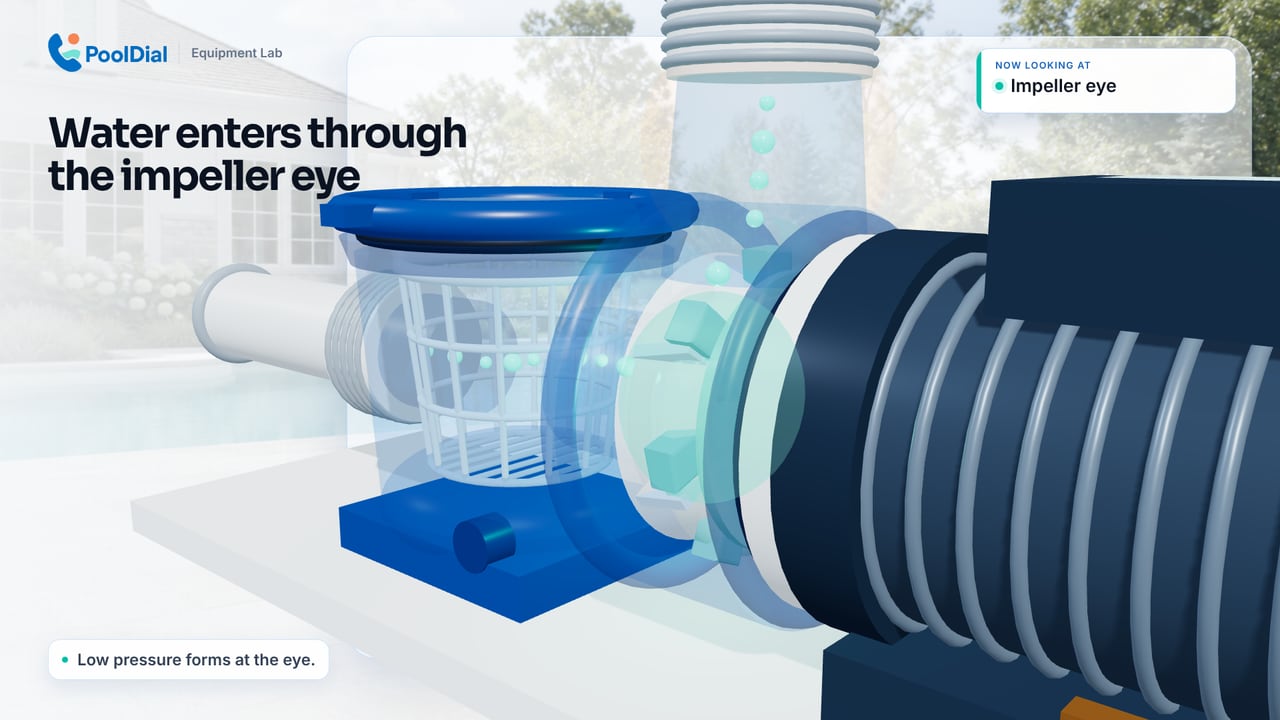
The stationary volute surrounds the impeller. Its expanding passage gathers the fast-moving water and guides it toward the outlet. A diffuser may also help organize the flow on pumps that use one. These parts create useful circulation together. The impeller adds energy, while the stationary passages direct it.
What Prime Really Means
Prime means the pump housing and suction line have enough water, with little enough air, for the impeller to establish steady flow. A self-priming label does not mean the pump should start dry. The housing needs to be filled as the installed manual directs, and the suction side must be able to hold a seal.
During startup, some air under the lid can be normal. A bubble that keeps growing, a basket that never fills, or return bubbles that continue after startup are better clues. Check pool water level, skimmer weirs, baskets, the lid seal, drain plugs, unions, and other suction-side joints using the equipment manual.
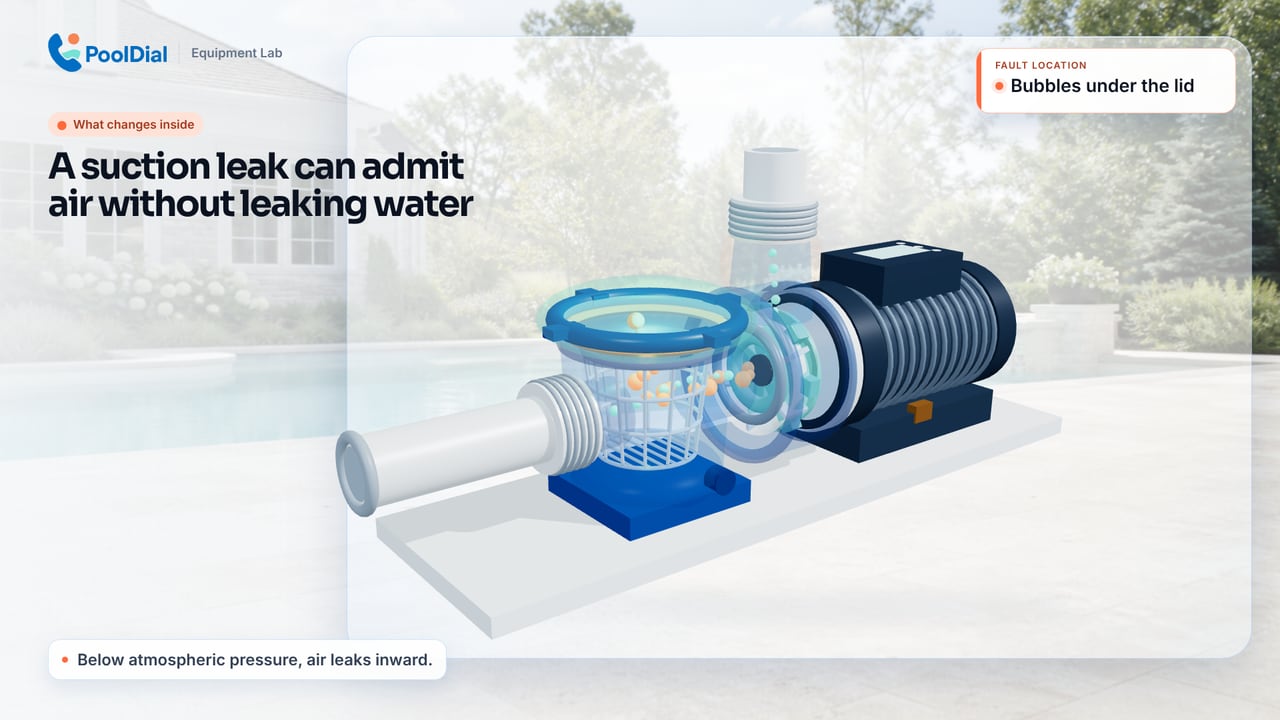
This explains a confusing field pattern: a joint may be dry when the pump runs but still leak air inward. When the pump stops, the same area may release a small amount of water or lose the water held in the line.
Suction Air Leak or Shaft Seal Leak?
The mechanical shaft seal sits where the motor shaft enters the wet pump housing. Its job is to keep pool water away from the motor. A damaged shaft seal usually shows as water near the seal plate or between the wet end and motor. It is not the usual cause of air collecting under the pump lid.
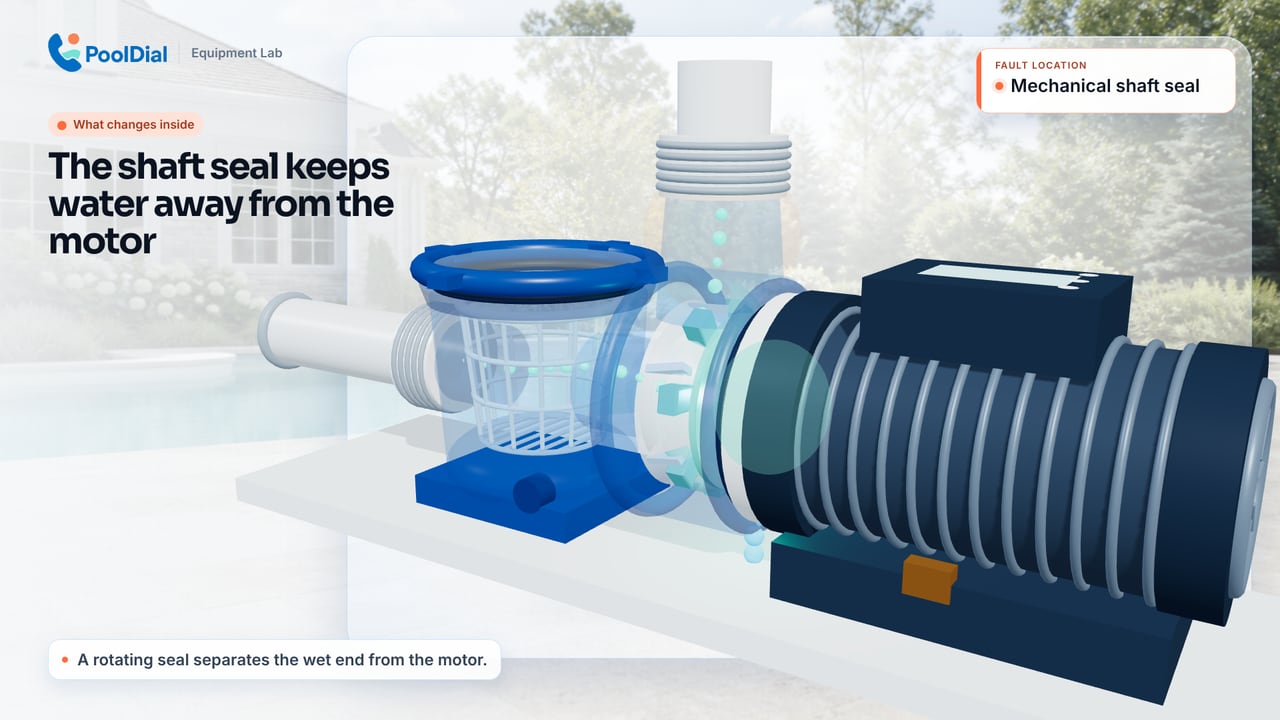
A lid O-ring, suction union, valve stem, drain plug, or cracked suction fitting is on the low-pressure side while the pump runs. A leak there can add air to the water path. Location and operating state matter more than the word “leak.”
Read Symptoms as a Pattern
| What you see | What it suggests | First safe observations |
|---|---|---|
| Air grows under the lid and returns bubble | Air may be entering on the suction side | Water level, skimmer action, baskets, lid seal, visible suction joints |
| Low flow with a full, clear basket | Restriction, impeller blockage, speed setting, or downstream resistance | Compare pump speed, filter pressure, valve position, and return strength |
| Gravel-like noise | Poor suction conditions may be causing cavitation | Water supply, baskets, valves, suction restrictions, and pump speed |
| Water near the motor face | The shaft seal or seal-area parts may be leaking | Shut down safely and locate the wet trail without touching live equipment |
None of these clues proves one failed part by itself. Record pump speed, filter pressure at that speed, basket condition, valve position, and whether the symptom changes between startup and steady operation.
Related Pool Pump Tools
Use the pump run time calculator to compare schedules, the pump energy cost calculator to estimate operating cost, and the pump horsepower calculator for basic power conversions. Calculators do not replace a hydraulic design or the pump's published performance curve.
Frequently Asked Questions
Does a pool pump pull water?
A pressure difference moves water toward the low-pressure area at the impeller eye. Saying the pump “pulls” water is convenient, but it hides what the impeller and atmospheric pressure are doing.
Why does a pool pump lose prime after it shuts off?
A suction-side seal or check-valve problem can let air enter and water drain from the line. Water level, skimmer action, lid seals, drain plugs, unions, valves, and plumbing are common observation points.
Can a shaft seal cause bubbles in the pool?
A shaft-seal leak normally lets water escape near the motor side. Persistent return bubbles more often direct attention to the suction path, although a complete diagnosis should use all system clues.
This guide is an original, generic teaching explanation based on manufacturer documentation. Visuals are simplified and not to scale. The installed equipment manual controls service and safety procedures.
- Pentair/Sta-Rite, Swimming Pool and Spa Pumps training material, centrifugal pump and strainer sections.
- Pentair, WhisperFlo and IntelliFlo installation manuals, priming, capacity, cavitation, and shaft-seal sections.
- Jandy, VS FloPro installation manual, priming and operating sections.
- Hayward, TriStar VS 950 manual, no-prime and noisy-pump troubleshooting sections.