
Customer Changed the Pump Schedule: What Now?


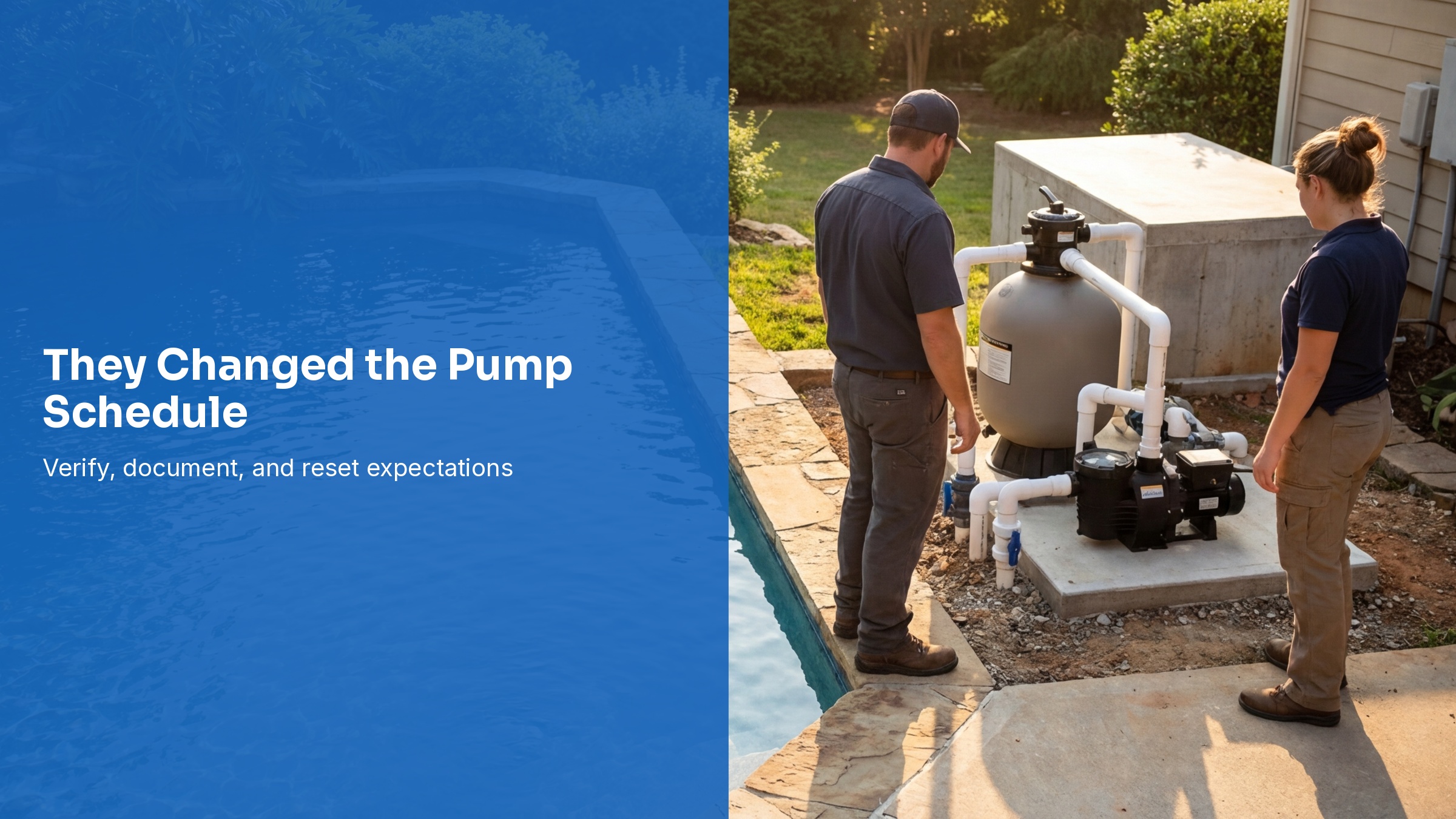
When a customer turns a pool pump down or off, restore the correct program, save the evidence, explain the consequence once, and charge separately for recovery work the customer caused. If it happens again, enforce the written policy you already gave them.
Do not skip the diagnostic step. A changed schedule may contribute to poor circulation, filtration, surface skimming, cleaner operation, or sanitizer production. It is not automatic proof that the schedule alone turned the pool green. Low sanitizer, a failed salt cell, a clogged filter, heavy contamination, an automation reset, or another equipment fault may be part of the same event.
The goal is not to win an argument in the equipment app. It is to establish what changed, what failed, what it costs to recover, and who controls the program going forward.
Key Takeaways
- Save evidence before editing. Capture schedule, controller time, history, alarms, flow, pump state, and water readings.
- Diagnose the whole pool. A schedule change can expose a weak sanitizer or filtration plan rather than being the only cause.
- Use a tailored run plan. Pool volume, actual flow, filter condition, cleaner, heater, chlorinator, weather, and use all matter.
- Charge for actual extra work. Get approval for recovery labor, chemicals, filter service, and return visits.
- Use a clear escalation ladder. Education, written warning, paid correction, then termination if the interference continues.
First, Prove What Changed
Take screenshots before you restore anything. Record the programmed days, start and stop times, speed or flow setpoint, controller clock, time zone, active mode, and recent history. Photograph the pump display and automation panel. A remote app can show that the current schedule is wrong, but its history may not prove which person changed it.
| Check | Question it answers |
|---|---|
| Schedule and controller clock | Was the program edited, disabled, shifted by a bad clock, or affected by a power event? |
| Pump status and alarms | Did the pump receive the command, start, prime, and maintain the expected speed or flow? |
| Valves and active mode | Was the system left in spa, service, timeout, or another configuration? |
| Filter pressure and flow | Was circulation limited even while the pump appeared to run? |
| Salt cell or feeder status | Did reduced flow or runtime also reduce sanitizer production? |
| Complete water test | Was effective sanitizer already too low for the water conditions? |
| Recent weather and pool use | Did heat, a storm, debris, or a party add unusual demand? |
Check for automatic causes before accusing the customer. Controllers can lose time, schedules can conflict, power can be interrupted, and equipment can fail to execute a valid program. Restore settings only after capturing the original condition, then verify that the pump actually runs the connected features.
Do Not Use One Runtime for Every Pool
There is no defensible residential rule that every pool must run exactly eight hours. A schedule has to serve measurable functions: circulate chemicals, skim the surface, send enough flow through the filter, operate a cleaner or heater, and support the sanitizer system. The answer depends on actual flow, not only hours on a display.
Pentair's current IntelliFlo3 support page illustrates the flexibility. That model offers manual, timer, and schedule modes, up to eight programs, and either speed or flow settings. Its factory default is a 24-hour schedule at 30 gallons per minute, but a factory default is not a design calculation for every pool.
For public aquatic venues, the CDC's 2024 Model Aquatic Health Code calculates turnover from total system volume and measured flow through filtration. It also ties any flow turndown to specific conditions. The MAHC is guidance for public facilities, not a residential runtime rule, but the method reinforces a useful point: runtime without flow and system context is incomplete.
Use the PoolDial pump run-time calculator as a planning aid, then verify performance at the pool. For variable-speed systems, compare energy scenarios with the pump energy cost calculator instead of letting a customer save electricity by randomly disabling circulation.
An energy conversation often works better than a lecture. Show the customer the estimated cost of the approved schedule, explain what each program does, and offer a documented efficiency adjustment if appropriate. Do not promise that lower speed is always enough. Heaters, salt cells, cleaners, water features, and skimming can have minimum flow requirements.
A Green Pool Still Needs a Diagnosis
That field observation is not a license to leave pumps off, but it is a useful challenge to the diagnosis. Algae growth indicates that the overall prevention plan failed. Test free and combined chlorine with an appropriate method, check stabilizer and pH, inspect circulation, confirm the sanitizer source, and consider recent contamination.
If recovery is needed, quote it as a separate green-to-clean service. State the chemical allowance, filter work, expected visits, customer access requirements, and what happens if equipment is changed again during treatment.
Use a Four-Step Customer Policy
1. Educate
Explain the approved schedule, its estimated energy cost, and which pool functions depend on it.
2. Warn
Send one written notice that schedule changes can prevent the company from meeting the agreed water standard.
3. Charge
Require approval for extra diagnostics, chemicals, filter work, and return trips caused by unauthorized changes.
4. Decide
Keep the account only if the customer accepts the operating plan and the added cost of future interference.
Charge for the work, not for revenge. The estimate should identify diagnostic time, schedule restoration, chemicals, filter cleaning, cleanup labor, and follow-up visits. Use the authorization and cancellation terms in your pool service agreement. Avoid inventing a surprise penalty after the event if the customer never accepted it.
Put Control of Equipment in the Agreement
The service agreement should say who may change pump schedules, valve positions, sanitizer output, heater settings, and automation modes. It should also require the customer to maintain internet, power, and equipment access when those are necessary for service. Define whether remote monitoring is included and what the logs can establish.
A firm boundary protects both parties. The customer still owns the equipment and pays the electricity bill. The service company decides whether it can accept responsibility under the customer's operating limits. If those positions do not match, end service cleanly using the steps in our guide to firing a pool service customer.
Use custom inspections in PoolDial to require schedule screenshots, pump status, pressure, valve photos, salt-cell state, and water test results. A repeatable record makes the second conversation much easier than relying on memory.
Common Questions
Should you lock the customer out of the pump app?
Only with the owner's informed agreement and within the manufacturer's account model. Do not take over credentials secretly. A shared control policy, separate user roles where available, and written authorization are safer than a password fight.
Should a customer pay more every month after changing the schedule?
Not automatically. Charge for the added ongoing scope if the customer wants a reduced schedule that requires more testing, chemicals, or visits. Charge separately for actual recovery work when your agreement allows it. Explain the price before performing non-emergency work.
Can you guarantee the pool will not turn green if the schedule is restored?
No. The schedule is one part of sanitation, circulation, filtration, equipment condition, weather, and bather load. Commit to a defined service process, not an outcome regardless of customer actions or equipment failures.
The Bottom Line
When a customer changes the pump schedule, save the evidence, inspect the full system, restore a measured program, and explain the cost in energy and pool performance. A changed screen is a clue, not the entire diagnosis.
Give one clear education and warning cycle. After that, charge for approved recovery work and enforce the service agreement. If the customer continues to disable the operating plan while expecting routine results, the account is no longer a fit.
Keep Equipment Settings in the Service Record
PoolDial gives every technician the approved schedule, inspection steps, photos, water readings, and customer history before the next visit.
Start Your Free Trial