


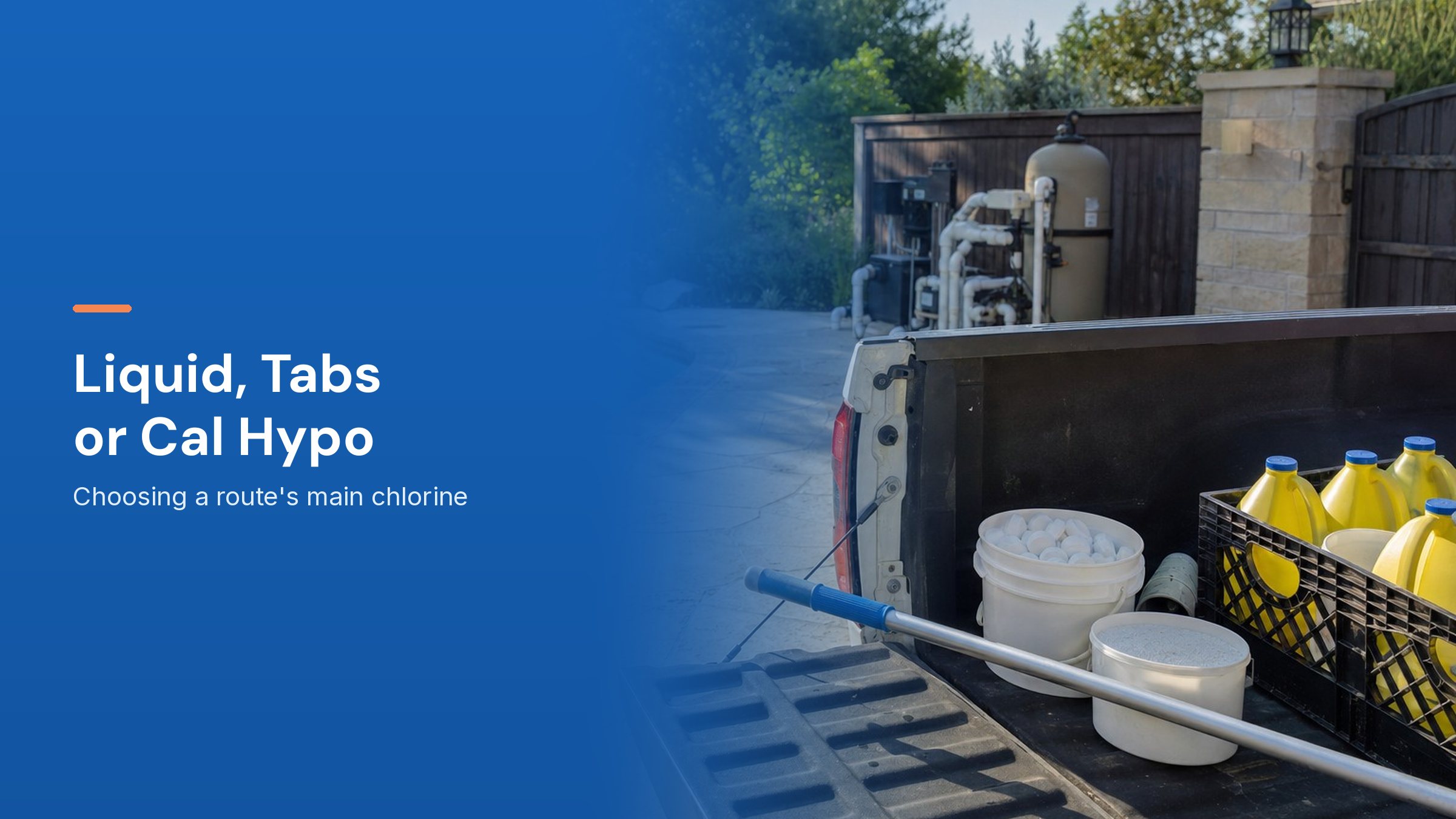
There is no one best chlorine for a route. Each kind adds chlorine, and each one leaves something else in the water. Liquid leaves salt. Cal hypo leaves calcium. Tabs leave cyanuric acid, which pros call CYA or stabilizer.[1]Pool & Hot Tub AllianceCertified Pool/Spa Operator Handbook, 2024 edition, Disinfection chapter: available chlorine, pH and by-products of sodium hypochlorite, calcium hypochlorite, trichlor and dichlor, and cyanuric acid (pages 68 to 74).phta.org
So the real question is what this pool can take more of. Most weekly routes end up with a mix: liquid or cal hypo goes in at the visit, and tabs hold the pool between visits when it needs them. This guide covers the trade-offs, the cost, the fight over tabs in the skimmer, and what to check when a tab feeder acts up.
Key Takeaways
- Pick by the water, not by habit. Liquid adds salt, cal hypo adds calcium, and trichlor and dichlor add CYA.[1]Pool & Hot Tub AllianceCertified Pool/Spa Operator Handbook, 2024 edition, Disinfection chapter: available chlorine, pH and by-products of sodium hypochlorite, calcium hypochlorite, trichlor and dichlor, and cyanuric acid (pages 68 to 74).phta.org
- Compare cost by the pound of chlorine. A gallon of 12% liquid holds about one pound. Cal hypo and tabs are stronger by weight, so the price per pound of product does not tell you much.[2]Pool & Hot Tub AllianceCertified Pool/Spa Operator Handbook, 2024 edition, Appendix B-2, Water Chemistry Adjustment Guide: dosages to treat 10,000 gallons (page 276).phta.org
- Keep tabs out of the skimmer. Pentair, Raypak and Hayward heater manuals all say not to do it, and Jandy lists it as a warranty exclusion.[7]PentairMasterTemp Pool and Spa Heater Installation and User's Guide, P/N 467107 Rev. Z, plumbing and water chemistry sections.pentair.com[8]RaypakGas-Fired Pool and Spa Heater manual, models 206A to 406A, P/N 241236 Rev. 51, effective October 27, 2026, "Automatic Chlorinators and Chemical Feeders."raypak.com[9]HaywardUniversal H-Series pool heater owner's manual, "Skimmer Chlorination" and "Chlorinator Installation."Hayward manual[10]JandyUSA and Canada limited warranty, document H0333803 Rev Y, exclusion 8.jandy.com
- To stop adding CYA, stop feeding trichlor. Use liquid, cal hypo or a salt system, and add stabilizer by hand only when a test says so.
- Never mix chlorine types. Feeder makers warn that trichlor and cal hypo together can cause fire or an explosion.[13]PentairRainbow Automatic Chlorine/Bromine Feeder, Model 300, installation guide, P/N R24292 Rev. F, September 12, 2023.pentair.com[14]HaywardSeries CL100/110 and CL200/220 Automatic Chlorine Feeders Owner's Manual, ISCLSERIES Rev D.hayward.com
The short answer
- Liquid chlorine is the cleanest. It adds no CYA and no calcium. It is also heavy, it loses strength as it sits, and it does not feed the pool between visits.[1]Pool & Hot Tub AllianceCertified Pool/Spa Operator Handbook, 2024 edition, Disinfection chapter: available chlorine, pH and by-products of sodium hypochlorite, calcium hypochlorite, trichlor and dichlor, and cyanuric acid (pages 68 to 74).phta.org
- Trichlor tabs are the only common choice that feeds chlorine slowly all week. They are also acidic, and they add CYA every time they dissolve.[1]Pool & Hot Tub AllianceCertified Pool/Spa Operator Handbook, 2024 edition, Disinfection chapter: available chlorine, pH and by-products of sodium hypochlorite, calcium hypochlorite, trichlor and dichlor, and cyanuric acid (pages 68 to 74).phta.org
- Cal hypo is strong, dry and easy to carry. It adds calcium and raises pH, so it fits soft-water areas best.[1]Pool & Hot Tub AllianceCertified Pool/Spa Operator Handbook, 2024 edition, Disinfection chapter: available chlorine, pH and by-products of sodium hypochlorite, calcium hypochlorite, trichlor and dichlor, and cyanuric acid (pages 68 to 74).phta.org
Many pros use liquid or cal hypo as the main dose and treat tabs as a tool. Tabs go in when the pool needs a steady feed and the CYA has room to rise, and they come out when the CYA gets high.
What each chlorine leaves behind
The PHTA handbook rates each product by available chlorine. That number tells you how much chlorine a product puts in the water, by weight, next to pure chlorine gas at 100%.[1]Pool & Hot Tub AllianceCertified Pool/Spa Operator Handbook, 2024 edition, Disinfection chapter: available chlorine, pH and by-products of sodium hypochlorite, calcium hypochlorite, trichlor and dichlor, and cyanuric acid (pages 68 to 74).phta.org The same pages list what else each one does.
| Product | Available chlorine | pH of the product | What it leaves in the pool | Feeds between visits? |
|---|---|---|---|---|
| Liquid chlorine (sodium hypochlorite) | 10% to 12% | 9 to 14 | Salt. It also pushes pH up when it goes in. | No. It is one dose. |
| Cal hypo (calcium hypochlorite) | 47% to 78% | 8.5 to 11 | Calcium. It also pushes pH up. | Granular: no. Tablets: only in a feeder made for them. |
| Trichlor tabs | About 90% | 2.8 to 3.5 | CYA. It pulls pH and total alkalinity down over time. | Yes. It dissolves slowly. |
| Dichlor granules | 56% to 63% | 6.5 to 6.8 | CYA, and more of it per dose than trichlor. | No. It dissolves fast. |
All of those numbers come from the PHTA handbook.[1]Pool & Hot Tub AllianceCertified Pool/Spa Operator Handbook, 2024 edition, Disinfection chapter: available chlorine, pH and by-products of sodium hypochlorite, calcium hypochlorite, trichlor and dichlor, and cyanuric acid (pages 68 to 74).phta.org Orenda makes the same point: the real differences between chlorine types are the by-products they leave and what each one does to pH for a while.[3]Orenda Technologies"Pool Sanitizers, Part 1: Chlorine," read November 24, 2026.blog.orendatech.com
CYA from tabs. The CYA is part of the trichlor itself. When the chlorine is used up, the CYA stays. It keeps building as you add more.[1]Pool & Hot Tub AllianceCertified Pool/Spa Operator Handbook, 2024 edition, Disinfection chapter: available chlorine, pH and by-products of sodium hypochlorite, calcium hypochlorite, trichlor and dichlor, and cyanuric acid (pages 68 to 74).phta.org Orenda puts trichlor at about 55% CYA by weight. One pound adds about 6 to 6.5 ppm of CYA to 10,000 gallons.[3]Orenda Technologies"Pool Sanitizers, Part 1: Chlorine," read November 24, 2026.blog.orendatech.com Our chlorine by-products explorable shows how it stacks up. Feed 4 ppm of chlorine a week from tabs for eight weeks and you add about 19 ppm of CYA. See the glossary pages on trichlor and dichlor.
Calcium from cal hypo. The handbook says steady use of cal hypo can lead to high calcium. Where the fill water is already hard, that can mean scale on walls, in the filter and in the heater. Where the water is soft, the added calcium is a plus.[1]Pool & Hot Tub AllianceCertified Pool/Spa Operator Handbook, 2024 edition, Disinfection chapter: available chlorine, pH and by-products of sodium hypochlorite, calcium hypochlorite, trichlor and dichlor, and cyanuric acid (pages 68 to 74).phta.org See the cal hypo glossary page for more.
Salt and pH from liquid. Liquid chlorine adds sodium and chloride, which is salt. The handbook says that salt does not hurt how chlorine works. It also says liquid raises pH when it goes in, so acid is part of the plan.[1]Pool & Hot Tub AllianceCertified Pool/Spa Operator Handbook, 2024 edition, Disinfection chapter: available chlorine, pH and by-products of sodium hypochlorite, calcium hypochlorite, trichlor and dichlor, and cyanuric acid (pages 68 to 74).phta.org More on that in the liquid chlorine glossary page.
Low pH from tabs. Trichlor has a pH of about 2.8 to 3.5. Over time it lowers pH and total alkalinity.[1]Pool & Hot Tub AllianceCertified Pool/Spa Operator Handbook, 2024 edition, Disinfection chapter: available chlorine, pH and by-products of sodium hypochlorite, calcium hypochlorite, trichlor and dichlor, and cyanuric acid (pages 68 to 74).phta.org That same acid is why the skimmer is the wrong place for a tab, as covered below.
Cost per pound of chlorine
A gallon and a pound are not the same thing, so the fair way to compare is cost per pound of available chlorine.
The handbook's dose table makes the math easy. To add 10 ppm of chlorine to 10,000 gallons, it lists 3.3 quarts of 12% liquid or 1.25 pounds of 67% cal hypo.[2]Pool & Hot Tub AllianceCertified Pool/Spa Operator Handbook, 2024 edition, Appendix B-2, Water Chemistry Adjustment Guide: dosages to treat 10,000 gallons (page 276).phta.org That dose is about 0.83 pounds of chlorine. So one gallon of 12% liquid holds about one pound of chlorine. Cal hypo at 67% takes about 1.5 pounds of product. Trichlor at 90% takes about 1.1 pounds. Orenda gives a matching rule: one gallon of 12.5% liquid raises 10,000 gallons by about 12.5 ppm.[4]Orenda Technologies"Understanding Labeled Chlorine %," read November 24, 2026.blog.orendatech.com
| Product | Product for one pound of chlorine | Example price | Cost per pound of chlorine |
|---|---|---|---|
| Liquid, 12% | About 1 gallon | $1.79 to $6.00 a gallon, what pros reported by state | $1.79 to $6.00 |
| Cal hypo, drum price | About 1.5 pounds at 67% | $189 to $205 for a 100-pound drum, one pro's two suppliers, strength not stated | About $2.80 to $3.10 if it is 67% |
| Cal hypo, store price | About 1.4 pounds at 70% | $219.99 for 50 pounds of 70% product | About $6.30 |
| Trichlor tabs, store price | About 1.1 pounds at 90% | $154.99 to $179.99 for a 50-pound bucket | About $3.45 to $4.00 |
The liquid prices come from our liquid chlorine cost by state report. The store prices for tabs and cal hypo come from the chemical tracker on poolrates.fyi, PoolDial's sister site.[5]poolrates.fyiChemical price tracker, store prices for 3-inch chlorine tablets, calcium hypochlorite and liquid chlorine, last updated October 12, 2026.poolrates.fyi The drum price comes from a pro on Reddit.[6]r/PoolPros"Where is everyone buying their chems these days?" A pro lists what two suppliers charge for a 100-pound drum of cal hypo.reddit.com Pros who buy tabs through a distributor often report bucket prices a bit under those store prices, so ask your own supplier before you run the math.
- Where you live decides the winner. At $1.79 a gallon, liquid is the cheapest chlorine there is. At $6.00 a gallon, it is the most costly.
- Liquid gets weaker. The handbook says liquid slowly loses strength in storage, and faster when it is hot.[1]Pool & Hot Tub AllianceCertified Pool/Spa Operator Handbook, 2024 edition, Disinfection chapter: available chlorine, pH and by-products of sodium hypochlorite, calcium hypochlorite, trichlor and dichlor, and cyanuric acid (pages 68 to 74).phta.org A gallon that has dropped below label strength costs more per pound than the table shows.
- The side effects have a price too. Liquid and cal hypo need acid. Tabs need less acid, but the CYA they add may one day mean draining water. Orenda calls that the cost of removing by-products.[3]Orenda Technologies"Pool Sanitizers, Part 1: Chlorine," read November 24, 2026.blog.orendatech.com
If you bill chemicals, the chemical pricing guide and the chemical markup guide show how to pass these costs on.
Hauling, storage and shelf life
Liquid is mostly water. The handbook says it is about 88% to 90% water and salt, which is why shipping it costs so much.[1]Pool & Hot Tub AllianceCertified Pool/Spa Operator Handbook, 2024 edition, Disinfection chapter: available chlorine, pH and by-products of sodium hypochlorite, calcium hypochlorite, trichlor and dichlor, and cyanuric acid (pages 68 to 74).phta.org A pound of chlorine means hauling a full gallon jug. It should be stored cool and dark, and it should be used fresh.[1]Pool & Hot Tub AllianceCertified Pool/Spa Operator Handbook, 2024 edition, Disinfection chapter: available chlorine, pH and by-products of sodium hypochlorite, calcium hypochlorite, trichlor and dichlor, and cyanuric acid (pages 68 to 74).phta.org If you carry a lot of it, read our guide to DOT rules for hauling liquid chlorine.
Cal hypo packs the most chlorine into the least space. It also keeps its strength far better than liquid. The trade-off is fire risk. The handbook lists plain cal hypo as a Class 3 oxidizer. That means it can make a fire burn much faster, and it can ignite if it is contaminated or heated.[1]Pool & Hot Tub AllianceCertified Pool/Spa Operator Handbook, 2024 edition, Disinfection chapter: available chlorine, pH and by-products of sodium hypochlorite, calcium hypochlorite, trichlor and dichlor, and cyanuric acid (pages 68 to 74).phta.org One label says not to let it get wet or damp before use and to use only clean, dry scoops.[12]U.S. Environmental Protection AgencyMaster label for a calcium hypochlorite granule product, EPA Reg. No. 100368-7, December 2025: precautions and directions for use.epa.gov
Tabs are the easiest to carry and store. The handbook rates trichlor as a Class 1 oxidizer, the mildest class.[1]Pool & Hot Tub AllianceCertified Pool/Spa Operator Handbook, 2024 edition, Disinfection chapter: available chlorine, pH and by-products of sodium hypochlorite, calcium hypochlorite, trichlor and dichlor, and cyanuric acid (pages 68 to 74).phta.org It still must stay dry and away from every other chemical.
Whatever you carry, the CDC says to keep each chemical in its own spot, in its labeled container, dry and out of the heat.[17]Centers for Disease Control and Prevention"Pool Chemical Safety," Healthy Swimming, June 24, 2025.cdc.gov Our pool chemical storage guide covers the shop and the truck.
How pros choose by pool, season and CYA
Good route techs do not run one program on every pool. They test first, and then they pick.
“I could take care of one pool that always holds chlorine, always looks beautiful, go four houses down and the pH was always off, it never held chlorine. Every pool is different.”
Here is how the choice usually breaks down on a route.
By fill water. In soft-water areas, many pros make cal hypo the main chlorine. The added calcium helps the water there. In hard-water areas like the desert Southwest, pros tend to skip cal hypo and stay with liquid, since calcium is already their problem. This matches the handbook's advice on hard and soft water.[1]Pool & Hot Tub AllianceCertified Pool/Spa Operator Handbook, 2024 edition, Disinfection chapter: available chlorine, pH and by-products of sodium hypochlorite, calcium hypochlorite, trichlor and dichlor, and cyanuric acid (pages 68 to 74).phta.org If cal hypo is your main dose, test calcium often and run the numbers in the LSI calculator.
By surface. Many pros avoid granular cal hypo on vinyl. The handbook says granules left on the floor can bleach a liner, so they must be brushed until they are gone.[1]Pool & Hot Tub AllianceCertified Pool/Spa Operator Handbook, 2024 edition, Disinfection chapter: available chlorine, pH and by-products of sodium hypochlorite, calcium hypochlorite, trichlor and dichlor, and cyanuric acid (pages 68 to 74).phta.org Cal hypo can also cloud the water for a while, more so when pH and calcium are already high. Some pros stir it into a pail of water first, but at least one label says not to pre-mix it at all, so follow the label on how to add it.[12]U.S. Environmental Protection AgencyMaster label for a calcium hypochlorite granule product, EPA Reg. No. 100368-7, December 2025: precautions and directions for use.epa.gov
By season. This is where tabs earn their place. The handbook says sunlight can destroy half the chlorine in a pool in under an hour when there is no CYA.[1]Pool & Hot Tub AllianceCertified Pool/Spa Operator Handbook, 2024 edition, Disinfection chapter: available chlorine, pH and by-products of sodium hypochlorite, calcium hypochlorite, trichlor and dichlor, and cyanuric acid (pages 68 to 74).phta.org One liquid dose may not last seven days in July. A few tabs in a floater or feeder fill that gap. In the cool months, demand drops and the tabs come out.
“I really only use tabs here in SoCal from May through Oct. Usually by the beginning of fall, CYA is maxed out from tab usage during the summer and we switch to liquid only, then let fill water and rain dilute levels down through the off-season.”
By CYA level. The handbook's target for CYA is 30 to 50 ppm.[1]Pool & Hot Tub AllianceCertified Pool/Spa Operator Handbook, 2024 edition, Disinfection chapter: available chlorine, pH and by-products of sodium hypochlorite, calcium hypochlorite, trichlor and dichlor, and cyanuric acid (pages 68 to 74).phta.org Plenty of pros in hot, sunny markets run higher than that and argue about where the line is, but they agree on the rule: when CYA is high, tabs stop. A rule of "one or two tabs every visit, no matter what" is how a route ends up with pools over 100 ppm. Test CYA on a schedule and write it down. Then use the free chlorine to CYA calculator to see how much chlorine a pool needs at its CYA level.
By what the pool does all week. A heated spa, a rental, a pool with lots of kids or a pool that gets hammered by rain may need a steady feed that one weekly dose cannot give. Those pools get tabs, a salt system or a liquid feed pump.
Are tabs in the skimmer OK?
No, not on a pool you service. Here is what the paperwork says.
What heater makers say. Pentair's MasterTemp manual says not to sanitize the pool by putting chlorine tablets or sticks in the skimmer. It says that when the pump is off, a high dose of chlorine enters the heater and can corrode the heat exchanger.[7]PentairMasterTemp Pool and Spa Heater Installation and User's Guide, P/N 467107 Rev. Z, plumbing and water chemistry sections.pentair.com Raypak says not to place sanitizing chemicals in the skimmer, because high chemical levels build up when the pump is not running, such as overnight.[8]RaypakGas-Fired Pool and Spa Heater manual, models 206A to 406A, P/N 241236 Rev. 51, effective October 27, 2026, "Automatic Chlorinators and Chemical Feeders."raypak.com Hayward's heater manual has a section called "Skimmer Chlorination." It says not to place chlorine or bromine tablets in the skimmer.[9]HaywardUniversal H-Series pool heater owner's manual, "Skimmer Chlorination" and "Chlorinator Installation."Hayward manual
What the warranty says. Jandy's warranty leaves out damage from improper use of chemicals. Its examples are adding chemicals before the heater or through the skimmer.[10]JandyUSA and Canada limited warranty, document H0333803 Rev Y, exclusion 8.jandy.com Our pool equipment warranty guide covers that language and what else makers will not pay for.
Why it does harm. A tab is acid and chlorine in one puck. While the pump runs, the pool water thins it out. When the pump stops, the tab keeps dissolving. The water sitting in the skimmer and the suction pipe turns strong and sour. When the pump starts, that slug goes through the pump, the filter and the heater first. A pro on Reddit explained it this way:
“The problem is when the equipment shuts off, then the water in the skimmer and suction line becomes corrosively acidic as the tab degrades because it’s not flowing. Then the equipment turns back on and sucks that’s extremely acidic water into itself and destroys pump seals, check valves, heat exchangers, etc.”
Why people still argue. Some tab labels do allow skimmer use. One EPA-accepted trichlor label allows it only if the skimmer and the pipe to the pump are plastic. On vinyl pools, it says not to leave the pump off for more than eight hours with tabs in the skimmer, or the liner may bleach.[11]U.S. Environmental Protection AgencyAccepted master label for a trichlor tablet product, EPA Reg. No. 67262-17, July 8, 2013: directions for feeders, floaters and skimmers.epa.gov Plenty of owners have done it for years with a pump that never shuts off and say nothing broke. Repair techs tell the other side, and they link skimmer tabs to brittle baskets, failed pump seals, ruined heat exchangers and damaged suction pipe.
For a service pro, the choice is easy. You do not control when the pump shuts off, and a timer, a power cut or a tripped breaker is all it takes. If a heater fails with tabs in the skimmer, you are the one who put them there. Use a floater or a tab feeder.
A feeder has to be plumbed right too. Pentair and Hayward both say the chlorinator goes after the heater, with a check valve between the two, so strong chlorine cannot flow back when the pump stops.[7]PentairMasterTemp Pool and Spa Heater Installation and User's Guide, P/N 467107 Rev. Z, plumbing and water chemistry sections.pentair.com[9]HaywardUniversal H-Series pool heater owner's manual, "Skimmer Chlorination" and "Chlorinator Installation."Hayward manual A floater has its own risk. Orenda notes that the acid in tabs can etch or fade a surface where a floater sits.[3]Orenda Technologies"Pool Sanitizers, Part 1: Chlorine," read November 24, 2026.blog.orendatech.com If a tab has already left a mark, see how to identify and remove pool stains.
How to chlorinate without adding more CYA
If a pool's CYA is high, the first fix is to stop adding it. That means no trichlor and no dichlor until the number comes down.[1]Pool & Hot Tub AllianceCertified Pool/Spa Operator Handbook, 2024 edition, Disinfection chapter: available chlorine, pH and by-products of sodium hypochlorite, calcium hypochlorite, trichlor and dichlor, and cyanuric acid (pages 68 to 74).phta.org Here are the ways pros switch.
Liquid only. Liquid adds no CYA, so you set the stabilizer level by hand and top it up only when a test says so.
“All my route pools are liquid chlorine only, tabs became too expensive a few years back. Never had any issues pertaining to that, pretty much only check CYA when I show up and there’s no chlorine in the pool or something feels off.”
The weak spot is the six days between visits, since liquid is one dose and some pools will not hold it for a week in high summer. Other pros in that same thread said a liquid-only pool needs a check more than once a week, or a feed pump.
Cal hypo. Granular cal hypo adds no CYA. It trades the CYA problem for calcium, so it suits soft water. Cal hypo tablets go only in a feeder built for cal hypo. Orenda's warning is blunt: never put any other type of chlorine in a cal hypo feeder, and never put cal hypo in a trichlor feeder.[3]Orenda Technologies"Pool Sanitizers, Part 1: Chlorine," read November 24, 2026.blog.orendatech.com
“I'm a cal hypo guy. I like cal hypo. But you know what? I'm very well versed on sodium hypochlorite and trichlor. If for no other reason than to help identify why am I a cal hypo fan, right?”
A salt system. A salt cell makes chlorine from salt in the water. It adds no CYA and it feeds every day the pump runs.[3]Orenda Technologies"Pool Sanitizers, Part 1: Chlorine," read November 24, 2026.blog.orendatech.com It is the cleanest swap for tabs on a pool that needs a steady feed, though it costs more up front and has its own upkeep. See the salt cell glossary page.
A liquid feed pump. The handbook says most commercial pools feed liquid chlorine with a metering pump.[1]Pool & Hot Tub AllianceCertified Pool/Spa Operator Handbook, 2024 edition, Disinfection chapter: available chlorine, pH and by-products of sodium hypochlorite, calcium hypochlorite, trichlor and dichlor, and cyanuric acid (pages 68 to 74).phta.org Some homes use the same setup for a daily feed with no CYA.
Fewer tabs, not zero. Many routes keep tabs but ration them to summer, and only while CYA has room. Liquid or cal hypo covers the rest.
None of this lowers CYA that is already there. The handbook says the usual fix for high CYA is a partial drain, then a refill with fresh water.[1]Pool & Hot Tub AllianceCertified Pool/Spa Operator Handbook, 2024 edition, Disinfection chapter: available chlorine, pH and by-products of sodium hypochlorite, calcium hypochlorite, trichlor and dichlor, and cyanuric acid (pages 68 to 74).phta.org Our guide on how to drain a pool safely covers the risks. The CYA calculator shows how much water to swap, and the cyanuric acid glossary page explains the rest.
Why a tab feeder stops dissolving, clogs or leaks
A tab feeder is called an erosion feeder. Water flows past the tabs and wears them down. The handbook says four things set how fast that happens: how easily the tablet dissolves, the flow of water through the feeder, how much tablet surface is wet, and the water temperature.[15]Pool & Hot Tub AllianceCertified Pool/Spa Operator Handbook, 2024 edition, Chemical Feed & Control chapter on erosion feeders (pages 121 to 122) and Facility Safety chapter on improper mixing (page 205).phta.org Most feeder trouble traces back to one of those.
First, a point that fools a lot of techs. Many feeders are not meant to sit full of water. Pentair says its Rainbow feeder lowers the water level on purpose, so the tabs do not soak while the pump is off.[13]PentairRainbow Automatic Chlorine/Bromine Feeder, Model 300, installation guide, P/N R24292 Rev. F, September 12, 2023.pentair.com A chamber that is not full to the lid is not proof of a problem, but a chlorine reading that keeps dropping is.
Tabs are not dissolving. Work down this list.
- The dial. Higher numbers feed more. Pentair says to change the setting in small steps. It gives an example of a 2 in winter and a 3 in summer.[13]PentairRainbow Automatic Chlorine/Bromine Feeder, Model 300, installation guide, P/N R24292 Rev. F, September 12, 2023.pentair.com
- Low flow. A dirty filter or a pump set to a very low speed sends less water through the feeder. Clean the filter and check the reading again.
- Cold water. Tabs wear down slower in cold water.[15]Pool & Hot Tub AllianceCertified Pool/Spa Operator Handbook, 2024 edition, Chemical Feed & Control chapter on erosion feeders (pages 121 to 122) and Facility Safety chapter on improper mixing (page 205).phta.org
- The wrong tablet. Hayward says to use only slow-dissolving trichlor tablets in its CL feeders and never the fast-dissolving kind.[14]HaywardSeries CL100/110 and CL200/220 Automatic Chlorine Feeders Owner's Manual, ISCLSERIES Rev D.hayward.com Pentair says to use only clean tablets.[13]PentairRainbow Automatic Chlorine/Bromine Feeder, Model 300, installation guide, P/N R24292 Rev. F, September 12, 2023.pentair.com
- How it was plumbed. Check the flow arrow and the plumbing drawing in the manual.
The feeder is clogged. The small parts clog first: the control valve, the check valve and, on offline models, the tubing. Tablet residue builds up in them, and many pros blame soft, low-grade tabs that turn to paste. Hayward says to close the flow control valve when you vacuum, so sediment does not clog it.[14]HaywardSeries CL100/110 and CL200/220 Automatic Chlorine Feeders Owner's Manual, ISCLSERIES Rev D.hayward.com Pentair says to check the inlet and outlet lines each time you refill and to replace them yearly if needed.[13]PentairRainbow Automatic Chlorine/Bromine Feeder, Model 300, installation guide, P/N R24292 Rev. F, September 12, 2023.pentair.com
Do not pour acid or any other cleaner into a feeder that holds tabs or tab residue. One trichlor label says adding other chemicals through the feeder may cause an explosion.[11]U.S. Environmental Protection AgencyAccepted master label for a trichlor tablet product, EPA Reg. No. 67262-17, July 8, 2013: directions for feeders, floaters and skimmers.epa.gov Pentair's advice for a feeder with dirt, debris or an unknown past is to flush it well with fresh water.[13]PentairRainbow Automatic Chlorine/Bromine Feeder, Model 300, installation guide, P/N R24292 Rev. F, September 12, 2023.pentair.com If a valve is still blocked after that, replace the part.
The feeder leaks. Start at the lid.
- Lid O-ring. Pentair says to keep it clean, lube it with silicone and tighten the cap by hand only. It warns never to use oil or grease, since oil that touches trichlor can start a fire.[13]PentairRainbow Automatic Chlorine/Bromine Feeder, Model 300, installation guide, P/N R24292 Rev. F, September 12, 2023.pentair.com Hayward also bans petroleum lube.[14]HaywardSeries CL100/110 and CL200/220 Automatic Chlorine Feeders Owner's Manual, ISCLSERIES Rev D.hayward.com Carry spare O-rings.
- Fittings. Hayward says threaded fittings go hand tight plus one to one and a half turns. It says to check all joints for leaks after start-up.[14]HaywardSeries CL100/110 and CL200/220 Automatic Chlorine Feeders Owner's Manual, ISCLSERIES Rev D.hayward.com
- Tubing. On offline feeders, old tubing gets brittle and weeps, so replace it.
- A cracked body. Do not patch it. Replace the feeder. While you are there, make sure a check valve sits on the pipe from heater to feeder, and add one if it is missing.[7]PentairMasterTemp Pool and Spa Heater Installation and User's Guide, P/N 467107 Rev. Z, plumbing and water chemistry sections.pentair.com
Open it the safe way. A feeder can be under pressure and full of fumes. Hayward's steps are: shut off the pumps, turn the feeder's valve to off, wait one minute, then take off the cover. It also says to wear eye and skin protection and not to breathe the fumes.[14]HaywardSeries CL100/110 and CL200/220 Automatic Chlorine Feeders Owner's Manual, ISCLSERIES Rev D.hayward.com The handbook adds that a feeder run the wrong way can rupture or explode.[15]Pool & Hot Tub AllianceCertified Pool/Spa Operator Handbook, 2024 edition, Chemical Feed & Control chapter on erosion feeders (pages 121 to 122) and Facility Safety chapter on improper mixing (page 205).phta.org
The tab feeder glossary page covers sizing and the two main types. For the CMP PowerClean, see our PowerClean troubleshooting guide.
The one rule: never mix chlorine types
Every chlorine in this article is safe in the pool at the right dose, but they are not safe with each other in a bucket, a scoop, a skimmer or a feeder.
Pentair's feeder guide says that under no circumstances should trichlor be mixed with calcium hypochlorite, with other forms of concentrated chlorine or with other chemicals. It says fire or an explosion may result, and that cal hypo is not to be used in the feeder in any form.[13]PentairRainbow Automatic Chlorine/Bromine Feeder, Model 300, installation guide, P/N R24292 Rev. F, September 12, 2023.pentair.com Hayward's CL manual gives the same warning. It adds that no other chlorine, shock, pH product or algaecide should go in through the skimmer on a pool with its feeder.[14]HaywardSeries CL100/110 and CL200/220 Automatic Chlorine Feeders Owner's Manual, ISCLSERIES Rev D.hayward.com A cal hypo label says not to use that product in any floater or feeder.[12]U.S. Environmental Protection AgencyMaster label for a calcium hypochlorite granule product, EPA Reg. No. 100368-7, December 2025: precautions and directions for use.epa.gov
The EPA explains why this matters so much. Most common pool chemicals do not get along with each other. Mixing them, on purpose or by accident, can cause enough heat to start a fire and can release chlorine gas. It can happen with one scoop used for two products, or with spills swept up together.[16]U.S. Environmental Protection AgencyChemical Safety Alert, "Safe Storage and Handling of Swimming Pool Chemicals," EPA 550-F-01-003, March 2001.epa.gov The PHTA handbook repeats that warning.[15]Pool & Hot Tub AllianceCertified Pool/Spa Operator Handbook, 2024 edition, Chemical Feed & Control chapter on erosion feeders (pages 121 to 122) and Facility Safety chapter on improper mixing (page 205).phta.org
For a route tech, that turns into a few habits.
- Give each chemical its own scoop and its own bucket. Label them.
- Keep dry chlorine dry. Close lids before you drive.
- Never top off a feeder or floater with a different product. If you do not know what was in a feeder, flush it with fresh water first.[13]PentairRainbow Automatic Chlorine/Bromine Feeder, Model 300, installation guide, P/N R24292 Rev. F, September 12, 2023.pentair.com
- Store chlorine types apart from each other and apart from acid.[17]Centers for Disease Control and Prevention"Pool Chemical Safety," Healthy Swimming, June 24, 2025.cdc.gov
“And we're careful to keep certain chemicals in separate boxes from other incompatible chems. Like, we don't store calhypo in the same deck box as Trichlor.”
Our article on pool chemical mixing accidents shows what is at stake.
The bottom line
Pick your main chlorine by what your water and your market give you. Cheap liquid and hard water point to liquid, while costly liquid and soft water point to cal hypo. Tabs are the steady feed for summer and for pools that cannot make it a week on one dose. Watch CYA and calcium, switch before either one gets away from you, keep tabs out of the skimmer and keep each chlorine in its own container.
Sources
- [1]Pool & Hot Tub Alliance, Certified Pool/Spa Operator Handbook, 2024 edition, Disinfection chapter: available chlorine, pH and by-products of sodium hypochlorite, calcium hypochlorite, trichlor and dichlor, and cyanuric acid (pages 68 to 74). phta.org
- [2]Pool & Hot Tub Alliance, Certified Pool/Spa Operator Handbook, 2024 edition, Appendix B-2, Water Chemistry Adjustment Guide: dosages to treat 10,000 gallons (page 276). phta.org
- [3]Orenda Technologies, "Pool Sanitizers, Part 1: Chlorine," read November 24, 2026. blog.orendatech.com
- [4]Orenda Technologies, "Understanding Labeled Chlorine %," read November 24, 2026. blog.orendatech.com
- [5]poolrates.fyi, Chemical price tracker, store prices for 3-inch chlorine tablets, calcium hypochlorite and liquid chlorine, last updated October 12, 2026. poolrates.fyi
- [6]r/PoolPros, "Where is everyone buying their chems these days?" A pro lists what two suppliers charge for a 100-pound drum of cal hypo. reddit.com
- [7]Pentair, MasterTemp Pool and Spa Heater Installation and User's Guide, P/N 467107 Rev. Z, plumbing and water chemistry sections. pentair.com (PDF)
- [8]Raypak, Gas-Fired Pool and Spa Heater manual, models 206A to 406A, P/N 241236 Rev. 51, effective October 27, 2026, "Automatic Chlorinators and Chemical Feeders." raypak.com (PDF)
- [9]Hayward, Universal H-Series pool heater owner's manual, "Skimmer Chlorination" and "Chlorinator Installation." Hayward manual (PDF)
- [10]Jandy, USA and Canada limited warranty, document H0333803 Rev Y, exclusion 8. jandy.com (PDF)
- [11]U.S. Environmental Protection Agency, Accepted master label for a trichlor tablet product, EPA Reg. No. 67262-17, July 8, 2013: directions for feeders, floaters and skimmers. epa.gov (PDF)
- [12]U.S. Environmental Protection Agency, Master label for a calcium hypochlorite granule product, EPA Reg. No. 100368-7, December 2025: precautions and directions for use. epa.gov (PDF)
- [13]Pentair, Rainbow Automatic Chlorine/Bromine Feeder, Model 300, installation guide, P/N R24292 Rev. F, September 12, 2023. pentair.com (PDF)
- [14]Hayward, Series CL100/110 and CL200/220 Automatic Chlorine Feeders Owner's Manual, ISCLSERIES Rev D. hayward.com (PDF)
- [15]Pool & Hot Tub Alliance, Certified Pool/Spa Operator Handbook, 2024 edition, Chemical Feed & Control chapter on erosion feeders (pages 121 to 122) and Facility Safety chapter on improper mixing (page 205). phta.org
- [16]U.S. Environmental Protection Agency, Chemical Safety Alert, "Safe Storage and Handling of Swimming Pool Chemicals," EPA 550-F-01-003, March 2001. epa.gov (PDF)
- [17]Centers for Disease Control and Prevention, "Pool Chemical Safety," Healthy Swimming, June 24, 2025. cdc.gov