


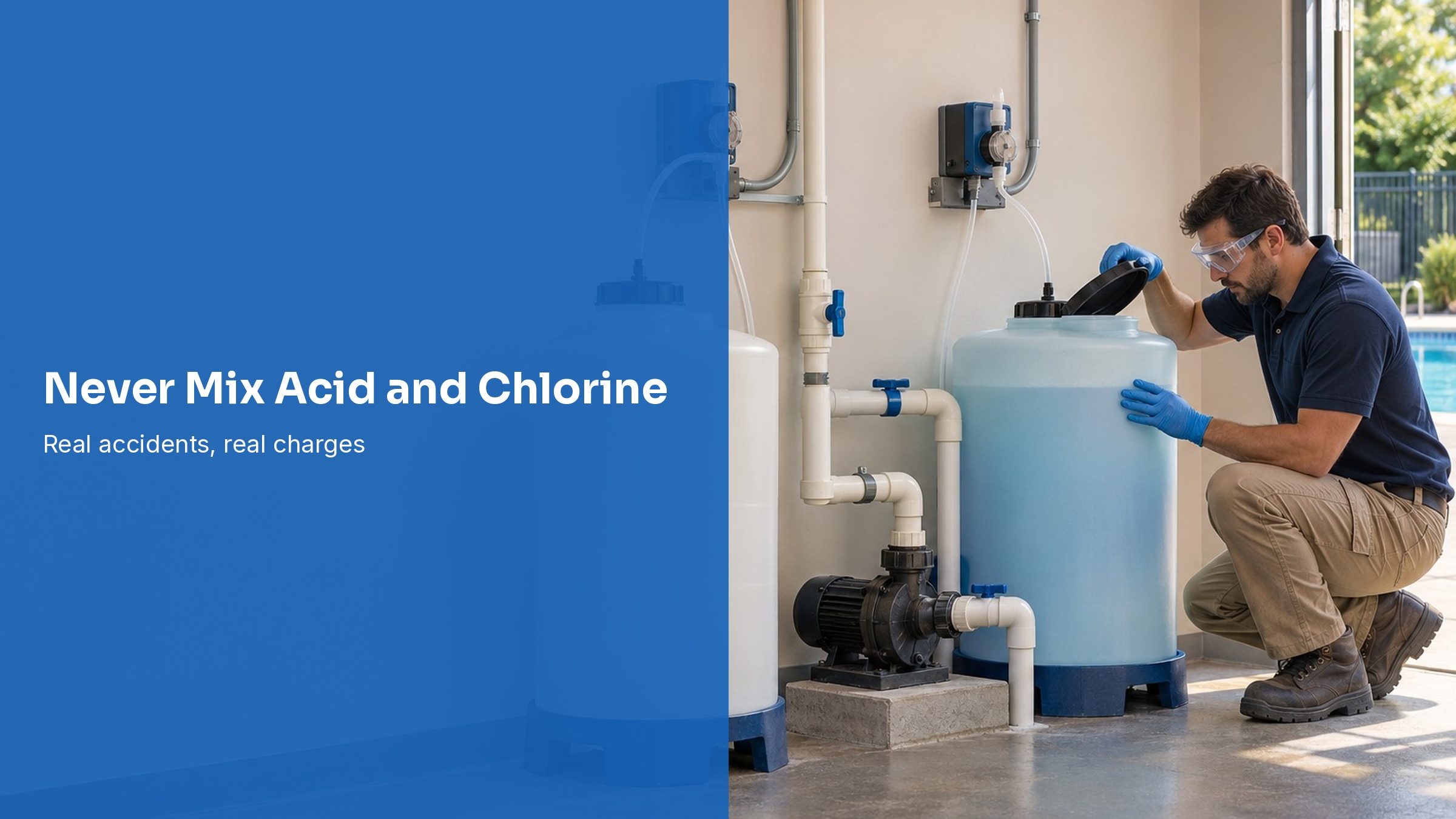
Pool acid and pool chlorine sit side by side on almost every service truck. Mix them by mistake and you make chlorine gas. It can put a tech, a delivery driver, or a whole pool full of swimmers in the hospital.
This guide gives the plain safety answer first. Then it walks through real cases where a mix-up led to criminal charges, fines, or lawsuits. It ends with a checklist you can hand to every person on your crew.
Can you mix muriatic acid and chlorine?
No. Never. Muriatic acid (hydrochloric acid) and chlorine (liquid sodium hypochlorite, or dry products like cal-hypo) react fast. The reaction gives off chlorine gas. It is yellow-green, it smells like a very strong pool, and it burns your eyes, throat, and lungs. A small amount in a closed pump room can hurt people in seconds.
The same goes for any acid. Dry acid (sodium bisulfate) does the same thing when it meets chlorine. Dry chlorine products should not touch each other either. Cal-hypo and trichlor tabs can start a fire if they mix.
Here are the five rules that prevent almost every accident in this article:
- Never mix chemicals. Not in a bucket, not in a feeder, not in a tank. One chemical, one container.
- Store acid and chlorine apart. Keep them on separate shelves or in separate bins, with a wall or real distance between them if you can.
- Label every container. Use the original label. If a drum or tank gets refilled, the label must still be clear and correct.
- Add chemical to water, never water to chemical. Pour each chemical into the pool or a bucket of pool water on its own. Wait and let the pump mix it before adding the next one.
- Feeders off when circulation is off. If the pump stops, the chemical feeders must stop too. Otherwise acid and chlorine can collect in the same pipe.
For the full rules on safety data sheets, labels, and protective gear, see our guide to OSHA chemical safety for pool pros. For the storage side, read the pool chemical storage guide.
Key Takeaways
- Acid plus chlorine makes chlorine gas. A UK safety inspector called this the most common cause of chlorine gas incidents in pool buildings.[4]Bracknell NewsCircle Health Group fined after chlorine gas exposure, June 2023bracknellnews.co.uk
- In 2026, New Jersey charged a pool tech, a delivery driver, and a pool company after a mislabeled acid container was filled with chlorine. The case is pending.[1]New Jersey Office of the Attorney GeneralPress release, October 29, 2026njoag.gov
- Most accidents happen at the same few moments: tank fills, chemical deliveries, and pump restarts.
- Fines and claims run into six figures. One UK clinic paid a £160,000 fine. One city faced about $2.2 million in unsettled claims.[9]Indianapolis Business JournalCity facing heavy costs over pool evacuation, June 2013ibj.com
- Clear labels, written steps, and training would have stopped nearly every case below.
Who gets charged now
For years, a chlorine gas accident at a pool usually meant a lawsuit against the property owner. That is changing. Prosecutors and safety agencies now look at everyone who touched the chemicals: the tech who keeps the chemical room, the driver who fills the tank, and the company that hired and trained them.
That matters for small service companies. If you run commercial accounts, or you send a helper to fill a tank, your name can end up on the charging papers. The cases below show how.
Seven real accidents
1. North Brunswick, New Jersey (2026): tech, driver, and company charged
On July 16, 2026, toxic gas filled the spa equipment and chemical room at a fitness club in North Brunswick. Prosecutors say a delivery of sodium hypochlorite went into a container of muriatic acid. At least six people were hurt.[1]New Jersey Office of the Attorney GeneralPress release, October 29, 2026njoag.gov Local police said at least four went to the hospital with breathing problems.[2]New Jersey 101.5Chlorine gas leak at a North Brunswick fitness center, October 2026nj1015.com
On October 29, 2026, the state Attorney General announced charges against three parties:
- The pool tech. He worked for the pool company and kept up the pool and spa chemicals. He is accused of not keeping clear, legally required labels on the containers. His top charge is second-degree "risking widespread injury or damage." That charge carries 5 to 10 years in prison.
- The delivery driver. He is accused of not checking that the container he filled actually held sodium hypochlorite. He faces a third-degree charge.
- The pool company, United Pools of New Jersey, doing business as Arch Pool Management. It is accused of not making sure containers had proper labels.[1]New Jersey Office of the Attorney GeneralCharges and penalty ranges, October 29, 2026njoag.gov
These are charges only. Everyone named is presumed innocent, and the case is pending.
It was not the first chlorine gas case at a North Brunswick gym pool. In an earlier lawsuit over a release at an LA Fitness there, a jury awarded a swimmer $85,000 against a different pool contractor. Court papers say the contractor's employee caused the gas release while working in the spa pump room. The health department had looked into chlorine gas incidents at that pool twice in the two months before. In 2020, an appeals court upheld a ruling that she could not also seek punitive damages (extra money meant to punish).[3]Cignarella v. Fitness International, LLCN.J. Super. Ct. App. Div., No. A-5190-17, decided January 10, 2020 (unpublished)njcourts.gov
The lesson: A worn label is not a small thing. It can be the start of a criminal case for the tech, the driver, and the owner.
2. Basingstoke, England (2021): wrong tank, £160,000 fine
A private clinic asked an engineer to lower the pH in its hydrotherapy pool. He added sodium bisulfate, a dry acid, to the pool's sodium hypochlorite tank. The mix released chlorine gas, and three workers were exposed. Investigators found the clinic had no trained staff to run the pool plant, and the engineer had not been fully trained in chlorine dosing or chemical storage.[5]Pool Water Treatment Advisory Group (PWTAG)Summary of HSE prosecution of Circle Health Grouppwtag.org
Lab tests found the gas reached nearly 8,000 times the workplace exposure limit. The owner, Circle Health Group, pleaded guilty. In June 2023 it was fined £160,000 plus £12,520.03 in costs.[4]Bracknell NewsCircle Health Group pled guilty, June 2023bracknellnews.co.uk The inspector said that "the accidental addition of acid to hypochlorite is the commonest cause of chlorine release incidents in pool buildings."
The lesson: Acid goes in the acid tank, or straight into the pool water. Never into the chlorine tank. A person who has not been trained on that system should not be dosing it.
“A bit of care, a bit of caution and a bit of training goes a long way.”
3. St. Catharines, Ontario (2012): 90 litres into the acid tank
In July 2012, a worker supplying a city pool poured about 90 litres (about 24 gallons) of chlorine into a tank that held muriatic acid. A gas cloud filled the pool area. The spill affected about 180 people and sent 12 to the hospital.[7]Pool & Spa MarketingLegal issues and concerns involving chemical-related accidents at public swimming pools, September 2015poolspamarketing.com[6]CTV News Toronto12 sent to hospital after chemical leak at St. Catharines pool, July 2012ctvnews.ca A $10 million proposed class action followed against the city and the company that serviced the pool.[7]Pool & Spa MarketingLegal issues and concerns involving chemical-related accidents, September 2015poolspamarketing.com We could not find a public record of how it ended.
The lesson: This is the same mistake as New Jersey, ten years earlier. Tank fills are the most dangerous few minutes in commercial pool work.
4. MGM Grand, Las Vegas (2010): pumps off, feeder still live
In August 2010, a pool contractor was replacing backwash controllers at the MGM Grand. To do the work, it shut off the circulation pumps. MGM's lawsuit says the crew did not isolate or disable the chemical controller first. A mix of chlorine and muriatic acid built up in the pipes and then flowed into the pool. MGM says 26 guests went to the hospital. In 2011 the resort sued the contractor to hold it responsible.[8]Vegas Inc. (Las Vegas Sun)MGM Grand sues contractor over 2010 chlorine leak that hospitalized 26, April 14, 2011vegasinc.com These were the hotel's claims; we did not find a public ruling.
The lesson: Before you shut off pumps for any repair, shut off and lock out the chemical feeders. Then turn them back on last, after flow is back.
5. Garfield Park, Indianapolis (2012): one closed valve, 70 to the hospital
In June 2012, a city pool worker did a routine backwash and did not reopen a valve afterward. A city review found that this let two chemicals combine into chlorine gas, which entered the pool. About 70 people, mostly children, went to hospitals.[9]Indianapolis Business JournalCity facing heavy costs over pool evacuation, June 2013ibj.com
A year later, the city had settled 17 of 44 claims for $33,456. The claims still open totaled about $2.2 million, and the city faced four lawsuits. The state safety agency also found leaking chemical tubing and a lack of proper gloves and flushing equipment for workers.[9]Indianapolis Business JournalClaims, lawsuits, and IOSHA findingsibj.com
The lesson: A backwash is routine until a valve is left in the wrong spot. Use a written step list, and check every valve before you walk away.
6. Ipswich, England (2015 sentencing): restarting pumps with swimmers in the water
After a power surge stopped the circulation pumps at a David Lloyd club, staff tried to restart them while about 13 people were still swimming. The pumps needed re-priming, and the company had no written steps for that. The second restart pushed gas and a yellow-brown stain into the pool. Five swimmers needed hospital care. A similar release had hit the same pool less than two years earlier.[10]6 Pump Court ChambersIpswich Borough Council v David Lloyd Leisure Ltd, August 20156pumpcourt.co.uk
The company pleaded guilty. It was fined £70,000 and ordered to pay £60,000 in costs.[10]6 Pump Court ChambersSentence: £70,000 fine and £60,000 costs6pumpcourt.co.uk
The lesson: When pumps stop with feeders running, chemicals can pool in the lines. Clear the water before any restart. Have a written restart plan.
7. Branson, Missouri (2021): shocking a pool full of kids
Three families sued a Branson hotel in 2024. Their lawsuit says that in May 2021, a hotel worker scooped granular calcium hypochlorite straight into the indoor pool while kids and adults were swimming, on two separate occasions that night. The suit says 12 children needed medical care, and one has lasting lung and throat damage. It also says the product label warned that no one can be in the pool when chemicals are added directly.[11]McClatchy via AOLKids suffer burns when hotel worker dumps chemicals in pool with them in it, suit says, February 7, 2024aol.com These are claims in a lawsuit, not court findings.
The lesson: Clear the pool before you shock it. Read the label. It is part of the legal standard you will be judged against.
“It doesn't matter what it is or how familiar you think you are, read the damn label.”
What the cases have in common
Here is how the seven cases line up:
| Case | What went wrong | Result |
|---|---|---|
| North Brunswick, NJ (2026) | Chlorine delivered into a poorly labeled acid container | Tech, driver, and company charged (pending) |
| Basingstoke, UK (2021) | Dry acid added to the chlorine tank | Guilty plea, £160,000 fine |
| St. Catharines, ON (2012) | 90 L of chlorine poured into an acid tank | $10M proposed class action |
| MGM Grand, NV (2010) | Pumps shut off without isolating the chemical controller | Hotel sued its contractor |
| Garfield Park, IN (2012) | Valve left closed after backwash | About $2.2M in open claims, safety citations |
| Ipswich, UK (2015) | Pumps restarted with swimmers in the pool | Guilty plea, £70,000 fine |
| Branson, MO (2021) | Pool shocked with swimmers in it (alleged) | Lawsuit by three families (pending) |
Three patterns stand out. First, the mix-up almost always happens at a handoff: a delivery, a tank fill, or a repair crew working around someone else's equipment. Second, pumps and feeders cause as many accidents as buckets do. When water stops moving, chemicals collect. Third, nearly every case had a missing piece of paper: no clear label, no written restart steps, or no training record.
A safety checklist for your crew
Print this, or load it into your service checklist. Go over it with every new hire and every helper.
Tank fills and chemical deliveries
- Read the label on the tank or drum before you open a cap. If you can't read it, stop. Do not guess by color or by which side of the room it is on.
- Keep labels clean, readable, and correct. Replace any label that is faded, peeling, or covered in crust.
- Use different fill caps, colors, or locks for acid and chlorine tanks where you can.
- If a supplier delivers, walk the driver to the right tank, or confirm the tank in writing ahead of time.
- Wear eye protection and gloves, and keep the door open for air.
Pump stops, repairs, and restarts
- Before you shut off the pump, turn off and lock out every chemical feeder.
- After a backwash or repair, check that every valve is back where it belongs.
- After a power outage, check the feeders before you restart anything.
- Clear swimmers from the pool before you restart pumps at a commercial pool.
- Turn feeders back on last, only after you see good flow.
Adding chemicals by hand
- Add one chemical at a time, to water, never water to the chemical.
- Never pre-mix chemicals in one bucket. Use separate buckets, and rinse them.
- Do not add chemicals with swimmers in the pool. Follow the label for when people can swim again.
- On the truck, keep acid and chlorine in separate bins or on separate sides. If you haul bulk liquid chlorine, see our guide to DOT rules for hauling liquid chlorine.
“Don't store acid and chlorine together indoors, ever.”
Training helpers and new techs
- Show each new person the acid tank, the chlorine tank, and the feeders at every commercial account. Don't assume they know.
- Have them do a supervised fill before they do one alone.
- Teach the gas signs: a yellow-green haze, a sharp bleach smell, coughing, or burning eyes.
- Write down who was trained, on what, and when.
If gas is released
- Get out and get everyone else out. Move upwind and uphill. Chlorine gas is heavier than air.
- Call 911. Do not go back in to fix it.
- Get medical care for anyone who breathed it in, even if they feel fine.
- Call the property owner and your insurer, and write down what happened while it is fresh.
Homeowners face these risks too. If your customers add their own acid between visits, tell them to keep it away from every other chemical. One Australian podcast host put the problem plainly:
“We keep saying we're really an unlicensed profession, yet we deal with such hazardous situations.”
Write it down
Every case above turns on the same few questions. Who touched the chemicals? What was added, and when? Was the worker trained? Were the labels readable? A good record answers those questions for you.
- Log every chemical you add, with the amount, the time, and who added it. The PoolDial chemical log saves readings and doses at each visit and keeps the history with the pool.
- Use a checklist with photos. PoolDial's service checklists can require a photo for a step. A photo of a clean tank label before each fill takes five seconds.
- Know what to keep. Our guide to pool chemical documentation covers which records matter.
- Dose with math, not guesses. The chemical dosage calculator helps you add the right amount the first time.
Good records do not replace safe work. But when something does go wrong, they show what you did and when you did it. For more cases where pool pros ended up in court, read pool service lawsuits every pro should know.
Sources
- [1]New Jersey Office of the Attorney General, "Two Men and Pool Maintenance Company Charged With Risking Widespread Injury and Damage," October 29, 2026. njoag.gov
- [2]New Jersey 101.5, coverage of the July 16, 2026 chlorine gas release at a North Brunswick fitness center. nj1015.com
- [3]Cignarella v. Fitness International, LLC, No. A-5190-17 (N.J. Super. Ct. App. Div. Jan. 10, 2020) (unpublished). njcourts.gov
- [4]Bracknell News, "Circle Health Group pled guilty to exposing workers to toxins," June 2023. bracknellnews.co.uk
- [5]Pool Water Treatment Advisory Group, "Private health care provider fined for exposing workers to chlorine gas," summary of HSE release, June 2023. pwtag.org
- [6]CTV News Toronto, "12 sent to hospital after chemical leak at St. Catharines pool," July 12, 2012. ctvnews.ca
- [7]Donald G. Kidd, "Legal issues and concerns involving chemical-related accidents at public swimming pools," Pool & Spa Marketing, September 4, 2015. poolspamarketing.com
- [8]Vegas Inc. (Las Vegas Sun), "MGM Grand sues contractor over 2010 chlorine leak that hospitalized 26," April 14, 2011. vegasinc.com
- [9]Indianapolis Business Journal, "City facing heavy costs over pool evacuation," June 2013. ibj.com
- [10]6 Pump Court Chambers, "Pascal Bates prosecutes David Lloyd Leisure for exposing swimming pool users to noxious gas and hospitalising five," August 3, 2015. 6pumpcourt.co.uk
- [11]McClatchy News via AOL, "Kids suffer burns when hotel worker dumps chemicals in pool with them in it, suit says," February 7, 2024. aol.com