What Is Cyanuric Acid (CYA) in Pool Water?


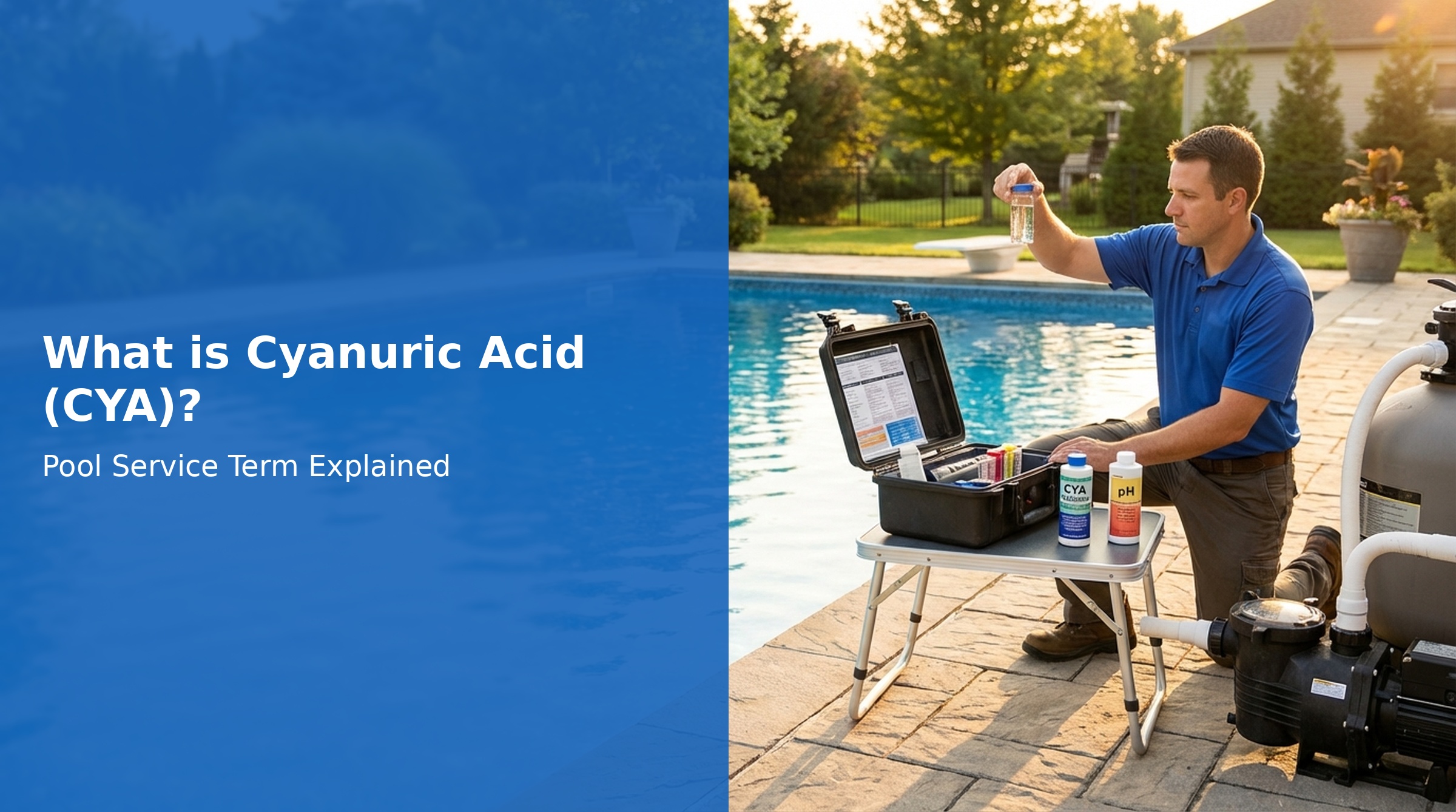
Cyanuric acid (CYA), commonly known as pool stabilizer or conditioner, is one of the most critical yet frequently misunderstood chemicals in pool maintenance. As a pool service professional, understanding how CYA works, its proper levels, and its impact on chlorine effectiveness can mean the difference between crystal-clear water and persistent algae problems. This comprehensive guide will equip you with the knowledge to manage CYA levels expertly and educate your clients about this essential pool chemical.
Key Takeaways
- CYA protects chlorine from UV degradation but reduces its sanitizing power at high levels
- Ideal CYA range is 30-50 ppm for most pools, with higher levels acceptable for salt water systems
- High CYA (above 80 ppm) can cause "chlorine lock" requiring partial water replacement
- CYA accumulates over time and doesn't evaporate, making regular testing essential
- Proper CYA management significantly reduces chemical costs and improves water quality
What is Cyanuric Acid (CYA)?
Cyanuric acid is a chemical compound that forms a weak bond with free chlorine in pool water, creating a protective shield against ultraviolet (UV) radiation from sunlight. Without CYA, UV rays can destroy up to 90% of free chlorine within two hours on a sunny day, leading to rapid chlorine depletion and potential algae growth.
CYA is introduced to pools through:
- Stabilized chlorine products: Dichlor and trichlor contain built-in CYA
- Direct addition: Pure cyanuric acid powder or granules
- Liquid stabilizer: Sodium cyanurate solutions
The molecular structure of CYA allows it to create a reservoir effect, where chlorine molecules are temporarily "stored" and released as needed for sanitization. This mechanism extends chlorine residual time significantly in outdoor pools.
The Critical Balance: Protection vs. Effectiveness
How CYA Protects Chlorine
When CYA levels are within the optimal range (30-50 ppm), the chemical provides excellent UV protection while maintaining chlorine's sanitizing ability. Studies show that properly stabilized pools can maintain adequate chlorine levels with 50-75% less chemical addition compared to unstabilized water.
The Downside of High CYA Levels
However, CYA's protective effect comes with a trade-off. As CYA levels increase, the sanitizing power of chlorine decreases proportionally. At CYA levels above 80 ppm, a phenomenon called "chlorine lock" can occur, where chlorine becomes so bound to CYA that it cannot effectively sanitize the water, even when total chlorine readings appear adequate.
The relationship between CYA and required chlorine levels follows this general guideline:
- CYA 30-50 ppm: Maintain 2-4 ppm free chlorine
- CYA 60-80 ppm: Maintain 4-6 ppm free chlorine
- CYA above 80 ppm: Requires 6+ ppm free chlorine (not recommended)
Testing and Managing CYA Levels
Accurate Testing Methods
Regular CYA testing is essential because the chemical doesn't evaporate and accumulates over time. The most reliable testing methods include:
- Turbidity test: Most common field test using melamine powder
- Digital photometers: Provide precise readings for professional use
- Laboratory analysis: Most accurate method for disputed readings
Test CYA levels monthly during peak season and after any significant chemical additions. Many service professionals overlook CYA testing until problems arise, but proactive monitoring prevents costly issues.
Raising CYA Levels
When CYA levels are too low (below 30 ppm), add cyanuric acid directly to achieve the target range. Use our CYA calculator to determine exact dosage requirements based on pool volume and current levels. Always pre-dissolve granular CYA in warm water and add slowly to prevent localized high concentrations.
Lowering High CYA Levels
Unfortunately, no chemical can effectively reduce CYA levels. The only practical solutions are:
- Partial water replacement: Most common and cost-effective method
- Complete drain and refill: Necessary for severely over-stabilized pools
- Reverse osmosis treatment: Mobile RO units can reduce CYA without draining
Calculate the percentage of water replacement needed using this formula: (Current CYA - Target CYA) ÷ Current CYA = Percentage to replace
Real-World CYA Management Scenarios
Scenario 1: The Trichlor Trap
A client has been using trichlor tablets exclusively for two seasons. CYA has built up to 120 ppm, and despite high chlorine readings, the pool repeatedly develops algae. Solution: Implement a 60% water replacement and switch to liquid chlorine or cal-hypo for routine sanitization, using trichlor only occasionally.
Scenario 2: Salt Water Pool Considerations
Salt water chlorine generators benefit from slightly higher CYA levels (50-80 ppm) because they produce unstabilized chlorine. However, many salt pool owners unknowingly add stabilized shock, gradually increasing CYA beyond optimal levels. Regular monitoring and using cal-hypo shock prevents this accumulation.
Scenario 3: Seasonal CYA Management
In regions with distinct seasons, CYA management strategies should adapt accordingly. During winter months with reduced UV exposure, lower CYA levels (20-30 ppm) may be acceptable, while peak summer conditions benefit from higher levels (40-60 ppm).
Professional Best Practices
Successful CYA management requires a systematic approach:
- Document CYA levels: Track readings over time to identify trends
- Educate clients: Explain the relationship between CYA and chlorine effectiveness
- Choose chemicals wisely: Balance convenience of stabilized chlorine with CYA accumulation
- Plan for dilution: Budget partial water changes as routine maintenance
Consider using our chemical dosage calculator to determine optimal chlorine levels based on current CYA readings, ensuring effective sanitization while minimizing chemical waste.
Integration with Overall Water Balance
CYA management doesn't occur in isolation—it's part of comprehensive water chemistry management. High CYA levels can affect pH stability and may influence calcium scaling potential. Use tools like the Langelier Saturation Index calculator to ensure all parameters work together harmoniously.
Understanding cyanuric acid's role in pool chemistry elevates your service quality and helps prevent the frustrating cycle of algae blooms and excessive chemical consumption. By maintaining proper CYA levels and educating clients about this critical parameter, you'll deliver consistently superior results while optimizing chemical efficiency. Remember, CYA management is a long-term strategy that requires patience, monitoring, and sometimes difficult conversations about water replacement costs—but the payoff in water quality and customer satisfaction makes it worthwhile.