


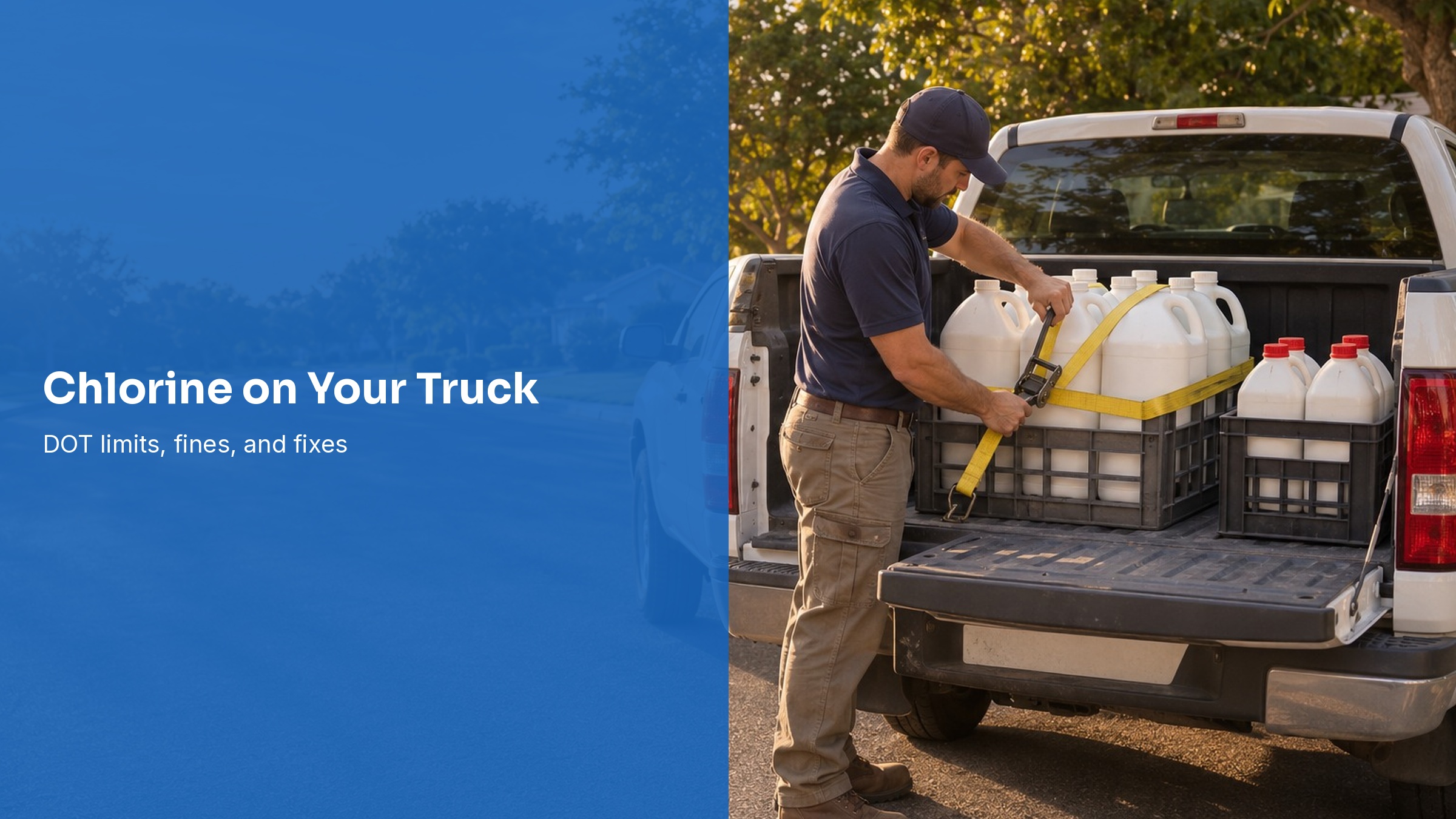
Most pool techs carry liquid chlorine and muriatic acid every day. Both are hazardous materials under federal transportation law. That does not mean you need placards or a special license. A small truck load usually fits under a lighter set of rules called materials of trade. But those rules have hard limits, and a lot of service trucks go over them without knowing it.
This guide covers the federal limits, what changes when you go over them, the fines pool companies have actually paid, and why refilling jugs on your truck can also bring in the EPA.
Key Takeaways
- Liquid chlorine and muriatic acid are Class 8 corrosives. Pool chlorine ships as "Hypochlorite solutions," UN1791. Muriatic acid ships as "Hydrochloric acid," UN1789.[3]49 CFR 172.101, Hazardous Materials TableUN1791 Hypochlorite solutions; UN1789 Hydrochloric acid; UN2468, UN2880 entriesecfr.gov
- 8 gallons per container, 440 pounds per truck. Stay under both and you can use the materials of trade exception.[1]49 CFR 173.6, Materials of trade exceptionseCFR, current textecfr.gov
- Over the limit means full hazmat rules. That brings shipping papers, emergency response information and hazmat training. Placards start at 1,001 pounds.[4]49 CFR 172.504, General placarding requirementsTable 2 and the 454 kg (1,001 lb) exceptionecfr.gov
- Pool companies have been fined. PHMSA fined one pool management company $4,125 over a hypochlorite load.[9]PHMSA, In the Matter of USA Pool Management, Inc.Case No. 04-298-SPT-SO, Decision on Appeal (2005)webarchive.library.unt.edu
- Refilling jugs can be an EPA issue too. A Rhode Island pool supply paid $10,400 for repackaging and selling sodium hypochlorite without the manufacturer's agreement.[13]U.S. EPA news release, Modern Swimming Pool SupplyJanuary 9, 2008, FIFRA settlementepa.gov
Is liquid chlorine hazmat?
Yes. The U.S. Department of Transportation (DOT) lists hazardous materials in one big table. Pool chlorine, which is sodium hypochlorite, falls under "Hypochlorite solutions." It is Class 8, which means corrosive. Muriatic acid falls under "Hydrochloric acid," also Class 8.[3]49 CFR 172.101, Hazardous Materials TableUN1791 Hypochlorite solutions; UN1789 Hydrochloric acid; UN2468, UN2880 entriesecfr.gov
Each entry also has a packing group. That is a danger rating: I is the most dangerous, III is the least. Both chemicals can be packing group II or III depending on strength. Check section 14 of your product's safety data sheet (SDS) to see which one you have. For the truck limits below, II and III are treated the same.
Your dry chemicals count too. Trichlor tablets are listed as Division 5.1, an oxidizer. So is calcium hypochlorite, also called cal hypo.[3]49 CFR 172.101, Hazardous Materials TableUN1791 Hypochlorite solutions; UN1789 Hydrochloric acid; UN2468, UN2880 entriesecfr.gov Products like bicarb are generally not regulated for transport, but check each SDS to be sure.
The materials of trade exception
PHMSA, the Pipeline and Hazardous Materials Safety Administration, writes the hazmat transportation rules. It made a lighter set of rules for businesses that carry small amounts of hazmat to do their real work. Think plumbers with propane, landscapers with fuel, and pool techs with chlorine.
The rule calls these materials of trade. It covers hazmat carried by a business "in direct support of a principal business that is other than transportation by motor vehicle."[2]49 CFR 171.8, DefinitionsMaterial of trade, bulk packaging, hazmat employeeecfr.gov A pool service company fits. A company whose main job is delivering chemicals may not.
The limits
For Class 8 and Division 5.1 materials in packing group II or III:[1]49 CFR 173.6, Materials of trade exceptionseCFR, current textecfr.gov
- Each container: no more than 30 kg (66 pounds) gross weight, or 30 liters (8 gallons) capacity.
- Whole truck: no more than 200 kg (440 pounds) aggregate gross weight of all materials of trade.
- Packing group I: only 1 pound or 1 pint per container. This rarely comes up in pool work, but check your SDS.
"Gross weight" means the chemical plus the jug, bucket or box. "Aggregate" means everything added together: chlorine, acid, tabs and cal hypo. Liquid chlorine weighs about 10 pounds per gallon, so a full 2.5-gallon jug is about 25 pounds before the plastic. That puts roughly 16 full jugs at the 440-pound line, and that is with nothing else on board. Our chemical weight converter helps with the math for dry products.
“You cannot carry a liquid container that holds more than eight gallons, a single container that holds more than eight gallons of liquid, no matter what the type.”
The 8-gallon cap is the one most trucks break. A 30, 55 or 100-gallon chlorine tank is over it. So is a 100-pound bucket of cal hypo, which is over the 66-pound container limit. Those loads are not illegal by themselves. They just fall out of the materials of trade exception and into the full rules below.
What you still have to do under the exception
Materials of trade skips most of the paperwork. It still has four plain rules:[1]49 CFR 173.6, Materials of trade exceptionseCFR, current textecfr.gov
- Tight and secured. Containers must be leak tight, securely closed, secured against shifting, and protected from damage.
- Right container. Use the manufacturer's original container, or one of equal or greater strength.
- Marked. Each container must show the common name or shipping name, like "Liquid Chlorine" or "Muriatic Acid."
- Driver informed. The driver must know the hazmat is on board and know these rules.
Under the exception, you do not need shipping papers, placards or formal hazmat training. The section says materials of trade carried this way are "not subject to any other requirements" beyond the ones it lists.[1]49 CFR 173.6, Materials of trade exceptionseCFR, current textecfr.gov
“Because truth is pool service vehicles do get pulled over by DOT.”
What happens above the limits
Go over 8 gallons in one container, 66 pounds in one bucket, or 440 pounds total, and the full Hazardous Materials Regulations apply to that load. Here is what that usually adds:
- Shipping papers. A document in the cab that names each material, its UN number, class, packing group and amount.
- Emergency response information. Including a phone number that someone answers the whole time the load is on the road.
- Approved containers. Packaging rated for that material, marked and labeled the way the rules require.
- Hazmat training. Every driver or worker who loads, unloads or handles the hazmat needs general awareness, job-specific, safety and security awareness training, repeated at least once every three years.[5]49 CFR 172.704, Training requirementsTraining content and three-year recurrent trainingecfr.gov The rules count self-employed owner-operators as hazmat employees too.[2]49 CFR 171.8, DefinitionsMaterial of trade, bulk packaging, hazmat employeeecfr.gov
Placards
Class 8 is a "Table 2" material. On the highway, you do not need placards for Table 2 materials if the truck carries less than 454 kg (1,001 pounds) aggregate gross weight of them.[4]49 CFR 172.504, General placarding requirementsTable 2 and the 454 kg (1,001 lb) exceptionecfr.gov At 1,001 pounds or more, you need CORROSIVE placards (or OXIDIZER placards for the dry products).
That exception does not cover bulk packaging. For liquids, bulk means a single container that holds more than 450 liters, or 119 gallons.[2]49 CFR 171.8, DefinitionsMaterial of trade, bulk packaging, hazmat employeeecfr.gov A large skid tank over that size needs placards no matter how much is in it.[4]49 CFR 172.504, General placarding requirementsTable 2 and the 454 kg (1,001 lb) exceptionecfr.gov
CDL and security plans
A placarded hazmat load changes your license. Federal rules treat a vehicle "of any size" hauling hazmat that requires placards as a commercial motor vehicle.[7]49 CFR 383.5, CDL definitionsCommercial motor vehicle, Group C; hazardous materialsecfr.gov The driver then needs a commercial driver's license with a hazmat endorsement. Below the placard line, the hazmat itself does not trigger a CDL.
Security plans used to apply to any load big enough to need placards. That is what caught USA Pool Management in the case below. Today the list is narrower. For Class 8, it only covers large bulk loads of packing group I material.[6]49 CFR 172.800, Security plansApplicability list, as amendedecfr.gov Most pool trucks will not need one now, but confirm with PHMSA if you run large tanks.
Which rules apply to your truck?
Use this table as a starting point. Weigh your real load, check your SDS, and call PHMSA or your state DOT if your setup is close to a line.
| What is on the truck | Which rules apply |
|---|---|
| A few 2.5-gallon jugs of chlorine, a gallon or two of acid, a 50-pound bucket of tabs. Under 440 pounds total. | Materials of trade. Containers tight, secured and marked. Driver informed. No shipping papers, placards or formal training. |
| Same jugs, but enough to go over 440 pounds total. | Full hazmat rules: shipping papers, emergency response info, approved packaging, hazmat training. No placards while under 1,001 pounds. |
| Any single liquid container over 8 gallons, such as a 30 to 100-gallon chlorine tank. | That load is outside materials of trade. Full hazmat rules, and the tank must be an approved packaging for the material. |
| A 100-pound bucket of cal hypo or tabs. | Over the 66-pound container limit. Full hazmat rules for that load. |
| A tank that holds more than 119 gallons. | Bulk packaging. Full hazmat rules plus placards at any amount. Check tank and endorsement rules with your state DOT. |
| 1,001 pounds or more of corrosives or oxidizers. | Full hazmat rules plus placards. Driver needs a CDL with hazmat endorsement. |
| Filling customer jugs from a bulk tank to sell or leave on site. | DOT: containers must match the original's strength and be marked. EPA: may count as repackaging a pesticide (see below). |
One more thing: you can carry materials of trade alongside other hazmat on the same truck without losing the exception for the materials of trade portion.[1]49 CFR 173.6, Materials of trade exceptionseCFR, current textecfr.gov
Real fines pool companies have paid
USA Pool Management: no security plan, no training
USA Pool Management offered a load of hypochlorite solution (UN1791, Class 8) big enough to need placards. PHMSA found three violations. The company had no security plan. The emergency phone number on its shipping paper was not monitored the whole time the load was moving. And an employee handled the hazmat without the required training.[9]PHMSA, In the Matter of USA Pool Management, Inc.Case No. 04-298-SPT-SO, Decision on Appeal (2005)webarchive.library.unt.edu
PHMSA assessed a $4,125 penalty in June 2005. The company tried to appeal, but its letter arrived about eight weeks after the 20-day deadline. PHMSA dismissed the appeal and said the full penalty was "due immediately."[9]PHMSA, In the Matter of USA Pool Management, Inc.Case No. 04-298-SPT-SO, Decision on Appeal (2005)webarchive.library.unt.edu
The lesson: If you receive a PHMSA order, the clock starts right away. Answer in time. Also note that this case was decided under the older security plan rule, which reached more loads than today's version.
Par Pool & Spa: no markings, wrong packaging, untrained shipper
Par Inc. of Connecticut, doing business as Par Pool & Spa, shipped oxidizing and corrosive pool and spa chemicals. PHMSA's case summary lists three problems: no hazmat markings, labels or shipping papers; packaging not authorized for those materials; and an employee who had not received hazmat training within the past three years. PHMSA assessed a $14,350 penalty.[10]PHMSA, Par Inc. of Connecticut d/b/a Par Pool & SpaCase No. 08-0141-SB-EA, Order (2009)phmsa.dot.gov
The lesson: Pool chemicals are hazmat whether you haul them yourself or ship them. The person who packs and sends them needs training.
Poolsure: a paperwork error on a bulk load
Poolsure moved hypochlorite solution in intermediate bulk containers under a special permit, which is a written DOT approval to do something the normal rules do not allow. PHMSA's summary says the shipping papers showed the wrong special permit number. PHMSA assessed a $1,600 penalty.[11]PHMSA, Poolsure, Inc.Case No. 09-0072-SIBC-SO, Orderphmsa.dot.gov
The lesson: Even when you have permission for a big load, the details on the paperwork still get checked.
Galaxy Pools: a run-in over 600 gallons of bleach (as reported)
In 2016, Pool & Spa News reported on Galaxy Pools in Sarasota, Florida. The owner said he had a run-in with DOT after failing to update a special permit that allowed his company to move more than 600 gallons of bleach in a 30-ton truck. At the time, he was still waiting to learn the fine.[12]Pool & Spa News, "Is the DOT Cracking Down on the Pool Industry?"Nate Traylor, December 14, 2016poolspanews.com
The same article quoted a safety consultant who said he knew of five recent DOT fines against small businesses, two of them pool service firms. It put such fines at $7,000 to $10,000.[12]Pool & Spa News, "Is the DOT Cracking Down on the Pool Industry?"Nate Traylor, December 14, 2016poolspanews.com These are reported claims, not agency records, so treat the numbers as a rough range.
Refilling jugs on the truck: the EPA side
Many pool pros carry a big chlorine tank and fill jugs from it. There are two separate problems with this.
The DOT problem. The tank is over 8 gallons, so it is outside materials of trade. Any jug you fill must be as strong as the original and must be marked with what is inside.[1]49 CFR 173.6, Materials of trade exceptionseCFR, current textecfr.gov
The EPA problem. Pool chlorine is a registered pesticide because it kills algae and bacteria. Under federal pesticide law, called FIFRA, a "producer" includes anyone who does "packaging, repackaging, labeling and relabeling."[16]40 CFR 167.3, Pesticide establishment definitionsDefinition of producerecfr.gov Pouring chlorine straight into the customer's pool is using the product. Filling jugs to sell to customers, or to leave at their homes, can start to look like repackaging. Three EPA cases show where that goes:
- Modern Swimming Pool Supply (North Providence, R.I., 2008). The company repackaged and sold sodium hypochlorite without a distribution agreement from the manufacturer. EPA said that "amounts to the sale of an unregistered pesticide." The penalty was $10,400.[13]U.S. EPA news release, Modern Swimming Pool SupplyJanuary 9, 2008, FIFRA settlementepa.gov
- Johnston Pool Supply and AMCO (Rhode Island, 2004). Both bought sodium hypochlorite in bulk and repackaged it. EPA alleged the product was well below the strength on the label. They paid $10,000 and $13,000.[14]U.S. EPA news release, Johnston Pool Supply and AMCOJuly 7, 2004, FIFRA settlementsepa.gov
- Pool Water Products (Phoenix, 2020). A different problem: it sold an unregistered, China-made version of its 3-inch chlorine tablets. The penalty was $800,000.[15]U.S. EPA news release, Pool Water ProductsFebruary 5, 2020, $800,000 FIFRA penaltyepa.gov
These were supply companies, not route techs. But the rules do not have a size exemption. If you sell chlorine you repackaged yourself, ask your state pesticide agency what you need first.
What to do this week
- Weigh a real day's load. Add up every jug, bucket and bag of chlorine, acid, tabs and cal hypo. Count the containers too. Is it under 440 pounds?
- Check the biggest container. Anything over 8 gallons or 66 pounds is outside materials of trade.
- Read your SDS section 14. Note the UN number, class and packing group for each product.
- Mark every container. Especially refilled jugs. "Liquid Chlorine" and "Muriatic Acid" in big letters.
- Secure the load. Use racks, crates or straps so nothing slides or tips. Tighten caps. See our truck setup guide for layouts.
- Tell every driver. Write down what is on each truck and walk each tech through these rules. Keep a signed copy.
- Keep acid and chlorine apart. That is a safety rule, not just a DOT rule. Our guide to chemical mixing accidents shows what happens when they meet, and our OSHA chemical safety guide covers the workplace side.
- Plan restocks. If you need more chlorine than the limit allows, restock midday or use rented storage closer to your route instead of hauling it all at once.
Knowing how much chlorine you really use helps you load less. If you log the gallons added at each stop in your chemical tracking records, you can see your daily use and load to match. Our liquid chlorine price guide shows what that chlorine costs in your state.
Federal penalties can reach $102,348 per violation, and each day of a continuing violation can count separately.[8]49 CFR 107.329, Maximum penaltiesCivil penalty per violationecfr.gov Most pool cases have been far smaller than that. A scale, some marker labels and a few straps cost a lot less than either.
Sources
- [1]49 CFR 173.6, Materials of trade exceptions, eCFR, current text. ecfr.gov
- [2]49 CFR 171.8, Definitions, Material of trade, bulk packaging, hazmat employee. ecfr.gov
- [3]49 CFR 172.101, Hazardous Materials Table, UN1791 Hypochlorite solutions; UN1789 Hydrochloric acid; UN2468, UN2880 entries. ecfr.gov
- [4]49 CFR 172.504, General placarding requirements, Table 2 and the 454 kg (1,001 lb) exception. ecfr.gov
- [5]49 CFR 172.704, Training requirements, Training content and three-year recurrent training. ecfr.gov
- [6]49 CFR 172.800, Security plans, Applicability list, as amended. ecfr.gov
- [7]49 CFR 383.5, CDL definitions, Commercial motor vehicle, Group C; hazardous materials. ecfr.gov
- [8]49 CFR 107.329, Maximum penalties, Civil penalty per violation. ecfr.gov
- [9]PHMSA, In the Matter of USA Pool Management, Inc., Case No. 04-298-SPT-SO, Decision on Appeal (2005). webarchive.library.unt.edu
- [10]PHMSA, Par Inc. of Connecticut d/b/a Par Pool & Spa, Case No. 08-0141-SB-EA, Order (2009). phmsa.dot.gov
- [11]PHMSA, Poolsure, Inc., Case No. 09-0072-SIBC-SO, Order. phmsa.dot.gov
- [12]Pool & Spa News, "Is the DOT Cracking Down on the Pool Industry?", Nate Traylor, December 14, 2016. poolspanews.com
- [13]U.S. EPA news release, Modern Swimming Pool Supply, January 9, 2008, FIFRA settlement. epa.gov
- [14]U.S. EPA news release, Johnston Pool Supply and AMCO, July 7, 2004, FIFRA settlements. epa.gov
- [15]U.S. EPA news release, Pool Water Products, February 5, 2020, $800,000 FIFRA penalty. epa.gov
- [16]40 CFR 167.3, Pesticide establishment definitions, Definition of producer. ecfr.gov