


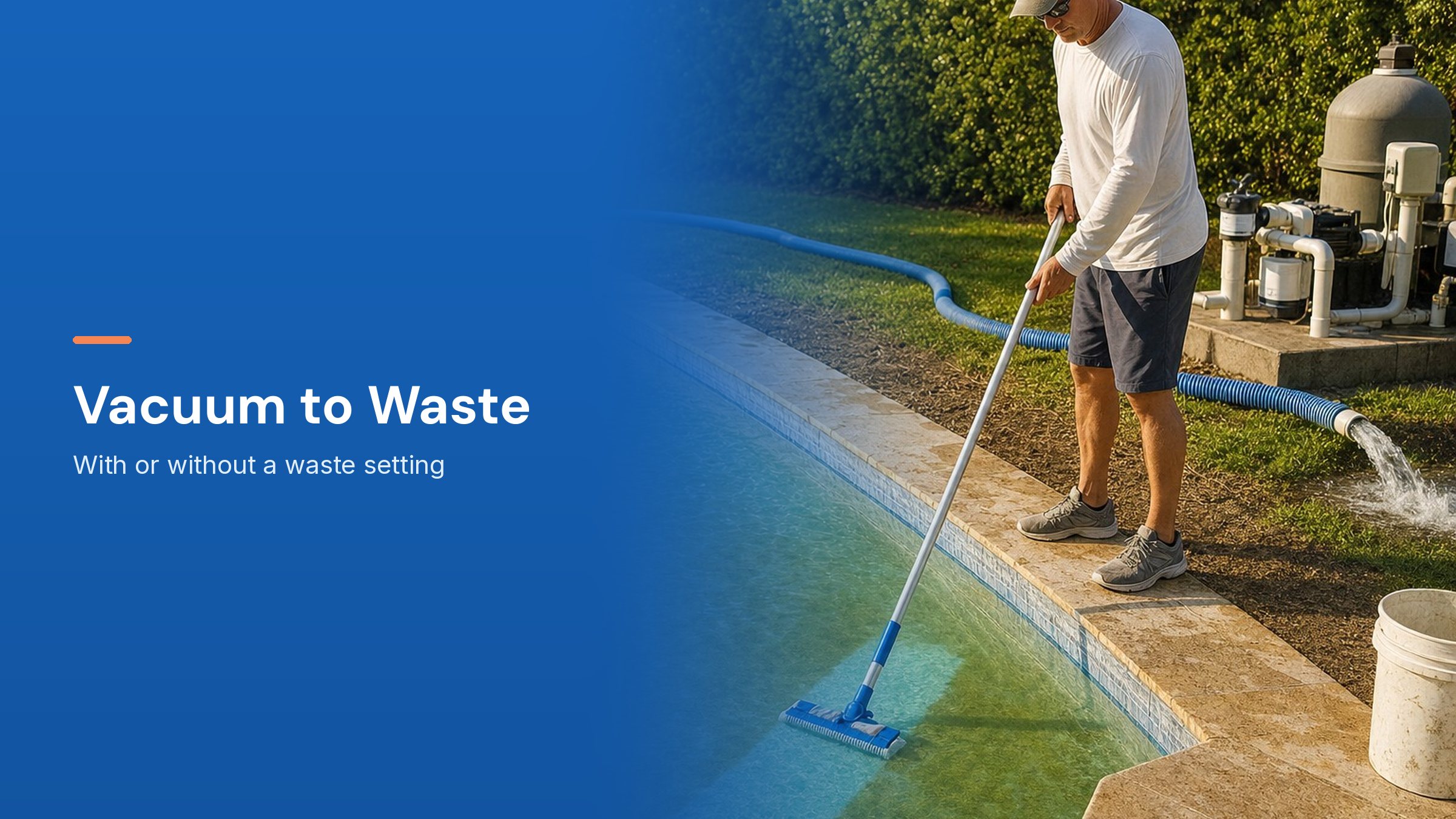
To vacuum to waste, you send the water from the vacuum straight out of the pool. It skips the filter. With a sand or DE filter, you do that by turning the multiport valve to Waste. With a cartridge filter there is no Waste setting, so you need a waste line, a separate pump, or a slow siphon.
You need this for dirt that is too fine or too heavy for the filter, such as dead algae, floc, storm mud and deep silt. If you vacuum that on Filter, a lot of it shoots right out of the return jets and you are back where you started.
This guide covers the multiport steps first, and then what to do when your filter has no waste port. To write it, we read the filter and valve manuals from Hayward, Pentair and Jandy, the pool operator handbook, and how working pros handle these cleanups.
Key Takeaways
- Waste skips the filter. The dirt and the water both leave the pool. Hayward lists Waste for "vacuuming heavy debris directly to waste."[1]HaywardProSeries High Rate Sand Filters Owner's Manual (IS210TS Rev A): filter control valve functions, vacuuming, safety warnings and troubleshooting list.hayward-pool-assets.com
- Pump off before you touch the valve. Every manual we read says so. Moving the handle with the pump on can damage the valve.[2]PentairSand Dollar and Cristal-Flo II Top Mount Sand Filter Installation and User's Guide (P/N 152006): filter and control valve functions, operation warnings and troubleshooting.pentair.com[3]JandyJS Sidemount Composite Sand Filters Installation and Operation Manual (H0282300 Rev K): filter cleaning steps, slide valve and multiport valve, troubleshooting table.fluidrausa.com
- Fill the pool first. The level drops fast. Stop before the water gets below the skimmer mouth, or the pump will pull air.[9]PentairWhisperFlo High Performance Pump Installation and User's Guide: priming the pump and the caution on running the pump dry.pentair.com
- Go slow. Fast strokes kick the dust into a cloud, and the dust needs hours to sink again.
- Cartridge filters have no Waste setting. Use a plumbed waste line, a portable pump, or a siphon. Adding a waste line is a job for a pool pro.
- Dirt blowing back on Filter is a clue. The dust may be too fine, or the sand or the valve may have a problem.[3]JandyJS Sidemount Composite Sand Filters Installation and Operation Manual (H0282300 Rev K): filter cleaning steps, slide valve and multiport valve, troubleshooting table.fluidrausa.com
What vacuuming to waste means
In normal vacuuming, the pump pulls water through the hose, pushes it through the filter, and sends it back to the pool. The filter keeps the dirt. In a vacuum to waste, the water never reaches the filter. It goes from the pump out the waste pipe or backwash hose, and the dirt goes with it.
A multiport valve makes this easy. Pentair says the Waste setting sends water from the pump, through the valve, past the filter and out the waste port. It lists three uses, which are vacuuming to waste, lowering the pool level and draining the pool.[2]PentairSand Dollar and Cristal-Flo II Top Mount Sand Filter Installation and User's Guide (P/N 152006): filter and control valve functions, operation warnings and troubleshooting.pentair.com
“And in the waste setting, you can vacuum all the algae and everything that you're getting. It doesn't go stay in the pool or blow back through the filter. Everything goes out the waste line, right?”
The trade-off is water, since every gallon you vacuum out has to be put back.
When you need it
Most weeks you should vacuum on Filter. Hayward's sand filter manual says regular vacuuming goes through the filter, and heavy debris loads go to waste.[1]HaywardProSeries High Rate Sand Filters Owner's Manual (IS210TS Rev A): filter control valve functions, vacuuming, safety warnings and troubleshooting list.hayward-pool-assets.com Use waste for these jobs:
- Dead algae. After a green pool is shocked, the dead algae sinks as a fine gray or white dust. It is too fine for most filters to hold on the first pass.
- Floc. The operator handbook says floc clumps settle on the floor and are then vacuumed to waste.[8]Pool & Hot Tub AllianceCertified Pool/Spa Operator Handbook, 2024 edition: flocculants (page 82), the filtration chapter on particle sizes and filter rates, vacuuming through the skimmer, and the glossary entry for channeling.phta.org Our floc and clarifier guide covers the dose and the wait.
- Storm mud, ash and silt. A thick layer will plug a filter in minutes.
- A pool that is too full. After heavy rain you have to drop the level anyway, so you might as well take the dirt out with it.
Do not use waste for big leaves and sticks, which clog the hose and the pump basket. Scoop those out with a leaf rake first. If the pool is still green, kill the algae before you vacuum. Our green to clean guide covers that part.
What each valve setting does
A six-way valve has six settings, and it helps to know where each one sends the water. This table follows the Hayward and Pentair sand filter manuals.[1]HaywardProSeries High Rate Sand Filters Owner's Manual (IS210TS Rev A): filter control valve functions, vacuuming, safety warnings and troubleshooting list.hayward-pool-assets.com[2]PentairSand Dollar and Cristal-Flo II Top Mount Sand Filter Installation and User's Guide (P/N 152006): filter and control valve functions, operation warnings and troubleshooting.pentair.com
| Setting | Where the water goes | Use it for |
|---|---|---|
| Filter | Through the filter, back to the pool | Normal running and weekly vacuuming |
| Waste | Past the filter, out the waste line | Vacuuming heavy or fine dirt, lowering the level |
| Backwash | Backward through the filter, out the waste line | Cleaning the filter |
| Rinse | Forward through the filter, out the waste line | Settling the sand after a backwash |
| Recirculate | Past the filter, back to the pool | Mixing chemicals or floc with no filtering |
| Closed | Nowhere | Service only. Never run the pump on Closed. |
One common mix-up is vacuuming on Backwash, which pushes the water backward through the filter before it leaves. The manuals list it for cleaning the filter, not for vacuuming.[1]HaywardProSeries High Rate Sand Filters Owner's Manual (IS210TS Rev A): filter control valve functions, vacuuming, safety warnings and troubleshooting list.hayward-pool-assets.com Our glossary has more on backwash and recirculate.
How to vacuum to waste with a multiport valve
These steps fit any sand filter, and any DE filter that has a multiport valve, though your own manual wins if it says something else.
- Let the dirt settle. Turn the pump off for several hours, or overnight. You want the dust lying on the floor and the water still.
- Fill the pool high. Bring the water up near the top of the skimmer mouth. Many pros leave a garden hose running in the pool the whole time. Lay it on a step so it does not stir the floor.
- Check where the water will go. Roll out the backwash hose and look at where it ends. More on that below.
- Turn the pump off. Do this before you touch the valve, every time.
- Set the valve to Waste. Push the handle down, then turn it. Hayward says to always press the handle down before turning, to protect the seal inside the valve.[1]HaywardProSeries High Rate Sand Filters Owner's Manual (IS210TS Rev A): filter control valve functions, vacuuming, safety warnings and troubleshooting list.hayward-pool-assets.com
- Hook up the vacuum and fill the hose. Put the head and pole in the water. Sink the hose a little at a time, or hold the free end over a return jet, until no more bubbles come out of the head. Then connect it to the skimmer.
- Turn the pump on. Water should start running out of the waste line right away.
- Vacuum slowly. Start in the shallow end. Use long, slow, even strokes that overlap a little. Keep the head on the floor.
- Watch the water level. When it nears the lower edge of the skimmer mouth, turn the pump off, let the pool refill, and go again.
- Finish up. Turn the pump off. Set the valve back to Filter. Empty the skimmer and pump baskets. Turn the pump on and let the air out of the filter.
If a cloud lifts off the floor, stop and let it settle for a few hours, because pushing on through a cloud just spreads the dust around the pool.
Do you need to backwash or rinse after?
Pros do not agree on this one. On Waste, the water never touched the sand, so there is nothing to rinse out of it. Rinse is the step after a backwash. Hayward says to rinse for half a minute to a minute so dirty backwash water does not return to the pool. Jandy says a one minute rinse helps settle the sand bed.[1]HaywardProSeries High Rate Sand Filters Owner's Manual (IS210TS Rev A): filter control valve functions, vacuuming, safety warnings and troubleshooting list.hayward-pool-assets.com[3]JandyJS Sidemount Composite Sand Filters Installation and Operation Manual (H0282300 Rev K): filter cleaning steps, slide valve and multiport valve, troubleshooting table.fluidrausa.com
After a green pool, though, the filter is often loaded from the days before, so a backwash and rinse at the end is a good habit.
Why dirt blows back into the pool on Filter
You vacuum the floor, and a gray cloud pours out of the return jets. Owners complain about this all the time, and it has three usual causes.
The dust is too fine. Every filter has a limit. The operator handbook's chart puts a high-rate sand filter at about 25 microns, a cartridge at 15 and a DE filter at 4. The eye cannot see anything smaller than about 40 microns.[8]Pool & Hot Tub AllianceCertified Pool/Spa Operator Handbook, 2024 edition: flocculants (page 82), the filtration chapter on particle sizes and filter rates, vacuuming through the skimmer, and the glossary entry for channeling.phta.org Dead algae dust can be finer than what a sand filter holds, so some of it sails through.
The water is moving too fast. The handbook warns that too much flow drives dirt deeper into a sand bed and can cause channeling, where water finds a path around the sand. In a cartridge, high flow can push dirt into and through the fabric and back to the pool.[8]Pool & Hot Tub AllianceCertified Pool/Spa Operator Handbook, 2024 edition: flocculants (page 82), the filtration chapter on particle sizes and filter rates, vacuuming through the skimmer, and the glossary entry for channeling.phta.org
Something in the filter is worn or broken. Jandy's manual lists "dirt returns to pool" as a sign of channels or tunnels in the sand bed.[3]JandyJS Sidemount Composite Sand Filters Installation and Operation Manual (H0282300 Rev K): filter cleaning steps, slide valve and multiport valve, troubleshooting table.fluidrausa.com Hayward says to check the top of the sand for crusting or caking when the water will not clear.[1]HaywardProSeries High Rate Sand Filters Owner's Manual (IS210TS Rev A): filter control valve functions, vacuuming, safety warnings and troubleshooting list.hayward-pool-assets.com Pentair ties sand in the pool to a broken lateral, which is one of the slotted pipes at the bottom of the tank.[2]PentairSand Dollar and Cristal-Flo II Top Mount Sand Filter Installation and User's Guide (P/N 152006): filter and control valve functions, operation warnings and troubleshooting.pentair.com
So use the blow-back as a test. If only fine algae dust comes back, and the water clears in a day or two of filtering, the filter is likely fine. If dirt comes back every time you vacuum, look at the sand. Our guide on when to change pool filter sand covers the signs. Pros also check the gasket inside the multiport valve, since a worn one can let water slip past the filter. On a DE filter they look for a torn grid, and on a cartridge filter they look for a torn or poorly seated cartridge.
“This debris you are showing is too fine for even ultrafine bags and can only be caught in some sort of filtration media with a micron rating of <50 micron.”
That pro was talking about a robot cleaner, but the point holds for any bag or basket.
Cartridge filters: getting to waste with no Waste setting
A cartridge filter has no multiport valve, so it has no Waste and no Recirculate. Hayward's cartridge manual simply says to vacuum into the filter and clean the cartridges after.[6]HaywardSwimClear cartridge filter Owner's Manual (ISC2030 Rev C): vacuuming the pool and safety warnings.hayward.com That is fine for normal dirt, but a floor covered in dead algae means pulling and hosing the cartridges again and again. Here are the ways around it.
| Option | How it works | Best for |
|---|---|---|
| Plumbed waste line | A valve after the pump sends water out a pipe or hose and not into the filter | Any cartridge pool. A pro has to add it if it is not there. |
| Portable pump or vacuum cart | A separate pump pulls from the vacuum hose and sends the water out a long hose | Pros, and heavy cleanups |
| Siphon | A water-filled vacuum hose drains downhill with no pump | Above ground pools and small jobs |
| Vacuum into the filter | Normal vacuuming, then clean the cartridges, and repeat | Light dust, when you cannot lose water |
| Battery vacuum with a fine bag | The dirt stays in a bag on the vacuum | Leaves, sand and grit. Not fine algae dust. |
A plumbed waste line
Many pros say every cartridge system should have one. It is a valve, often a three-way valve, set between the pump and the filter. Turn it one way and the water goes to the filter. Turn it the other way and the water goes out a waste pipe.
If your pad has one, the steps are the same as above: pump off, valve to waste, vacuum, then turn it back. If your pad does not have one, do not cut into the plumbing yourself. Ask a pool pro to add it, which also gives you an easy way to lower the pool after heavy rain.
Taking the cartridge out
Owners often ask if they can just pull the cartridge and vacuum. That does not send anything to waste, because the pump just sends the dirty water right back to the pool. It only helps when you want to mix in floc without clogging the cartridge.
Some people go one step further and open the drain plug low on the filter tank, so part of the water runs out there. Treat that as a last resort, for three reasons. Only part of the flow leaves, so a lot of dust still returns to the pool. The water dumps out at the equipment pad, and Pentair says a filter should drain away from electrical equipment.[7]PentairClean and Clear Plus Cartridge Filter Installation and User's Guide: safety warnings and installation notes on filter drainage.pentair.com And a filter tank is under pressure when the pump runs. Never run the pump with the lid or clamp loose or off.[7]PentairClean and Clear Plus Cartridge Filter Installation and User's Guide: safety warnings and installation notes on filter drainage.pentair.com
Portable pumps and vacuum carts
Most pros handle cartridge pools by bringing their own pump. The vacuum hose connects to the suction side of the pump. A long discharge hose runs from the pump out to the yard or a drain. The dirt never touches the customer's filter.
A common setup is a used pool pump bolted to a hand truck or a pressure washer cart, with hose fittings on both ends. Some pros use a gas trash pump for the worst jobs, since it can pass small debris. Others buy a ready made vacuum cart, and some carts add a filter so the pro can pick waste or filter. Our portable pool vacuum comparison covers the battery units and carts pros carry.
“Whenever we do a vac to waste, we use our own pumps. I know some people use the customer pumps for vac to waste jobs. I really don't like that because if it damages their pump, we're going to have to fix it.”
Two tips come up again and again from pros who run these pumps:
- Prime the pump with a bucket of water before you start, and keep the suction hose full.
- Scoop leaves first. A pump basket full of leaves every few feet turns a one hour job into three.
Battery vacuums are great for leaves and grit, and a fine bag helps with sand and dirt. Most pros agree they are the wrong tool for dead algae or floc, because that dust passes through the bag and back into the water.
Slide valves and push-pull valves
Some sand and DE filters have a slide valve, which is also called a push-pull valve. It has a T-handle that moves up and down. Pentair's training manual says this valve has only two directions, Filter and Backwash.[4]PentairSta-Rite Industries Basic Training Manual, third edition: filtration section, types of backwash valves.pentair.com Hayward's DE filter manual shows the same thing. Its six-way and four-way valves have a Waste setting, and its slide valve does not.[5]HaywardPro-Grid Vertical DE Filter Series owner's manual (ISDE2423): filter control valve functions for the six-position valve, four-position valve and two-position slide valve. Copy hosted by a pool retailer.propools.com
So a filter with a slide valve is in the same spot as a cartridge filter. Use a portable pump or a siphon, or ask a pro about adding a waste valve ahead of the filter, and do not vacuum on Backwash to get around it. As with any valve, turn the pump off before you move the handle.[3]JandyJS Sidemount Composite Sand Filters Installation and Operation Manual (H0282300 Rev K): filter cleaning steps, slide valve and multiport valve, troubleshooting table.fluidrausa.com
Above ground pools
Above ground pools come with two kinds of filters. If yours has a sand filter, look at the valve on top. Many have a Waste or Drain setting, and the steps above work the same way. You just need a hose on the waste port.
If yours has a small cartridge pump, you have no waste setting, and the pump is often too weak to vacuum well in any case. The low cost fix is a siphon:
- Sink the vacuum head and the whole hose until the hose is full of water and the bubbles stop.
- Cover the free end with your hand and pull it over the wall.
- Lay that end on the ground, lower than the water in the pool, and let go.
- Water will run on its own. Move the head slowly across the floor.
A siphon is slow, which helps here, because it stirs up less dust and wastes less water than a pump. Do not take a vinyl pool down far, though, since a liner can shift or shrink when the water gets low. Our guide to draining a pool safely explains the risk.
Suction side tips
Vacuum plate or straight to the pump. A vacuum plate sits on top of the skimmer basket, so the basket catches leaves and grit. Without a plate, the hose plugs into the suction hole under the basket, and the debris rides to the pump basket. Either way works for fine dust.
Send the suction where you need it. The operator handbook notes you may need to close off other skimmers or change the valves to get enough pull at the vacuum. It also says to mark the normal valve settings so they go back the same way.[8]Pool & Hot Tub AllianceCertified Pool/Spa Operator Handbook, 2024 edition: flocculants (page 82), the filtration chapter on particle sizes and filter rates, vacuuming through the skimmer, and the glossary entry for channeling.phta.org
Do not starve the pump. A clogged hose or a full basket chokes off the water. Pentair warns not to run a pump dry, because it damages the seal and the pump starts to leak.[9]PentairWhisperFlo High Performance Pump Installation and User's Guide: priming the pump and the caution on running the pump dry.pentair.com If the pump basket looks half empty or the pump gets loud, shut it off and find the clog.
Keep air out. Fill the hose all the way before you connect it. Keep the vacuum head under water. Check the hose for cracks and a loose cuff. Hayward says bubbles coming out of the returns point to an air leak on the suction side.[1]HaywardProSeries High Rate Sand Filters Owner's Manual (IS210TS Rev A): filter control valve functions, vacuuming, safety warnings and troubleshooting list.hayward-pool-assets.com If the pump loses its prime, Pentair's steps are to shut it off, fill the pump basket with water, put the lid back on and start again.[9]PentairWhisperFlo High Performance Pump Installation and User's Guide: priming the pump and the caution on running the pump dry.pentair.com
Where the waste water can go
Waste water is dirty pool water, and after a green pool cleanup it is often high in chlorine too. Where you can send it depends on your city.
Mesa, Arizona tells owners to drain pool and backwash water onto their own yard or into the home's sewer cleanout, and not into streets or gutters.[10]City of Mesa, Arizona"Drain or Backwash Your Pool" page, read November 24, 2026.mesaaz.gov Portland, Oregon bans filter backwash water and salt pool water from its storm drains, and says never to let pool water run onto the street or a neighbor's lot.[11]City of Portland, Oregon, Environmental Services"Drain Pools and Hot Tubs" page, read November 24, 2026.portland.gov
So check your city or sewer utility's site before you roll out the hose. Our draining guide compares the rules in five places, and California has its own page on pool water discharge rules. Then spread the water over a wide area on your own lot, and keep salty or high chlorine water off plants you care about.
“Another guy vacuumed it to waste in a dumb spot and essentially salted the earth ruining the lawn for 5 years after.”
How much water you will lose
Plan on a few inches. Careful pros often report losing one to three inches on a floc job, and much more on a pool with deep sludge.
“Yeah, you're going to end up having to replace some water. What we're looking at is probably a couple of three inches in a slow vac to waste in a pool, depending on how well you slow vac to waste.”
One inch of water over one square foot is about 0.62 gallons. A 16 by 32 foot pool has 512 square feet of surface, so each inch is about 320 gallons. Three inches is close to 1,000 gallons. A pool pump can move that much in well under an hour.
To cut the loss, let everything settle before you start, vacuum only the dirty parts of the floor, and turn the pump off any time you stop. Stay with the pool the whole time the valve is on Waste.
Refilling and rebalancing after
Once the floor is clean, set the valve back to Filter and top the pool off to the middle of the skimmer mouth. Then test the water. You swapped out a good share of it, so the numbers have moved.
- Chlorine and pH. Test both and adjust. The chemical dosage calculator does the math.
- Stabilizer and salt. Both drop when you replace water. Lose a tenth of the water and you lose about a tenth of each.
- Calcium and alkalinity. These shift toward what your fill water has. The LSI calculator shows if the water is in balance.
- The filter. Backwash it or clean the cartridges, so it starts fresh on what is left in the water.
Know your fill water too. If it has iron or a lot of phosphate, every refill adds more.
“My biggest battle has been that every backwash and vacuum to waste removes water, and every refill adds more iron rich well water back into the system.”
Expect a second pass, because some dust always lifts and settles again. That light vacuum a day or two later can often go through the filter.
Common mistakes
- Turning the valve with the pump on. Pentair says this can damage the valve and may cause injury.[2]PentairSand Dollar and Cristal-Flo II Top Mount Sand Filter Installation and User's Guide (P/N 152006): filter and control valve functions, operation warnings and troubleshooting.pentair.com Pros have blown pump lids and fittings this way.
- Starting with a low pool. The water drops below the skimmer in minutes, and the pump pulls air and loses prime.[9]PentairWhisperFlo High Performance Pump Installation and User's Guide: priming the pump and the caution on running the pump dry.pentair.com
- Going too fast. You make a cloud and lose hours while it sinks.
- Vacuuming floc through the filter. It can clog the filter or blow back into the pool. See our floc guide for what to do if floc gets into the filter.
- Walking away with the valve on Waste. The pool keeps draining until someone notices.
What pros charge for heavy cleanups
A vacuum to waste is usually one part of a bigger cleanup, so pros price the whole job. On poolrates.fyi, pool pros shared 83 prices for a green to clean with no drain. The average was about $1,360. The lowest was $300 and the highest was $3,500.[12]poolrates.fyiRepair and one-time job prices shared by pool pros, January to October 2026, read November 24, 2026.poolrates.fyi Most of those prices were quotes on a few very bad pools, so a lightly green pool should cost less.
The price climbs with the time on site, and many pros bill the worst pools by the hour plus chemicals, because nobody can see what is on the floor until the water clears. If you are pricing storm jobs, see our guide to pricing storm debris cleanup.
The bottom line
Vacuuming to waste is simple once you know the order: let the dirt settle, fill the pool, turn the pump off, set the valve to Waste, and move slowly while you watch the water level. If your filter has no Waste setting, a waste valve, a portable pump or a siphon will still get fine dust out of the pool. And if dirt keeps coming back through the returns on normal days, the filter is telling you it needs a look.
Sources
- [1]Hayward, ProSeries High Rate Sand Filters Owner's Manual (IS210TS Rev A): filter control valve functions, vacuuming, safety warnings and troubleshooting list. hayward-pool-assets.com (PDF)
- [2]Pentair, Sand Dollar and Cristal-Flo II Top Mount Sand Filter Installation and User's Guide (P/N 152006): filter and control valve functions, operation warnings and troubleshooting. pentair.com (PDF)
- [3]Jandy, JS Sidemount Composite Sand Filters Installation and Operation Manual (H0282300 Rev K): filter cleaning steps, slide valve and multiport valve, troubleshooting table. fluidrausa.com (PDF)
- [4]Pentair, Sta-Rite Industries Basic Training Manual, third edition: filtration section, types of backwash valves. pentair.com (PDF)
- [5]Hayward, Pro-Grid Vertical DE Filter Series owner's manual (ISDE2423): filter control valve functions for the six-position valve, four-position valve and two-position slide valve. Copy hosted by a pool retailer. propools.com (PDF)
- [6]Hayward, SwimClear cartridge filter Owner's Manual (ISC2030 Rev C): vacuuming the pool and safety warnings. hayward.com (PDF)
- [7]Pentair, Clean and Clear Plus Cartridge Filter Installation and User's Guide: safety warnings and installation notes on filter drainage. pentair.com (PDF)
- [8]Pool & Hot Tub Alliance, Certified Pool/Spa Operator Handbook, 2024 edition: flocculants (page 82), the filtration chapter on particle sizes and filter rates, vacuuming through the skimmer, and the glossary entry for channeling. phta.org
- [9]Pentair, WhisperFlo High Performance Pump Installation and User's Guide: priming the pump and the caution on running the pump dry. pentair.com (PDF)
- [10]City of Mesa, Arizona, "Drain or Backwash Your Pool" page, read November 24, 2026. mesaaz.gov
- [11]City of Portland, Oregon, Environmental Services, "Drain Pools and Hot Tubs" page, read November 24, 2026. portland.gov
- [12]poolrates.fyi, Repair and one-time job prices shared by pool pros, January to October 2026, read November 24, 2026. poolrates.fyi