
California Pool Water Discharge: Environmental Regulations


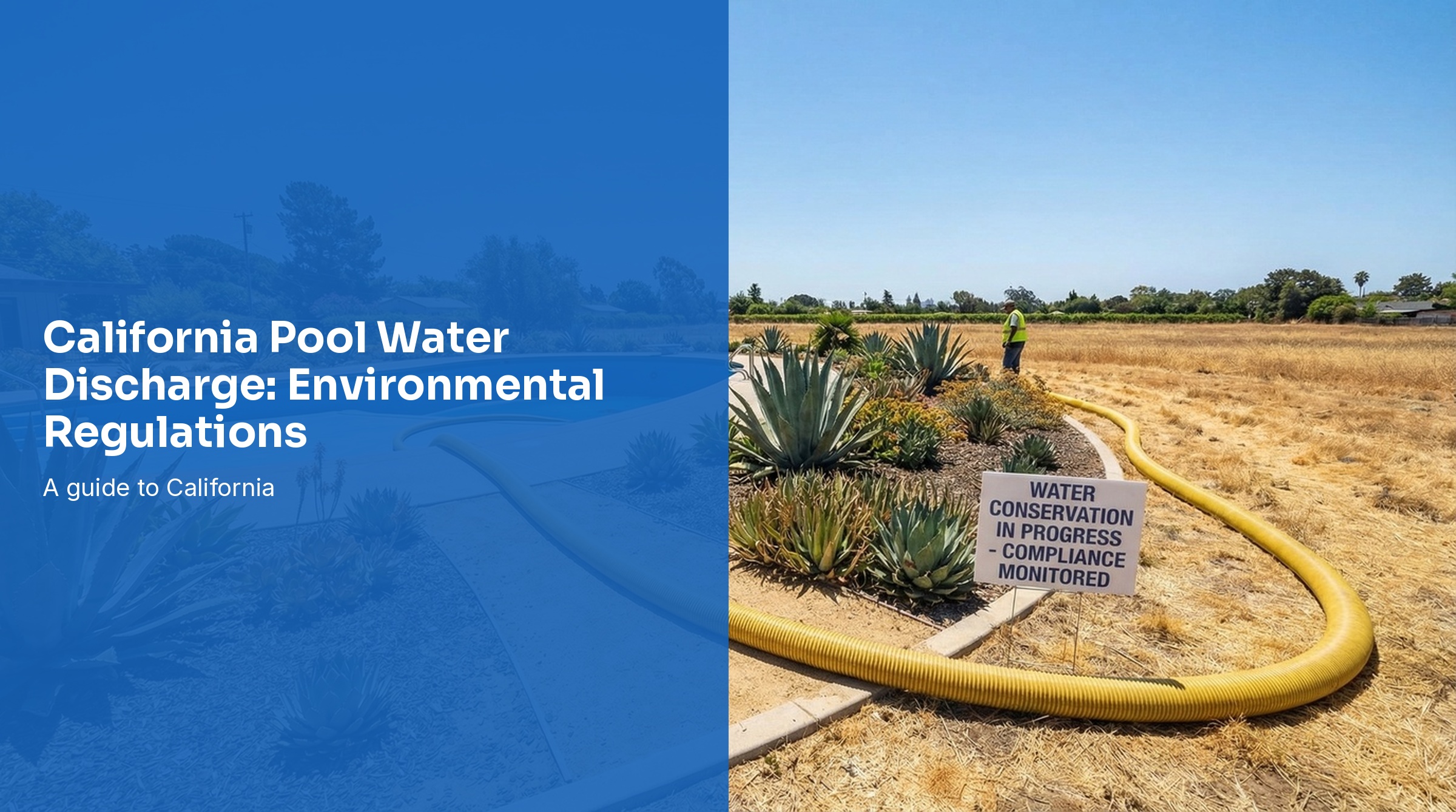
Discharging pool and spa water in California is strictly regulated to prevent environmental contamination and protect public infrastructure. Because pool water often contains high levels of chemicals like chlorine and salt, as well as debris and pathogens, it cannot be simply drained into any landscape or storm drain. Professionals must adhere to the California Building Code and local wastewater agency rules to ensure legal and safe disposal.[1]CBC Chapter 31B Public PoolsPool Water Discharge Standardsup.codes
Key Takeaways
- Indirect Waste Mandate — California Building Code requires pool drainage to be installed as an "indirect waste" with no direct physical connection to the sewer[1]CBC Chapter 31B Public PoolsPool Water Discharge Standardsup.codes
- Prohibited Storm Drain Connections — Pool water cannot be discharged directly into storm drains or waterways to protect local ecosystems[2]CDPH Recreational HealthPool Sanitation Requirementscdph.ca.gov
- Local Agency Authority — Each wastewater agency may impose additional requirements beyond state minimums for discharge permits[1]CBC Chapter 31B Public PoolsPool Water Discharge Standardsup.codes
- Filter Backwash Rules — Backwash water must be disposed in a manner acceptable to the local wastewater agency without creating a nuisance[1]CBC Chapter 31B Public PoolsSection 3141B.1 Filter Backwashup.codes
- DE Filter Separation Tank Required — Diatomaceous earth filters require separation tanks to capture DE media before wastewater enters the sewer system[1]CBC Chapter 31B Public PoolsDE Filter Requirementsup.codes
Discharge Standards and Procedures
The California Building Code requires that pool wastewater be installed as an "indirect waste," meaning there is no direct physical connection to the sewer. This typically means discharging to an area drain or other approved receptor that flows to the sanitary sewer system. The indirect waste requirement provides an air gap that prevents contaminated sewer gases and backflow from entering the pool system.[1]CBC Chapter 31B Public PoolsPool Water Discharge Standardsup.codes
Before discharging pool water, operators and service professionals must contact the local wastewater agency for specific requirements. Most jurisdictions require dechlorination of the water to approved levels, typically reducing free chlorine to 0.1 ppm or less. The pH should also be neutralized to an acceptable range between 6.5 and 8.5. Flow rates must be controlled to avoid overwhelming the municipal sewer system during high-volume draining operations.[2]CDPH Recreational HealthPool Sanitation Requirementscdph.ca.gov
Diatomaceous Earth (DE) Specifics
Diatomaceous earth filters require special consideration under California regulations. When DE filters are backwashed, the wastewater contains fine diatomaceous earth particles that can clog sewer lines and cause environmental damage if discharged improperly. California Building Code Section 3141B.1 addresses this by requiring separation tanks or approved filtration systems to capture DE media before the water enters the sewer system.[1]CBC Chapter 31B Public PoolsDE Filter Requirementsup.codes
The separation tank must be properly sized to handle the volume of backwash water generated during normal filter maintenance cycles. Pool service professionals should verify that existing DE filtration systems have appropriate separation equipment installed, and new installations must include this equipment as part of the permitting process.
"Material cleaned from filters and backwash water... shall be disposed in a manner that is acceptable to the local wastewater agency and will not create a nuisance." — Cal. Building Code Section 3141B.1
Visual Monitoring and Capacity
The California Building Code establishes requirements for monitoring discharge operations to ensure compliance. Operators must be able to visually verify that discharge water is reaching its intended destination without creating runoff to storm drains or adjacent properties. For public and commercial pools, documentation of discharge events may be required by local health departments.[2]CDPH Recreational HealthPool Sanitation Requirementscdph.ca.gov
Discharge capacity planning is essential for large pools and commercial facilities. The local wastewater agency may limit the rate at which pool water can be drained based on sewer system capacity in the area. Pool professionals should coordinate with the agency well in advance of any major draining operations, particularly for initial fills, complete drains, or acid washes that involve large water volumes.
Interaction with Environmental Health
California's framework for pool water discharge involves coordination between multiple agencies. The California Department of Public Health establishes baseline sanitation standards through its Recreational Health Branch, while local county health departments and wastewater agencies enforce specific discharge requirements. This multi-layered approach ensures that both public health and environmental protection goals are met.[2]CDPH Recreational HealthPool Sanitation Requirementscdph.ca.gov
During drought conditions, California may impose additional restrictions on pool draining. Some agencies offer permits for discharge to landscaping if water quality meets specific standards and the discharge will not contaminate groundwater. Pool professionals should stay informed about current drought restrictions and water conservation requirements in their service area, as these regulations can change rapidly based on regional water conditions.
Summary Table
| Requirement | Standard | Citation |
|---|---|---|
| Discharge Connection | Indirect waste (no direct sewer connection) | CBC Chapter 31B |
| Chlorine Level | Below 0.1 ppm before discharge | Local Agency |
| pH Range | 6.5 to 8.5 | Local Agency |
| Storm Drain Discharge | Prohibited | CBC / SWRCB |
| DE Filter Backwash | Separation tank required | CBC Section 3141B.1 |
| Permits | Required by most local agencies | Local Wastewater Agency |
Sources
- [1] California Building Code Chapter 31B, Public Pools. up.codes
- [2] California Department of Public Health, Recreational Health Branch. cdph.ca.gov