


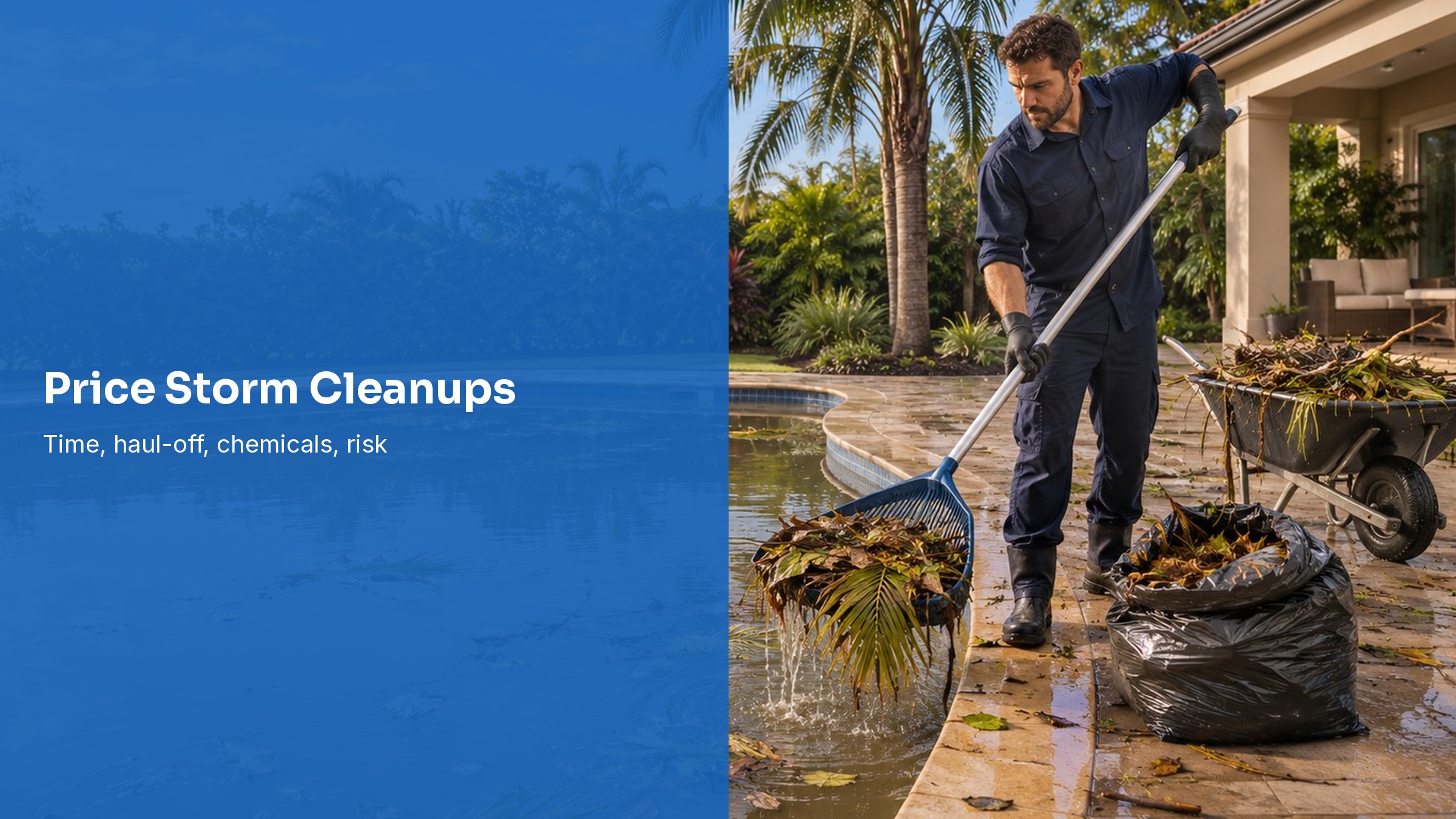
After a hurricane or a big storm, your phone fills up with calls. Pools are full of branches, leaves, roofing and even pieces of screen enclosure. Every owner wants to know one thing first: how much will it cost?
One pool company owner asked other pros that question after a hurricane. They expected about 20,000 gallons per pool, diving to pull out metal, and about three big garbage cans of debris per pool. Their plan was simple:
“We're estimating about 3 hours for 2 people working together.”
Most of the pros who answered thought that was too short. This guide walks through what they said and gives you a simple way to price these jobs so you do not lose money on them.
Key Takeaways
- Storm cleanups are not normal service. Price them as one-time jobs, not as extra weekly stops.
- Pros in one thread suggested two ways to charge: a per pool price with a set amount of debris included, or hourly with a minimum.
- Build your price from four parts: labor time, haul-off, chemicals and equipment risk.
- Send a written quote and get a yes before you start.
- Take before and after photos. Put each kind of work on its own line of the invoice.
- Do not turn on the pump until you have checked the equipment pad.
Why storm pools always run long
A storm pool hides most of the work. You can see the branches on top. You cannot see what is under a foot of leaves until you start pulling them out. There may be metal, glass, roof tiles or patio furniture down there.
One pro in the thread put it this way:
“Storm pools always run long once you see what's under the leaves.”
The debris is only part of it. Once the pool is clear, the water still needs work. Leaves and dirt eat chlorine fast. If you use a flocculant, you have to wait for it to settle and come back to vacuum. One commenter said the chemical side alone will take more than one visit.
Storms near the coast can be worse. One Florida pro posted about three pools hit by a king tide in a single day. On one elevated infinity pool, seaweed filled the trough, and the pump kept running:
“pump was running basically pumping ocean water, bacteria and seaweed into pool.”
Another comment in that thread said it happens in some places there once or twice a year with high winds, and that it is “not cheap” to clean up. When salt water, sand and seaweed get into the pool, plan for more time and more chemicals than a leaf-only job.
What pros said they would charge
The answers in the hurricane thread were all over the place. Treat these as single opinions from a few pros, not as market rates. Your area, crew and disposal costs will be different.
- Flat per pool. One pro said $2,500 per pool. They also said the job would not get done in 3 hours with 2 people.
- Hourly for a crew. Another suggested $150 an hour for two people for 8 hours, then a new look at the price once you see how much is in the pool. They called it “a one to two day job with two people.”
- Higher hourly. A third pro answered with just “$300/hr.”
The more useful part of the thread was how pros said to set up the price. Two models came up.
Model 1: Per pool with debris included
One pro said to set a base price per pool that already covers a normal amount of debris, then add a fixed charge for anything more:
“quote it per pool with your three cans baked into the base, then a set price for every extra can.”
This is easy for the customer to understand. They know the starting price, and they know what each extra can costs. It works best when most pools on your list look about the same.
Model 2: Time and materials with a minimum
Another pro liked hourly billing with a floor. They described a 4 hour minimum for a 2 person crew, hourly after that, plus a fee for each can or load you haul away. This protects you on the bad pools, where the first look did not show the real mess.
You can also mix them. Quote a per pool price for light jobs and use time and materials for pools with diving, metal or a flooded pad. Whichever you pick, it is still a one-time job. If you already have a rule for charging for extra service calls, a storm cleanup should sit well above your normal minimum.
A simple way to build the price
You do not need a perfect number. You need a price that covers your costs on a bad day. Build it from four parts.
- Labor time. Guess the hours for your crew, then add a cushion. Count driving, setup, diving, skimming, vacuuming and the return visits for chemicals. Multiply crew hours by your hourly rate. If you are not sure what your hourly rate should be, the one-time job calculator can help.
- Disposal and haul-off. Decide if you will haul the debris or leave it at the curb. One pro asked the owner that exact question. Hauling costs you truck space, time and maybe dump fees. Charge per can or per load so the price grows with the mess.
- Chemicals and water recovery. After the debris is out, the pool may be green or cloudy. Price this the way you would a green pool. The green-to-clean guide and the green pool recovery calculator cover that part.
- Equipment risk. Add a line for checking the pump, motor, filter and baskets before startup. If the pad flooded, list repairs as a separate quote after you inspect it. Do not hide repair work inside the cleanup price.
Add the four parts together. Then ask yourself: if this pool takes twice as long as I think, am I still OK? If not, raise the minimum or switch that pool to hourly.
Put the quote in writing first
After a storm, people are stressed and in a hurry. That is when a quick verbal number turns into a fight later. Send a short written quote before you start. It should say:
- What the base price includes, such as hours or number of cans.
- What costs extra, such as each extra can, each extra hour or diving.
- Whether you haul debris away or leave it at the curb.
- How many chemical visits are included.
- That equipment repairs are quoted separately.
Get a clear yes in writing before your crew gets in the water. If you also price one-time opening cleanings, you can use the same quote format for storm jobs.
Take photos and itemize the invoice
Take photos before you touch anything. Get the whole pool, the debris on the bottom, the deck and the equipment pad. Take the same shots when you finish. Photos show the customer what you did. They also protect you if someone says you broke something. See our guide to photo documentation for pool service for a simple routine.
Then split the invoice into clear lines. One pro gave a good reason:
“a lot of homeowners policies cover debris removal and the adjuster will want that breakdown.”
That pro suggested separate lines for debris removal, diving, haul-off and chemical recovery. Policies are different, so do not promise the customer that insurance will pay. Just give them a clean invoice and photos, and let them ask their insurance company.
Check the equipment pad before the pump runs
It is tempting to turn the pump on right away. Do not. A flooded motor, a cracked basket or a clogged line can turn your cleanup into a repair job. Look at the motor, the baskets and the pad first. If the pad was under water, check with the owner or an electrician before you power anything up. The same pro who talked about insurance gave this warning:
“If the equipment pad flooded you don't want to be the last guy who touched it.”
Write down what you found and add a photo. If something is broken, send a separate repair quote. That keeps the cleanup price clean and shows the customer the damage was there before you started.
Storm cleanups also pull you away from your weekly route. Tell your regular customers what to expect. Our rain and lightning policy guide covers how pros handle weather days on the route.