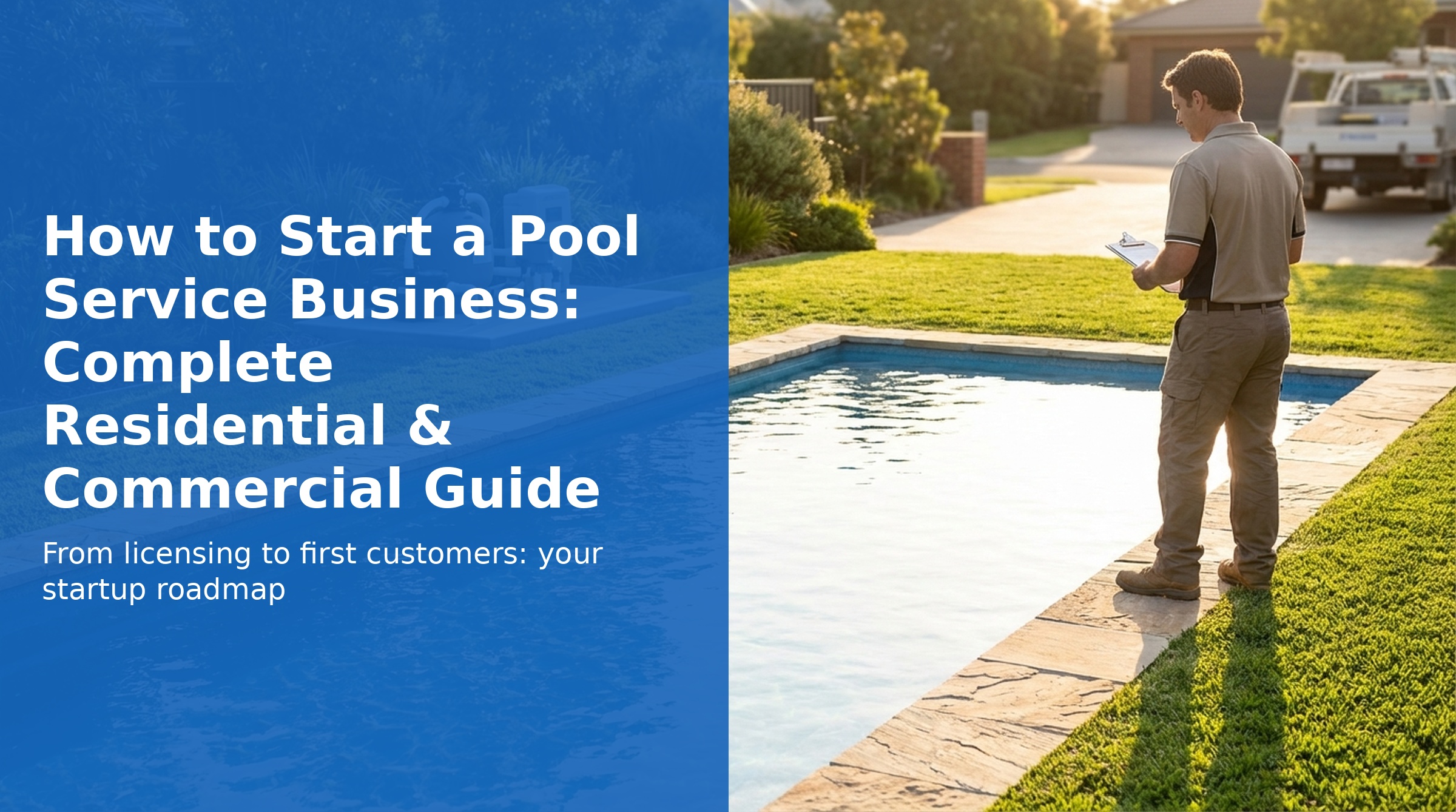
How to Start a Pool Service Business: The Complete Guide


Pool service is one of the best small businesses you can start. The startup costs are low. The revenue is recurring. And every pool in your area needs someone to take care of it every single week.
This guide walks you through everything — from getting your first customer to hiring your first employee. It's based on real advice from pool pros who've done it, not theory from people who haven't.
Key Takeaways
- Low startup costs — You can get started for $5,000–$15,000 in equipment and supplies
- Recurring revenue — Weekly service creates steady, predictable income
- $80K–$120K+ — Typical owner income once established with a full route
- 10.7 million — Residential pools in the U.S., and growing every year
- No degree needed — Learn the trade, get licensed, and start building your route
The Pool Service Industry at a Glance
There are over 10.7 million residential pools in the United States. Every one of them needs weekly cleaning and chemical balancing. Most pool owners don't want to do it themselves. That's where you come in.
The industry keeps growing. New pools get built every year. Older pools need more maintenance. And in states like Florida, Arizona, Texas, and California, pools run year-round. Even in seasonal states, you can stay busy with pool openings, closings, and equipment repairs in the off months.
You'll serve two main types of customers:
Residential Pools
- Weekly service ($100–$200/month)
- Personal relationships with homeowners
- Lower regulatory requirements
- Strong referral networks
- Most new businesses start here
Commercial Pools
- Larger contracts ($500–$2,000+/month)
- Strict health department rules
- CPO certification often required
- Hotels, apartments, HOAs, gyms
- More frequent visits (often 3–7x/week)
Most people start with residential pools. The barrier to entry is lower, and you can build a route one customer at a time. Once you're established, adding commercial accounts can boost your revenue. For a deeper look at the differences, see our residential vs. commercial comparison.
Is This Business Right for You?
Before you invest a dollar, let's be honest about what this job looks like day to day. You'll be outside in the heat. You'll carry heavy buckets of chemicals. You'll deal with green pools, broken equipment, and customers who call you on Sunday morning.
But for the right person, it's one of the best jobs in the world. You work outside. You're your own boss. And you can build real wealth with recurring revenue.
Here's what pool pros say about getting started:
"I went on my own when I was 18. I went on my own the day I graduated high school. So graduated, walked across the stage around 11 in the morning. Three o'clock, I had my first customer. Still have them to this day."
— Rich Gallo, Pure Swim (Los Angeles), on the Talking Pools Podcast
"I went to the store — I bought the stuff. I had my trunks on and I dove in and I cleaned that pool. I had no idea what I was doing... That first customer, man, that was everything."
— Edgar De Jesus, Pool Nation Podcast
You don't need a degree. You don't need years of experience. You need a willingness to learn, a reliable truck, and the discipline to show up every week no matter what.
That said, it's not get-rich-quick. Rich Gallo puts it bluntly:
"Everybody and everything you heard about business is like, hey, it's going to take three years before you make a profit. They all lied. It took nine."
— Rich Gallo, Talking Pools Podcast
Nine years is the extreme end. Most solo operators with a full route (80–100 pools) earn $80,000–$120,000 per year. But the first year is the hardest. You're building your route, learning the trade, and figuring out your numbers all at the same time.
Steps to Start Your Pool Service Business
1. Market Research and Business Plan
Start by learning your local market. How many pools are in your area? How many companies already service them? What do they charge? You can check how many pool service companies operate in the U.S. to understand the competitive landscape.
Use Google Maps satellite view to scout neighborhoods with pools. Drive through the areas you want to serve. Talk to pool supply stores — they see every pool pro in town and can tell you what the market looks like.
"I want you to find out like what does it entail to be a pool person where you are... Talk to the guys that come in. Those guys are worth just talking to them for 10 minutes is worth its weight in gold."
— Steve Sherwood, Talking Pools Podcast
Then write a business plan. It doesn't need to be 50 pages. A good one covers:
Services You'll Offer
Weekly cleaning, chemical balancing, filter cleans, equipment repair, green-to-cleans, pool openings and closings. Start with the basics and add services as you learn.
Target Area
Pick a tight geographic area. Route density matters — driving 30 minutes between pools kills your profit. Aim for neighborhoods where pools are close together.
Startup Budget
List every expense: equipment, chemicals, truck, insurance, licensing, software. Most people can start for $5,000–$15,000. Use our free business plan generator to get a head start.
Financial Projections
How many pools do you need to cover your bills? At $150/month per pool, 50 pools is $7,500/month gross. Use the cost-per-pool calculator to know your real margins.
Need help picking a name? Try the pool service business name generator. Want a logo? Use the free logo generator.
2. Choose Your Business Structure
Most pool service businesses start as an LLC. It protects your personal assets if something goes wrong, and it's simple to set up. A sole proprietorship is even easier, but offers less protection.
Read our full comparison: Sole Proprietor vs. LLC for Pool Service.
Here's what you'll need:
- Register your business name with your state
- Get an EIN (Employer Identification Number) from the IRS — it's free
- Open a separate business bank account
- Get a business credit card to track expenses
- Find an accountant who knows pool service — they'll save you more than they cost
3. Licensing and Insurance
Requirements vary by state. Some states require a contractor's license. Others just need a business license. A few require specific pool technician certifications.
Here are the licensing guides for the biggest pool markets:
- California — CSLB Contractor License
- Florida — Chapter 489 Contractor License
- Texas — Pool Contractor License
- Arizona — ROC License
If you plan to service commercial pools (hotels, apartments, HOAs), you'll likely need a CPO certification. Start studying early — free practice tests are available at CPO Study and PoolDial Training.
Insurance Checklist
- General liability insurance — Covers property damage and injuries. Non-negotiable. See our guide to pool service insurance
- Commercial auto insurance — Your personal policy won't cover business use of your vehicle
- Workers' compensation — Required once you hire employees (required in most states even for one employee)
- Inland marine insurance — Covers your tools and equipment in your truck
"Are you licensed? How many pools do you have? Are any of them commercial? And if they would say, yeah, I would tell them that, hey, you have to have your license. And basically what you're doing is illegal."
— Steve Sherwood, on unlicensed operators in California
Don't skip licensing and insurance. It's tempting when you're starting out and money is tight, but one accident without insurance can end your business before it starts.
4. Equipment and Vehicle
One of the best things about pool service is you don't need much to get started. Here's your essential equipment list:
- Telescopic pole (16–24 ft) with leaf net, wall brush, and vacuum head
- Water test kit — A good drop-based kit (Taylor K-2006 is the industry standard)
- Manual pool vacuum with hose
- Chemical supplies — Liquid chlorine, muriatic acid, sodium bicarbonate, CYA, cal hypo shock
- 5-gallon buckets for carrying chemicals
- Basic hand tools — Screwdrivers, pliers, wrenches, Teflon tape, O-rings
- Leaf rake (deep bag net) for heavy debris
- Pump basket and skimmer basket replacements
For your vehicle, a pickup truck or cargo van works best. See our best vehicles for pool service comparison and truck setup guide for how to organize everything. Use the truck breakeven calculator to figure out whether to buy new or used.
You can learn about chemical storage best practices to keep your truck safe and organized.
5. Price Your Services Right
This is where most new pool pros get it wrong. They look at what other companies charge and go a little lower to win customers. That's a trap.
"We go into business thinking Zach is charging $100. I'm going to charge $80 and I'm going to take over all the customers. And I'm going to tell you that does not work."
— Edgar De Jesus, Pool Nation Podcast
"The very first thing that you need to figure out is what it truly costs you to show up and clean a pool... if your cost per pool is $60, but you're charging 55, you're losing $5 per pool."
— Edgar De Jesus, Pool Nation Podcast
Before you set a single price, figure out your cost per pool. That includes fuel, chemicals, wear on your equipment, insurance, and your time. Our cost-per-pool calculator does this math for you.
Prices vary by region. A pool in Phoenix might go for $100/month. The same pool in Los Angeles might be $175. Check what pool pros charge in your area at poolrates.fyi.
For a deep dive on pricing strategy, read our complete pricing guide. Also consider whether to charge per stop or monthly, and how the 48/52 billing model works.
Don't Undercharge
Rudy Stankowitz, host of the Talking Pools Podcast, says it best: "If your customers have never complained about your prices, you're probably not charging enough." One Pool Nation guest, Zach Nicholas, went from a $150 minimum per stop all the way up to $275 — and barely lost any customers along the way.
Use the service price calculator to model different pricing scenarios. And when it's time for your first price increase, we have a price increase guide and calculator to help.
6. Get Your First Customers
This is the part that scares people most. But getting your first 10–20 customers is simpler than you think.
One pool pro on Reddit shared how he did it after working for other companies for 12 years:
"Been a pool boy for 12 years for companies, but not till 6 months ago did I become a business owner. It was scary as fuck but I'm so thankful I did. Making more money working less time, and I have more pride in the work I do since it's mine."
— Pool pro via Reddit
His approach: collect addresses with pools in his area, send flyers offering a free first month, deliver great work, and ask happy customers for referrals. Customers who referred a new account got a free month of service. He hit 50 accounts in six months.
Here's what works for getting those first customers:
- Tell everyone you know. Friends, family, neighbors, your church, your kids' school. Word of mouth is how most pool businesses start.
- Walk neighborhoods with pools. Knock on doors or leave door hangers. Focus on the neighborhoods you want to serve — route density matters from day one.
- Partner with pool builders and repair companies. They don't want to do weekly maintenance. You do. These referral relationships can fill a route fast.
- Set up Google Business Profile. It's free and it's how homeowners find local service companies.
- Post before-and-after photos on social media. Green-to-cleans are gold on Facebook and Instagram.
- Get on Nextdoor. Homeowners constantly ask for pool service recommendations there.
"I'm proud to say I've never spent that one dollar on any marketing for my business. Everything's just come through referrals and holding myself with integrity and building compassion for the people that I'm working for and building trust with people."
— James Broderick, JB's Pool Care (Pool Nation 30 Under 40 nominee)
Referrals are powerful. But the Skimmer State of Pool Service Report found that most pool companies don't spend anything on marketing — which means there's a huge opportunity if you do.
"So many folks in the industry are like, 'I don't need to pay for marketing because I get a lot of referrals.' And that's true — you can grow your business that way. But you can grow it so much more quickly if you are spending a little bit on marketing. And because most of the industry is still not doing it, there's a real chance to be the first mover."
— Jack Nelson, CEO of Skimmer, on the Talking Pools Podcast
For a full breakdown of every marketing channel, see our pool service marketing strategies guide.
Once you start getting customers, you'll need service agreements. Use our free service agreement generator to create professional contracts. And to send invoices, try the invoice generator. For onboarding new customers smoothly, see our customer onboarding process guide and our guide on how to collect payments from pool customers.
Look Professional From Day One
PoolDial gives you a professional website, invoicing, route management, and an AI receptionist that answers calls when you're on a pool. Everything you need to run your business from your phone.
Start Free TrialKnow Your Numbers
The #1 reason new pool businesses fail isn't bad service. It's not knowing the numbers.
"When we started the company, everything lived in my head. And so a lot of times I was making decisions based on my current assumptions rather than the real data."
— Edgar De Jesus, Pool Nation Podcast
"We were literally like, if we don't figure this out in the next year or two, let's switch gears... One minute there's a bunch of money and the next minute we're scared to buy a Taco Bell."
— Zach Nicholas, Pool Nation Podcast
Here are the numbers you need to track from day one:
- Cost per pool. Fuel + chemicals + time + insurance + overhead, divided by your pool count. Use the calculator.
- Revenue per stop. What you actually collect per pool per month.
- Customer retention rate. How many customers stay with you month over month.
- Drive time between stops. This is where tight route management pays for itself.
- Chemical costs. Use the chemical margin calculator to make sure you're not losing money on chems.
For a full breakdown of the KPIs that matter, see average pool service revenue benchmarks and seasonality patterns.
The free Pool Service Starter Kit spreadsheet gives you a simple way to track customers, routes, and billing from the start. For a deeper look at keeping your customer data clean and accessible, see our guide on organizing pool customer records.
The Four Phases of Growth
Every pool service business goes through the same stages. Edgar De Jesus from the Pool Nation Podcast lays out four phases that every pool pro recognizes. We wrote a detailed guide on the four phases, but here's the overview:
Phase 1: The Hustler (0–50 pools)
It's just you. You have plenty of time at each pool. You learn the craft, build relationships, and figure out your systems. This is where you fall in love with the work.
Phase 2: The Grinder (50–100 pools)
You're maxed out. Every day is packed. You're answering the phone at 7 PM. Your personal life starts to suffer. Something has to change.
Phase 3: The Builder (100–150 pools)
You hire your first employee but you're still doing pools too. This is the chaos phase. Training, managing, and still servicing pools at the same time.
Phase 4: The Owner (150+ pools)
You step out of the field. You work on the business, not in it. Your team handles the pools. You handle the growth.
Most solo operators cap out around 80–100 pools. That's a great living. But if you want to grow beyond that, you'll need to hire. For more on scaling, read our growth stages guide.
Hiring Your First Employee
Hiring is one of the hardest steps. You've built every customer relationship yourself. Handing that to someone else is scary.
"At the beginning, you're not in a position where you can be picky."
— Steve Sherwood, Talking Pools Podcast
Rich Gallo's first hire was a kid right out of high school. That kid fried the engine on Rich's truck. His second employee he met at an apartment complex — the guy spotted the pole sticking out of Rich's truck and asked about the job. That employee worked for him for 10 years and eventually bought a route.
You never know where your best people will come from. But here are some tips:
- Hire before you're desperate. Train them while you still have time to ride along. Our hiring guide covers where to find good candidates.
- Introduce them to customers personally. Customers trust you. Transfer that trust to your new tech.
- Set expectations early. Standard checklists, photo documentation, and service reports help everyone stay accountable.
- Pay fairly. Use the tech compensation calculator to model pay structures. Read the pool technician salary guide for market rates.
Zach Nicholas describes the moment he knew his business had crossed a threshold:
"Things are moving without me... I checked in one day and they're like, oh yeah, so-and-so starting on this day. And I'm like, who? I had no idea."
— Zach Nicholas, Pool Nation Podcast
That's the goal. A business that runs whether you're there or not. Tools like GPS tracking, the PoolDial mobile app, and inspection checklists make it possible to manage a team without micromanaging.
For more on managing technicians, see our guide on handling tech callouts and coverage.
Marketing Your Business
Once you've got your foundation set, you need a steady flow of new customers. Peter, a pool pro in Australia, tracks where every customer comes from:
"I keep track of where customers come from and get 97% of recommendation."
— Peter, Talking Pools Podcast (Monday's Down Under)
Word of mouth is king. But you can accelerate it with other channels:
- Vehicle wrap. An ASP franchise rep puts it simply: "If you don't have a wrap on your truck, you're costing yourself some money and some reputation. It is, in some ways, your biggest marketing tool that you have."
- Google Business Profile & local SEO. Show up when homeowners search "pool service near me."
- Door hangers and flyers. Old school, but they work — especially in the neighborhoods you already serve.
- Facebook and Nextdoor. Post before-and-after photos. Engage in local community groups.
- Referral program. Give existing customers a free month (or credit) when they refer someone.
- Google Local Service Ads. Pay-per-lead, and Google pre-screens you so customers trust the result.
- A professional website. PoolDial's website builder creates one for you in minutes.
Our full marketing strategies guide breaks down each channel in detail. You can also consider joining IPSSA for networking and referral opportunities.
Build Skill in Layers, Not All at Once
Recent r/PoolPros questions from an experienced equipment technician considering a part-time route and a young technician candidate show the same gap: knowing how to clean one familiar pool is not the same as being ready to sell professional service.
A San Diego technician offered a more useful progression after a year in the field:
"My first year doing pools, I drilled in only water chemistry - didn't worry about repairs. Listened to a bunch of orenda podcasts and took 3 seminars at different locations in California with my own money."
— Pool pro via Reddit
Start with safe water testing, repeatable cleaning, equipment identification, route documentation, and customer communication. Add repairs through ride-alongs, manufacturer training, supervised work, and a clear boundary for jobs you are not yet qualified to perform. A technician who has mastered chemistry should build a repair troubleshooting ladder, not guess at boards, gas equipment, or high-voltage work.
Business ownership adds another skill set. A former route technician considering his own company described strong customer relationships but little repair or installation experience. That is a reason to create a training and referral network before launch, not a reason to hide the gap from customers. A technician studying chemistry also asked whether deeper technical education creates a better pool-industry career. Specialized chemistry education can be valuable, but a degree does not remove the need for field judgment, safety rules, and documented procedures.
Common Mistakes New Pool Pros Make
Every successful pool pro has a list of things they wish they'd done differently. Here are the most common mistakes:
1. Undercharging
This is by far the biggest mistake. New operators set prices too low because they're afraid of losing customers. Lee Salisbury, a pool business coach in Australia, says:
"Make sure that you charge for your time accordingly. And if you don't value yourself, why would anybody else?"
— Lee Salisbury, The Pool Shop Coach
2. Accepting Every Customer
"Don't fill your days with C's and D's. The people that nickel and dime you."
— Lee Salisbury, Talking Pools Podcast
Not every customer is worth having. The ones who argue about every invoice, call you at all hours, and never appreciate your work will drain your energy and your profit.
3. Not Having Written Contracts
Verbal agreements work until they don't. One pool pro won a lawsuit from a customer who refused to pay for additional services. The customer sued him for "not finishing the job." The judge ruled in the pro's favor because he had documentation.
"Document what you do, have contracts, and save communication making sure it's all in writing. Without that, I would have lost."
— Pool pro via Reddit
Save every text, email, and photo. Use a service agreement that spells out exactly what is included. When the scope changes, get it in writing before you do the work.
4. Not Tracking Numbers
If you don't know your cost per pool, you don't know if you're making money. Edgar De Jesus learned this the hard way: "I lost money in the beginning when I did my route in 2015 because of this — I wasn't tracking the numbers."
5. Ignoring Route Density
"Your service routes should be clustered together so that you're going to one suburb on one day... you just don't want to be darting from one side of town to the other."
— Lee Salisbury, Talking Pools Podcast
Every minute you spend driving is a minute you're not earning. Use a route optimizer and the fuel cost calculator to see how much loose routing is costing you. Our guide on how to plan pool service routes walks through building a tight, profitable schedule from scratch.
6. No Systems or Software
Pen and paper works for 10 pools. It falls apart at 30. Get pool service software early — it'll help you track customers, schedule routes, send invoices, and log chemical readings. It pays for itself in organization alone. If you're starting from scratch, see our guide on switching from pen and paper.
7. Skipping Insurance
One chemical burn, one slip and fall, one cracked tile — without proper insurance, a single accident can wipe out everything you've built.
Tools and Resources
We've built over 50 free tools to help pool pros at every stage. Here are the most useful ones for someone just starting out:
Business Planning
Business Plan Generator · Name Generator · Logo Generator · Starter Kit Spreadsheet
Pricing & Financials
Cost Per Pool Calculator · Service Price Calculator · Chemical Margin Calculator · Customer LTV Calculator · ROI Calculator
Pool Chemistry
Chemical Dosage Calculator · LSI Calculator · CYA Calculator · Salt Calculator
See all 50+ free tools for pool service professionals.
Related Reading
We've written extensively about every aspect of running a pool service business. Here are the most relevant guides:
- How to Price Pool Service — The complete pricing guide
- The 4 Phases of Pool Business Growth — From solo to CEO
- Average Pool Service Revenue — What you can expect to earn
- Pool Service Truck Setup Guide — Organize your rig
- Marketing Strategies for Pool Service — Fill your route
- Commercial Pool Bidding Guide — Win bigger contracts
- Pool Route Valuation Guide — What routes are worth
- Pool Service Software Comparison — Choose the right tools
- Best Insurance for Pool Service — Protect your business
- LSI Balance Guide — Understand water chemistry
- Pool Technician Salary Guide — Know the market for hiring
- Best Phone Systems for Pool Service — Never miss a call
Start Building Your Business Today
Starting a pool service business is straightforward. Research your market. Get licensed and insured. Buy a pole, some chemicals, and a test kit. Price your services based on real costs, not guesswork. Then go out and get your first customer.
The hardest part isn't the work — it's taking the leap. But as Rich Gallo proved, you can land your first customer the same day you decide to go for it.
Show up on the same day every week. Do excellent work. Ask for referrals. Track your numbers. And before you know it, you'll have a business that pays well, gives you freedom, and puts you in control of your own future.
Ready to Launch Your Pool Service Business?
PoolDial is the all-in-one platform built for pool service pros. Manage customers, routes, billing, and your team — all from your phone. Our AI receptionist answers calls when you're on a pool so you never miss a lead.
Start Your Free Trial