
Texas Pool Contractor License: What You Actually Need (It's Not What You Think)


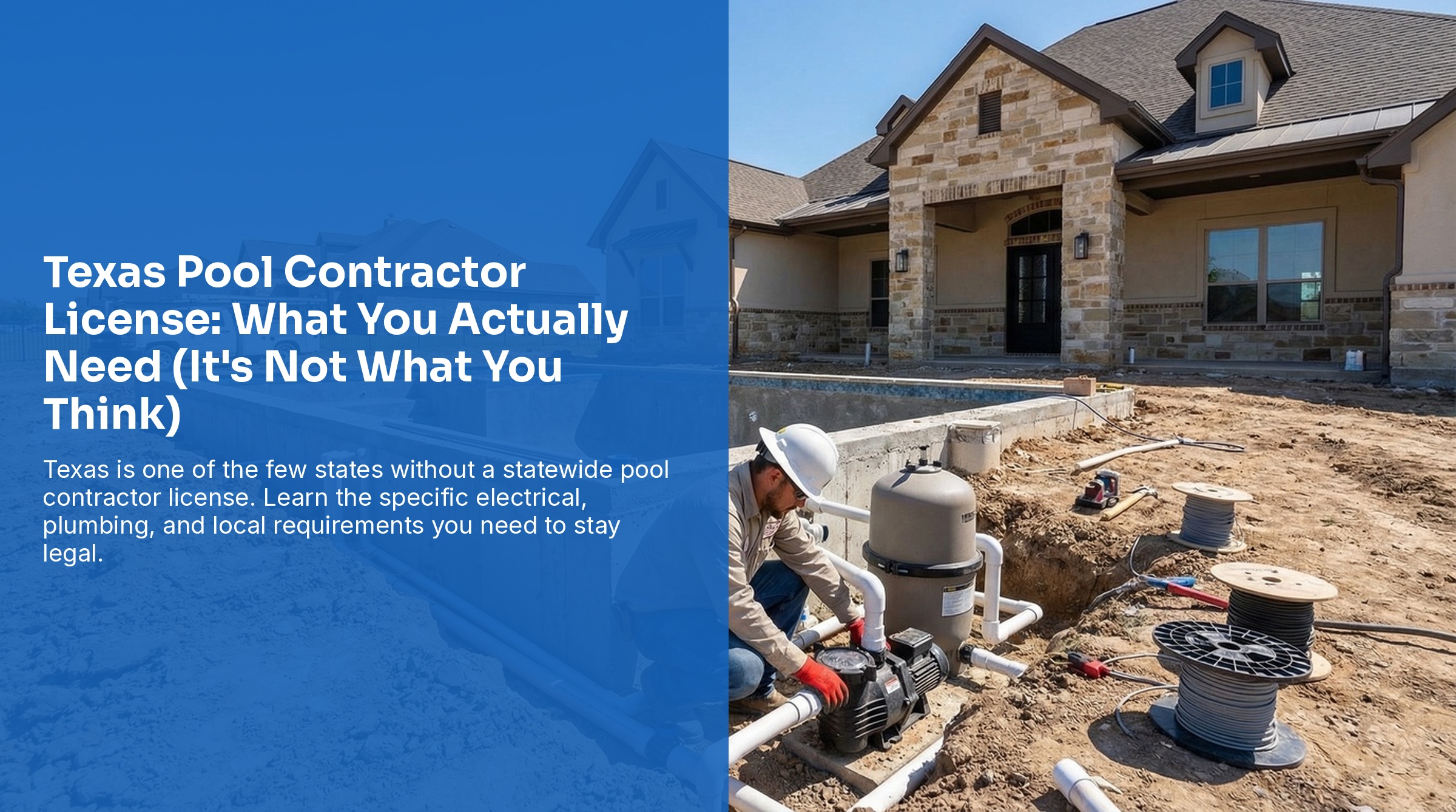
In the national pool industry, Texas stands out as a major outlier regarding professional licensing. While other "Big Four" pool markets like Florida and California require rigorous state-level testing and licensing for pool contractors, Texas has no such requirement. This "no license" environment does not, however, mean that the industry is unregulated; rather, the regulatory burden is shifted to specific trade licenses and local municipal codes.[1]H&S Code Chapter 341Public Health - Minimum Standardsstatutes.capitol.texas.gov
Key Takeaways
- No State License — Texas has NO statewide pool contractor license for service or construction[1]H&S Code Chapter 341Public Health - Minimum Standardsstatutes.capitol.texas.gov
- Electrical License Required — All electrical work on pools must be performed by a licensed electrician[4]25 TAC Chapter 265General Sanitation - Public Swimming Poolsdshs.texas.gov
- Plumbing/Gas Oversight — Plumbing and gas line work requires specific trade licensing[3]Occupations Code Chapter 1302Plumbing License Lawstatutes.capitol.texas.gov
- Comparison to Peers — Unlike FL, CA, and AZ, Texas does not centralize pool professional oversight
- Local Permits — Cities like Austin, Dallas, and Houston maintain their own registration and permit systems
- CPO Requirement — While contractors aren't licensed by the state, public pool operators must be certified[4]25 TAC Chapter 265General Sanitation - Public Swimming Poolsdshs.texas.gov
The "No License" Reality
Texas is the second-largest pool market in the United States, yet it remains one of the few states that does not require a comprehensive statewide license for pool builders or service technicians. In Florida or Arizona, a professional must obtain a specialized "Pool and Spa Contractor" license to legally operate. In Texas, a business owner can theoretically start a pool construction or service company without a specific "pool" credential from the state.[1]H&S Code Chapter 341Public Health - Minimum Standardsstatutes.capitol.texas.gov
This lack of a central license is the primary differentiator of the Texas market. It places a significant responsibility on the consumer to vet contractors and on the professional to ensure they are compliant with the various trade-specific laws that do exist.
The contrast with other trades surprises many professionals. Texas requires a license to cut hair, but not to build a $100,000 pool that could injure or kill someone if done wrong.
"You don't need one to build someone's home, either. But you need one to cut someone's hair."
— Pool pro via Reddit
Oklahoma takes it even further. No license is required to build or repair pools. Some towns charge a $20 building fee and explicitly state there will be no inspections.
For consumers, this means the responsibility for vetting a pool builder falls entirely on them. As one Texas pool professional with 20 years of experience put it:
"How do you pick a good pool builder? You contact the last three pools the guy built and ask them how it went. If they can only supply you someone from 2 years ago or their cousin, then be careful."
— 20-year Texas pool pro via Reddit
Trade-Specific Licensing: Electrical and Plumbing
While there is no "pool license," there are very strict rules regarding who can touch the equipment connected to the pool. The Texas Electrical Safety and Licensing Act is clear: any person performing electrical work on a pool or spa must be a licensed electrician. This includes the installation and repair of pumps, underwater lighting, and control systems.[2]Occupations Code Chapter 1951Electriciansstatutes.capitol.texas.gov
"The electrical system of a pool or spa and structures in the pool yard or spa yard must be installed, maintained, repaired, or replaced by a licensed electrician..." — 25 TAC §265.186(a)
Similarly, plumbing and gas work fall under the jurisdiction of the Texas State Board of Plumbing Examiners. Any work involving the potable water supply, backflow prevention, or the installation of gas-fired pool heaters requires the appropriate trade license. Therefore, a "pool professional" in Texas is often a coordinator of various licensed trades rather than a single licensed entity.[3]Occupations Code Chapter 1302Plumbing License Lawstatutes.capitol.texas.gov
In practice, enforcement is uneven. One experienced Texas pool pro noted that 90% of pool technicians doing equipment work don't actually hold the required electrical license. They just do the work. The license exists, but compliance is low.
"I do have an electrical license but it will only let me do things from the junction box on. I can not do breaker box or breaker box to junction box. It is required for anyone like AC techs or other similar techs. 90% of the pool guys do not get the license but it is required."
— Texas pool pro via Reddit
Local Ordinances and Municipal Control
Because the state does not issue a general license, many Texas cities have stepped in to create their own regulatory frameworks. Major metropolitan areas like Houston, San Antonio, Dallas, and Austin often require pool contractors to register with the city and pull permits for any significant work. These local requirements can vary significantly; for instance, one city might require a specific "Maintenance Provider" registration while another only requires a standard business permit.
Furthermore, local health departments are the primary enforcers of water quality and safety standards for commercial pools. While the state provides the "minimum standards" via the Texas Administrative Code, local authorities can — and often do — adopt standards that are more stringent than the state requirements. Professionals must be as familiar with their city's building department as they are with the state's health and safety codes.[4]25 TAC Chapter 265General Sanitation - Public Swimming Poolsdshs.texas.gov
In unincorporated areas, things get even looser. No city permits, no inspections. But experienced Texas pros say the quality in those areas is often just as good, because the builders who work there have reputations to protect.
"You do not have to have a license correct but you still have to pull permits and have inspections. Electrical work must be done under an electrical license and inspected along with gas plumbing for heater."
— 20-year Texas pool pro via Reddit
Does Licensing Actually Improve Quality?
This is where pool pros disagree. Some argue that licensing is essential consumer protection. Others say it just adds cost without improving outcomes.
The pro-licensing argument is straightforward. Building something that costs $100,000 and can injure or kill someone should require demonstrated competence. A license means a credit check, a background check, bonding, and accountability. If a licensed contractor does bad work, the consumer has recourse through the licensing board.
"It doesn't just have to do with technical acumen when it comes to licensing. It's also about consumer protection. My state requires a credit check and no felony convictions. This puts consumers in the best place for protection from frauds and hustlers."
— Pool pro via Reddit
The anti-licensing argument comes from experience on the ground. Licensed contractors aren't automatically better. Some haven't done a job in decades. They just sell their license number to others for a fee. The permit gets pulled under a licensed name, but the actual work is done by someone else entirely.
"If you think the fact that someone is licensed is a true safety and increased quality control, you are mistaken. I've known licensed electricians here in Texas that haven't done a job in decades. They just sell their license to people for a fee."
— Texas pool pro via Reddit
The truth is probably somewhere in the middle. Licensing isn't a guarantee of quality, but it does create a minimum bar and gives consumers a path for complaints. Without it, the consumer's only protection is due diligence and the court system.
Summary Table
| Licensing Category | Texas Requirement | Governing Body |
|---|---|---|
| Pool Contractor | None (Statewide) | N/A |
| Electrical Work | Licensed Electrician | TDLR / Texas Occupations Code |
| Plumbing/Gas | Licensed Plumber | TSBPE |
| Public Operator | Certified Operator (CPO) | DSHS (Recognized Courses) |
| Local Registration | Varies by City | Municipal Building/Health Depts |
Sources
- [1] Texas Health & Safety Code Chapter 341, Public Health - Minimum Standards. statutes.capitol.texas.gov
- [2] Texas Occupations Code Chapter 1951, Electricians. statutes.capitol.texas.gov
- [3] Texas Occupations Code Chapter 1302, Plumbing License Law. statutes.capitol.texas.gov
- [4] Texas Administrative Code Title 25, Chapter 265, General Sanitation - Public Swimming Pools and Spas. dshs.texas.gov