
How a Cartridge Pool Filter Works: Pleats and Pressure


Key Takeaways
- Water fills the tank outside the cartridges, crosses the pleated media, enters the perforated cores, and leaves through a collection manifold.
- Pleats place a large filtering area inside a compact tank.
- Dirt adds resistance, so gauge pressure usually rises and flow can fall as the cartridges load.
- A cartridge filter is normally opened and cleaned, not backwashed through a multiport setting.
A cartridge filter separates the dirty and clean sides of the circulation path with pleated fabric. The tank shell holds pressure. The cartridges provide the filtering surface. The cores and manifold collect water after it crosses the media.
Follow Water Through the Pleats
On a common multi-element design, pump water enters the space outside the cartridges. It crosses the pleated media from the dirty side to the clean side, enters holes in each inner core, and then reaches a shared manifold and outlet.
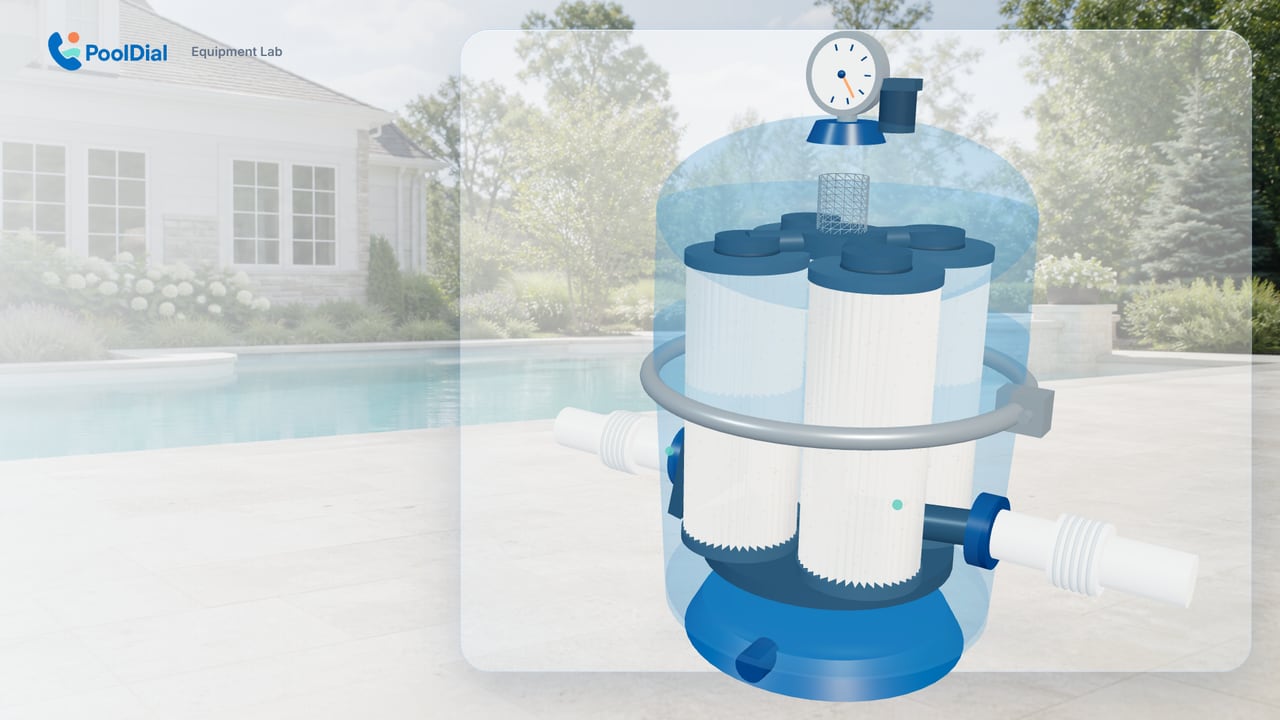
Each fold adds more surface area. More area can spread dirt loading across more media and support longer cycles, but the exact filter still has a rated area and flow guidance that must match the system.
Why Pressure Rises as the Filter Gets Dirty
Dirt trapped on and within the pleats makes it harder for water to cross the media. Resistance rises. At the same pump speed and normal valve setup, the tank gauge often reads higher while return flow weakens.
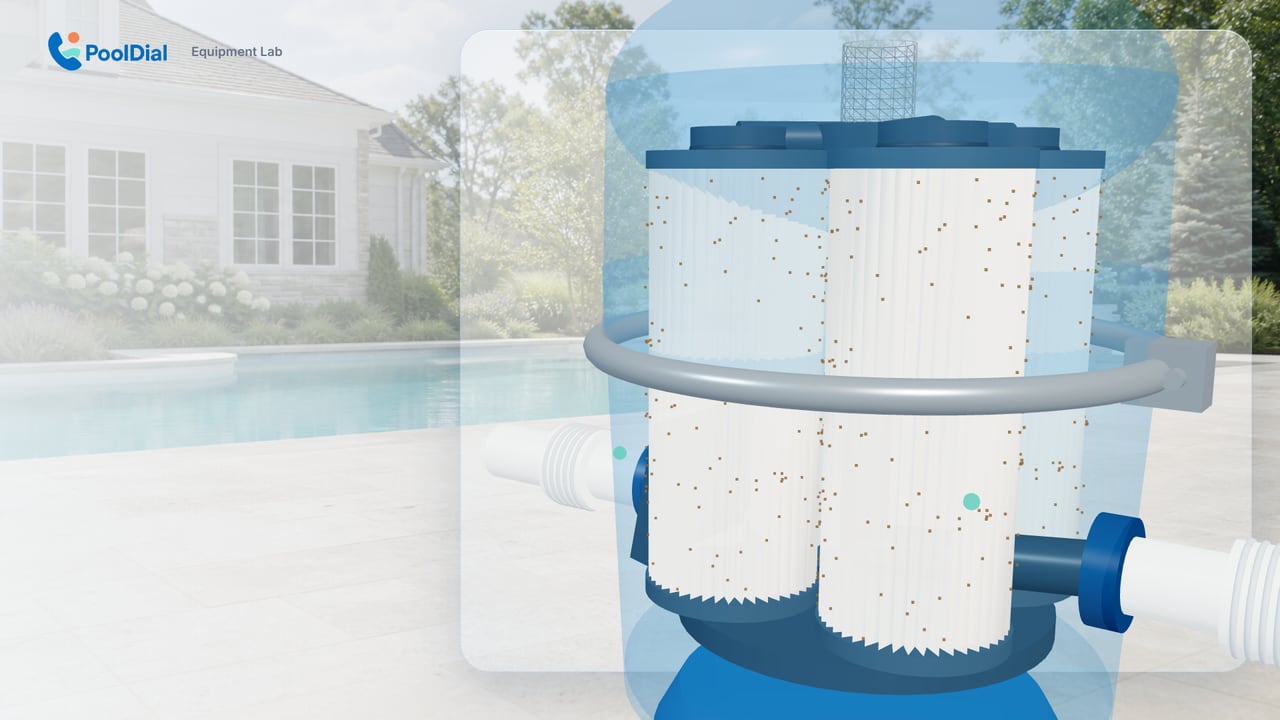
Record a clean starting pressure after the cartridges are serviced and the system is fully bled of air. For a variable-speed pump, record the speed too. A pressure at 1,500 RPM cannot be compared fairly with a reading at 3,000 RPM.
Cleaning Is Different From Backwashing
Most cartridge filters do not reverse flow through a Backwash position. The normal maintenance path is to shut the system down safely, relieve all pressure, open the vessel as the manual directs, remove the elements, and rinse them with a normal garden hose. Pressure washing can damage the media.
The manual may include a chemical-cleaning sequence for oils or scale. Do not mix cleaners or improvise an acid soak. Oils should be handled in the correct order because acid can set some contamination into the fabric.
Trapped Air Changes the Risk
Air compresses inside a pressurized tank. That stored energy is why startup and opening steps matter. The manual air-relief valve stays open during startup until a steady stream of water, not an air-water mixture, is discharged safely.
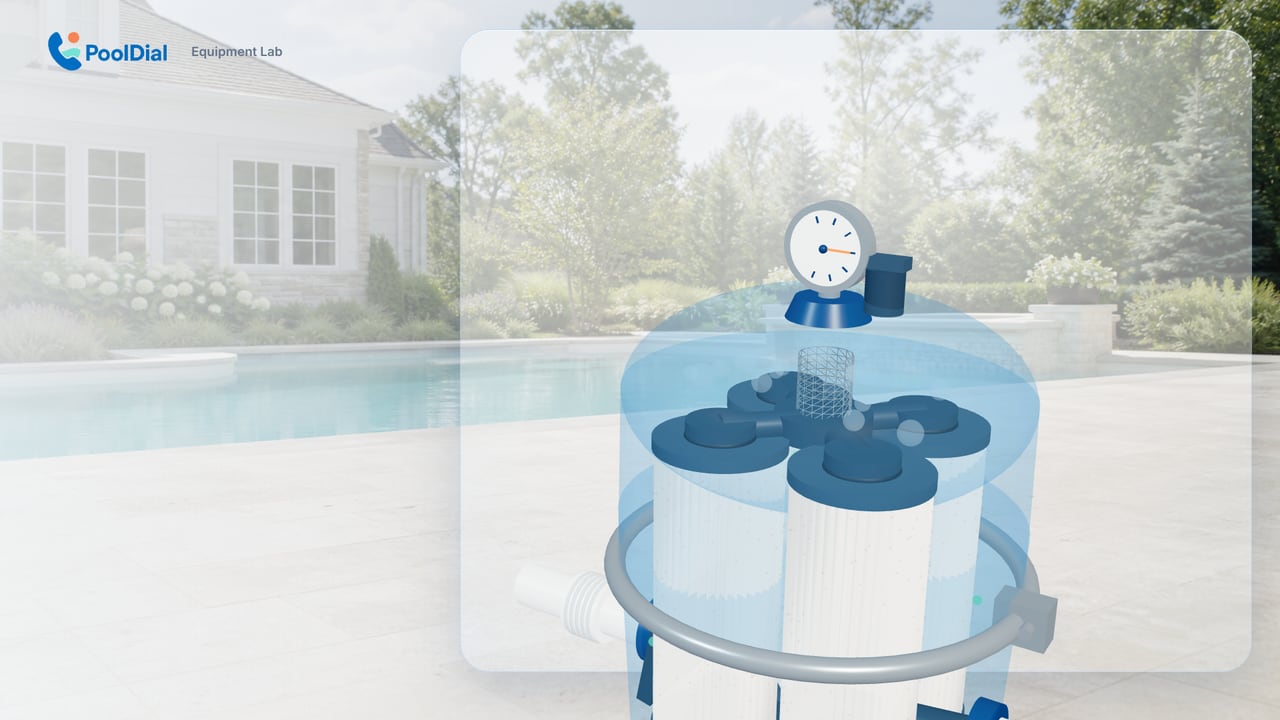
Before touching the clamp, the pump must be off, the air relief must be used as directed, and the gauge must read zero. Stand clear during startup and inspect the clamp and tank exactly as the manufacturer requires.
Use Pressure and Flow Together
| Pattern | Possible zone | Useful notes |
|---|---|---|
| Pressure high, return flow low | Loaded media or a downstream restriction | Compare with clean pressure at the same speed |
| Pressure low, return flow low | Suction supply, pump basket, pump speed, or impeller | Check whether the pump is receiving and moving water |
| Cycle becomes short again soon after cleaning | Heavy debris, algae, plaster dust, or damaged/aged media | Record water condition and how quickly pressure returns |
| Dirt returns to the pool | Torn media, manifold seal, standpipe, or assembly issue | Note whether it began after filter service |
A gauge alone does not diagnose the system. Combine pressure, pump speed, return strength, water condition, and the time since cleaning.
Useful Filter Tools
Estimate required area with the filter sizing calculator. Track element age with the cartridge filter life calculator, then save clean-pressure readings and replacement dates in PoolDial equipment records.
Frequently Asked Questions
Does a cartridge pool filter need backwashing?
Most cartridge filters are cleaned by safely opening the vessel and removing the elements. They normally do not use the reverse-flow Backwash mode found on many sand and D.E. systems.
Why does cartridge filter pressure rise?
Captured dirt adds resistance across the pleated media. Compare the reading with a clean baseline at the same pump speed and valve setup.
Can I pressure wash pool filter cartridges?
Manufacturer manuals commonly direct users to a normal garden hose and warn against high-pressure washing because it can damage the media. Follow the exact element manual.
This guide is an original, generic teaching explanation based on manufacturer documentation. Visuals are simplified and not to scale. The installed equipment manual controls service and safety procedures.
- Pentair, Clean and Clear Plus Cartridge Filter Installation and User’s Guide, operation, cleaning, startup, and pressure-safety sections.
- Hayward, SwimClear Top Manifold Cartridge Filters Owner’s Manual, flow, operation, cleaning, and troubleshooting sections.