

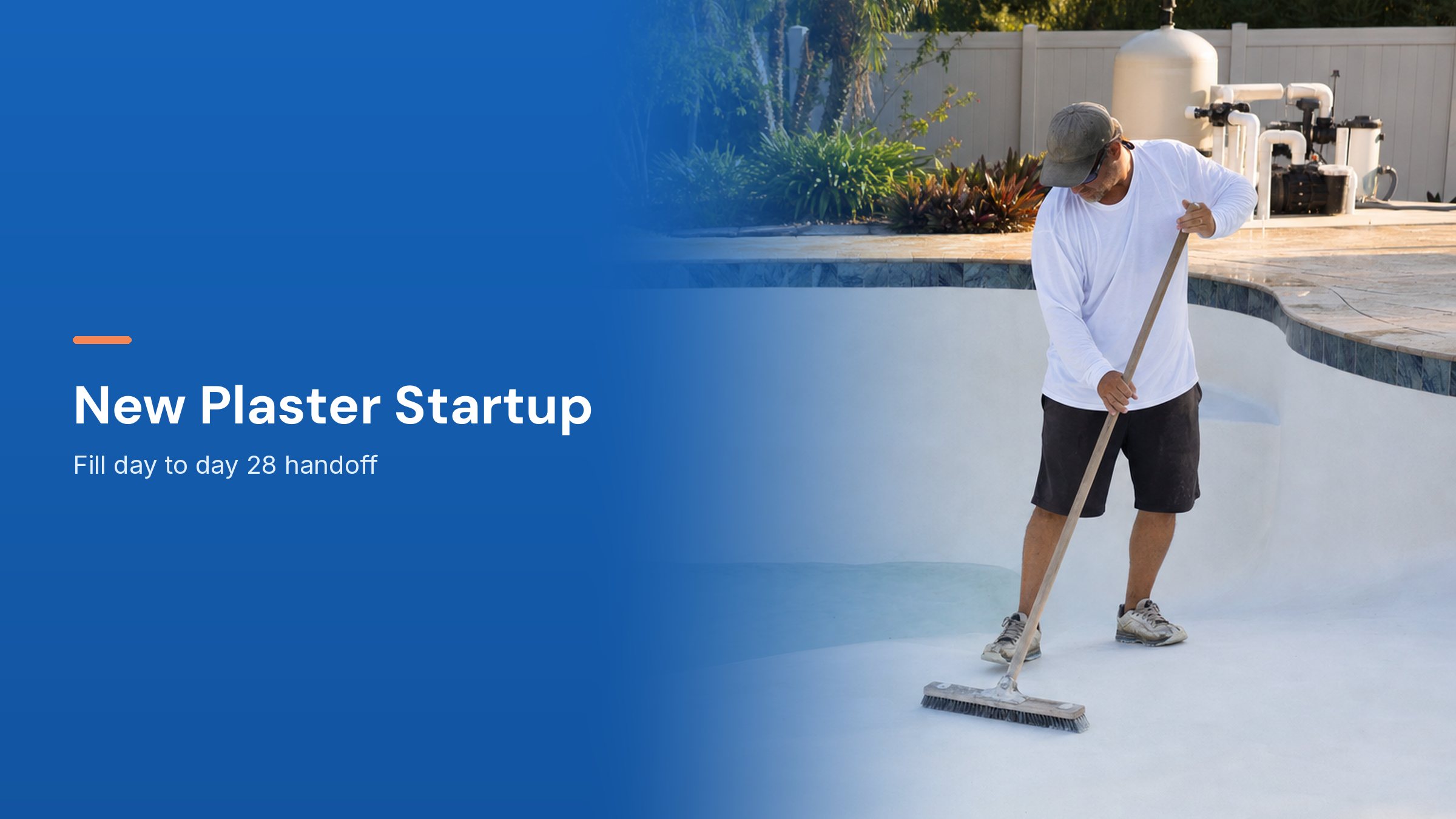
A new plaster startup is a 28-day job. The first week is the hard part. You fill the pool without stopping, test every day, keep the water from eating calcium out of the new finish, and brush off the plaster dust. Chlorine waits until day 3. Salt and wheeled cleaners wait about a month. Heat waits until the dust is gone, or longer if the finish maker says so.
That is the short version of the National Plasterers Council (NPC) card.[1]National Plasterers CouncilStart-Up Procedures card, REV 03-2021, English and Spanish, hosted by NPT. Read November 28, 2026.nptpool.com This guide walks it day by day for the tech who gets the pool after a replaster. It also covers the other two methods you will hear about, what normal mottling and craze cracks look like, how to tell bad startup water from bad plaster work, and what to charge.
Key Takeaways
- Find out who owns the startup first. The NPC says the person who turns off the water and the person who does the startup must be named up front.[2]National Plasterers CouncilWhite Paper 6, "Tips on Filling the Pool and Initial Start Up." Read November 28, 2026.npconline.org
- Fill nonstop. A pause in the fill can leave a bowl ring and more shrinkage cracks.[2]National Plasterers CouncilWhite Paper 6, "Tips on Filling the Pool and Initial Start Up." Read November 28, 2026.npconline.org
- No chlorine for 48 hours. On the NPC card, chlorine goes in on day 3 at 1.5 to 3 ppm.[1]National Plasterers CouncilStart-Up Procedures card, REV 03-2021, English and Spanish, hosted by NPT. Read November 28, 2026.nptpool.com
- Salt waits about a month. NPC, Pentair and Jandy say about 30 days. Hayward says 10 to 14 days. Follow the finish maker first.[1]National Plasterers CouncilStart-Up Procedures card, REV 03-2021, English and Spanish, hosted by NPT. Read November 28, 2026.nptpool.com[10]PentairIntelliChlor IC15, IC20, IC40, IC60 Installation and User's Guide. Read November 28, 2026.pentair.com[11]Jandy (Zodiac)AquaPure APURE700 and APURE1400 Installation and Operating Data, Rev 7. Read November 28, 2026.zodiacpoolsystems.com[12]HaywardSwimPure Plus salt chlorine generator owner's manual, 092744 Rev C. Read November 28, 2026.hayward.com
- Skip the acid startup. Tests found acid startups etch new plaster. Bicarb and the NPC method did best.[8]Pool & Spa NewsBen Thomas, "Plaster Analyzed in Chemical Start-Up Tests," June 1, 2010. Read November 28, 2026.poolspanews.com
- Some mottling is normal. The NPC says even, cloudy shading is not a defect and often fades.[3]National Plasterers CouncilWhite paper, "Interior Finish Tolerances: Smoothness, Levelness, Thickness and Mottling." Read November 28, 2026.npconline.org
Before day 1: who owns this startup?
Most techs get a new finish after someone else filled it. The NPC says the person who shuts off the water and the person who does the startup should be named up front.[2]National Plasterers CouncilWhite Paper 6, "Tips on Filling the Pool and Initial Start Up." Read November 28, 2026.npconline.org Get that in writing before you add one chemical, and ask which finish went in, since proprietary finishes follow the maker's own steps.[2]National Plasterers CouncilWhite Paper 6, "Tips on Filling the Pool and Initial Start Up." Read November 28, 2026.npconline.org The handoff checklist covers who owns each stage and what records to ask for.
Traditional, bicarb or acid: which startup method?
You will hear about three main methods. Two are good. One is not.
| Method | How it works | Main rule | Verdict |
|---|---|---|---|
| NPC traditional | Fill with normal water. Test and adjust pH, alkalinity and calcium every day. Brush hard to remove plaster dust.[1]National Plasterers CouncilStart-Up Procedures card, REV 03-2021, English and Spanish, hosted by NPT. Read November 28, 2026.nptpool.com | Keep pH 7.2 to 7.6 and raise calcium slowly to at least 200 ppm by day 4.[1]National Plasterers CouncilStart-Up Procedures card, REV 03-2021, English and Spanish, hosted by NPT. Read November 28, 2026.nptpool.com | The standard. Simple to follow. Ranked a close second in field tests.[8]Pool & Spa NewsBen Thomas, "Plaster Analyzed in Chemical Start-Up Tests," June 1, 2010. Read November 28, 2026.poolspanews.com |
| Bicarb start | Dose baking soda into the fill water so the water does not pull calcium out of the plaster. Run high alkalinity for the first month.[7]onBalanceThe Bicarb Start card, 2014, poolhelp.com. Read November 28, 2026.poolhelp.com | Keep pH at 8.2 or lower for the first month, then bring alkalinity down.[7]onBalanceThe Bicarb Start card, 2014, poolhelp.com. Read November 28, 2026.poolhelp.com | Ranked first in the onBalance tests. Takes more setup.[8]Pool & Spa NewsBen Thomas, "Plaster Analyzed in Chemical Start-Up Tests," June 1, 2010. Read November 28, 2026.poolspanews.com |
| Orenda startup | Add dissolved calcium as the pool fills so the water is a little over saturated from the first hour.[5]Orenda TechnologiesOrenda Startup 30-day Guide card, version 1.0, May 2021. Read November 28, 2026.orendatech.com | LSI +0.20 to +0.30 for days 1 to 3, then 0.00 to +0.30 through day 30.[5]Orenda TechnologiesOrenda Startup 30-day Guide card, version 1.0, May 2021. Read November 28, 2026.orendatech.com | A balance-first cousin of the bicarb idea. Popular with startup companies. |
| Acid or "hot" start | Dump in acid, often down to zero alkalinity, to burn off dust and even out the top layer.[6]Orenda TechnologiesBlog post, "What is a hot start?" Read November 28, 2026.orendatech.com | No set dose or time. | Ranked last. Causes tiny etching, even when the surface feels smooth.[8]Pool & Spa NewsBen Thomas, "Plaster Analyzed in Chemical Start-Up Tests," June 1, 2010. Read November 28, 2026.poolspanews.com |
Why do the good methods work? Fresh plaster is full of calcium hydroxide, and it dissolves easily. Water that is low in calcium or low in pH pulls it out. That loss shows up as plaster dust, rising pH and a weaker, rougher surface. Orenda says calcium lost this way cannot be put back.[6]Orenda TechnologiesBlog post, "What is a hot start?" Read November 28, 2026.orendatech.com The bicarb and Orenda methods both try to stop the loss before it starts. The NPC method manages it with daily testing and brushing.
The NPC knows bicarb may protect plaster better. Its leader said in 2010 that the council picked its method because it is simple enough for anyone to follow, homeowners included.[8]Pool & Spa NewsBen Thomas, "Plaster Analyzed in Chemical Start-Up Tests," June 1, 2010. Read November 28, 2026.poolspanews.com That matters if you will not be there every day.
“It's really no set standard. That's one of the things that's so bad about it.”
That is the core problem with a hot start. Nobody agrees how much acid or how long. Orenda strongly advises against hot starts, especially in the first 30 days.[6]Orenda TechnologiesBlog post, "What is a hot start?" Read November 28, 2026.orendatech.com
Fill day: the part you cannot redo
Many finish problems are locked in before the pool is full. Here is what the NPC asks for on fill day.[1]National Plasterers CouncilStart-Up Procedures card, REV 03-2021, English and Spanish, hosted by NPT. Read November 28, 2026.nptpool.com[2]National Plasterers CouncilWhite Paper 6, "Tips on Filling the Pool and Initial Start Up." Read November 28, 2026.npconline.org
- Equipment works first. Pump and filter should run before the finish goes on. If the filter cannot keep up with the dust, the NPC says to bring a portable filter.[2]National Plasterers CouncilWhite Paper 6, "Tips on Filling the Pool and Initial Start Up." Read November 28, 2026.npconline.org
- Hose in the deep end, wrapped in a clean cloth. With a water truck, put about 24 inches of water in the deep end first as a cushion.[1]National Plasterers CouncilStart-Up Procedures card, REV 03-2021, English and Spanish, hosted by NPT. Read November 28, 2026.nptpool.com
- Fill without stopping, as fast as you can, to the middle of the skimmer. A stop can leave a ring at that level.[2]National Plasterers CouncilWhite Paper 6, "Tips on Filling the Pool and Initial Start Up." Read November 28, 2026.npconline.org
- No other water on the surface. Rain runoff, sprinklers or a hose running down a wall can cause streaks and spots.[2]National Plasterers CouncilWhite Paper 6, "Tips on Filling the Pool and Initial Start Up." Read November 28, 2026.npconline.org
- No people or pets in the pool during the fill.[1]National Plasterers CouncilStart-Up Procedures card, REV 03-2021, English and Spanish, hosted by NPT. Read November 28, 2026.nptpool.com
- Test the fill water for pH, alkalinity, calcium and metals, and write it down.[1]National Plasterers CouncilStart-Up Procedures card, REV 03-2021, English and Spanish, hosted by NPT. Read November 28, 2026.nptpool.com
- Start the pump as soon as it is full. Leave the heater off.[1]National Plasterers CouncilStart-Up Procedures card, REV 03-2021, English and Spanish, hosted by NPT. Read November 28, 2026.nptpool.com
The NPC also says not to fill with softened water or reverse osmosis water.[2]National Plasterers CouncilWhite Paper 6, "Tips on Filling the Pool and Initial Start Up." Read November 28, 2026.npconline.org Well water is the other trap. If the source is a well, test it for iron and copper before the fill. Many pros truck in water rather than risk metals in a new finish. If you are stuck with the well, read the iron well water guide before the first chlorine goes in, because chlorine is what makes dissolved iron drop out.
Days 1 and 2: balance and brush, no chlorine
On the NPC card, days 1 and 2 are about alkalinity, pH, calcium and dust.[1]National Plasterers CouncilStart-Up Procedures card, REV 03-2021, English and Spanish, hosted by NPT. Read November 28, 2026.nptpool.com
- Alkalinity first. Bring it to 80 to 100 ppm. Lower high alkalinity with diluted muriatic acid. Raise low alkalinity with baking soda.[1]National Plasterers CouncilStart-Up Procedures card, REV 03-2021, English and Spanish, hosted by NPT. Read November 28, 2026.nptpool.com
- Then pH. Bring it to 7.2 to 7.6 once alkalinity is in range.[1]National Plasterers CouncilStart-Up Procedures card, REV 03-2021, English and Spanish, hosted by NPT. Read November 28, 2026.nptpool.com
- Then calcium, slowly. Day 1 target is 80 to 100 ppm. Day 2 target is 100 to 150 ppm. The NPC adds calcium chloride dissolved, in 10 pound steps, several hours apart.[1]National Plasterers CouncilStart-Up Procedures card, REV 03-2021, English and Spanish, hosted by NPT. Read November 28, 2026.nptpool.com
- Brush the whole pool at least twice a day.[1]National Plasterers CouncilStart-Up Procedures card, REV 03-2021, English and Spanish, hosted by NPT. Read November 28, 2026.nptpool.com For which brush to use, see the new plaster brush guide.
- Run the pump nonstop for seven days, or until the dust is gone and the water is clear. The minimum is 72 hours.[1]National Plasterers CouncilStart-Up Procedures card, REV 03-2021, English and Spanish, hosted by NPT. Read November 28, 2026.nptpool.com
- A metal sequestrant is optional but common. Follow the product's startup dose.[1]National Plasterers CouncilStart-Up Procedures card, REV 03-2021, English and Spanish, hosted by NPT. Read November 28, 2026.nptpool.com
Two safety rules come straight from the card. Always add chemicals to water, never water to chemicals. And never add calcium chloride and baking soda at the same time.[1]National Plasterers CouncilStart-Up Procedures card, REV 03-2021, English and Spanish, hosted by NPT. Read November 28, 2026.nptpool.com Orenda says the same: the two react and cloud the pool badly.[5]Orenda TechnologiesOrenda Startup 30-day Guide card, version 1.0, May 2021. Read November 28, 2026.orendatech.com Pre-dilute acid in a bucket of water. Add chemicals with the pump running, in the deep end, away from steps and benches, then brush the spot.[1]National Plasterers CouncilStart-Up Procedures card, REV 03-2021, English and Spanish, hosted by NPT. Read November 28, 2026.nptpool.com
Expect pH to climb every day as the plaster cures.
“No. Ph will continue to rise due to the plaster, but adding aeration will speed up the increase in pH, which leads to harder LSI swings and can cause scaling and mottling.”
So hold off on bubblers, sheer descents and in-floor jets that splash. The NPC card says in-floors and directional eyeballs can be added once the water is balanced.[1]National Plasterers CouncilStart-Up Procedures card, REV 03-2021, English and Spanish, hosted by NPT. Read November 28, 2026.nptpool.com
Day 3: the first chlorine
Chlorine waits 48 hours on the NPC card. On day 3, add pre-diluted chlorine or liquid chlorine to 1.5 to 3.0 ppm. Keep testing, keep balancing and keep brushing twice a day.[1]National Plasterers CouncilStart-Up Procedures card, REV 03-2021, English and Spanish, hosted by NPT. Read November 28, 2026.nptpool.com PebbleTec says not to chlorinate until pH and carbonate alkalinity are in range.[9]Pebble Technology InternationalPool Care Instructions page. Read November 28, 2026.pebbletec.com
Use liquid chlorine. Undissolved granules can sit on a new floor and leave marks. Most pros keep granular chlorine and cal hypo off fresh plaster for the first month. A tab feeder set low is a common way to hold a small level between visits. For more on the tradeoffs, see liquid chlorine vs tabs vs cal hypo.
If you filled from a well, watch the water right after the first chlorine. If it turns yellow or brown, metals are dropping out. Stop adding chlorine and treat for metals before you go on.
“New plaster needs a proper 28-day startup and not just weekly visits. First 5 days at least need daily visits.”
Days 4 to 7: calcium up, then stabilizer
For days 4 through 7, the NPC card keeps the daily test, the twice-a-day brushing and the nonstop pump. The goal is to stop scale from forming on the new surface.[1]National Plasterers CouncilStart-Up Procedures card, REV 03-2021, English and Spanish, hosted by NPT. Read November 28, 2026.nptpool.com
- Calcium: raise it slowly, if needed, to at least 200 ppm.[1]National Plasterers CouncilStart-Up Procedures card, REV 03-2021, English and Spanish, hosted by NPT. Read November 28, 2026.nptpool.com
- Stabilizer: the NPC card starts CYA on day 4, aiming for 30 to 50 ppm. Add it through the skimmer with the pump running, spread over at least three days, and brush after each dose. Concentrated CYA can discolor colored finishes.[1]National Plasterers CouncilStart-Up Procedures card, REV 03-2021, English and Spanish, hosted by NPT. Read November 28, 2026.nptpool.com Orenda says no CYA until day 5 or later.[5]Orenda TechnologiesOrenda Startup 30-day Guide card, version 1.0, May 2021. Read November 28, 2026.orendatech.com
- Day 7: if dust remains, take it out with a brush vacuum.[1]National Plasterers CouncilStart-Up Procedures card, REV 03-2021, English and Spanish, hosted by NPT. Read November 28, 2026.nptpool.com
Plaster dust is hard on filters. Expect short filter runs and more cleanings in week one. Clean the filter at the end of the startup too, before you hand the pool off.
Days 8 to 28: lighter work, same records
Once the dust is gone and a good cleaning plan is in place, the NPC says brushing can drop to removing debris and brushing when you add chemicals.[1]National Plasterers CouncilStart-Up Procedures card, REV 03-2021, English and Spanish, hosted by NPT. Read November 28, 2026.nptpool.com Visits can thin out. Many startup companies go daily for the first five days, then a few times a week, then weekly to day 28.
Keep the LSI in range the whole time. The NPC wants 0.0 to +0.3, especially in the first six months.[1]National Plasterers CouncilStart-Up Procedures card, REV 03-2021, English and Spanish, hosted by NPT. Read November 28, 2026.nptpool.com A negative LSI leaches and etches. A positive one scales and stains.[1]National Plasterers CouncilStart-Up Procedures card, REV 03-2021, English and Spanish, hosted by NPT. Read November 28, 2026.nptpool.com Run the numbers with the LSI calculator, and see the LSI balance guide if you need a refresher.
Write down every test and every dose, with the date and time. Use product names, not just "acid." If the finish looks bad in month three, the log is what protects you.
“There is zero chance that you're going to remember the alkalinity of this pool on day six, you know, on the startup if you didn't write it down.”
The dosing record guide shows what a useful log looks like.
When can you add salt, stabilizer and heat?
This is the most common startup question, and the sources do not all agree. Here is what each one says.
| Item | What the sources say | Safe default |
|---|---|---|
| Salt | NPC: not within the first 30 days.[1]National Plasterers CouncilStart-Up Procedures card, REV 03-2021, English and Spanish, hosted by NPT. Read November 28, 2026.nptpool.com PebbleTec: at least 28 days.[9]Pebble Technology InternationalPool Care Instructions page. Read November 28, 2026.pebbletec.com Orenda: after 28 to 30 days.[5]Orenda TechnologiesOrenda Startup 30-day Guide card, version 1.0, May 2021. Read November 28, 2026.orendatech.com Pentair IntelliChlor: at least one month.[10]PentairIntelliChlor IC15, IC20, IC40, IC60 Installation and User's Guide. Read November 28, 2026.pentair.com Jandy AquaPure: at least 4 weeks, since salt before the cure may cause pitting.[11]Jandy (Zodiac)AquaPure APURE700 and APURE1400 Installation and Operating Data, Rev 7. Read November 28, 2026.zodiacpoolsystems.com Hayward: 10 to 14 days.[12]HaywardSwimPure Plus salt chlorine generator owner's manual, 092744 Rev C. Read November 28, 2026.hayward.com | Wait 30 days, unless the finish maker says longer. Brush salt in until it is fully dissolved. |
| Stabilizer (CYA) | NPC: start on day 4, spread over 3 days.[1]National Plasterers CouncilStart-Up Procedures card, REV 03-2021, English and Spanish, hosted by NPT. Read November 28, 2026.nptpool.com Orenda: day 5 or later.[5]Orenda TechnologiesOrenda Startup 30-day Guide card, version 1.0, May 2021. Read November 28, 2026.orendatech.com | Not before day 4 or 5. Dissolve it or feed it slowly. Brush after. |
| Heater | NPC card: not until the water is balanced and no dust remains.[1]National Plasterers CouncilStart-Up Procedures card, REV 03-2021, English and Spanish, hosted by NPT. Read November 28, 2026.nptpool.com NPC white paper: not for 28 days.[2]National Plasterers CouncilWhite Paper 6, "Tips on Filling the Pool and Initial Start Up." Read November 28, 2026.npconline.org PebbleTec: at least 14 days.[9]Pebble Technology InternationalPool Care Instructions page. Read November 28, 2026.pebbletec.com | Off until the dust is gone at the very least. Follow the finish maker if it says longer. |
| Wheeled cleaners | NPC card: not until after 28 days. Brush vacuums are fine.[1]National Plasterers CouncilStart-Up Procedures card, REV 03-2021, English and Spanish, hosted by NPT. Read November 28, 2026.nptpool.com Orenda: after 28 to 30 days.[5]Orenda TechnologiesOrenda Startup 30-day Guide card, version 1.0, May 2021. Read November 28, 2026.orendatech.com | Day 28 or later. |
Why the wait on salt? Pentair calls salt corrosive and warns of severe damage to plaster that has not cured.[10]PentairIntelliChlor IC15, IC20, IC40, IC60 Installation and User's Guide. Read November 28, 2026.pentair.com Salt also piles up on the floor before it dissolves, and a pile sitting on a new colored finish can leave a mark. If a customer insists on salt early, get it in writing.
Why the wait on heat? Warm water raises the LSI, so it scales faster.[1]National Plasterers CouncilStart-Up Procedures card, REV 03-2021, English and Spanish, hosted by NPT. Read November 28, 2026.nptpool.com And the heater is copper. Pentair lists corrosion of the copper heater tubes as a result of low pH water, along with blue, green or black stains on the plaster from corroded metal.[13]PentairMasterTemp 125 Installation and User's Guide, Rev C. Read November 28, 2026.pentair.com An acid startup with the heater running is the worst case. It can eat the heat exchanger and stain the new finish with the copper. If you get a pool after a hot start, check the heater. The heater warranty and water chemistry guide explains how makers look at that damage.
Finally, skip copper algaecide on a new finish. Copper can drop out of the water and stain the surface. Keep the chlorine steady and the filter clean instead.
What's normal: dust, mottling and craze cracks
New finishes worry owners. Some of what they see is normal. Here is what the NPC says is expected.
Plaster dust. A fine white or gray powder that clouds the water and settles on the floor in the first days. It is the reason for all the brushing. It should be gone within about the first week.[1]National Plasterers CouncilStart-Up Procedures card, REV 03-2021, English and Spanish, hosted by NPT. Read November 28, 2026.nptpool.com If it keeps coming back after week two, the water is still pulling calcium out of the surface. Check the LSI.
Mottling. The NPC says normal mottling is an even, blotchy or cloudy shading across the whole surface. It comes from small differences in moisture and in how fast the cement cures. It is not a defect, needs no fix, and often fades or goes away with time.[3]National Plasterers CouncilWhite paper, "Interior Finish Tolerances: Smoothness, Levelness, Thickness and Mottling." Read November 28, 2026.npconline.org The NPC-backed disclosure adds that finishes are not promised to be an even color, and that colored finishes fade over time.[4]National Plasterers CouncilPool Interior Finish Disclosure, endorsed by the NPC, revised December 16, 2015, hosted by NPT. Read November 28, 2026.nptpool.com Darker colors show it the most.
Craze cracks. Fine, hairline check cracks are normal and not a defect, says the same disclosure. They can be quite easy to see on colored finishes.[4]National Plasterers CouncilPool Interior Finish Disclosure, endorsed by the NPC, revised December 16, 2015, hosted by NPT. Read November 28, 2026.nptpool.com A stopped fill can make shrinkage cracks worse above the waterline where it stopped.[2]National Plasterers CouncilWhite Paper 6, "Tips on Filling the Pool and Initial Start Up." Read November 28, 2026.npconline.org What is not normal: cracks that sound hollow when you tap the area, or a crack with a raised or flaking edge. That can point to the finish coming loose. Photograph it and refer it out. The plaster expert guide covers when to do that.
A small loss of pebbles. PebbleTec says a few pebbles or glass beads coming loose during startup is normal.[9]Pebble Technology InternationalPool Care Instructions page. Read November 28, 2026.pebbletec.com
Judge the finish in the right light. The NPC says to look when the pool is full and clean, in the morning, the afternoon or on a cloudy day. Do not judge it at noon, at night, or with pool lights shining across it, since those make flaws look worse.[3]National Plasterers CouncilWhite paper, "Interior Finish Tolerances: Smoothness, Levelness, Thickness and Mottling." Read November 28, 2026.npconline.org
Blotchy, streaked or spotted: startup chemistry or application?
When a finish looks bad, everyone points at someone else. The plaster crew blames the water. The service tech blames the plaster. The truth is often both, or neither. Use the timing and the pattern to sort it out.
| What you see | When it shows | Often points to |
|---|---|---|
| Even, cloudy shading over the whole pool | Day 1 on | Normal mottling from curing.[3]National Plasterers CouncilWhite paper, "Interior Finish Tolerances: Smoothness, Levelness, Thickness and Mottling." Read November 28, 2026.npconline.org Usually fades. |
| A ring around the walls at one height | Day 1 | A stop in the fill.[2]National Plasterers CouncilWhite Paper 6, "Tips on Filling the Pool and Initial Start Up." Read November 28, 2026.npconline.org Application day, not chemistry. |
| Streaks down a wall, or spots in one area | Day 1 to week 1 | Outside water hitting the surface before it was full, or a hose running down the wall.[2]National Plasterers CouncilWhite Paper 6, "Tips on Filling the Pool and Initial Start Up." Read November 28, 2026.npconline.org |
| Footprints or handprints | Can take weeks or months to show | Someone in the pool before or during the fill.[1]National Plasterers CouncilStart-Up Procedures card, REV 03-2021, English and Spanish, hosted by NPT. Read November 28, 2026.nptpool.com |
| Rough, white, chalky film on the surface | Weeks 1 to 6 | Scale from a positive LSI.[1]National Plasterers CouncilStart-Up Procedures card, REV 03-2021, English and Spanish, hosted by NPT. Read November 28, 2026.nptpool.com Check pH, calcium and how much tap water went in. |
| Lighter, rough, etched patches, more dust | Weeks 1 to 4 | Aggressive water: low pH, low calcium or an acid start.[1]National Plasterers CouncilStart-Up Procedures card, REV 03-2021, English and Spanish, hosted by NPT. Read November 28, 2026.nptpool.com[8]Pool & Spa NewsBen Thomas, "Plaster Analyzed in Chemical Start-Up Tests," June 1, 2010. Read November 28, 2026.poolspanews.com |
| Blue, green, brown or black stains | Often right after chlorine or acid | Metals from fill water, a copper algaecide or a corroding heater.[13]PentairMasterTemp 125 Installation and User's Guide, Rev C. Read November 28, 2026.pentair.com |
| Uneven pebble exposure, light or dark bands | Day 1, after the pool is full | How the crew exposed or acid washed the finish on install day. |
| Darker spots, blotches that grow in year one | Months 1 to 12 | Can be either. Get a full chemistry log and an outside expert. |
A quick spot test helps. A vitamin C tablet held on a stain that lightens it points to metal. A chlorine tab that lightens it points to organic. Neither one proves who caused it. If the question is who pays, document and refer it. Do not diagnose a warranty fight on your own. The stain identification guide covers removal once the cause is known.
One more pattern pros see a lot: colored plaster and colored quartz show every swing in chemistry. Many builders now steer customers to white or to pebble for that reason. If you are asked, say so before plaster day, and put the warning in writing.
Should new plaster ever be acid washed?
Not during the startup. There are two very different acid jobs, and people mix them up.
Install-day exposure. Pebble and some quartz finishes get a light acid wash by the crew the day of or the day after install. That exposes the stone and takes off the cement cream. The NPC says these finishes may need to be cleaned, exposed or polished before the fill.[2]National Plasterers CouncilWhite Paper 6, "Tips on Filling the Pool and Initial Start Up." Read November 28, 2026.npconline.org That is part of applying the finish. It is the plaster crew's job.
“Pebble plaster is acid washed the day after install to remove the plaster dust and expose the pebble. Then we fill it and balance the chemicals for new plaster start up.”
An acid wash after the fill. That is a different thing. Orenda says not to do a hot start or a low alkalinity acid treatment until after 28 to 30 days or longer. It also warns that early acid can ruin surfaces, and that most blemishes are dealt with after 30 days.[5]Orenda TechnologiesOrenda Startup 30-day Guide card, version 1.0, May 2021. Read November 28, 2026.orendatech.com The onBalance tests found that acid etches new plaster even when you cannot see it.[8]Pool & Spa NewsBen Thomas, "Plaster Analyzed in Chemical Start-Up Tests," June 1, 2010. Read November 28, 2026.poolspanews.com
Acid also changes how a new finish looks, which makes things worse on a surface that is already in question.
“On newer pools, the acid does really deepen the color where it hits. On older pebble tech, it doesn't change much at all.”
So if a new finish is streaky or blotchy, give it the full 28 days with good balance first. Many marks fade. If it still needs work after that, the fix belongs to the plaster crew or the builder while the finish is under warranty. Touching it yourself can make it look like you caused it.
Once a finish is cured and out of the startup, a drain and acid wash is a normal paid job. On poolrates.fyi, pros' acid wash labor prices average about $1,325, from a small set of four prices.[14]poolrates.fyiRepair and one-time job prices, January to October 2026, acid wash labor prices. Read November 28, 2026.poolrates.fyi For your own quote, use the acid wash pricing calculator and the acid wash how-to. If the finish is past saving, see acid wash vs replaster.
What to charge for a 28-day startup
A true startup is many visits, a lot of chemicals and real liability. Price it like that. poolrates.fyi does not have enough startup prices yet to give an average. Here is what pros commonly report instead.
- Full 28-day startup, chemicals included: pros commonly report about $750 to $2,000. Bigger pools, long drives and daily visits push it higher.
- Short "startups" of one to three visits: much less, but they are not the same job. Do not let the customer think they are.
- Per visit: some pros bill each startup visit at a set rate, plus chemicals and a filter clean at the end.
“We charge 1500 for startups in most places but we do it right, brush everyday, chem check everyday, everything documented, we use Orendas startup plan(no we didn’t buy their fancy barrel) and take it very seriously.”
To build your own price, add up the parts:
- Visits. Count them. A common plan is daily for days 1 to 5 or 7, then a few times a week, then weekly to day 28.
- Time on site. Testing, dosing and a full brush take longer than a normal stop. Brushing a large pool twice a day is real labor.
- Drive time. A pool 30 minutes off your route doubles the cost of every visit.
- Chemicals. Calcium, acid, baking soda, sequestrant and chlorine add up fast. Hard or well water costs more.
- Filter cleans. At least one during the dust phase and one at the end.
- Risk. You are the one holding the log if the finish goes wrong. Price that in, or do not take the job.
The one-time job calculator can do the math.
Day 28: the handoff
At day 28 or 30, the pool moves to normal care. The NPC's ongoing ranges are pH 7.2 to 7.6, carbonate alkalinity 80 to 120 ppm, calcium 200 to 400 ppm, CYA 30 to 50 ppm and free chlorine 1 to 3 ppm.[1]National Plasterers CouncilStart-Up Procedures card, REV 03-2021, English and Spanish, hosted by NPT. Read November 28, 2026.nptpool.com Clean the filter. Add salt now if it is a salt pool and brush it in, then turn on the cell once the water is balanced.[10]PentairIntelliChlor IC15, IC20, IC40, IC60 Installation and User's Guide. Read November 28, 2026.pentair.com Put the wheeled cleaner back in. The handoff checklist covers the photos, log and packet to pass on.
Sources
- [1]National Plasterers Council, Start-Up Procedures card, REV 03-2021, English and Spanish, hosted by NPT. Read November 28, 2026. nptpool.com (PDF)
- [2]National Plasterers Council, White Paper 6, "Tips on Filling the Pool and Initial Start Up." Read November 28, 2026. npconline.org (PDF)
- [3]National Plasterers Council, White paper, "Interior Finish Tolerances: Smoothness, Levelness, Thickness and Mottling." Read November 28, 2026. npconline.org (PDF)
- [4]National Plasterers Council, Pool Interior Finish Disclosure, endorsed by the NPC, revised December 16, 2015, hosted by NPT. Read November 28, 2026. nptpool.com (PDF)
- [5]Orenda Technologies, Orenda Startup 30-day Guide card, version 1.0, May 2021. Read November 28, 2026. orendatech.com (PDF)
- [6]Orenda Technologies, Blog post, "What is a hot start?" Read November 28, 2026. orendatech.com
- [7]onBalance, The Bicarb Start card, 2014, poolhelp.com. Read November 28, 2026. poolhelp.com (PDF)
- [8]Pool & Spa News, Ben Thomas, "Plaster Analyzed in Chemical Start-Up Tests," June 1, 2010. Read November 28, 2026. poolspanews.com
- [9]Pebble Technology International, Pool Care Instructions page. Read November 28, 2026. pebbletec.com
- [10]Pentair, IntelliChlor IC15, IC20, IC40, IC60 Installation and User's Guide. Read November 28, 2026. pentair.com (PDF)
- [11]Jandy (Zodiac), AquaPure APURE700 and APURE1400 Installation and Operating Data, Rev 7. Read November 28, 2026. zodiacpoolsystems.com (PDF)
- [12]Hayward, SwimPure Plus salt chlorine generator owner's manual, 092744 Rev C. Read November 28, 2026. hayward.com (PDF)
- [13]Pentair, MasterTemp 125 Installation and User's Guide, Rev C. Read November 28, 2026. pentair.com (PDF)
- [14]poolrates.fyi, Repair and one-time job prices, January to October 2026, acid wash labor prices. Read November 28, 2026. poolrates.fyi