Best Salt and TDS Meters for Pool Pros in 2026


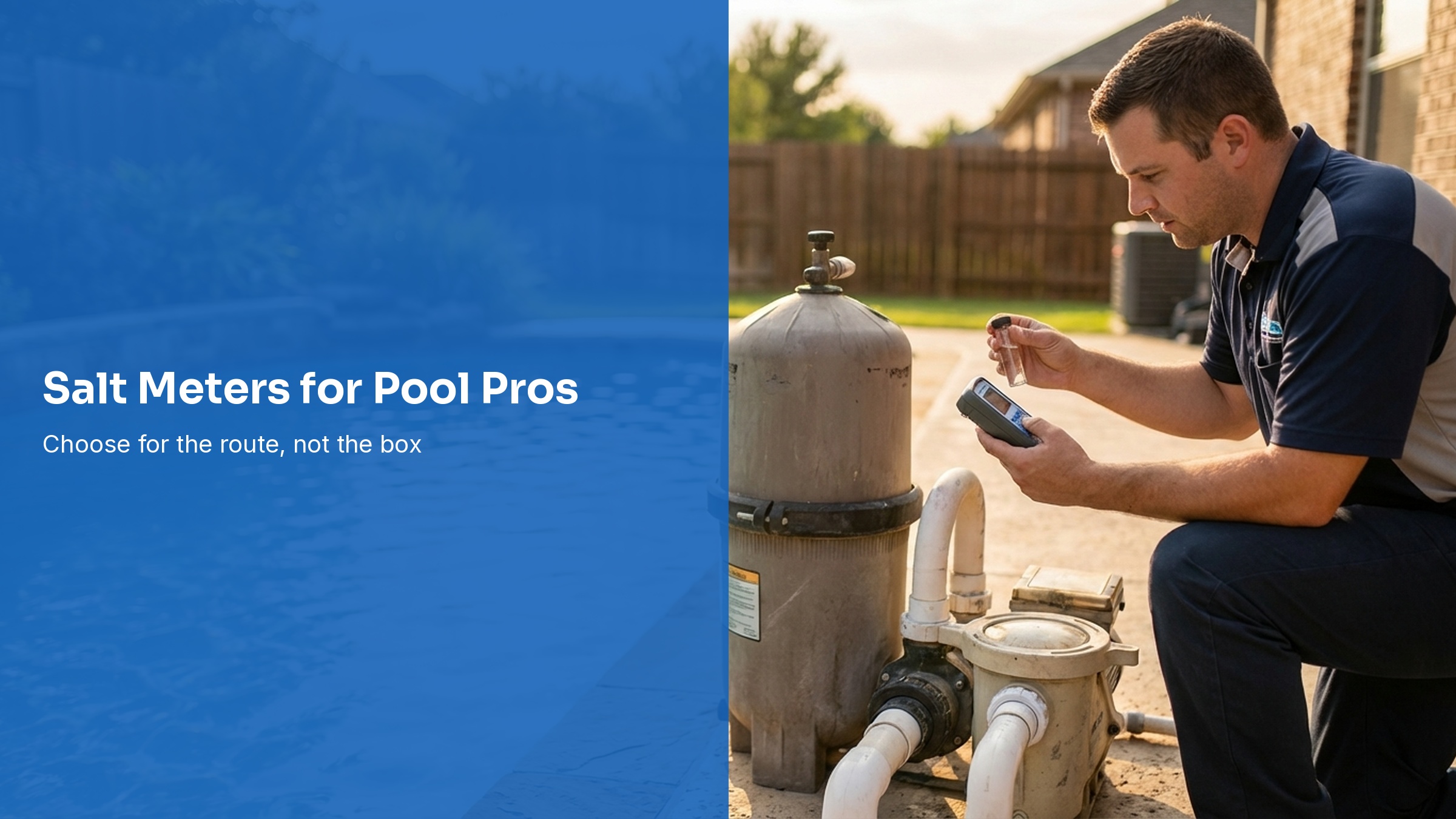
The best salt meter for a pool route is not always the most expensive one. It is the tester your technicians can use correctly, verify, maintain, and replace without turning one disputed salt reading into a callback.
Pool pros in a recent discussion named everything from disposable titrator strips to recalibratable pens and professional waterproof instruments. Their answers point to five buying questions: Does the tool test salt or only general TDS? Can it be calibrated? How well does it survive a wet route? Can the sensing part be replaced? What will the company use to verify a surprising result?
This comparison uses current manufacturer specifications and direct pricing where the maker publishes it. It is not an independent laboratory test. Prices and warranties can change, so confirm them before ordering.
Quick Picks
- Best simple route test: AquaChek Salt Titrators for teams that value a disposable method and do not need TDS.
- Best low-cost digital salt meter: eSeasonGear SALT-3050 for a recalibratable, salt-only pen.
- Best serviceable professional pen: LaMotte 1749 TRACER for salt, TDS, conductivity, temperature, memory, and a replaceable electrode.
- Best rugged professional pen: Myron L ULTRAPEN PT1 for selectable NaCl modes, one-percent stated accuracy after wet calibration, and IP67 protection.
- Best non-digital check: Taylor K-1766 drop test for confirming a result when a cell and meter disagree.
Salt and TDS Are Not the Same Reading
A conductivity sensor measures how well the water carries an electrical current. The meter then applies a conversion model to display conductivity, total dissolved solids, or salinity. Pool salt is mostly sodium chloride, but total dissolved solids include more than sodium chloride.
That means a cheap pen labeled "TDS" is not automatically a pool salt meter. Look for a dedicated salt or NaCl mode, the correct range for the pools you service, and a calibration standard near normal operating salt levels. If the manual does not explain the conversion, do not assume the displayed ppm is interchangeable with the salt reading from a chlorinator.
One thread reply made the team's simple choice clear.
AquaChek says its White Salt Titrators measure sodium chloride from 400 to 7,000 ppm. They need no battery, probe, or calibration solution. The tradeoff is ongoing strip cost, a slower titration-style read, expiration and storage management, and less convenient digital documentation.
Professional Salt and TDS Meter Comparison
| Tool | What it measures | Published salt range | Calibration and protection | Published price |
|---|---|---|---|---|
| AquaChek Salt Titrators | Sodium chloride | 400 to 7,000 ppm | Disposable strip, no electronic calibration | Dealer pricing |
| eSeasonGear SALT-3050 | Salt and temperature | 0 to 9,999 ppm | Recalibrates with 3,000 ppm solution, IP65 | $49.99 list, $33.96 sale when checked |
| LaMotte 1749 TRACER | Salt, TDS, conductivity, temperature | 0 to 9,999 ppm | Self calibration, replaceable electrode, automatic temperature compensation | Dealer pricing |
| Myron L ULTRAPEN PT1 | Salt, TDS, conductivity, temperature | 0.0010 to 10.000 ppt salinity | Wet calibration, NaCl mode, IP67 and NEMA 6 | $231 on the maker's January 2025 price list |
| Taylor K-1766 | Sodium chloride by drop test | One drop equals 200 ppm | Reagent-based argentometric test | $53.92 when checked |
Prices were checked on August 5, 2026. The Myron amount comes from the current price-list link on its product page, but the PDF itself is dated January 1, 2025. Treat every amount as a comparison point, not a quote.
Best Low-cost Digital Pick: eSeasonGear SALT-3050
The SALT-3050 is a focused tool. Its manufacturer says it is built for saltwater pools and koi ponds, reads 0 to 9,999 ppm, uses automatic temperature compensation, and carries an IP65 rating. It is not a general TDS meter. That limitation can be a benefit if the goal is a clear NaCl reading without extra modes.
eSeasonGear publishes a recalibration procedure using 3,000 ppm solution and recommends checking or calibrating monthly at room temperature. It also warns that IP65 is not the same as immersion protection. Collect the sample in a cup and dip only to the stated depth.
This is the practical choice for a company that wants several inexpensive route meters and is willing to manage a monthly verification routine. Keep a spare because the probe is not listed as a replaceable field component.
Best Serviceable Pen: LaMotte 1749 TRACER
LaMotte's 1749 TRACER measures salinity and TDS from 0 to 9,999 ppm and also reads conductivity and temperature. The manufacturer states two-percent accuracy for salt and TDS, automatic temperature compensation, self calibration, storage for 25 readings, and a replaceable EC/TDS/salt electrode.
The replaceable electrode is the important ownership difference. A company can replace the sensing part instead of throwing away the full instrument. The memory function may also help a technician confirm what was on the screen before entering the visit result.
That is one field report, not a reliability study. It does reinforce a good rule for every pen: the stated water resistance applies only when caps, seals, and battery compartments are installed correctly. A wet test tool should still be rinsed, dried, capped, and stored in a protected case.
Best Rugged Professional Pen: Myron L ULTRAPEN PT1
The PT1 has separate modes for conductivity, TDS using a natural-water model, TDS using sodium chloride, and salinity using either model. For pool salt, the selectable NaCl mode removes some of the ambiguity found in generic TDS pens.
Myron publishes an accuracy of plus or minus one percent of the reading after wet calibration, a 10-to-20-second stabilization time, automatic temperature compensation to 25 degrees Celsius, and IP67 and NEMA 6 water protection. The aluminum body is designed as a one-button professional instrument. It is the highest-priced option in this group, so it makes the most sense when repeatability, ruggedness, and multiple water-quality modes justify the investment.
Why Strips Still Belong on the Truck
Digital is not automatically more dependable. A digital number can look precise while the probe is dirty, the calibration is old, the wrong mode is selected, or the sample has not reached a stable temperature. A strip has its own weaknesses, but it gives the technician a different method.
Carry either fresh salt titrator strips or a Taylor K-1766 as a second method. The Taylor kit reports in 200 ppm increments. It is slower than a pen, but useful when a salt cell, automation screen, and handheld meter disagree.
A Better Route Testing Procedure
Salt-meter quality check
- Collect a clean sample. Follow the instrument maker's sampling depth and container instructions.
- Confirm the mode. Use salt or NaCl mode, not a generic TDS conversion, when testing pool salt.
- Wait for stability. Let temperature compensation and the displayed reading settle.
- Question surprises. If the result would trigger a large salt addition, confirm it with another method first.
- Compare with the equipment. A large gap may indicate a scaled cell, sensor issue, wrong average, calibration problem, or testing error.
- Record the method. Save the value, tool, mode, and any confirmation test in the service report.
- Rinse and store. Follow the manual for probe cleaning, drying, cap placement, and calibration frequency.
Independent testing matters when handling an incorrect AquaRite salt reading or another chlorinator alert. Never add a large amount of salt from one unexpected display.
PoolDial's chemical tracking can store salt readings with the rest of the visit chemistry. Consistent records help the office see whether one pool changed or one technician's meter changed.
How to Choose for Your Company
Choose strips
If training simplicity matters most and you only need salt, standardize the lot, storage, timing, and reading method.
Choose SALT-3050
If you need a low-cost digital salt value and can support routine calibration and careful handling.
Choose LaMotte
If replaceable sensing hardware, several modes, and reading memory matter to the service department.
Choose Myron
If rugged construction, selectable solution models, and the strongest published accuracy in this group justify the price.
The best company setup may be one professional meter at the shop, simpler route tools in each truck, and a drop or strip method for confirmation. Standardize the process, not only the brand. That is how the meter becomes evidence instead of another opinion when diagnosing the most common salt chlorinator problems.
Make Every Reading Part of the Record
PoolDial keeps chemistry results, chemical additions, service notes, and customer history together for every pool on the route.
Start Your Free Trial