
Pool Heater Repair vs. Replace: When to Swap the Heat Exchanger and When to Sell a New Unit


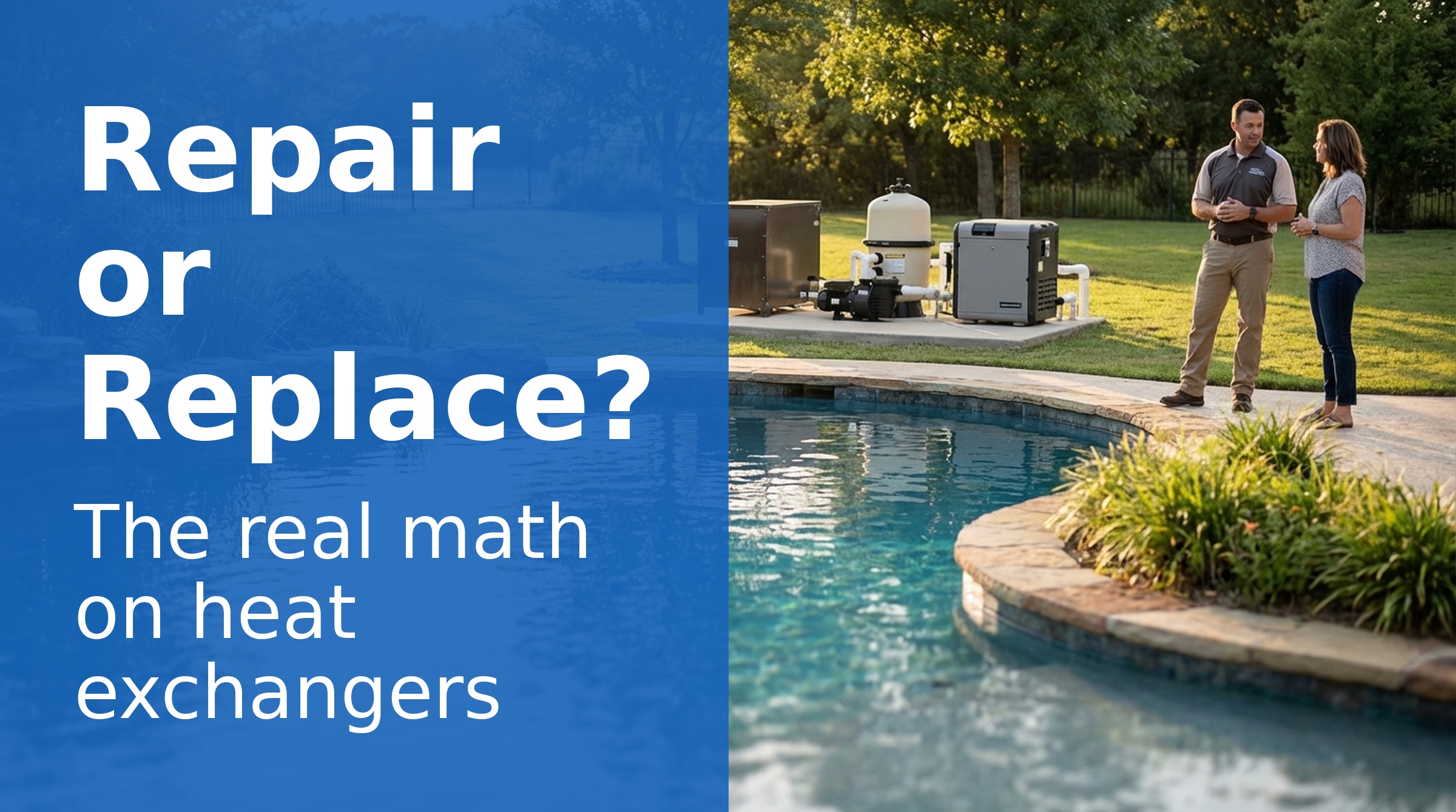
A customer calls with no heat. You open the heater, find a cracked heat exchanger leaking into the combustion chamber, and now you have a decision to make — and more importantly, a recommendation to give. Do you quote the repair, quote a new unit, or present both and let the homeowner decide?
This question comes up constantly among pool service professionals, and the answer depends on the specific heater, the condition of everything around the exchanger, and what your client actually cares about. Here's how experienced techs think through it.
Key Takeaways
- Heat exchanger repair typically runs 60-70% the cost of a new unit — Once you add labor, parts markup, and the extras you'll find once you open it up, the savings shrink fast
- The Jandy JXI is notoriously difficult to work on — First-timers can easily spend 6+ hours. Many experienced pros avoid repairing them entirely and sell a MasterTemp instead
- Present both options with real numbers — "$1,800 repair vs. $3,500 new unit with full warranty" lets the client make an informed decision and builds trust
- It's rarely just the heat exchanger — When the tube bundle fails and floods the combustion chamber, expect collateral damage to the ignitor, blower, sensors, and refractory
The Math: Repair vs. Replace
Let's look at real numbers. A Jandy JXI 260 wholesales around $2,800. The heat exchanger tube bundle alone is roughly $1,000. The full combustion chamber assembly — which includes the heat exchanger, refractory panels, and associated hardware — runs about $1,500.
Now add labor. Even experienced techs report 3-6 hours on a JXI heat exchanger swap, depending on what else they find inside. At typical service rates with parts markup, that repair bill lands between $1,800 and $2,500. Compare that to a full replacement installed at $3,500 to $4,500 with a clean manufacturer warranty.
| Cost Factor | Repair (Exchanger Swap) | Full Replacement |
|---|---|---|
| Heat exchanger / tube bundle | $1,000 – $1,500 | Included |
| Additional parts (ignitor, sensors, gaskets) | $200 – $600 | Included |
| Labor (3-6 hrs repair vs. 2-3 hrs swap) | $450 – $900 | $300 – $450 |
| New unit (wholesale) | — | $2,400 – $3,200 |
| Total to customer | $1,800 – $2,500 | $3,500 – $4,500 |
| Warranty | Parts only, no labor | Full manufacturer warranty |
| Risk of additional failures | Moderate to high | Low |
At first glance the repair looks like a clear win — save the client $1,500+. But that 60-70% ratio is the critical threshold. Once a repair exceeds about 60% of the replacement cost, most pros lean toward recommending the new unit because the warranty alone closes most of the remaining gap.
It's Never Just the Heat Exchanger
This is the part that trips up techs who haven't done many exchanger swaps. When the tube bundle cracks and pool water floods the combustion chamber, it doesn't just sit there politely waiting for you to drain it.
Here's what commonly needs replacing alongside the heat exchanger:
- Fire brick / refractory panels — Pool water in the combustion chamber causes thermal shock damage to ceramic components. Hairline cracks may not be visible until the unit heats up
- Hot surface ignitor (HSI) — These are fragile and often corroded or cracked from exposure to moisture. At $50-80 each, replace it prophylactically
- Blower assembly — If water reached the blower motor or bearings, it may work initially but fail within weeks
- Temperature and pressure sensors — Corrosion from standing water affects sensor accuracy
- Header bypasses and gaskets — Any rubber or polymer component exposed to pool water chemistry in the combustion chamber should be inspected and likely replaced
Each of these adds $50-300 to the repair. More importantly, each one is a potential callback if you miss it. And callbacks on heater jobs are expensive — they require a truck roll, a diagnosis, and often another teardown of a unit you just reassembled.
The JXI Is a Special Case
The Jandy JXI comes up in every repair-vs-replace discussion for a reason: it's one of the most difficult residential heaters to work on.
Experienced technicians report 4-6 hours for a JXI heat exchanger swap, and that's after they've done several. First-timers can easily spend an entire day. The combustion chamber design uses stacked refractory panels that must go back in a specific order, and the tube bundle sits deep inside the unit with minimal working room.
This isn't a knock on Jandy — the JXI is an efficient heater when it's working. But from a service professional's perspective, the labor economics of repairing one are unfavorable compared to units like the Pentair MasterTemp or Hayward H-Series, which are designed with more accessible internals. If you're using equipment tracking to log service history, you'll start to see patterns in which models generate the most repair callbacks.
When Repair Makes Sense
Despite everything above, there are real scenarios where repairing the heat exchanger is the right call:
Budget-Conscious Client
Not every homeowner can write a $4,000 check on the spot. If the client genuinely can't afford a new unit, a well-executed repair at $1,800 keeps their pool heated. Just be transparent about the trade-offs. Document the conversation — work order notes that capture what you recommended and what the client chose protect you if something fails later.
Rest of the Heater Checks Out
If the unit is only 3-5 years old and the exchanger failure was caused by a specific water chemistry issue (low pH eroding copper tubes, for example) rather than age, the rest of the components may have plenty of life left. Fix the exchanger, fix the water chemistry, and the heater could run another 5+ years.
Pressure Test Before Reassembly
One smart practice: after installing the new exchanger but before reassembling the entire combustion chamber, pressure test the new tube bundle. If it holds, you can reassemble with confidence. If it doesn't — and defective parts do happen — you haven't wasted hours on a full rebuild.
Supply Shortages
During the COVID-era supply crunch, new heaters had 8-16 week lead times. When you can't get a new unit for months, repairing the existing one with available parts is the only option. The math changes entirely when "buy new" means "no heat until August." This is less common now, but supply chain disruptions still pop up — especially for specific models.
How to Present the Options
The best service techs don't make the decision for the client. They present clear options with real numbers and let the homeowner choose.
A few tips for the conversation:
- Lead with the diagnosis, not the price. Explain what failed and why. Then present options
- Be honest about the unknowns. "I won't know the full extent of the damage until I pull the exchanger. The $1,800 estimate could go up if I find additional problems inside"
- Mention the warranty difference. A new unit comes with a full manufacturer warranty. A repair typically only covers the parts you replaced, not labor
- Don't pressure. If the client wants to think about it overnight, let them. Heater decisions aren't emergencies (most of the time)
- Document everything. Whatever they choose, note it in your work order system. "Presented Option A (repair, $1,800) and Option B (replace, $3,500). Client chose Option A."
A Decision Framework
When you're standing in front of a dead heater and need to give the client a recommendation, run through this checklist:
Repair vs. Replace Decision Checklist
- Age of the unit: Over 8-10 years old? Lean toward replacement. The exchanger won't be the last thing to fail
- Repair-to-replace cost ratio: Repair exceeds 60% of new unit cost? Replacement usually makes more sense
- Condition of other components: Corroded burner tray, damaged blower, cracked refractory? Those add-ons push the ratio higher
- Part availability: Can you get the exchanger in 1-2 days, or is it a 3-week backorder? Lead time matters
- Model serviceability: Is this a JXI (hard) or a MasterTemp (easier)? Factor in your own labor efficiency
- Client's long-term plans: Are they selling the house next year? Repair. Planning to stay 10+ years? Replace
- Warranty status: Still under manufacturer warranty? Always attempt the warranty claim first
- Your experience with this repair: Have you done this specific swap before? If not, factor in learning time — or refer it out
Use your equipment tracking records to quickly pull up the unit's age, model, and service history. Knowing that a heater has already had two repairs in the last three years changes the recommendation entirely.
Learning on Your Own Time
If you want to get comfortable with heater internals — especially the JXI — the advice from experienced techs is unanimous: practice on scrap units.
Some specific things to practice on scrap heaters:
- Full disassembly and reassembly of the combustion chamber
- Removing and reinstalling the tube bundle without damaging headers
- Identifying worn or corroded components by sight
- Practicing the exact fastener sequence for your most common heater models
- Timing yourself — if it takes 4 hours in the shop with no pressure, budget 6 hours in the field
You can also use the pool heater calculator to help clients understand their ongoing heating costs, which can factor into the repair-vs-replace conversation. If a newer, more efficient unit will save them $30-50 per month in gas, that changes the payback math on the higher upfront cost.
Track equipment age, service history, and warranty status
PoolDial's equipment tracking lets you log every heater, pump, and filter at each property — with install dates, model numbers, warranty expiration, and full service history. Know when to recommend repair vs. replace before you even arrive on site.
Start Your Free Trial