


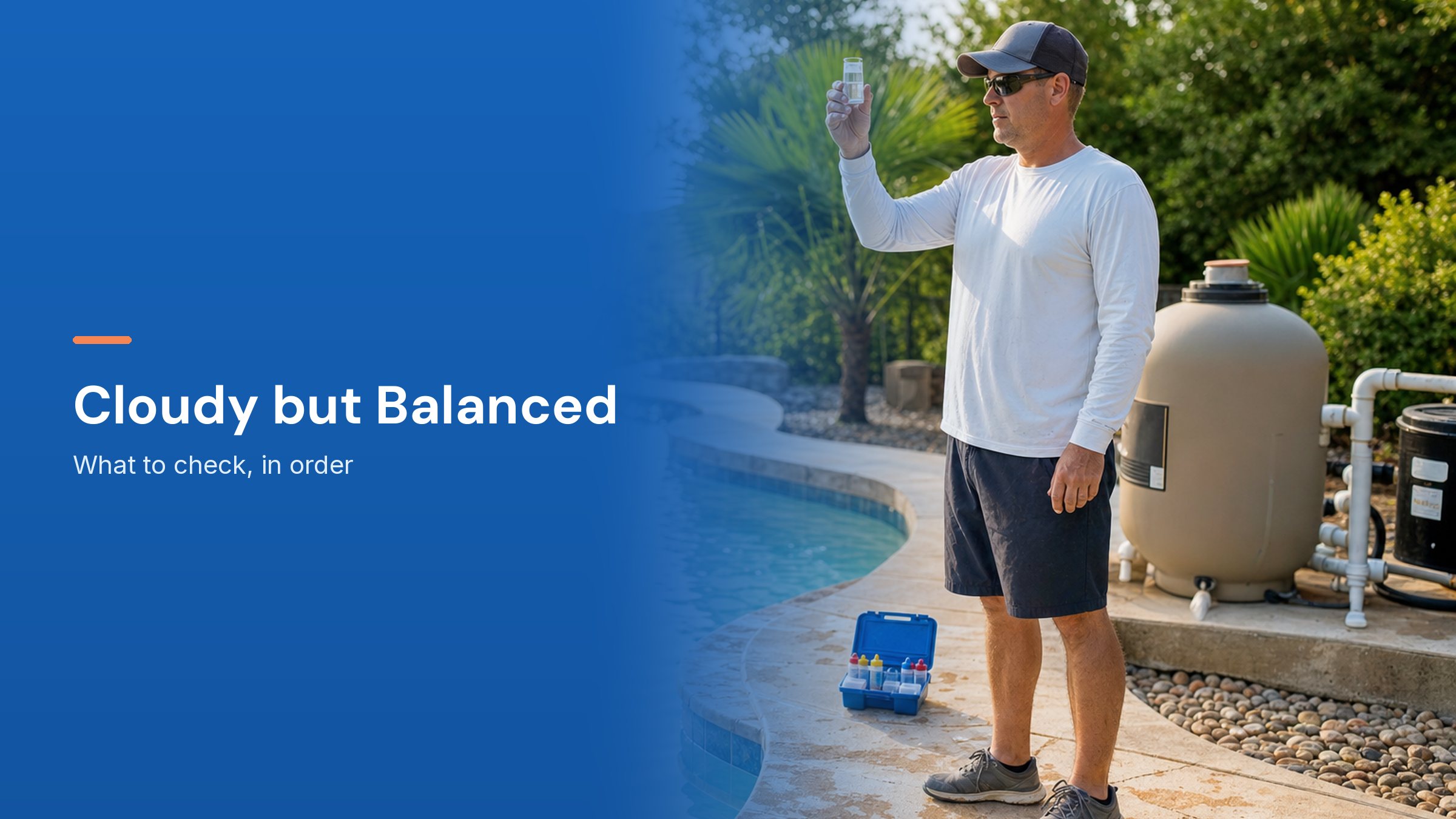
When a pool is cloudy and the test kit says everything is fine, the kit is usually right about what it measured. It just did not measure the problem. Cloudy water means tiny bits are floating in it. They come from three places: the filter is not catching them, the water is making them (calcium coming out of solution), or something keeps feeding them faster than chlorine and the filter can keep up.
So you work the call in order. Start with the cheap checks that fix most pools: run time and the filter. Then move to the numbers a basic test skips: saturation, stabilizer, combined chlorine and chlorine demand. Last, look at dust and old water. This guide walks that order, then covers when the family can swim and how to talk about it.
Key Takeaways
- Check the equipment before the bottle. Hayward lists only three fixes for water that will not clear: check chlorine, pH and alkalinity, make sure flow is high enough, and run the filter longer.[2]HaywardSwimClear Cartridge Filter Owner's Manual, ISC2031EF Rev B: Problem Solving List, "Pool water won't clear up." Read November 28, 2026.hayward.com manual
- A normal gauge does not prove the filter works. Channeled sand, a torn cartridge or a broken DE grid can let fine bits pass at a normal pressure.[4]Orenda TechnologiesHelp center article, "What causes cloudy pool water?" Read November 28, 2026.ask.orendatech.com
- White, milky cloud is often calcium. Orenda ties carbonate clouding to an LSI over +0.30, often right after soda ash, bicarb, cal hypo or a hot spa.[4]Orenda TechnologiesHelp center article, "What causes cloudy pool water?" Read November 28, 2026.ask.orendatech.com[5]Orenda TechnologiesBlog post, "Why does soda ash cloud up pool water?" Read November 28, 2026.blog.orendatech.com
- A good free chlorine number can still be weak. The public-pool code caps CYA at 90 ppm and closes a pool when CYA runs more than 45 times the free chlorine.[6]Centers for Disease Control and PreventionCheat Sheet for Calculating Scores for the Aquatic Facility Inspection Form, based on the 2024 Model Aquatic Health Code. Read November 28, 2026.cdc.gov
- TDS alone does not cloud water. Dissolved solids are invisible. Old water matters because it often carries high calcium and stabilizer too.[4]Orenda TechnologiesHelp center article, "What causes cloudy pool water?" Read November 28, 2026.ask.orendatech.com
- No swimming if you cannot see the main drain. After a shock, the label decides. One common shock says to wait until free chlorine is back to 1 to 4 ppm.[6]Centers for Disease Control and PreventionCheat Sheet for Calculating Scores for the Aquatic Facility Inspection Form, based on the 2024 Model Aquatic Health Code. Read November 28, 2026.cdc.gov[8]HTH PoolsShock Advanced product page with directions and FAQ. Read November 28, 2026.hthpools.com
Why "every reading looks fine" is usually half a test
When a tech says the readings look fine, it often means chlorine and pH. Sometimes alkalinity too. That is not enough to clear a cloudy pool, because most clarity problems hide in the numbers that were not run.
Before you add anything, get a full panel and write it down:
- Free chlorine and total chlorine, so you can work out combined chlorine
- pH, alkalinity, calcium hardness and water temperature, so you can work out the saturation index
- Cyanuric acid (CYA)
- Phosphates, if the pool keeps losing chlorine
- Salt and TDS on salt pools
- Filter type, filter pressure now and when clean, pump speed and hours of run time
The last line is not chemistry, but it solves more cloudy pools than any reagent. A common mistake is to post or report "levels are good" with no filter details. Another is to keep shocking for days while the real problem sits in the tank.
It also helps to know what the kit can and cannot tell you. A test is one sample, at one spot, at one time. Take it from elbow depth, away from a return, and repeat it if the result does not match what you see.
Check 1: Is the pump running long enough?
Turnover is the first thing to rule out. One turnover means all the water in the pool has passed through the filter once. Pentair's training manual gives the math: divide the pool's gallons by the minutes in your turnover time. A 30,000 gallon pool on an 8 hour turnover needs about 62.5 gallons per minute.[1]PentairSta-Rite Industries Basic Training Manual, third edition: turnover rate and gallons per minute, with the 30,000 gallon example. Read November 28, 2026.pentair.com Three turnovers in a day is an "8 hour turnover." Two turnovers is a "12 hour turnover."[1]PentairSta-Rite Industries Basic Training Manual, third edition: turnover rate and gallons per minute, with the 30,000 gallon example. Read November 28, 2026.pentair.com
Now compare that to the pad. Look at the pump's speed and its hours on the timer or automation. A variable speed pump set low to save power can move far less water than the owner thinks. A pool that ran 4 hours a day all spring may simply need more hours in summer heat.
Hayward's filter manuals list "Pool water won't clear up" as its own problem. The fixes are short: check chlorine, pH and alkalinity, make sure the flow through the filter is high enough, and run the filter longer.[2]HaywardSwimClear Cartridge Filter Owner's Manual, ISC2031EF Rev B: Problem Solving List, "Pool water won't clear up." Read November 28, 2026.hayward.com manual[3]HaywardPro-Grid Vertical DE Filter Series Owner's Manual, ISDE2423EF Rev E: Problem Solving List. Read November 28, 2026.hayward.com Commercial pools run around the clock for this reason. The public-pool code counts it as a violation when the pump or filter is not kept running 24 hours a day.[6]Centers for Disease Control and PreventionCheat Sheet for Calculating Scores for the Aquatic Facility Inspection Form, based on the 2024 Model Aquatic Health Code. Read November 28, 2026.cdc.gov
“The turnover rates in most states are six or four hours, depending on the body of water. In some states, they're still at 8.”
For a cloudy residential pool, many pros run the pump around the clock until it clears, then set a summer schedule that the pool can live with. Also check circulation, not just hours. Point returns to roll the water, open the main drain if the pool has one, and look for dead corners where haze lingers.
Check 2: Is the filter actually catching anything?
A clean pressure reading only tells you the filter is not clogged. It does not tell you the filter is catching fine bits. Orenda lists channeled sand, a torn cartridge and a broken DE grid as common reasons a pool stays cloudy, along with dead spots and an undersized system.[4]Orenda TechnologiesHelp center article, "What causes cloudy pool water?" Read November 28, 2026.ask.orendatech.com
What to look for on each type:
- Sand. Open it and look. Sand that has formed channels, clumped, or feels greasy is not filtering well. A backwash that runs clear in about a minute can be a sign that water is flowing through a channel, not the whole bed. Sand on the pool floor near a return points to a broken lateral. For the signs, the steps and the media choices, see when to change pool filter sand.
- Cartridge. Check that each element sits straight on its seat and is not twisted or sagging. Look for split pleats, loose end caps and cracked cores. An old element can pass fine bits while the gauge looks normal. Our filter cleaning guide covers when to clean and when to replace.
- DE. A torn grid or cracked manifold lets powder and fine dirt through. If DE shows up in the pool, the DE blowback section of our filter media guide walks through the parts to check.
Also think about size. Small filters on above ground pools, and small cartridges on big pools, can keep up on a normal week but not after a storm or a party. Some pros help a sand or cartridge filter catch finer bits by adding a small amount of DE as a filter aid. If you try that, check the filter maker's manual first, since some say not to.
One more filter trap: haze right after you clean the filter. Some loose dirt always falls into the line when the element comes out. Tell the customer before they see it.
“I warn every customer after a filter clean that there could be a small amount of blowback that will filter itself out within the day.”
Check 3: Is calcium coming out of the water?
If the cloud is white, milky or a little gray, think calcium. When water is oversaturated, calcium carbonate leaves the water as fine solid bits. Orenda calls this carbonate clouding and ties it to a saturation index (LSI) above +0.30. It often shows up after soda ash or bicarb, or when a spa heater is turned up.[4]Orenda TechnologiesHelp center article, "What causes cloudy pool water?" Read November 28, 2026.ask.orendatech.com
The trigger is often local, not pool-wide. Soda ash raises pH so fast that the water right where it lands goes over the limit, even if the pool as a whole is fine. Orenda's advice is to dissolve it first and add it slowly around the pool.[5]Orenda TechnologiesBlog post, "Why does soda ash cloud up pool water?" Read November 28, 2026.blog.orendatech.com The same thing can happen with any high pH product. Many pros have seen a pool turn milky for a short time after cal hypo hits high calcium water at a high pH, or after a bag of salt or bicarb is dumped in one spot.
So when the "fine" readings include a pH near the top of the range, high calcium and warm water, run the full LSI. Put temperature in it. A pool can look balanced on paper in spring and be over the line in August. Use our LSI calculator, and see the LSI guide for what each factor does.
Signs this is your cause:
- The haze is white, not green or yellow.
- It showed up right after a chemical went in, or after heat came on.
- A fine white dust settles on the floor or steps.
- The filter or salt cell is scaling faster than normal.
The fix is to bring the LSI back down with the tools you already use. That usually means lowering pH and sometimes alkalinity, per your product labels. Then let the filter catch the bits. If calcium is very high from years of cal hypo or hard fill water, the real answer may be a partial drain. Our guide on draining a pool safely covers when that is risky.
Check 4: Is the stabilizer too high for the chlorine?
Cyanuric acid protects chlorine from the sun. It also slows chlorine down. So a pool can show a normal free chlorine number and still not kill algae fast enough. The first sign of that is often a dull, hazy look a few days before anything turns green.
“When CYA gets too high, it can make chlorine less effective.”
The public-pool code gives you a yardstick. It cites a pool when CYA is over 90 ppm. It calls for closure when CYA is more than 45 times the free chlorine, and when CYA goes over 300 ppm.[6]Centers for Disease Control and PreventionCheat Sheet for Calculating Scores for the Aquatic Facility Inspection Form, based on the 2024 Model Aquatic Health Code. Read November 28, 2026.cdc.gov The CDC also sets a higher chlorine floor for stabilized water: at least 1 ppm in pools, but at least 2 ppm when CYA is used.[7]Centers for Disease Control and PreventionHealthy Swimming, "Home Pool and Hot Tub Water Treatment and Testing." Read November 28, 2026.cdc.gov Home pools are not held to the public code, but the math works the same way in the water.
Tab pools are the usual suspect, because every tab adds stabilizer. If the CYA test was skipped, run it. Then use our FC to CYA ratio calculator to see what free chlorine that pool really needs. If CYA is high, the only way down is fresh water. Our CYA calculator shows how much water to swap.
Bromine pools are different. The CYA math above is for chlorine, and the public code sets its own floor of 3 ppm bromine in pools.[6]Centers for Disease Control and PreventionCheat Sheet for Calculating Scores for the Aquatic Facility Inspection Form, based on the 2024 Model Aquatic Health Code. Read November 28, 2026.cdc.gov On a cloudy bromine pool, spend your time on run time, filter media, saturation and demand.
Check 5: Is there combined chlorine?
Combined chlorine is chlorine that has already reacted with sweat, urine and other waste. It still shows up in a total chlorine test, but it does little work. A pool with a lot of it can smell like "chlorine," feel harsh, and look dull.
To find it, run free chlorine and total chlorine. The gap is combined chlorine. The public-pool code wants it under 0.4 ppm.[6]Centers for Disease Control and PreventionCheat Sheet for Calculating Scores for the Aquatic Facility Inspection Form, based on the 2024 Model Aquatic Health Code. Read November 28, 2026.cdc.gov Test strips and low-resolution kits are not good at small gaps, so use a drop test with a large sample if you can.
“A combined chlorine of 1 ppm on a test that reads in 0.5 ppm steps is two drops, and CC is a difference between two readings, one of them 7 to 8 ppm.”
If combined chlorine is high, the usual fix is to raise free chlorine past breakpoint and keep the filter running. Our breakpoint chlorination calculator does the math. Follow the label on whatever you add. Indoor pools and heavy-use pools need fresh air too, or the problem comes right back. For the basics, see what combined chlorine is.
Check 6: Is something eating the chlorine?
Here is a clue many techs skip: "the readings are fine, but chlorine is low every visit." That is not fine. It means something in the water is using chlorine up. Common causes are early algae you cannot see yet, oils and lotions, leaves and pollen, and dead algae left over from a cleanup.
Orenda calls non-living organics, like sunscreen and body oils, the largest source of chlorine demand in pools.[4]Orenda TechnologiesHelp center article, "What causes cloudy pool water?" Read November 28, 2026.ask.orendatech.com On heavy-use pools, an enzyme product or a clarifier made for oils can help. On a pool with trees, check phosphates. Phosphates are algae food. They do not cloud water on their own, but a pool that keeps growing algae in the background can stay dull.
Be careful with the fix. Phosphate removers make the water cloudy for a while on purpose. That is the phosphate dropping out as a solid, and it has to be filtered or vacuumed.[4]Orenda TechnologiesHelp center article, "What causes cloudy pool water?" Read November 28, 2026.ask.orendatech.com
“Will probably cloud the water (as all phosphate treatments do) and may cause some powder settlement to be vacuumed.”
So warn the customer before you add it. Dose in steps on a weak filter, and clean the filter a day or two later.
Dead algae is its own problem. After a pool turns blue, the dead algae is so fine that many filters pass it, and the pool sits cloudy blue for days. At that point, more shock rarely helps. Many pros let it drop to the floor, then vacuum it out to waste. Our guides on floc versus clarifier and vacuuming to waste cover that step. If the pool was green and is still eating chlorine overnight, see our page on high chlorine demand on green pools.
Check 7: Is it dust, new plaster or something you added?
Some cloudy water is just fine solids that came in from outside or from the pool itself:
- New plaster. A fresh finish sheds plaster dust for weeks. That is normal, and it is a brushing and filtering job, not a shock job. Follow the startup steps in our new plaster startup guide.
- Wind and storms. Dust, pollen and dirt can be so light that they float for days. Orenda notes that oils can stick to small dirt and keep it floating.[4]Orenda TechnologiesHelp center article, "What causes cloudy pool water?" Read November 28, 2026.ask.orendatech.com
- Your own products. Too much clarifier, phosphate remover or undissolved granular shock can all leave a haze. If the cloud started right after a product went in, that product is your first suspect.
- A dumped bag. A bag of salt or bicarb dropped in one spot can make a white cloud that clears in minutes. That is the local saturation effect from Check 3, not a problem with the pool.
The fix for true dust is the filter. Run it longer, keep it clean, and if it is thick, use a clarifier or floc as our floc and clarifier guide lays out.
Check 8: Is the water just old?
Old water gets blamed a lot. TDS (total dissolved solids) climbs as water evaporates and chemicals go in. But dissolved solids are invisible. Orenda says TDS does not cause cloudiness. Only solids floating in the water do.[4]Orenda TechnologiesHelp center article, "What causes cloudy pool water?" Read November 28, 2026.ask.orendatech.com
So why does a partial drain sometimes fix a cloudy pool? Because old water usually carries more than TDS. It often has high calcium, which pushes the LSI up, and high CYA, which weakens chlorine. A drain and refill fixes both at once. On a salt pool, remember that salt is most of the TDS reading. Read our guide to salt and TDS meters for testing tips, and the TDS glossary entry for the basics.
Use TDS as a reason to look harder at calcium and CYA, not as the answer. If those are high and fresh water is soft, a partial drain is often the cheapest fix. Check that the pool and the ground can handle it first.
Quick guide: what the cloud looks like and where to look
Use the look of the water and the timing to pick your first check:
| What you see | Likely cause | Check first |
|---|---|---|
| Dull haze, chlorine fine, pump on low or short hours | Not enough turnover | Pump hours, speed and flow |
| Haze that never fully clears, normal pressure | Filter passing fine bits | Sand channels, cartridge seating, DE grids |
| White or milky, right after a chemical or heat | Calcium coming out of the water | Full LSI with temperature |
| Dull, then green in a few days, tab pool | CYA too high for the chlorine | CYA test and FC to CYA ratio |
| Dull with a strong chlorine smell | Combined chlorine | Free and total chlorine |
| Chlorine low every week, cloudy blue after algae | Demand or dead algae | Phosphates, organics, settle and vacuum |
| Cloud right after a product or new finish | Dust or product | What went in last, brush and filter |
Is it safe to swim in cloudy water, or right after a shock?
Customers will ask this on every cloudy call. Give them the same clear answer each time.
Cloudy water: if you cannot clearly see the main drain from the deck, no one should swim. The public-pool inspection form lists "water is clear, main drain visible" as an item, and a bottom that cannot be clearly seen is a violation.[6]Centers for Disease Control and PreventionCheat Sheet for Calculating Scores for the Aquatic Facility Inspection Form, based on the 2024 Model Aquatic Health Code. Read November 28, 2026.cdc.gov The reason is not germs. It is that a swimmer in trouble on the bottom cannot be seen. Home pools follow the same logic even though no inspector checks them.
Being able to see the drain is the floor, not the bar. Clear water with no chlorine is still not safe. The CDC calls for at least 1 ppm free chlorine in pools, or 2 ppm when stabilizer is used, with pH from 7.0 to 7.8.[7]Centers for Disease Control and PreventionHealthy Swimming, "Home Pool and Hot Tub Water Treatment and Testing." Read November 28, 2026.cdc.gov
Green water: no swimming. Green means the chlorine lost, and you usually cannot see the drain either.
Right after a shock: the product label decides. HTH's Shock Advanced, for example, says not to enter the pool until free chlorine is back to 1 to 4 ppm. Its FAQ says that often takes 8 to 24 hours, depending on dose, sun and pool size.[8]HTH PoolsShock Advanced product page with directions and FAQ. Read November 28, 2026.hthpools.com Other products and liquid chlorine have their own labels, so read the one you used. On public pools, the code says free chlorine may not go over 10 ppm while the pool is open.[6]Centers for Disease Control and PreventionCheat Sheet for Calculating Scores for the Aquatic Facility Inspection Form, based on the 2024 Model Aquatic Health Code. Read November 28, 2026.cdc.gov Test before you tell anyone it is fine. Do not guess from the clock.
After floc: keep everyone out until the floc has settled, been vacuumed and the water is clear. Our floc guide covers wait times by product.
Protect yourself here. When you shock or floc, tell the customer in writing that the pool is closed and why. Leave the reading you took and the time. If they swim anyway, you have a record that you told them. If a pump is down and you shock to hold the pool, say so in the same message so they are not surprised by a strong chlorine smell.
How to explain it and what to charge
A cloudy pool with good readings is a trust problem as much as a water problem. The customer sees a pool that looks wrong, and a tech who says the numbers are fine. Close that gap by telling them what you checked and what you found.
A simple message works: "Your chlorine and pH were good. The cloud is coming from the filter sand, which has worn out. I ran the pump longer for now. Here is a quote for new sand." Add a photo of the haze and of the filter. That turns a complaint into an approved repair.
When the fix is extra work, bill it. On poolrates.fyi, pool pros reported an average service call fee of about $162 (10 prices) and an average hourly rate of about $139 (12 prices). A cartridge filter clean averaged about $137 (15 prices), and a sand change with sand and parts averaged about $945 (5 prices).[9]poolrates.fyiRepair and one-time job prices shared by pool pros, January to October 2026: service call fee (10 prices), hourly rate (12), cartridge filter clean (15) and sand change with sand and parts (5). Averages worked out by PoolDial.poolrates.fyi The sand change average comes from only a few prices, so treat it as a rough guide.
Decide ahead of time what your monthly rate covers. Many companies include one extra trip for a cloudy pool and charge for return visits, filter work and specialty products after that. Put it in your service agreement so the call is easy.
The bottom line
When the pool is cloudy and the readings look fine, stop adding shock and start checking in order. Run time and filter first. Then the full LSI, CYA against free chlorine, combined chlorine and chlorine demand. Then dust, new plaster and old water. Most pools clear at the first or second step. Keep people out until you can see the drain and the chlorine is back in range, and write down what you found so the next visit starts ahead.
Sources
- [1]Pentair, Sta-Rite Industries Basic Training Manual, third edition: turnover rate and gallons per minute, with the 30,000 gallon example. Read November 28, 2026. pentair.com (PDF)
- [2]Hayward, SwimClear Cartridge Filter Owner's Manual, ISC2031EF Rev B: Problem Solving List, "Pool water won't clear up." Read November 28, 2026. hayward.com manual (PDF)
- [3]Hayward, Pro-Grid Vertical DE Filter Series Owner's Manual, ISDE2423EF Rev E: Problem Solving List. Read November 28, 2026. hayward.com (PDF)
- [4]Orenda Technologies, Help center article, "What causes cloudy pool water?" Read November 28, 2026. ask.orendatech.com
- [5]Orenda Technologies, Blog post, "Why does soda ash cloud up pool water?" Read November 28, 2026. blog.orendatech.com
- [6]Centers for Disease Control and Prevention, Cheat Sheet for Calculating Scores for the Aquatic Facility Inspection Form, based on the 2024 Model Aquatic Health Code. Read November 28, 2026. cdc.gov (PDF)
- [7]Centers for Disease Control and Prevention, Healthy Swimming, "Home Pool and Hot Tub Water Treatment and Testing." Read November 28, 2026. cdc.gov
- [8]HTH Pools, Shock Advanced product page with directions and FAQ. Read November 28, 2026. hthpools.com
- [9]poolrates.fyi, Repair and one-time job prices shared by pool pros, January to October 2026: service call fee (10 prices), hourly rate (12), cartridge filter clean (15) and sand change with sand and parts (5). Averages worked out by PoolDial. poolrates.fyi