


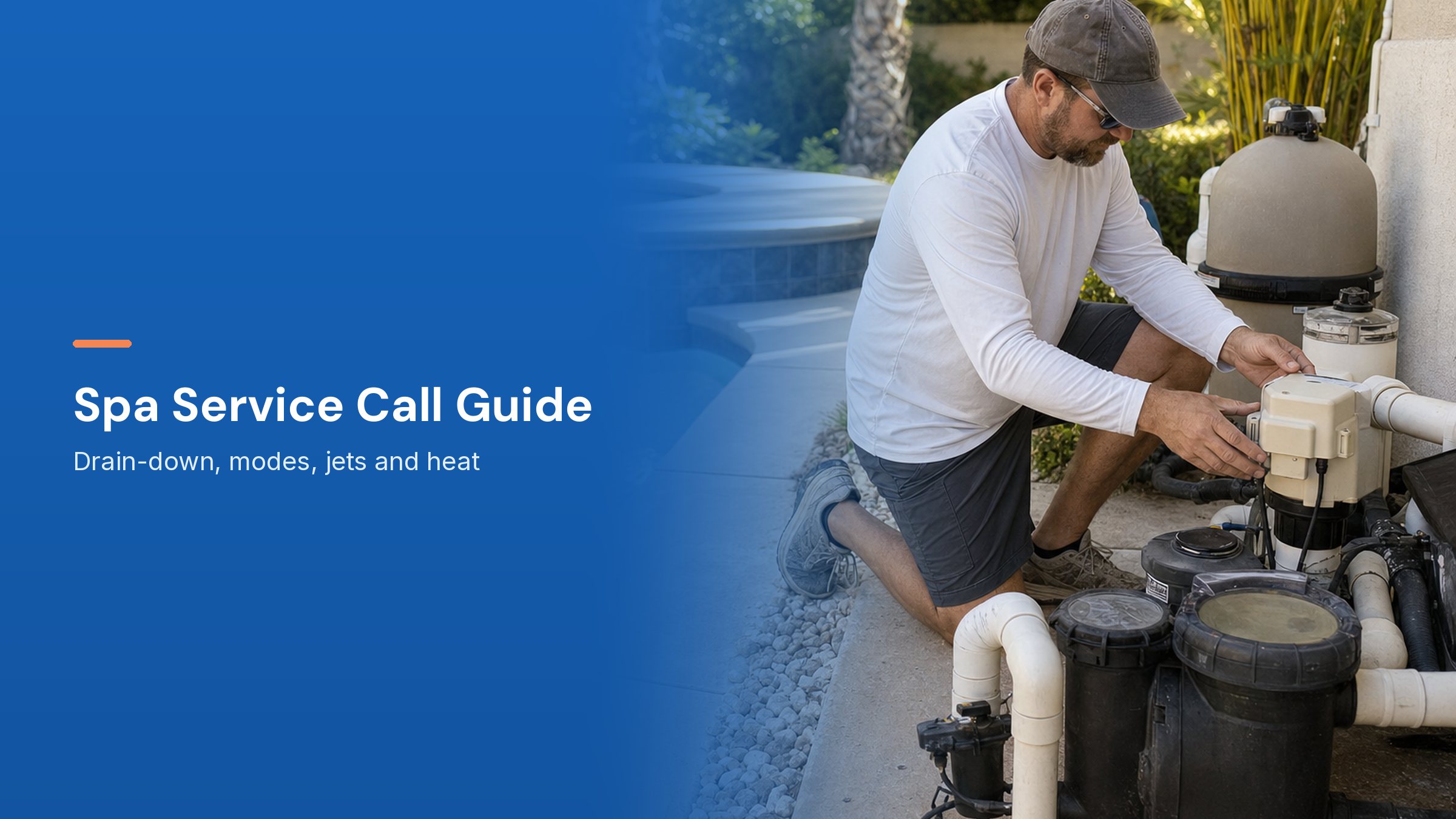
A raised spa that drains into the pool overnight is almost never a leak. The water is going back to the pool through the plumbing once the pump stops. A check valve is not sealing, a valve is not fully closed, or air is getting into the pad and letting the water fall back. If the pool comes up as the spa goes down, you have a transfer, not a leak.
The same few parts cause most other spa calls too: actuators, automation and heater settings. This guide walks the pad in the order that finds the problem fastest, using the manuals for anything with a setting.
Key Takeaways
- Check the pool level first. If the pool rises as the spa falls, the water is moving between the bodies. If it does not, treat it as a leak.
- Where the spa stops tells you which line. Below the jets means the suction side, where a return check valve will not help.
- Actuators are a top suspect. Jandy lists a motor that runs while the valve diverter does not turn as a cause of a spa draining or overflowing.[1]Jandy (Zodiac)Pro Series Valve Actuator JVA 2444 Installation and Operation Manual, H0570800 Rev J: synchronization, cam settings, maintenance and troubleshooting.assets.poolweb.com
- Air at the pad can drain a spa. Water held in a pipe falls once air can get in, just like lifting your finger off a straw.
- A spa that switches modes on its own is often a spa-side remote, a schedule or freeze protection. Rule those out before you replace a board.
- Heat-up math is simple. One Btu raises one pound of water one degree, and a gallon weighs 8.34 pounds.[7]U.S. Energy Information AdministrationBritish thermal units (Btu), Energy Explained: definition of one Btu.eia.gov[8]U.S. Geological SurveyCircular 1268, Estimated Use of Water in the United States in 2000, conversion factors: 1 gallon of water = 8.34 pounds.pubs.usgs.gov
First question: is the water going into the pool?
Before you touch a valve, ask one thing. When the spa drops, does the pool come up?
- Yes, the pool rises. The water is moving from the spa to the pool. Nothing is leaving the system. This is a valve, check valve or air problem.
- No, the pool stays the same or drops. Water is leaving the system. Work it as a leak. Our guide on how to find a pool leak covers the bucket test, dye and pressure testing.
- Not sure. Mark the pool and spa water lines with tape before the pump shuts off. Check both on the next visit.
Many customers call this a leak. A few questions and a photo of the pad can save them a leak detection bill.
“So I ask them a bunch of questions ahead of time. I'll ask for a couple pictures, and I'll go through a few obvious things. And I've had people, we figure it out before I even go over there, and they're super grateful that I didn't just sell them on the leak detection.”
Why a raised spa drains into the pool when the pump is off
A raised spa and a pool share plumbing at the pad. When the pump runs, it pushes water up into the spa. When the pump stops, gravity pulls the spa water back down through any open path. The water stops moving once the two levels match, or once the water falls below the opening it is draining through.
Three things are supposed to stop this:
- Check valves on the spa return lines. They let water flow toward the spa and close when it tries to flow back.
- The valves at the pad, often three-way valves turned by actuators. In pool mode they should seal the spa lines off.
- A tight, airtight pad. A full pipe can hold water up as long as no air gets in. Cap a full straw with a fingertip and nothing falls out. Let air in and it drains. A small air leak at the pad does the same.
Many spas have more lines than the builder checked. A spillway line, a separate jet line or a floor cleaner zone can each carry water back. A common find is a check valve on the main spa return and none on the spillway feed.
Read where the spa stops
Let the spa settle with the pump shut down and note the height where the water holds. That height points to the line it is leaving through.
| Where the spa water stops | What it points to | Check first |
|---|---|---|
| Just below the return jets | Water is leaving back through the return lines | Spa return check valve, return valve seal, return actuator position |
| Just below a spillway, fountain or high fitting | A line with no check valve or a bad one | Whether that line has a check valve at all, and its valve at the pad |
| Below the returns, down toward the floor | Water is going back through the spa drain or suction side | Suction valve diverter and seal, suction actuator, air leaks on the suction side |
| Level with the pool every time | The spa is fully open to the pool | Valve set wrong, actuator stuck in a middle spot, broken diverter |
| At a light or keeps dropping and the pool does not rise | Water is leaving the system | Work it as a leak: light niche, conduit, shell cracks, lines |
A check valve on a return line cannot stop water that is draining out through the spa drain. If the spa drops below the jets, your problem is on the suction side or in the air.
The isolation test that settles it
- Fill the spa to spillover.
- Shut the pump off.
- Close the spa return valve by hand. If the spa drain has its own valve, close that too.
- Check the level on the next visit, or after a few hours.
If the spa holds with its valves closed, it is not leaking. Water is backing up through the plumbing. Open one valve at a time on later visits to learn which side leaks by. If it drops with every valve closed, look for a real leak: jets, light, air line or shell.
Closing the return by hand also works as a stopgap until the part arrives.
The order of checks on the pad
Once you know it is a transfer, walk the pad in this order.
1. Look at the actuators and handles
Look down at each valve from above. In pool mode, the spa ports should be closed. On a Jandy valve, the end of the handle marked OFF is shaped like the diverter inside. When the handle is on the shaft, OFF sits right over the center of the diverter.[1]Jandy (Zodiac)Pro Series Valve Actuator JVA 2444 Installation and Operation Manual, H0570800 Rev J: synchronization, cam settings, maintenance and troubleshooting.assets.poolweb.com If OFF is not lined up with the spa port in pool mode, the diverter is not sealing it.
Actuators can stop a little short of a full seal, or turn too far. Even a small gap lets the spa drain. If the motor runs but the diverter does not turn, Jandy lists a broken actuator shaft, a broken diverter, the actuator left in manual, or a damaged gear train. Its manual notes that on a pool and spa, that problem shows up as the spa draining or overflowing.[1]Jandy (Zodiac)Pro Series Valve Actuator JVA 2444 Installation and Operation Manual, H0570800 Rev J: synchronization, cam settings, maintenance and troubleshooting.assets.poolweb.com
2. Open the check valves
Pull the lid on each spa check valve and look inside. Common finds:
- A flapper that is torn, warped, stuck open or missing.
- Old glue that dripped into the valve body when it was installed. The flapper cannot seat on it, so a new flapper will not fix it.
- Leaves, a pebble or a broken piece of something holding the flapper open.
- A replacement flapper from a different brand. Flappers do not swap between brands. Match the part to the valve body.
- A check valve installed backward, or on the wrong line.
“You're missing the flapper in the check valve.”
New parts can be bad parts. If a new check valve worked for a few weeks and the problem came back, open that valve again first.
3. Open the three-way valves
If the check valves look good, take the lids off the three-way valves. The rubber seal on the diverter wears out. Glue, grit or a stick can hold the diverter off its seat. The top cap can warp with age.
Jandy says the seals in its greased valves need lube at least every three months, and the valve should be taken apart and checked once a year. Its Never Lube valves are the exception.[1]Jandy (Zodiac)Pro Series Valve Actuator JVA 2444 Installation and Operation Manual, H0570800 Rev J: synchronization, cam settings, maintenance and troubleshooting.assets.poolweb.com A dry seal can also make an actuator handle shake back and forth, which the manual lists as a sign of a valve that needs lube or has something stuck in it.[1]Jandy (Zodiac)Pro Series Valve Actuator JVA 2444 Installation and Operation Manual, H0570800 Rev J: synchronization, cam settings, maintenance and troubleshooting.assets.poolweb.com
Many pros buy a whole new valve and move its insides into the old body. It often costs about the same as a rebuild kit.
4. Hunt for air leaks
If the valves and check valves are good, the spa is probably pulling air into the pad when it sits. Air lets water in the pipes fall back to the pool, and the spa follows it. Look at the filter air relief, pump lid, unions, valve lids and any threaded fitting such as a temperature sensor port. A pad that loses prime overnight is a strong clue.
“Get the hose and run water over anywhere you suspect is getting air. Look at the pump lid as you run water over the pipes, valves, unions etc. When the air bubbles go away you found the leak.”
A joint can be watertight under pressure and still let air in under suction. Last, make sure the automation is not turning itself to spa suction at night. That drains the spa through its drain line. The next sections cover it.
Valve actuators: stopping short, turning the wrong way, or not moving
Most actuators on pool and spa pads are 24-volt motors with two cams inside. The cams set where the valve stops in each direction. On the Jandy JVA, the upper cam stops counterclockwise travel and the lower cam stops clockwise travel.[1]Jandy (Zodiac)Pro Series Valve Actuator JVA 2444 Installation and Operation Manual, H0570800 Rev J: synchronization, cam settings, maintenance and troubleshooting.assets.poolweb.com A toggle switch on the bottom has ON 1, OFF and ON 2 positions.[1]Jandy (Zodiac)Pro Series Valve Actuator JVA 2444 Installation and Operation Manual, H0570800 Rev J: synchronization, cam settings, maintenance and troubleshooting.assets.poolweb.com
If the valve is plumbed and mounted the standard way, Jandy says you should not need to reset the cams. If another port is the common port, or the actuator is mounted another way, the cam setting must change so the diverter turns to the right spots.[1]Jandy (Zodiac)Pro Series Valve Actuator JVA 2444 Installation and Operation Manual, H0570800 Rev J: synchronization, cam settings, maintenance and troubleshooting.assets.poolweb.com Hayward says the same for actuators on an OmniLogic: the cams may need to be set for how the actuator sits on the valve.[4]HaywardOmniLogic Installation Manual (HLBASE): valve actuator cams, filter pump off for valve change and spillover setup.royalswimmingpools.com Jandy also warns that bad cam settings can dead-head the pump.[1]Jandy (Zodiac)Pro Series Valve Actuator JVA 2444 Installation and Operation Manual, H0570800 Rev J: synchronization, cam settings, maintenance and troubleshooting.assets.poolweb.com
| What you see | Likely causes (per the Jandy manual) | First check |
|---|---|---|
| Suction goes to spa while return goes to pool, or the reverse | Actuators out of sync with each other | Flip the toggle on the actuator that is backward to ON 2 and retry |
| Motor runs, valve does not turn | Broken shaft or diverter, actuator in manual, damaged gears | Pull up on the handle while turning it counterclockwise |
| Motor does not turn at all | No power, toggle in OFF, failed motor or microswitch, both cams on their switches | Look at the toggle and the cam settings |
| Turns one way but not back | Bad microswitch, bad connection, bad relay, broken wire | Have the control and wiring checked |
| Water inside the actuator | Damaged seals | Replace the top lid and grease the seals |
Those causes come from the manual's troubleshooting chart.[1]Jandy (Zodiac)Pro Series Valve Actuator JVA 2444 Installation and Operation Manual, H0570800 Rev J: synchronization, cam settings, maintenance and troubleshooting.assets.poolweb.com Voltage and wiring checks are electrical work. Leave them to someone licensed for it, per the manual and local code.[1]Jandy (Zodiac)Pro Series Valve Actuator JVA 2444 Installation and Operation Manual, H0570800 Rev J: synchronization, cam settings, maintenance and troubleshooting.assets.poolweb.com
If a new actuator goes in and the panel dies soon after, stop swapping parts. Call the control maker's tech line. Off-brand actuators are a common thread in these calls.
Why the system won’t switch to spa mode, or switches on its own
When the pad goes to spa by itself, or ignores the spa button, check these in order:
- The spa-side remote. Old wired spa-side remotes are a well-known cause of ghost commands. Water gets into the switch and it presses buttons on its own. On a Jandy AquaLink RS, button 1 on the spa side switch is set to Spa by default.[2]Jandy (Zodiac)AquaLink RS All Button and OneTouch Control Systems Installation Manual (6594): spa spillover DIP switch, spa side switch defaults and freeze protection defaults.cdn.shopify.com Pentair's IntelliCenter has a setting to turn spa side control on or off.[3]PentairIntelliCenter Control System User's Guide, P/N 522990.D (12/2020): delay settings, spa side control and feature circuits.images.inyopools.com Turning it off in the settings is a clean test. If the problem stops, the remote is the cause. Ask the customer where every remote is.
- Schedules and other controls. Check every schedule, the indoor panel, the app and any wireless remote.
- Freeze protection. On an AquaLink RS, if the spa is set for freeze protection, flow switches between pool and spa every 30 minutes once freeze mode is on.[2]Jandy (Zodiac)AquaLink RS All Button and OneTouch Control Systems Installation Manual (6594): spa spillover DIP switch, spa side switch defaults and freeze protection defaults.cdn.shopify.com A spa that drains on cold nights may just be doing what it was told. Pentair lets you set a spa freeze override time as well.[3]PentairIntelliCenter Control System User's Guide, P/N 522990.D (12/2020): delay settings, spa side control and feature circuits.images.inyopools.com See our guides to AquaLink RS freeze protection and IntelliCenter freeze protection.
- Valve delay. Most systems shut the pump off while valves turn. IntelliCenter turns the pool or spa pump off for one minute during valve rotation when Valve Delay is on.[3]PentairIntelliCenter Control System User's Guide, P/N 522990.D (12/2020): delay settings, spa side control and feature circuits.images.inyopools.com OmniLogic shuts the filter pump off for 35 seconds when "Filter Pump Off for Valve Change" is set to yes.[4]HaywardOmniLogic Installation Manual (HLBASE): valve actuator cams, filter pump off for valve change and spillover setup.royalswimmingpools.com That pause is normal. Do not chase it as a fault.
- Lost settings. After a power outage or update, some systems lose valve assignments. Check the setup menus before you condemn a board.
For brand steps, see AquaLink RS equipment not responding, OmniLogic equipment not turning on and IntelliCenter circuit setup. If the board is old and failing, our guide to replacing an old automation system covers the upgrade.
Spillover that won’t run, won’t stop, or runs weak
Spillover works by turning only the return valve. On an AquaLink RS with DIP switch 3 on, pressing AUX 3 turns the return valve actuator to spa. The intake valve does not turn, so the spa fills and overflows into the pool.[2]Jandy (Zodiac)AquaLink RS All Button and OneTouch Control Systems Installation Manual (6594): spa spillover DIP switch, spa side switch defaults and freeze protection defaults.cdn.shopify.com Jandy's manual also notes the cleaner turns off when spillover is on.[2]Jandy (Zodiac)AquaLink RS All Button and OneTouch Control Systems Installation Manual (6594): spa spillover DIP switch, spa side switch defaults and freeze protection defaults.cdn.shopify.com
On an OmniLogic, spillover stops when the spa filter pump turns on, and it can be locked out by a cover sensor.[4]HaywardOmniLogic Installation Manual (HLBASE): valve actuator cams, filter pump off for valve change and spillover setup.royalswimmingpools.com On an IntelliCenter, spillway is often a feature circuit.[3]PentairIntelliCenter Control System User's Guide, P/N 522990.D (12/2020): delay settings, spa side control and feature circuits.images.inyopools.com
- Won't run: check that the feature or DIP setting exists, that a cover interlock is not blocking it, and that the return actuator turns.
- Won't stop: check schedules, then look for a return actuator stuck toward spa or a return diverter that no longer seals.
- Runs weak: a dirty filter is the usual cause. With a variable speed pump, give the spillover feature its own speed. With a single speed pump, many pros set the return actuator cam so it only partly opens to the spa, so the spillover flow is right.
Why the spa jets are weak
Weak jets are almost always a flow problem. Work from the easy end:
- Is it really in spa mode? Look for water still coming out of the pool returns. If the return valve sends some water to the pool, the jets get less.
- Clean the filter. A loaded cartridge cuts jet flow before it shows up much anywhere else.
- Check the jet nozzles. Scale, sand and flakes from an old heat exchanger can lodge where the nozzle narrows. Many pros pull the nozzles and run the pump to flush the lines.
- Look for restrictions. A clogged salt cell, a reducer or a short run of smaller pipe at the pad can choke a spa that should be strong.
- Check the air and speed. A worn O-ring on a jet insert kills the bubbles. Too little pump speed gives weak jets. Too much can push water up the air line.
Hayward's blower manual gives a quick rule for jet pumps: about a quarter horsepower per water jet. It says to run the water pump without the blower and look at the air line for water backing up.[5]HaywardSpa Blower Owner's Manual, ISSPB Rev-A: installation guidelines, Hartford loop, check valve, sizing and replacement.propools.com
“Anything change with the spa eyeballs? Too small and you get backpressure and it forces water backwards to the air line.”
Do not promise strong jets after a pump swap. If they were weak before, the cause may be under the deck. Film the jets before you start.
Blower not working, popping off, or full of water
A blower only pushes air. Without water flowing through the jets, the air boils straight up at the wall and splashes the deck.
Hayward's blower manual sets out how it should be installed:[5]HaywardSpa Blower Owner's Manual, ISSPB Rev-A: installation guidelines, Hartford loop, check valve, sizing and replacement.propools.com
- Install the blower upright, at least one foot above the water line.
- If the blower is more than 25 feet from the spa, add a Hartford loop one foot above the water line, as close to the spa as you can.
- Put the check valve upright, above the water, where it can be serviced.
- If the blower sits below grade, or it boosts water jets, a loop and check valve must be at least one foot above the water.
- Do not glue the blower to the pipe. Glue fumes can explode when the blower starts. Drill a small hole through the neck and use a screw instead.
When water shows up in a blower, look for a missing loop or a failed blower check valve first.
“Look for a Hartford loop as close to the spa as possible with a check valve on it. Air blowers can be installed below grade when plumbed like this. The check valve on it most likely failed.”
Do not grab any check valve off the truck for a blower line. Blower check valves use a very light spring. A heavy one adds back pressure. Hayward sizes blowers by the back pressure they face, counting water depth, pipe length and each 90-degree turn.[5]HaywardSpa Blower Owner's Manual, ISSPB Rev-A: installation guidelines, Hartford loop, check valve, sizing and replacement.propools.com Too much back pressure makes a blower work too hard.
“The ones that come with the blower are only like a half pound (maybe even quarter pound), and I’d avoid just slapping any old check valve on it that may cause too much back pressure which can trigger the blowers thermal cut off.”
A blower that hums, trips a breaker or will not start is an electrical call. Send it to an electrician or the maker's service network.
How long should a spa take to heat?
You can work out the least time it could take. One Btu is the heat needed to raise one pound of water by one degree Fahrenheit.[7]U.S. Energy Information AdministrationBritish thermal units (Btu), Energy Explained: definition of one Btu.eia.gov A gallon of water weighs 8.34 pounds.[8]U.S. Geological SurveyCircular 1268, Estimated Use of Water in the United States in 2000, conversion factors: 1 gallon of water = 8.34 pounds.pubs.usgs.gov So the Btu you need is gallons, times 8.34, times the degrees you want to add.
| Spa size | Raise 20°F | Raise 30°F | Raise 40°F |
|---|---|---|---|
| 300 gallons | 50,040 Btu | 75,060 Btu | 100,080 Btu |
| 500 gallons | 83,400 Btu | 125,100 Btu | 166,800 Btu |
| 800 gallons | 133,440 Btu | 200,160 Btu | 266,880 Btu |
| 1,000 gallons | 166,800 Btu | 250,200 Btu | 333,600 Btu |
Divide by the heater's output per hour for the best case. Output is lower than the input number on the label, so use the output rating. Real life takes longer, because the spa keeps losing heat:
- Heat leaves through the water surface, more on cold, windy nights. A cover helps a lot.
- Heat leaves through the pipes on the way to and from the pad.
- If any water is going to the pool, you are heating the pool too.
Field reports give a rough feel. Pros commonly see a gas heater bring an attached spa up in about an hour. A heat pump on the same spa often takes several hours, and longer in cold weather. Use the heater time calculator for a closer number, and the heater size calculator if the customer is shopping. Hayward warns that spa water should never be over 104°F.[6]HaywardUniversal H-Series Pool and Spa Heater Service and Installation Manual, H150FD to H400FD, 1301623301 Rev D: flow rates, remote control and set points.propools.com
Why the spa won’t heat or won’t reach temperature
Check that the heat is going to the spa
If the return valve is not fully on spa, part of the hot water goes to the pool and the spa never gets there. Spillover during a heat-up does the same. Check actuator positions as you would on a drain-down call.
Check the flow
Heaters need a set amount of flow. On Hayward's Universal H-Series, the minimum is 20 to 30 gallons per minute depending on the model, and the maximum is 125. Above 125, Hayward calls for a manual bypass valve.[6]HaywardUniversal H-Series Pool and Spa Heater Service and Installation Manual, H150FD to H400FD, 1301623301 Rev D: flow rates, remote control and set points.propools.com A dirty filter, a closed valve or a variable speed pump set too low in spa mode can drop flow under the minimum. Many pros raise the spa speed and the problem goes away.
Check the heater and automation settings
A heater on automation and its own keypad can fight each other. On the H-Series:[6]HaywardUniversal H-Series Pool and Spa Heater Service and Installation Manual, H150FD to H400FD, 1301623301 Rev D: flow rates, remote control and set points.propools.com
- The set point range for pool and spa is 65°F to 104°F.
- With a 2-wire remote, the heater shows "bo" and the remote thermostat runs the heater. The heater's own thermostat still limits the water to 104°F.
- With a 3-wire remote switch, the control picks pool or spa, but the heater uses its own set point for the mode chosen.
So a heater wired 3-wire stops at its own spa set point, even if the app says 102. On a 2-wire hookup, the automation's set point counts. Check the wiring type, then make both ends match. Also make sure each heater is set up only once in the control. Extra heater entries can stop it from firing.
Then look at the heater
If the heater shows a code, use our guide to the most common pool heater error codes, or the brand guide such as H-Series not heating or slow to heat. Gas and electrical repairs belong to someone licensed for them. If the heat exchanger is shot, see pool heater repair vs. replace.
Pricing the call and talking to the customer
Most of these calls are billed as a service call plus time. Pros on poolrates.fyi report an average service call fee of about $162 and an average hourly rate of about $139.[9]poolrates.fyiRepair prices pool pros shared, January to October 2026: service call fee and hourly rate.poolrates.fyi Parts go on top. A bad check valve is a short call. Resetting actuators, rebuilding a diverter and finding an air leak can take a few hours.
Tell the customer plainly: "Your spa is not leaking. A valve is not closing, so the spa empties into the pool." That calms most people down. Then name the part and the price.
Before you leave, write down which valve goes where, how the cams are set, which lines have check valves and where the spa stopped. Next time, you start from notes, not from scratch.
Sources
- [1]Jandy (Zodiac), Pro Series Valve Actuator JVA 2444 Installation and Operation Manual, H0570800 Rev J: synchronization, cam settings, maintenance and troubleshooting. assets.poolweb.com (PDF)
- [2]Jandy (Zodiac), AquaLink RS All Button and OneTouch Control Systems Installation Manual (6594): spa spillover DIP switch, spa side switch defaults and freeze protection defaults. cdn.shopify.com (PDF)
- [3]Pentair, IntelliCenter Control System User's Guide, P/N 522990.D (12/2020): delay settings, spa side control and feature circuits. images.inyopools.com (PDF)
- [4]Hayward, OmniLogic Installation Manual (HLBASE): valve actuator cams, filter pump off for valve change and spillover setup. royalswimmingpools.com (PDF)
- [5]Hayward, Spa Blower Owner's Manual, ISSPB Rev-A: installation guidelines, Hartford loop, check valve, sizing and replacement. propools.com (PDF)
- [6]Hayward, Universal H-Series Pool and Spa Heater Service and Installation Manual, H150FD to H400FD, 1301623301 Rev D: flow rates, remote control and set points. propools.com (PDF)
- [7]U.S. Energy Information Administration, British thermal units (Btu), Energy Explained: definition of one Btu. eia.gov
- [8]U.S. Geological Survey, Circular 1268, Estimated Use of Water in the United States in 2000, conversion factors: 1 gallon of water = 8.34 pounds. pubs.usgs.gov
- [9]poolrates.fyi, Repair prices pool pros shared, January to October 2026: service call fee and hourly rate. poolrates.fyi