


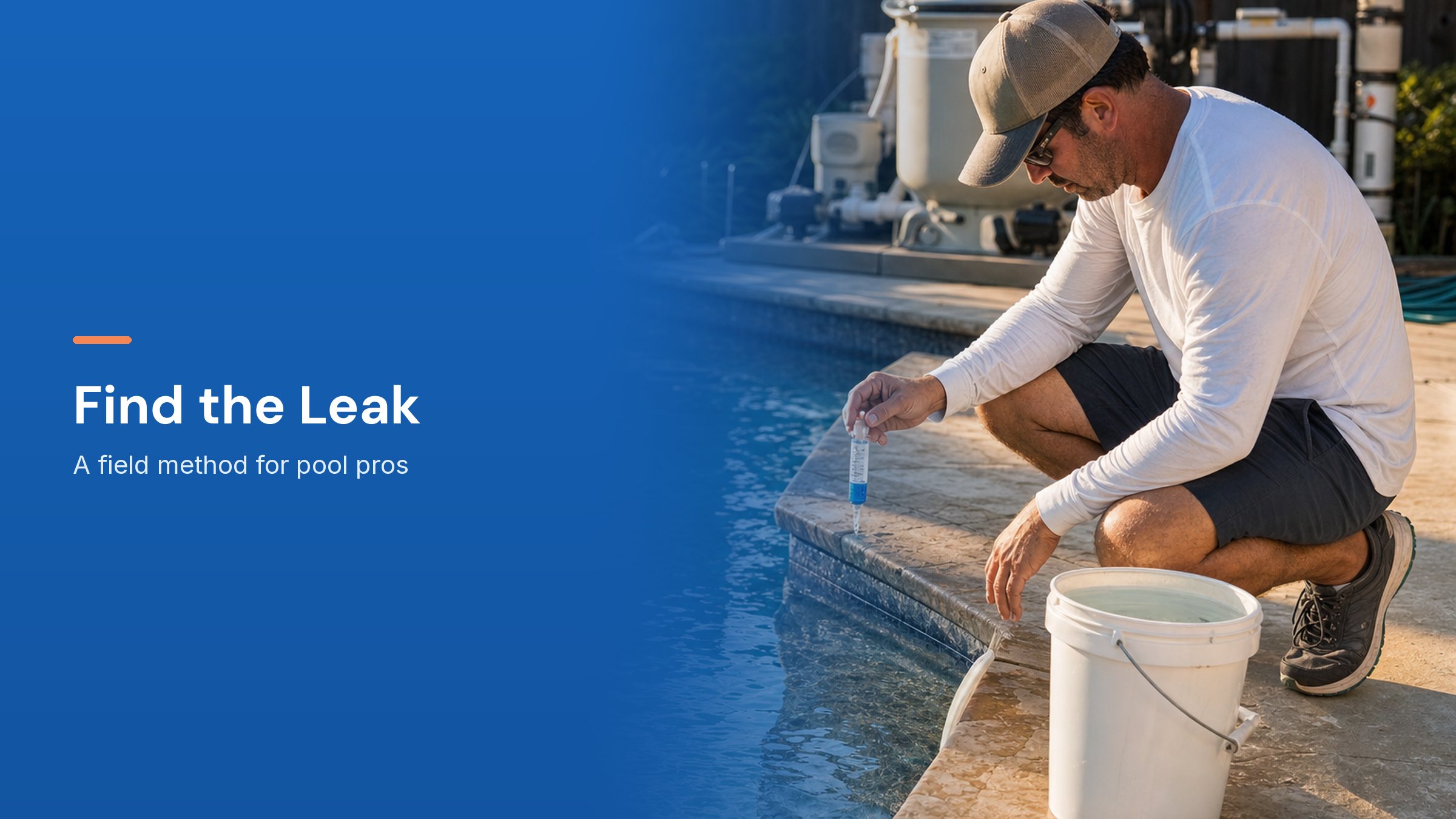
To find a pool leak, work from big to small. First prove the pool is losing more than evaporation. Then use the pump on and pump off loss to pick a zone. Watch where the water level stops. Dye test the spots at that level. Pressure test the lines only after that. Most leaks turn up at a fitting or penetration, such as a skimmer, a light niche, a return or a main drain.[3]AQUA MagazineEric Herman, "The Leak Mystique," September 18, 2014, hosted by Anderson Manufacturing, read November 26, 2026.leaktools.com
This guide is for the tech or owner who gets the "my pool is losing water" call. It covers the order of tests, what each result means, what a sealer can and cannot do, and when to hand the job to a leak detection company. To put a dollar figure on the water loss for a customer, use the pool leak cost calculator.
Key Takeaways
- Prove it first. A bucket test run for two to three days tells evaporation from a leak.[1]City of Scottsdale WaterWater Conservation for Homeowners page, "Is the pool leaking?" section and evaporation table, read November 26, 2026.scottsdaleaz.gov[2]City of Chandler Water ConservationPool Care page, bucket leak test steps, read November 26, 2026.chandleraz.gov
- Pump on vs off picks the zone. Suction leaks slow when the pump runs. Return leaks get worse. Shell leaks stay the same.[3]AQUA MagazineEric Herman, "The Leak Mystique," September 18, 2014, hosted by Anderson Manufacturing, read November 26, 2026.leaktools.com
- The stop line is a clue. If the level drops and then holds, the leak is usually at that height.
- Dye test penetrations first. Skimmers and light niches are the usual starting points.[3]AQUA MagazineEric Herman, "The Leak Mystique," September 18, 2014, hosted by Anderson Manufacturing, read November 26, 2026.leaktools.com
- Pressure tests need training. Use water, real test plugs and low pressure, and keep the filter out of any air test.[4]Anderson ManufacturingLance Anderson, "Putting the Pressure On: Pressure testing to detect and locate leaks," read November 26, 2026.leaktools.com[7]Pentair (Sta-Rite)System 2 PLDE Modular D.E. Filter Owner's Manual, pressure test safety checks and warnings, read November 26, 2026.pentair.com
- Sealers are a short list. One maker claims its liquid seals holes up to 1/8 inch. It is not a fix for a broken pipe or a moving crack.[9]Leslie'sProduct listing for Marlig Industries Fix A Leak Pool and Spa Sealer, 32 oz, maker description and dosage, read November 26, 2026.lesliespool.com
Step 1: Prove it is a leak, not evaporation
Many leak calls are not leaks. Hot, dry, windy weeks pull a lot of water out of a pool. Splash-out, backwashing and a heater running on a cold night all add to it. Before you hunt, prove the pool loses more than it should.
The bucket test is the standard first step. Scottsdale and Chandler, two desert cities, both publish the steps.[1]City of Scottsdale WaterWater Conservation for Homeowners page, "Is the pool leaking?" section and evaporation table, read November 26, 2026.scottsdaleaz.gov[2]City of Chandler Water ConservationPool Care page, bucket leak test steps, read November 26, 2026.chandleraz.gov
- Turn off the autofill. Do not add water by hand during the test.
- Set a bucket on a step. Weigh it down so it does not tip.
- Fill the bucket until its water matches the pool water line.
- Mark the water line inside the bucket and the pool line on the outside.
- Do not backwash or splash water out.
- Wait at least two to three days, then compare.
If both levels drop the same amount, it is evaporation. If the pool falls further than the bucket, there is a leak.[1]City of Scottsdale WaterWater Conservation for Homeowners page, "Is the pool leaking?" section and evaporation table, read November 26, 2026.scottsdaleaz.gov Scottsdale also says to run the test once with the pump on and once with it off. If the pool loses more with the pump running, the plumbing is the likely cause.[1]City of Scottsdale WaterWater Conservation for Homeowners page, "Is the pool leaking?" section and evaporation table, read November 26, 2026.scottsdaleaz.gov Redo the test if it rains or blows hard.
How much is normal? It depends on the place and the week. Scottsdale's chart for a 400 square foot pool shows about 10.8 inches lost in June and 2.4 inches in December.[1]City of Scottsdale WaterWater Conservation for Homeowners page, "Is the pool leaking?" section and evaporation table, read November 26, 2026.scottsdaleaz.gov June works out to about a third of an inch a day. Many pros treat a steady loss of more than about a quarter inch a day in mild weather as worth a closer look. Heated pools on cold nights can lose much more than that. Use the evaporation calculator to estimate the normal loss, and the bucket test calculator to read the result.
Lance Anderson of Anderson Manufacturing put the reason simply: "There's no reason to spend any time looking for a leak if there isn't a leak there."[3]AQUA MagazineEric Herman, "The Leak Mystique," September 18, 2014, hosted by Anderson Manufacturing, read November 26, 2026.leaktools.com Some pros carry an electronic water loss sensor for a fast reading. AQUA describes one that tracks level changes to a ten thousandth of an inch, which allows a 15 to 20 minute test.[3]AQUA MagazineEric Herman, "The Leak Mystique," September 18, 2014, hosted by Anderson Manufacturing, read November 26, 2026.leaktools.com
Step 2: Ask questions before you roll the truck
A good phone call saves a trip. Ask how much the pool drops in a day. Ask if there is an autofill, and whether it runs a lot. Ask where the level stops if they let it drop. Ask for photos of the equipment pad and any wet spots in the yard. Ask if anything changed lately, like new pavers, new turf, a pump swap or a new salt cell.
“I'll kind of dive into it because I don't wanna waste their money if they don't need to, but I also don't wanna waste my time if I don't need to go out there, and then I'll end up seeing something obvious anyway.”
Watch for autofills on your own route, too. An autofill hides the drop, so the only sign is a high water bill. A commercial specialist told AQUA that rising chemical use can also flag a leak on a pool with an autofill.[3]AQUA MagazineEric Herman, "The Leak Mystique," September 18, 2014, hosted by Anderson Manufacturing, read November 26, 2026.leaktools.com If your chlorine and salt use on one pool keeps climbing, check the fill valve.
Step 3: Read pump-on vs pump-off loss
Leak specialists split the pool into three zones. The first is the static part: the shell, the lights, the main drain sump and the liner. The second is the suction side, which carries water to the pump. The third is the pressure side, from the pump, through the filter, and out the returns.[3]AQUA MagazineEric Herman, "The Leak Mystique," September 18, 2014, hosted by Anderson Manufacturing, read November 26, 2026.leaktools.com
Each zone acts in its own way. A suction leak cannot leak water out while the pump runs, because the pump pulls on it. A return line leaks worse when the pump is on, because it is under pressure. A shell leak loses the same amount either way.[3]AQUA MagazineEric Herman, "The Leak Mystique," September 18, 2014, hosted by Anderson Manufacturing, read November 26, 2026.leaktools.com So run two bucket tests, or two days of marks on the tile, one with the pump on and one with it off.
| What you see | Most likely zone | What to check next |
|---|---|---|
| Same loss with pump on and off | Shell, lights, drain sump, liner | Dye test penetrations, tile line and cracks |
| More loss with pump on | Pressure side (returns, filter, pad) | Look at the pad, then pressure test return lines |
| More loss with pump off | Suction side (skimmer, main drain lines) | Pressure test suction lines; check for air at the pump |
| Raised spa drops, pool rises | Not a leak; water moving back to the pool | Check valves, diverter seals, actuators |
| Pump loses prime but the pool does not drop | Air leak on the suction side, not a water leak | Lid o-ring, plugs, unions and valves in front of the pump |
The last two rows trip up a lot of techs. When a raised spa drains down overnight, first check whether the pool level went up. If it did, the water just moved. A worn check valve, a diverter seal that no longer seats, or an actuator that stops short will let it drain back. That is a valve job, not a leak detection job. And a pump that loses prime with a full pool is pulling air somewhere. Fix that as an air leak. A suction leak at the pad can still drip water when the pump is off, so look for both.
Step 4: Watch where the water stops
If the customer can stand it, let the level drop with the autofill off and see where it holds. Water runs out of a hole until the pool level falls to the height of the hole. Then it stops. That stop line tells you where to look.
- Stops at the bottom of the skimmer mouth. Look at the skimmer body, the throat, the joint where the skimmer meets the shell and the tile, and the skimmer line.
- Stops at the light. Look at the niche and the conduit where the cord comes in.
- Stops at the returns. Look at the return fittings and the return lines.
- Stops at a step or a bench. Look at the step joint, the bench and any jets set there.
- Keeps dropping toward the floor. Think main drain, a floor crack, a liner hole low in the pool, or a line far below the water.
Do not drain a pool on purpose to find a leak. An empty or low shell can be at risk from groundwater, and that is a structural question. Read how to drain a pool safely before you take any pool down far. For a pool that is losing fast, stop at the first steady level and start dye testing there.
Step 5: Dye test the common spots
A dye test shows water moving into a crack or gap. Pros use syringe dye testers. One maker says its testers hold a concentrated dye "that holds together underwater," with a six inch tip for "precise dye placement without creating unwanted currents."[5]Anderson Manufacturing (Leaktools)Dye Testers and Dye product category, read November 26, 2026.leaktools.com
How to get a clean read:
- Turn the pump off. Close valves so lines are not moving water.
- Let the water go still. Give it some time after you shut things down.
- Stay low and move slowly. Your arm and body make currents.
- Put out a small puff right at the edge of the gap. Watch if it gets pulled in.
Dye is not magic. It does not swim across the pool to the leak. A Massachusetts specialist called that idea a wives' tale. He also said you have to be within a couple of inches before a leak pulls the dye in.[3]AQUA MagazineEric Herman, "The Leak Mystique," September 18, 2014, hosted by Anderson Manufacturing, read November 26, 2026.leaktools.com That is why the hunt starts with the stop line and the zone. You want to dye test a short list, not the whole pool.
“When we suspect one of our pools has a leak, we first dive the pool and dye test the liner/shell, the steps, skimmers, lights and all pool-side fittings. About half the leaks we find .. we find this way.”
Here are the spots to work through, with what to look for at each:
- Skimmer. Specialists name skimmers that pull away from the pool as a common cause. The gap may be tiny at first and grow over time.[3]AQUA MagazineEric Herman, "The Leak Mystique," September 18, 2014, hosted by Anderson Manufacturing, read November 26, 2026.leaktools.com Dye the seam where the skimmer meets the shell and tile, the throat, any cracks in the body and the threaded port at the bottom. For repair choices, see cracked pool skimmer: repair or replace.
- Light niche. Light niches are a big cause too.[3]AQUA MagazineEric Herman, "The Leak Mystique," September 18, 2014, hosted by Anderson Manufacturing, read November 26, 2026.leaktools.com Dye the conduit opening at the rear of the niche and the gap between the niche and the shell. Do not pull or rewire the light to do this. Pentair warns never to splice light wire under water or behind the niche, and says to use a new wire clamp and lens gasket whenever the light is put back together, so water does not get into the fixture.[8]PentairIntelliBrite 5G White and Color Pool and Spa Lights Installation and User's Guide, niche, cord and junction box notes.Pentair guide Light work belongs with someone qualified. Our pool light replacement guide covers the job.
- Returns and jets. Dye around each fitting where it meets the wall. On fiberglass pools, a cracked wall fitting is a common find.
- Main drain. Dye around the sump ring and the cover seat. Channel drains and long drain sumps are known for leaking at the joint between the plastic body and the concrete.
- Steps, benches and tile line. Dye any crack you can see, the step seam, and grout lines near the waterline.
- Liner. Look hard at the area under step strips, around fittings and at any wrinkle. Electronic liner tools find small holes faster than a dye search.[3]AQUA MagazineEric Herman, "The Leak Mystique," September 18, 2014, hosted by Anderson Manufacturing, read November 26, 2026.leaktools.com
One more trap: water in a line can rock back and forth when the pump is off. Temperature differences between the pool and the ground can make it move. If dye pulses in and out of a return, plug the other openings on that line and wait for it to settle before you decide.
Step 6: Check the equipment pad
Scottsdale says, "Most pool leaks are found in the pool equipment." It tells owners to look for leaks, wet ground and white, crusty mineral deposits on pipes.[1]City of Scottsdale WaterWater Conservation for Homeowners page, "Is the pool leaking?" section and evaporation table, read November 26, 2026.scottsdaleaz.gov That is a fast check on every visit, not just on leak calls.
Look at pump unions and plugs, the shaft seal area, the filter lid and drain, valve stems, the salt cell unions, heater connections and the backwash line. Crust and green or white trails show old drips that dry up between visits. Check under the pad and along the pipes where they enter the ground. A wet spot in the yard along a pipe run is a strong hint. If the pump end is leaking, our guide on pump leaks after a shaft seal swap may help.
Step 7: Isolate the lines with plugs and a pressure test
If the shell, fittings and pad check out, the leak is likely underground. This is where line plugs come in. Anderson Manufacturing lays out the basic method.[4]Anderson ManufacturingLance Anderson, "Putting the Pressure On: Pressure testing to detect and locate leaks," read November 26, 2026.leaktools.com
- Block off every opening on one section of plumbing with closed test plugs, except one.
- Put the pressure tester in the last opening, usually at the equipment.
- Fill the line with water through the tester. Bring it up to no more than 20 psi.
- Watch the gauge. A drop means a leak. A line that holds can be crossed off.
Anderson says to use water for this step. Water does not compress, so the test reads faster and more truly. And if a plug pops under water pressure, it does not fly out the way it can under air.[4]Anderson ManufacturingLance Anderson, "Putting the Pressure On: Pressure testing to detect and locate leaks," read November 26, 2026.leaktools.com It also warns against tapered winter plugs for testing, because they tend to pop out under test pressure. If you use valves at the pad to split up lines, test the valves first.[4]Anderson ManufacturingLance Anderson, "Putting the Pressure On: Pressure testing to detect and locate leaks," read November 26, 2026.leaktools.com
“Take 10 minutes pressure test tells me general health of system or if I gotta call someone.”
Once you know which line leaks, the next step is to find the spot. Specialists push regulated air into the isolated line, at no more than 20 psi and often only 5 to 10, so it bubbles out into the wet soil. Then they listen along the pipe path with a geophone or an electronic listening device. The loudest sound is usually right over the leak.[4]Anderson ManufacturingLance Anderson, "Putting the Pressure On: Pressure testing to detect and locate leaks," read November 26, 2026.leaktools.com[3]AQUA MagazineEric Herman, "The Leak Mystique," September 18, 2014, hosted by Anderson Manufacturing, read November 26, 2026.leaktools.com
Be careful with pressure at the pad. Pentair's System 2 filter manual says a trained pool professional should do all pressure tests. It warns that trapped air can cause an explosion, says to release all air first, and says never to connect that filter to compressed air under any conditions. For its own Sta-Rite gear, it limits a water test to under 25 psi and 24 hours, and tells you to ask the maker for other brands.[7]Pentair (Sta-Rite)System 2 PLDE Modular D.E. Filter Owner's Manual, pressure test safety checks and warnings, read November 26, 2026.pentair.com Keep the filter and pump out of any air test, read the manual for each part on the pad, and stand clear while lines are under pressure. If you have not been trained on this, this is the point to hand off.
When to hand off to a leak detection company
Most route techs can run a bucket test, read the zones and dye test the usual spots. Pressure testing and listening take tools and practice. Hand off when:
- Every line needs testing and you do not own plugs and a tester.
- A line fails and you need to pinpoint it under a deck.
- The pool has a vanishing edge, a raised spa, in-floor cleaning or many water features. One specialist told AQUA about a pool with 64 penetrations.[3]AQUA MagazineEric Herman, "The Leak Mystique," September 18, 2014, hosted by Anderson Manufacturing, read November 26, 2026.leaktools.com
- It is a vinyl liner with no visible hole.
- You have chased it twice and still lack an answer.
“Every system's a little bit different, and they're the same in the sense of what you're doing, but every system has its quirks.”
A good partner makes you look good. Pick one before you need one. Ask how they price, whether they repair or only locate, and how they report back. Some leak companies pay referral fees. Decide up front whether you take them, and tell the customer if you do.
Who repairs which leak
Finding the leak and fixing it are often two jobs. Here is how the work tends to split.
| Leak | Who usually fixes it | Typical fix |
|---|---|---|
| Pad leak (union, o-ring, lid, valve) | Service tech | New o-rings, gaskets, unions or a valve |
| Skimmer seam or small stable crack | Service or repair tech | Sealant or epoxy made for the material |
| Cracked or moving skimmer | Repair crew with deck work | Skimmer replacement and concrete |
| Light niche or conduit | Repair tech; electrical parts by a qualified pro | Seal the conduit or niche gap; cord seal where code needs it |
| Return or wall fitting | Repair tech | Reseal or replace the fitting |
| Underground line | Leak company or plumbing crew | Dig, cut and replace the pipe section |
| Main drain or shell crack | Leak company, diver or remodel crew | Underwater patch, or drain and repair |
| Vinyl liner hole | Diver or liner company | Underwater patch, or a new liner |
Underground work has the most unknowns. You do not know what is under the deck until you open it. Tell the customer that before you start.
Write the scope so it covers the first dig. Say what happens if the break is longer than it looks, or if there is a second leak. Anderson notes that a pressure test is also how you tell the owner the leaks you fixed are the only ones.[4]Anderson ManufacturingLance Anderson, "Putting the Pressure On: Pressure testing to detect and locate leaks," read November 26, 2026.leaktools.com Our guide on quoting pool repairs covers how to write that up.
Do leak sealers work?
Sometimes, for small leaks. The best known pool sealer is Marlig's Fix A Leak. The maker's listing says it will "permanently seal leaks and holes up to 1/8 in. in diameter" in spa shells and pool plumbing, at one quart per 22,000 gallons of pool water.[9]Leslie'sProduct listing for Marlig Industries Fix A Leak Pool and Spa Sealer, 32 oz, maker description and dosage, read November 26, 2026.lesliespool.com Treat that as the maker's claim. Read the label for the full steps before you use it.
What a liquid sealer will not do:
- Fix a broken or separated pipe.
- Hold a crack that keeps moving, like a settling skimmer or step.
- Fix a pad leak you can just replace parts on.
- Stand in for finding the leak. You still need to know where it is to know if the size fits.
Putty, epoxy and flexible sealant are a different tool. They work on a gap you can see and reach, like a skimmer seam or the conduit at the back of a light niche. Many are meant as stopgaps.
“Most of these type repairs are just temporary. Sometimes they'll last for months or even years.”
Tell the customer which kind of fix they are getting. A patch that holds a season is fine if they know it is a patch. It is a callback if they think it was the real repair.
Pricing the hunt and handling the customer
Charge for the diagnosis, even if you find nothing. On poolrates.fyi, pool pros report an average service call fee of about $162 and an average hourly rate of about $139.[10]poolrates.fyiPro service call fee and hourly rate values, January to October 2026 data, read November 26, 2026.poolrates.fyi poolrates.fyi does not have leak detection prices yet. Specialists often price per pool, with more for vanishing edges and extra charges per line pressure tested. Pros commonly report a few hundred dollars for a standard residential pool, and more for complex pools. Get local quotes from your partner so you can tell customers what to expect.
Some customers will not fix a leak. They would rather pay the water bill. That leak still costs you. Every gallon that goes into the ground takes chlorine, salt and stabilizer with it. Many pros move these pools to a plus-chemicals price, or charge for the extra chemicals until the leak is fixed. Put the risk in writing. Water running under a deck can wash out the soil, and a growing leak costs more later. Show them the numbers with the leak cost calculator.
Keep notes on every leak pool. Log the daily drop, the bucket test result, the stop line, photos of the dye tests and what you told the customer. If the leak gets worse, or the customer says you never warned them, the record is your proof.
Should you add leak detection as a service?
It can pay well, but it is a real skill. You need plugs in many sizes, a pressure tester with a 0 to 30 psi gauge and hookups for water and air, a regulated air source, dye, and a listening device.[4]Anderson ManufacturingLance Anderson, "Putting the Pressure On: Pressure testing to detect and locate leaks," read November 26, 2026.leaktools.com One maker sells a 32 piece plug kit for $555 and a 48 piece kit for $720, before the tester and listening gear.[6]Anderson Manufacturing (Leaktools)Pressure Testing category, plug kits and listed prices, read November 26, 2026.leaktools.com Add a mask or dive gear, liner patches and epoxy.
Lance Anderson told AQUA that a logical thinker with the right tools can learn it in weeks. The specialists in the same story said it takes full commitment and real money in gear.[3]AQUA MagazineEric Herman, "The Leak Mystique," September 18, 2014, hosted by Anderson Manufacturing, read November 26, 2026.leaktools.com Most pros who add it start on their own pool, then ride along with someone who does it every day.
“So once you invest in the equipment, the earnings on that are really high once you get all the equipment.”
Even if you never buy a pressure tester, the first five steps in this guide make you better at leak calls. You can sort out the real leaks, fix the pad and valve problems yourself, and send your partner a clear handoff with the zone and stop line already known.
Sources
- [1]City of Scottsdale Water, Water Conservation for Homeowners page, "Is the pool leaking?" section and evaporation table, read November 26, 2026. scottsdaleaz.gov
- [2]City of Chandler Water Conservation, Pool Care page, bucket leak test steps, read November 26, 2026. chandleraz.gov
- [3]AQUA Magazine, Eric Herman, "The Leak Mystique," September 18, 2014, hosted by Anderson Manufacturing, read November 26, 2026. leaktools.com (PDF)
- [4]Anderson Manufacturing, Lance Anderson, "Putting the Pressure On: Pressure testing to detect and locate leaks," read November 26, 2026. leaktools.com (PDF)
- [5]Anderson Manufacturing (Leaktools), Dye Testers and Dye product category, read November 26, 2026. leaktools.com
- [6]Anderson Manufacturing (Leaktools), Pressure Testing category, plug kits and listed prices, read November 26, 2026. leaktools.com
- [7]Pentair (Sta-Rite), System 2 PLDE Modular D.E. Filter Owner's Manual, pressure test safety checks and warnings, read November 26, 2026. pentair.com (PDF)
- [8]Pentair, IntelliBrite 5G White and Color Pool and Spa Lights Installation and User's Guide, niche, cord and junction box notes. Pentair guide (PDF)
- [9]Leslie's, Product listing for Marlig Industries Fix A Leak Pool and Spa Sealer, 32 oz, maker description and dosage, read November 26, 2026. lesliespool.com
- [10]poolrates.fyi, Pro service call fee and hourly rate values, January to October 2026 data, read November 26, 2026. poolrates.fyi