


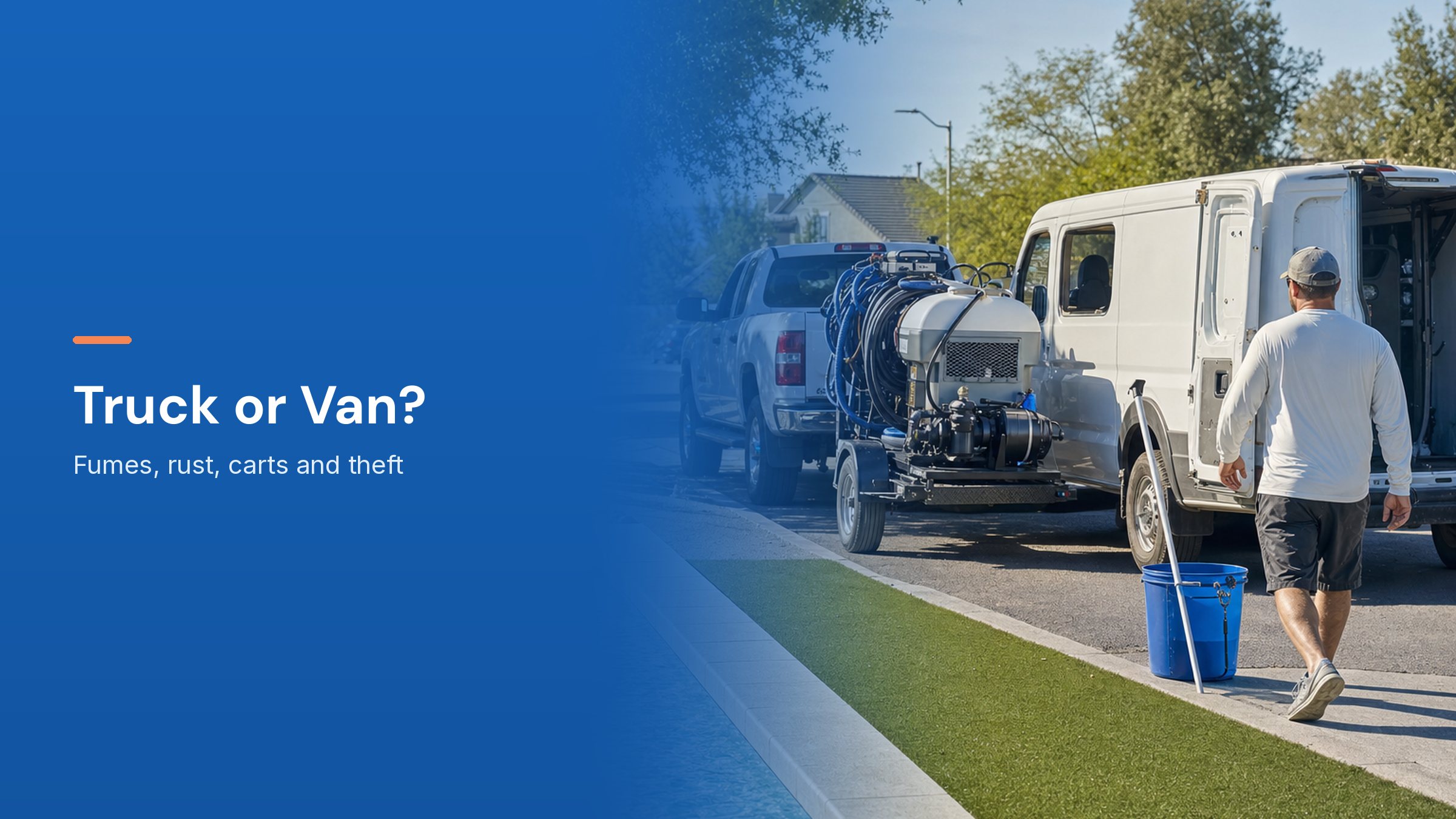
For a weekly cleaning route that runs on liquid chlorine and acid, an open-bed pickup is still the easy default. Spills drain, fumes blow away, and you can see the whole load. A cargo van wins for repair work. It holds more parts, keeps them dry and locks them up.
You can carry pool chemicals in a van. One chlorine maker lists the inside of a cargo van as a fine place for its cases, as long as they never ride in the cab.[1]HASAHow to Safely Transport HASA Products: Transporting and Handling HASA Sani-Clor, Hasachlor and HASA Muriatic Acid, two-page guide with product labels, read November 26, 2026.orendatech.com But a van asks more of you. You need a solid wall behind the seats, caps that stay shut, and a plan for rust.
This guide covers the parts our other truck pages skip: van fumes and corrosion, hitch vac carts, crates for liquid and acid, and theft. For what to carry, see the truck setup guide. For the legal limits on hauling chlorine, see our DOT rules guide.
Key Takeaways
- Pickup for chemicals, van for parts. Many companies run both: open beds on cleaning routes and vans on repair jobs.
- Never in the cab. HASA says its chlorine and acid should never ride in the passenger area of a vehicle.[1]HASAHow to Safely Transport HASA Products: Transporting and Handling HASA Sani-Clor, Hasachlor and HASA Muriatic Acid, two-page guide with product labels, read November 26, 2026.orendatech.com
- One case per chemical. Chlorine and acid go in separate cases, and the case bottom must be dry and free of holes or cracks.[1]HASAHow to Safely Transport HASA Products: Transporting and Handling HASA Sani-Clor, Hasachlor and HASA Muriatic Acid, two-page guide with product labels, read November 26, 2026.orendatech.com
- Lock the cart twice. Hammer-Head suggests a padlock through the cart’s mount ring plus a locking hitch pin.[6]Hammer-HeadHammer-Head User Guide, V1.2, mount assembly and theft sections.poolweb.com
- Loose tools need their own coverage. Insurers sell tools and equipment coverage apart from the auto policy.[12]Progressive CommercialTools and equipment insurance page, read November 26, 2026.progressivecommercial.com
Truck or van: match the vehicle to the job
The right vehicle depends on what the tech does all day. A cleaning tech tests, doses, brushes and vacuums. A repair tech hauls motors, filters, fittings and tools. Those are two different loads.
Here is how the common setups compare. The notes on chemicals come from the maker guidance cited in this article. The rest is what pros commonly report.
| Setup | Best for | Chemicals | Weak spots |
|---|---|---|---|
| Small pickup (Maverick, older Ranger or Tacoma) | Cleaning routes, solo pros | Open air. Easy to reach over the side. | Short bed. A hitch cart can scrape on dips. Little room for repair parts. |
| Full-size pickup, open bed | Mixed cleaning and light repair | Open air. Room for separate crates. | Rain soaks dry goods. Bed is high to reach into. Anything loose can walk off. |
| Pickup with cap or locking cover | HOA parking, theft-prone areas | Fumes collect when it is shut. Open it while you work. | Hard to reach the front of the bed. Some cover parts wear out from chlorine. |
| Cargo van with solid bulkhead | Repair techs, parts stock, rainy areas | Allowed in the cargo area by HASA, never in the cab.[1]HASAHow to Safely Transport HASA Products: Transporting and Handling HASA Sani-Clor, Hasachlor and HASA Muriatic Acid, two-page guide with product labels, read November 26, 2026.orendatech.com | Smell and rust if caps leak. Wiring and electronics take the hit. |
| Service body or cutaway | Heavy repair, installs | Outside boxes keep chemicals away from the cab. | Costs more. Worse fuel mileage. |
| Small trailer | Keeping chemicals off the family car | Fully outside the vehicle. | Backing up, parking and another thing to maintain. |
If you are still deciding on make and model, read what pros recommend for a first vehicle. Then run the numbers in the truck break-even calculator before you sign a loan.
Chemicals in a van: what the label allows
Pros argue about this one more than almost anything else on the truck. Some run whole fleets of vans with no trouble. Others say they would never ride in a closed box with chlorine. Both camps agree on one thing: the van is only as good as your habits.
Here is what the maker of one common pool chlorine and acid says:
- Never carry its chlorine or muriatic acid inside the cabin of a passenger vehicle.[1]HASAHow to Safely Transport HASA Products: Transporting and Handling HASA Sani-Clor, Hasachlor and HASA Muriatic Acid, two-page guide with product labels, read November 26, 2026.orendatech.com
- The rear of a pickup, a flatbed, a trailer or the inside of a cargo van are the suggested places.[1]HASAHow to Safely Transport HASA Products: Transporting and Handling HASA Sani-Clor, Hasachlor and HASA Muriatic Acid, two-page guide with product labels, read November 26, 2026.orendatech.com
- Keep bottles upright and capped, and never put a white chlorine bottle next to a red acid bottle.[1]HASAHow to Safely Transport HASA Products: Transporting and Handling HASA Sani-Clor, Hasachlor and HASA Muriatic Acid, two-page guide with product labels, read November 26, 2026.orendatech.com
- The chlorine label says to leave poorly ventilated areas and stay out until strong odors clear.[1]HASAHow to Safely Transport HASA Products: Transporting and Handling HASA Sani-Clor, Hasachlor and HASA Muriatic Acid, two-page guide with product labels, read November 26, 2026.orendatech.com
The safety sheets back this up. The chlorine sheet says mixing it with acids releases chlorine gas.[2]HASAHasachlor (12.5% sodium hypochlorite) Safety Data Sheet, revision date August 24, 2026, Sections 2, 7, 10 and 14.hasa.com The acid sheet says to use it only outdoors or in a well-ventilated area.[3]HASAHASA Acid 15 (14.5% hydrochloric acid) Safety Data Sheet, revision date August 24, 2026, Sections 2, 7 and 10.hasa.com
So the rules for a van are simple. Put a solid bulkhead between the cab and the cargo area. Keep every cap tight. Never pour, mix or measure chemicals inside the van. Do that at the pool. If you open the doors and smell chlorine or acid, step back and let it air out before you climb in. Then find the leak.
“My van came equipped with a Knapheide solid-partition between the cab and cargo area. The cab is completely sealed and separated from the back.”
That same owner said he noticed no smell. He kept dry chemicals in lidded buckets and liquids in sealed jugs. Pros who report a bad smell usually trace it to an open tab bucket or a leaking jug. The partition is what keeps it out of your lungs while you drive.
The worst case is a crash. A load of chlorine and acid can break open and mix in a wreck. That is a strong reason to keep the two in separate cases and to never stack acid on top of chlorine. Our page on chemical mixing accidents shows how badly that can go.
Corrosion: why vans rust from the inside
Both chlorine and acid are listed as corrosive to metals.[2]HASAHasachlor (12.5% sodium hypochlorite) Safety Data Sheet, revision date August 24, 2026, Sections 2, 7, 10 and 14.hasa.com[3]HASAHASA Acid 15 (14.5% hydrochloric acid) Safety Data Sheet, revision date August 24, 2026, Sections 2, 7 and 10.hasa.com In an open bed, the vapor blows away. In a closed box, it settles on everything.
Van owners commonly report the same pattern. Radios and speakers fail first. Then wiring in the roof or headliner turns green. Bare steel shelving rusts. Several pros said this happened even with every bucket closed, so tight lids slow it down but may not stop it.
“Chlorine and electronics go together about as well as a cat and a bathtub.”
Here is what van owners do to make a van last:
- Buy the partition first. A sealed bulkhead protects the cab, the dash and the driver.
- Vent the roof. Many owners add a roof vent. It helps with the smell. It does not make it safe to open containers inside.
- Pick aluminum or plastic shelving. Aluminum still corrodes, pros say, but much slower than painted steel.
- Clean it weekly. The owners with no problems are almost always the ones who wipe down and air out the cargo area every week.
- Keep electronics up front. Phones, tablets, chargers and test meters ride in the cab, not next to the chlorine.
- Bag the batteries. Tool batteries and spare meter batteries do better sealed in plastic bags.
Pickups rust too, just from the outside in. Chlorine eats the bed floor and the tailgate. Some pros find that a cheap roll-up cover wears out fast because the fasteners rot. A cap or locking cover that stays shut all day turns the bed into a small van, with the same fume problem. Open it while you work and close it when you park.
Not sure your own rig is set up well? Try the truck loadout quiz.
Hitch vac carts: getting into the bed and keeping the cart on
A battery vac on a hitch cart saves a lot of trips. It also blocks the tailgate and hangs a few thousand dollars of gear off the back of the truck. Two questions come up again and again: how do I get into the bed, and how do I stop the cart from falling off?
Getting into the bed
Pros use three fixes:
- Reach over the side. On a low bed, many techs never drop the tailgate. They grab what they need over the side or step up on the tire.
- Use a swing-away hitch. Riptide sells one that lets the rack and cart swing out of the way so you can open van doors or drop a tailgate.[7]Riptide Pool VacuumSwing Hitch Instructions, van or pickup truck, read November 26, 2026.riptide swing hitch Some pros find swing hitches clunky and only swing them on days they need the bed.
- Pull the cart. On most mounts the cart lifts off in a few seconds once the latch is open.
Riptide's instructions add a few rules for setting it up. The cart should not stick out past the side of the vehicle, and the rack should not block the taillights. The riser bolts must be very tight, and the hinge needs regrease and readjustment as it wears.[7]Riptide Pool VacuumSwing Hitch Instructions, van or pickup truck, read November 26, 2026.riptide swing hitch
Keeping it on
Carts do fall off. Pros tell stories of hearing a crash on the road, or of not hearing it at all because they were on a call. Some found the cart on the road shoulder. Some never found it. The usual cause is a broken or unlatched lock, a cracked mount or a hitch that snapped.
Hammer-Head says its service cart is held to the mount by a toggle clamp latch and a safety pin.[6]Hammer-HeadHammer-Head User Guide, V1.2, mount assembly and theft sections.poolweb.com It also suggests a padlock through the mount ring on the cart and a locking hitch pin, which are not included with the mount.[6]Hammer-HeadHammer-Head User Guide, V1.2, mount assembly and theft sections.poolweb.com That padlock does double duty: it stops thieves and it backs up the latch.
A good daily habit:
- Before you pull out, push and pull the cart by hand. It should not move.
- Check that the latch is closed and the safety pin or padlock is in.
- Look at the welds and the mount for cracks once a week.
- Fix a broken latch the same day. Do not drive "just one more week" on a bungee.
- Put a tracker tag on the cart so you can find it if it does come off.
Rattle wears out a receiver and loosens bolts. Many pros add an anti-rattle clamp. If you use a riser or extender to clear the tailgate, know that it cuts what the hitch can hold. A common retailer rule of thumb is to plan on losing up to half of the hitch's rated tongue weight.[8]etrailer.comDo All Trailer Hitch Extenders Reduce Capacity by 50 Percent, expert answer, read November 26, 2026.etrailer.com Check the rating on each part and go by the lowest one.
On small trucks, a loaded cart can drag on steep driveways and dips. Some pros with short beds stopped using hitch carts and carry the vac with a battery box and a folding dolly instead. A cart also tends to block the factory backup camera. A few pros add a second camera up high.
Last, check your plate. Florida, for example, requires the plate to be plainly visible and readable from 100 feet.[9]Florida StatutesSection 316.605(1), Licensing of vehicles (plate plainly visible and legible from 100 feet), read November 26, 2026.flsenate.gov Check the rule in your state. If the cart hides the plate, add a plate bracket. For the brand choice itself, see Hammerhead vs Riptide.
One more thing on carts. Some techs ride jugs of chlorine and acid in the cart's rack. HASA's list of places to carry its products does not include a hitch rack, and it asks for cases that are secured so they cannot move or tip.[1]HASAHow to Safely Transport HASA Products: Transporting and Handling HASA Sani-Clor, Hasachlor and HASA Muriatic Acid, two-page guide with product labels, read November 26, 2026.orendatech.com A rear-end hit would land right on those jugs. Keep chemicals in the bed.
Crates and bins for liquid chlorine and acid
Most chemical spills on a truck start the same way. A cap was loose, a jug rode outside its case, or acid and chlorine shared a box. HASA's transport guide answers most of the questions pros ask about crates:[1]HASAHow to Safely Transport HASA Products: Transporting and Handling HASA Sani-Clor, Hasachlor and HASA Muriatic Acid, two-page guide with product labels, read November 26, 2026.orendatech.com
- Use the case. Never move single bottles outside the plastic four-bottle case, or keep them in the original cardboard case.
- Color code. HASA chlorine bottles go in the yellow case. Acid bottles go in the red case. Never mix them in one case.
- Strap it down. Secure every case so it cannot slide or tip.
- Protect the bed. Put a plastic sheet under the case.
- No holes. The case bottom must be dry, clean and free of holes or cracks.
That last rule settles a common question: should you drill drain holes in a chemical bin so rain can get out? No. A case with holes cannot hold a leak. Keep rain out with a cover instead, and dump any water that gets in before you load. The same logic rules out milk crates as your only containment. They have open sides.
“Every time it rained, everything in the back got soaked. Bucket lids got covered with water, bags of salt, sodium bicarb, sand, etc. got soaked.”
That pro moved to a van. If you stay in a pickup, a cover you can roll back at each stop keeps dry goods dry and lets fumes out while you work.
Dry chemicals need care too
Cal hypo is the one that can start a fire. Its safety sheet says moisture, acids or other pool chemicals can set off heat, toxic gas and even fire.[4]HASAHASA Dri-Shock Shocking Granules (calcium hypochlorite) Safety Data Sheet, revision date August 24, 2026, Sections 6 and 7.hasa.com It also says to scoop with a clean, dry scoop and keep the product in its original container, never an unlabeled one.[4]HASAHASA Dri-Shock Shocking Granules (calcium hypochlorite) Safety Data Sheet, revision date August 24, 2026, Sections 6 and 7.hasa.com
That matters for a popular trick. Many crews pour dry chemicals into pet food bins with good seals. If you do, label every bin clearly. If you have employees, OSHA's hazard communication rule says each container of hazardous chemicals in the workplace must be labeled. The only exception is a portable container meant for the immediate use of the person who filled it.[5]OSHA29 CFR 1910.1200, Hazard Communication, paragraphs (f)(6), (f)(8) and (g)(8) to (g)(9), read November 26, 2026.osha.gov A bin that rides all week is not that. Our OSHA chemical safety guide covers labels and safety sheets in more detail.
Load heavy things low and against the front of the bed, such as salt bags and full cases. Keep cal hypo and tabs away from acid and from anything wet. Carry the spill supplies each safety sheet calls for. The truck setup guide lists them.
Stopping theft from the truck and the yard
Theft is the part no other page on our site covered. It is also where pros lose the most money in one night. The patterns repeat. Things get grabbed from an open bed parked on the street. A tool bag vanishes from the cab. A vac goes missing from a garage. Sometimes the thief is a former worker who knew where the gear lived.
Hammer-Head itself warns that theft of its units is on the rise.[6]Hammer-HeadHammer-Head User Guide, V1.2, mount assembly and theft sections.poolweb.com Here is what insurers, police and pros suggest.
Make the truck a hard target
- Lock what you can. A locking cover, cap or van turns a grab-and-go into a break-in. Fix toolboxes to the bed or van floor and use a visible lock.[10]Victoria PoliceSecure your tools, business and commercial safety page, updated August 13, 2025.police.vic.gov.au
- Keep gear out of sight. Thieves shop with their eyes. Police and insurers both say to keep tools hidden and the vehicle locked, even at a job site.[10]Victoria PoliceSecure your tools, business and commercial safety page, updated August 13, 2025.police.vic.gov.au[11]HSB (Munich Re)Safeguarding contractors' small tools and equipment, loss prevention guide, read November 26, 2026.munichre.com
- Carry only today's gear. HSB's guide says to carry only what the day's work needs and move the rest to secure storage overnight.[11]HSB (Munich Re)Safeguarding contractors' small tools and equipment, loss prevention guide, read November 26, 2026.munichre.com
- Park smart. Use a garage or driveway when you can. On the street, pick a well-lit spot.[10]Victoria PoliceSecure your tools, business and commercial safety page, updated August 13, 2025.police.vic.gov.au Some pros rent a gated storage space with cameras when home parking is not safe.
- Lock the cart. Padlock the cart to the mount and use a locking hitch pin.[6]Hammer-HeadHammer-Head User Guide, V1.2, mount assembly and theft sections.poolweb.com
Watch it and track it
If you park in a lot with no Wi-Fi, a home camera will not help. Pros commonly use a dash cam with a parking mode that records on motion or bumps, or a battery trail camera with a cell plan that sends alerts. A simple motion alarm in the bed is another cheap option.
Trackers come next. Many pros hide a small tag in the vac, the tool bag and the pump cart.
“I have a tile on my hammerhead already.”
Some pros say phone-style tags can alert the thief that a tracker is nearby, so they put a real GPS unit on the truck itself. Our guide to GPS tracking for pool fleets covers truck trackers.
Mark it and record it
Write down serial and model numbers and take photos of your tools.[10]Victoria PoliceSecure your tools, business and commercial safety page, updated August 13, 2025.police.vic.gov.au Keep receipts and photos of serial numbers somewhere other than the truck, such as your email.[13]Simply BusinessWant to Prevent Tool Theft? Here's What to Do, March 4, 2021.simplybusiness.com Mark gear with a code that is hard to remove.[10]Victoria PoliceSecure your tools, business and commercial safety page, updated August 13, 2025.police.vic.gov.au[11]HSB (Munich Re)Safeguarding contractors' small tools and equipment, loss prevention guide, read November 26, 2026.munichre.com Some pros engrave their logo under the paint so it shows even if a thief repaints it. Marked gear is harder to sell and easier for police to return.
The yard and the home garage
Solo pros often keep a week of stock at home. That saves supply runs.
“Luckily, I have space on my property to store chems. So I'll get like 15 cases at once and then store them, and that should take me into the next week.”
Home storage needs the same care as the truck. The chlorine sheet says to store it in a cool, shaded outdoor spot or a cool, well-ventilated room, in its vented container, and locked up.[2]HASAHasachlor (12.5% sodium hypochlorite) Safety Data Sheet, revision date August 24, 2026, Sections 2, 7, 10 and 14.hasa.com It also says not to store it next to chemicals that could react if something spills.[2]HASAHasachlor (12.5% sodium hypochlorite) Safety Data Sheet, revision date August 24, 2026, Sections 2, 7, 10 and 14.hasa.com Lock the shed or garage, and keep your vacs and pumps inside, not in the truck overnight. When you outgrow the garage, read our guides on renting chemical storage and leasing a first shop.
Inside jobs are real too. Control who has keys. Change lock codes when someone leaves. Do a quick count of the big items, like vacs, pumps and blowers, at the end of each week.
Insurance for tools: what the auto policy leaves out
Many pros learn this after a theft: the auto policy may not pay for the gear inside. Progressive says commercial auto is what covers equipment permanently attached to a work vehicle, like a built-in system.[12]Progressive CommercialTools and equipment insurance page, read November 26, 2026.progressivecommercial.com Loose tools are a different coverage. Tools and equipment insurance pays to replace covered items stolen while traveling or stored off-site, and it can be added through inland marine coverage.[12]Progressive CommercialTools and equipment insurance page, read November 26, 2026.progressivecommercial.com
“So those trucks that I had in New Jersey were outfitted with probably over $100,000 worth of equipment.”
Some pool trade insurance programs also cover chemical spills on the truck.
“There are very few things they don't cover. They even cover chemical spills”
Read your own policy, though. Ask your agent these questions in writing:
- Is gear in an open bed covered, or only gear in a locked vehicle or box?
- Do I need proof of forced entry? Insurers may ask for proof you were not careless about locking up.[13]Simply BusinessWant to Prevent Tool Theft? Here's What to Do, March 4, 2021.simplybusiness.com
- Is the hitch cart and vac covered while mounted, while at a pool and while parked overnight?
- What is the deductible, and do I need a list of items and serial numbers on file?
- Does my policy cover a chemical spill in the truck or at a customer's home?
For the rest of your coverage, see insurance for pool service businesses.
A daily truck checklist
Print this and tape it inside the cab or the van door:
- Chlorine and acid in separate cases. Caps tight. Cases strapped.
- Case bottoms dry and not cracked.
- Dry chemicals in labeled, closed containers, away from acid and water.
- No chemicals in the cab.
- Van: sniff test when you open the doors. Air it out if it smells.
- Hitch cart latched, pinned and padlocked. Push it by hand.
- Plate and taillights visible.
- End of day: vac, pumps and power tools out of the truck or locked away.
- Friday: wipe down the cargo area and check the cart mount for cracks.
Sources
- [1]HASA, How to Safely Transport HASA Products: Transporting and Handling HASA Sani-Clor, Hasachlor and HASA Muriatic Acid, two-page guide with product labels, read November 26, 2026. orendatech.com (PDF)
- [2]HASA, Hasachlor (12.5% sodium hypochlorite) Safety Data Sheet, revision date August 24, 2026, Sections 2, 7, 10 and 14. hasa.com (PDF)
- [3]HASA, HASA Acid 15 (14.5% hydrochloric acid) Safety Data Sheet, revision date August 24, 2026, Sections 2, 7 and 10. hasa.com (PDF)
- [4]HASA, HASA Dri-Shock Shocking Granules (calcium hypochlorite) Safety Data Sheet, revision date August 24, 2026, Sections 6 and 7. hasa.com (PDF)
- [5]OSHA, 29 CFR 1910.1200, Hazard Communication, paragraphs (f)(6), (f)(8) and (g)(8) to (g)(9), read November 26, 2026. osha.gov
- [6]Hammer-Head, Hammer-Head User Guide, V1.2, mount assembly and theft sections. poolweb.com (PDF)
- [7]Riptide Pool Vacuum, Swing Hitch Instructions, van or pickup truck, read November 26, 2026. riptide swing hitch (PDF)
- [8]etrailer.com, Do All Trailer Hitch Extenders Reduce Capacity by 50 Percent, expert answer, read November 26, 2026. etrailer.com
- [9]Florida Statutes, Section 316.605(1), Licensing of vehicles (plate plainly visible and legible from 100 feet), read November 26, 2026. flsenate.gov
- [10]Victoria Police, Secure your tools, business and commercial safety page, updated August 13, 2025. police.vic.gov.au
- [11]HSB (Munich Re), Safeguarding contractors' small tools and equipment, loss prevention guide, read November 26, 2026. munichre.com
- [12]Progressive Commercial, Tools and equipment insurance page, read November 26, 2026. progressivecommercial.com
- [13]Simply Business, Want to Prevent Tool Theft? Here's What to Do, March 4, 2021. simplybusiness.com