


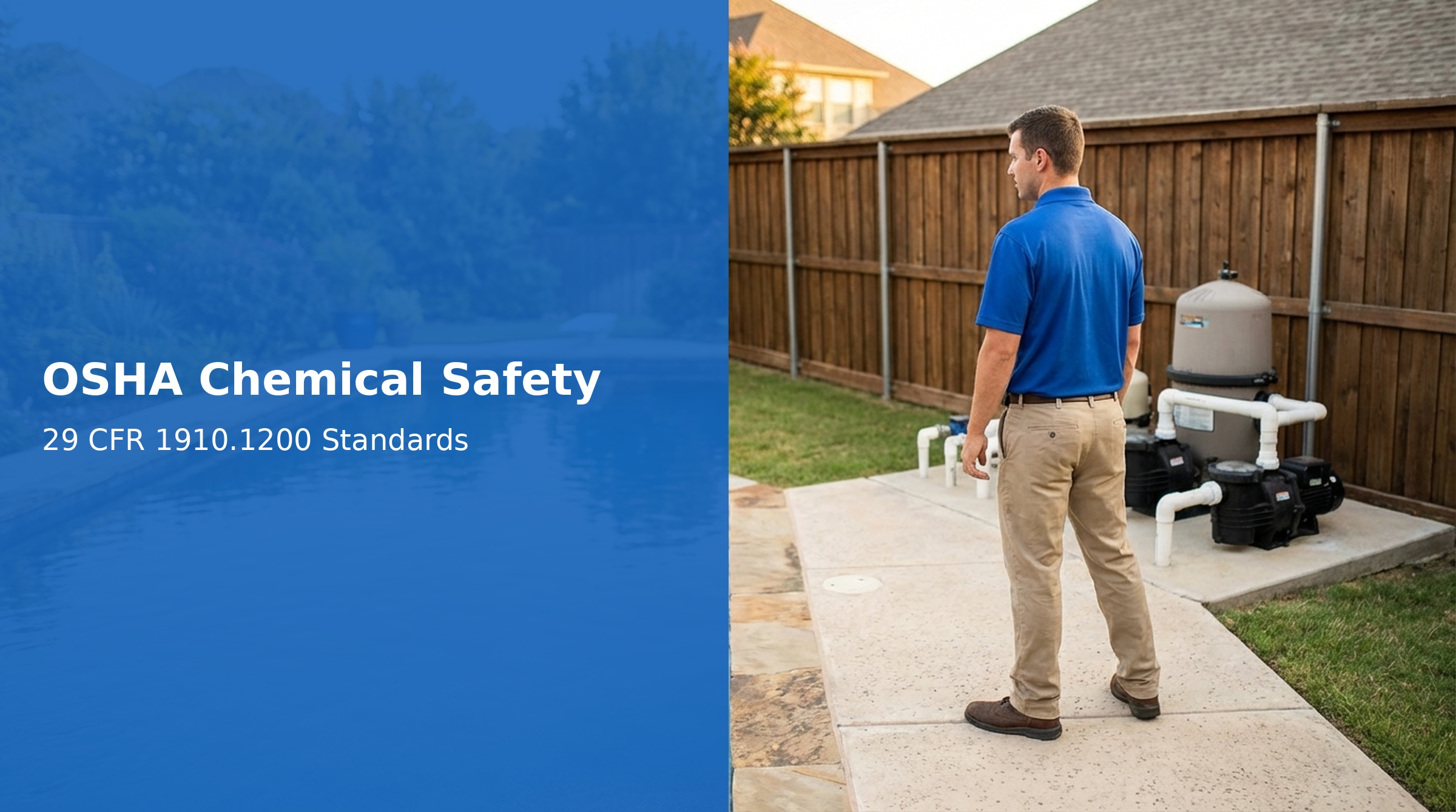
The Occupational Safety and Health Administration (OSHA) mandates strict protocols for handling pool chemicals through the Hazard Communication Standard (HCS), codified at 29 CFR 1910.1200. This regulation is designed to ensure that the hazards of all chemicals—from chlorine and muriatic acid to specialty clarifiers—are classified and that safety information is transmitted effectively to employees. For pool service businesses, compliance with these training, labeling, and storage requirements is a primary legal obligation for protecting staff from chemical burns, respiratory distress, and long-term health risks.[1]OSHA Hazard Communication Standard29 CFR §1910.1200osha.gov
Key Takeaways
- Right to Know — The purpose of the OSHA HCS is to ensure classified chemical hazard information is transmitted to employers and employees
- GHS Alignment — U.S. regulations are consistent with the Globally Harmonized System (GHS), requiring standardized labels and safety data formats[1]29 CFR §1910.1200GHS alignmentosha.gov
- Mandatory SDS — Employers must maintain a Safety Data Sheet (SDS) for every hazardous chemical in the workplace, organized into 16 specific sections
- Comprehensive Training — Employees must be trained on chemical hazards before their initial assignment and whenever a new hazard is introduced
- PPE Requirements — Employers are responsible for ensuring that workers use appropriate Personal Protective Equipment (PPE) as dictated by the chemical's SDS
- Storage Standards — Hazard communication programs must include details on the safe handling and storage of chemicals to prevent dangerous reactions
The Hazard Communication Program
The foundation of chemical safety in the pool industry is the comprehensive hazard communication program. This program must include container labeling, other forms of warning, Safety Data Sheets (SDS), and extensive employee training. OSHA requires every chemical manufacturer or importer to classify the intrinsic hazards of their products, but the burden of communicating those risks to workers falls on the employer. For a pool service company, this means ensuring that every technician understands the physical and health hazards associated with the products they use daily.[1]29 CFR §1910.1200(a)(1)Hazard communication purposeosha.gov
A critical component of this program is the standardization of information. The U.S. HCS is aligned with Revision 7 of the Globally Harmonized System of Classification and Labeling of Chemicals (GHS). This alignment ensures that symbols, signal words, and hazard statements are uniform across manufacturers, making it easier for pool pros to identify dangerous substances quickly. Even for common "consumer products" used in the workplace, such as retail-packaged cleaning chemicals, an employer must maintain a full hazard program if the duration and frequency of worker exposure is greater than what a typical consumer would experience.[1]29 CFR §1910.1200GHS alignment and consumer productsosha.gov
"The purpose of this section is to ensure that the hazards of all chemicals produced or imported are classified, and that information concerning the classified hazards is transmitted to employers and employees." — 29 CFR §1910.1200(a)(1)
Furthermore, the hazard classification must include any risks associated with the chemical's intrinsic properties. For pool chemicals, this often involves "Skin Corrosion" classifications, which range from Category 1A (destruction of skin tissue within 3 minutes of exposure) to Category 1C (responses occurring between 1 and 4 hours). Understanding these specific classifications allows employers to tailor their safety programs to the actual severity of the chemicals on their service trucks.[2]29 CFR §1910.1200 App ASkin corrosion categoriesecfr.gov
Safety Data Sheets (SDS) and Labeling
The Safety Data Sheet (SDS) is the primary document used to communicate detailed chemical information. OSHA requires each SDS to follow a rigid 16-section format to ensure that users can find information quickly in an emergency. For pool service pros, Sections 4 (First-aid), 7 (Handling and Storage), and 8 (Exposure Controls/Personal Protection) are particularly vital. Section 8, for example, specifies the exact type of gloves, eye protection, or respiratory gear needed to handle a specific chemical safely.[1]29 CFR §1910.1200(g)SDS format requirementsosha.gov
Labeling is the first line of defense in the field. Every container of hazardous chemicals in the workplace must be labeled with the product identifier and words, pictures, or symbols that provide general information about the hazards. If an ingredient in a pool chemical mixture is a known reproductive toxicant and is present at a concentration of 0.1% or greater, the entire mixture must be classified and labeled accordingly. This high level of detail ensures that even trace hazards are not overlooked by the end-user.[1]29 CFR §1910.1200(f)Labeling requirementsosha.gov
"The transmittal of information is to be accomplished by means of comprehensive hazard communication programs, which are to include container labeling and other forms of warning, safety data sheets and employee training." — 29 CFR §1910.1200(a)(1)
Chemical manufacturers must also disclose exact concentration ranges for ingredients on the SDS. These ranges must be the narrowest possible, such as "1% to 5%" or "30% to 60%." While companies can claim certain information as a "trade secret," they are still required to disclose the hazardous properties and must reveal the identity of the chemical to medical professionals or OSHA officials upon request.[2]29 CFR §1910.1200(i)Trade secret provisionsecfr.gov
Safe Handling, Storage, and PPE
Safe handling of pool chemicals requires strict adherence to Section 7 of the SDS, which details both storage requirements and incompatibility warnings. This is especially important for oxidizers like chlorine, which can react violently if stored near acids or organic materials. OSHA also identifies specific types of "Organic Peroxides" (Types A through E) based on their explosive properties and detonation potential, requiring specialized handling procedures for these highly reactive substances.[2]29 CFR §1910.1200 App BOrganic peroxide typesecfr.gov
Personal Protective Equipment (PPE) is the final layer of protection for pool technicians. Under Section 8 of the HCS, employers must ensure that technicians use the exposure controls and personal protection listed in the SDS. This might include acid-resistant gloves for handling muriatic acid or face shields when pouring liquid chlorine to prevent splashing into the eyes. Regular training is mandatory to ensure workers know how to inspect, wear, and maintain their PPE.[1]29 CFR §1910.1200(h)Training requirementsosha.gov
"Chemical manufacturers and importers shall evaluate chemicals produced in their workplaces or imported by them to classify the chemicals in accordance with this section." — 29 CFR §1910.1200(d)(1)
Finally, pool service businesses must recognize that training is an ongoing requirement. Employees must be informed of any new physical or health hazards introduced to their work area. For example, if a company switches from traditional chlorine to a new type of sanitizing tablet, the employer must provide updated hazard training before the technicians begin using the new product. This continuous loop of classification, communication, and training is what maintains a safe workplace in a chemically-intensive industry.[1]29 CFR §1910.1200(h)(3)New hazard trainingosha.gov
Summary Table
| Requirement | Details | Citation |
|---|---|---|
| Hazard Program | Must include labeling, SDS, and training | 29 CFR §1910.1200(b) |
| SDS Format | Standardized 16-section document required | 29 CFR §1910.1200(g) |
| Training Timing | Before initial assignment or when hazard changes | 29 CFR §1910.1200(h) |
| PPE Selection | Based on Section 8 of the product SDS | 29 CFR §1910.1200(g)(2) |
| Skin Corrosion 1A | Tissue destruction in ≤ 3 minutes | 29 CFR §1910.1200 App A |
| Concentration Limits | Mix triggers hazard if ingredient ≥ 0.1% | 29 CFR §1910.1200 App A |