


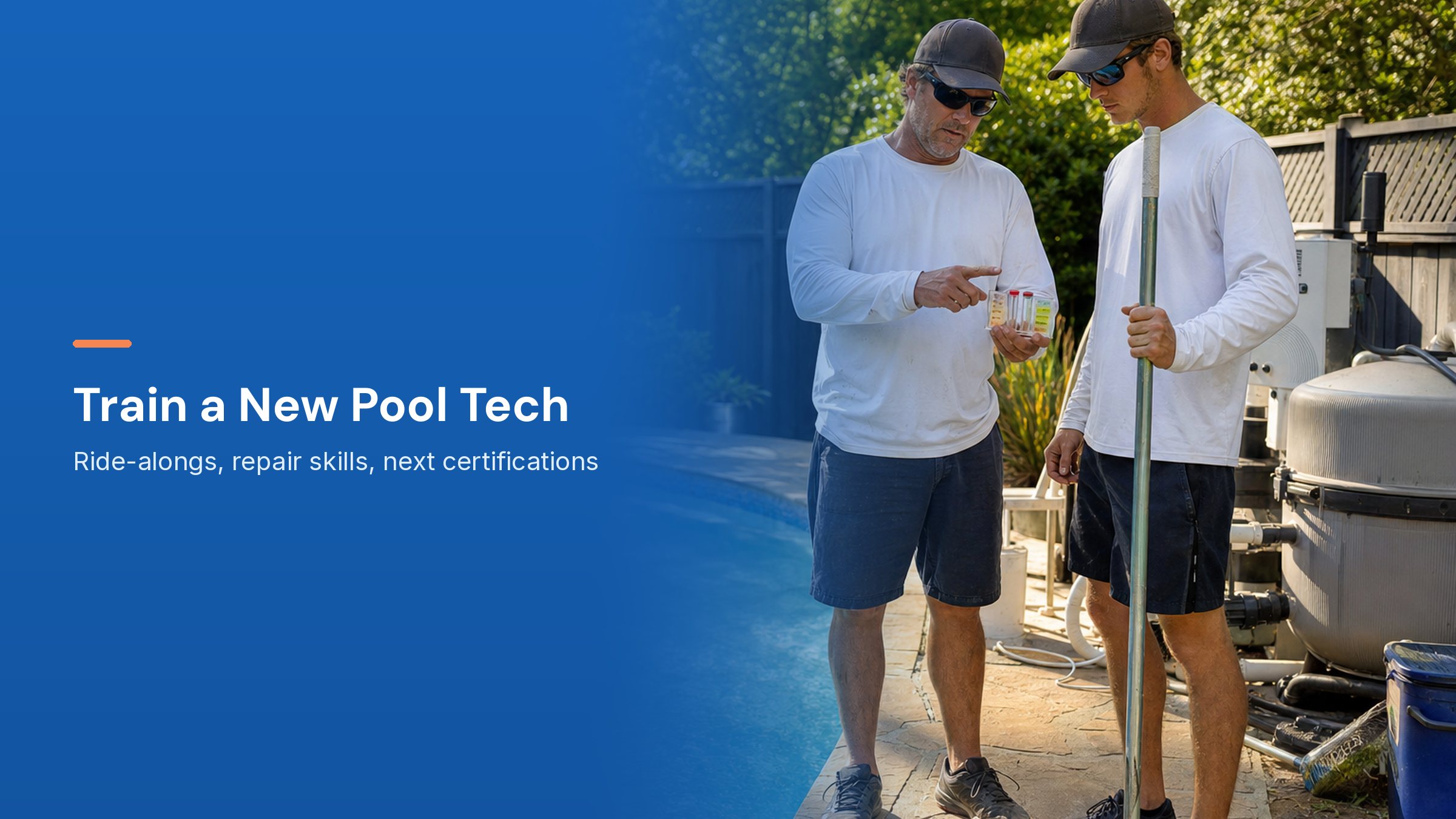
Most owners train a new pool tech the same way. The new hire rides in your truck for a few weeks, then takes a short list of easy pools. You check their photos and readings each night, and you add pools as the checks come back clean.
A green hire often needs four to eight weeks before a full route, and some shops plan on twelve. A tech with real experience may need only a week or two to learn your way. Repair takes much longer, so plan on a year or more of jobs done next to someone who knows the work.
Below is how owners run the ride-along, pick the first pools and check the work, plus the ways training goes wrong. After that comes how techs learn repair, where real classes are, and which certifications make sense after CPO.
Key Takeaways
- Ride first, then split. Many owners ride with a green hire for four to eight weeks. A common plan is to watch, then help, then lead while you watch.
- Start with easy pools. Give the new tech simple pools and easygoing customers. Keep the fussy and the brand-new accounts yourself for now.
- Check photos and readings every night. Spot check pools in person too. Checks are how you know the tech is ready for more.
- Repair is learned on jobs. Classes help. But most techs learn by doing repairs next to a person who has done them many times.
- After CPO, the PHTA path is CMS, then CST, then CSP. CST needs two years in the trade. CSP needs five years and a current CST.[4]Pool & Hot Tub AllianceCertified Pool & Spa Service Technician (CST) page, read November 25, 2026.phta.org[5]Pool & Hot Tub AllianceCertified Pool & Spa Service Professional (CSP) page, read November 25, 2026.phta.org
- A certificate is not a license. Many states want a license for repair or pool electrical work. The rules differ by state.[19]Texas Department of Licensing and RegulationApply for a New Residential Appliance Installer License page, read November 25, 2026.tdlr.texas.gov[17]California Contractors State License BoardSwimming Pool Construction: Selecting a Contractor page, read November 25, 2026.cslb.ca.gov
The short answer: a training timeline
No rule sets how long training takes, because the pools, the season and the person all change it. The table shows a plan many owners use for a hire with no pool background.
| Stage | Rough timing | What the new tech does | What you check |
|---|---|---|---|
| Paid trial day | Before you hire | Rides along for a day or two. Tries real tasks. | Do they jump in and ask questions? |
| Watch and help | Weeks 1 to 2 | Nets, brushes and empties baskets. Watches you test and dose. | Safe habits. Gates. Chemical handling. |
| Do it while you watch | Weeks 2 to 4 | Runs the whole stop. You stand back. | Test results match yours. Nothing skipped. |
| Short solo days | Weeks 4 to 8 | Runs a short list of easy pools alone. | Photos and readings each night. Spot visits. |
| Full route | After that | Runs a full route. Calls you when stuck. | Weekly spot checks. Callbacks. Customer notes. |
For a skill-by-skill list of what to teach in what order, see our pool technician training roadmap. This post is about how owners run the training in real life.
Before the first ride-along
Good training starts before the hire. Many owners use a paid trial, where the person rides along for a day or two and you both find out if the job fits.
Brian Wright runs Arizona Mirage, a 650-pool company near Phoenix. He told the Pool People Podcast he watches one thing on that trial day. Does the person step in and try?
“I'm looking for somebody that goes in on a ride-along and doesn't just stand back and watch. I will pay you for the ride-along.”
Owners split on who to hire. Some want a tech with years on a route, and others would rather take a person with no pool background and good people skills. Jarah Snyder of Jay's Complete Pool Service said on the same podcast that he looks first for people who are very good with customers, because the pool work can be taught.
Cover three things before day one:
- Driving. Ask for a driving record before you hand over truck keys. Call your insurance agent before the new hire drives or rides.
- Chemicals. If you have employees, OSHA says you must train them on the hazardous chemicals in their work area when they start. Safety data sheets must be easy for them to reach during the shift.[20]Occupational Safety and Health Administration29 CFR 1910.1200, Hazard Communication, paragraphs (g)(8) and (h), read November 25, 2026.osha.gov Teach from the product labels and the data sheets. Do not teach from memory.
- Dogs and gates. A new hire can get bit on a ride-along at a house where the dog loves you. Go over your rules on day one. Our dog safety guide covers them.
Write your stop down too, because a one-page checklist of your weekly service beats ten days of "watch me." You can build one with the free service checklist creator. For finding and screening people, see how to hire and manage pool technicians.
How the ride-along weeks work
Riding along is not the same as training. A new hire who nets pools for six weeks has learned to net pools, so move them through three steps on purpose.
- They watch, you talk. Say out loud what you see and why you do each thing. Why this pool gets brushed first. Why you look at the filter gauge before you leave.
- They do part, you do part. Hand over one task at a time. Baskets and netting first. Then brushing and vacuuming. Then testing. Dosing comes last.
- They do it all, you watch. Stay quiet until the stop is done. Then go over what they missed.
Testing gets its own time. Have the new tech test the same water you just tested and compare the numbers, at many pools, until the results match. Teach them to pull the sample the way your test kit's instructions say, because a bad sample gives a bad dose.
How long should the riding last? Owners give very different answers. On the Pool People Podcast, Brian Wright put his training at four weeks at a minimum. One owner on Reddit said it takes longer.
“In my experience, if you hire someone they will need to ride with you for about 2 months before they can go out on their own.”
Larger shops with a set program often plan on about twelve weeks for a hire with no experience. Even a tech with years in the trade should ride with you for a week or so, because they know pools but not your pools, your customers or your standards.
Expect your first try at training to be rough, as Jarah Snyder said.
“You're training your very first employee, I'm training myself to train him, right? So the difference between me training the first person and training the fifth person is going to be totally different.”
So take notes as you go, and put each thing you had to explain twice on the checklist. By the third hire you will have a real program.
Which pools the new tech gets first
Do not hand over a random half of your route.
- Give them easy pools. Simple equipment. Light debris. Good access. Water that holds steady week to week.
- Give them easygoing customers. A new tech will miss things. A relaxed customer gives you time to catch it.
- Keep the picky ones. Some customers signed up because of you. Hold those for now.
- Keep the new accounts. Many owners service each new pool themselves for the first weeks. They hand it off once the water and equipment are steady.
- Keep the problem pools. Pools with old gear, stains or a history of algae need your eyes.
Start with a short day. Many owners begin a new tech at around ten pools a day and build from there. Pros commonly put a full day for a trained tech at about ten to fifteen stops, depending on drive time and pool size.
A former regional supervisor on Reddit summed up what years of hiring taught him.
“Dont wait until you have 3 days of routes ready for them. Start early. Start them slow. Train thoroughly. Pay them well.”
Tell customers before the switch. Their fear is rarely that the owner is gone. It is that the service is about to get worse. Owners who keep accounts through a handoff bring the tech to meet the customer, say how the tech was trained, and make it clear the owner still stands behind the pool.
Some owners swap routes with the tech once a month, so they see every pool and every customer sees them. Others drop by a picky customer's pool to look at the work, then call the customer. Both moves keep the bond without taking the pool back.
Checklists, photos and reading checks
You cannot ride along forever, so checks take your place. Set them up before the first solo day.
- A checklist for every stop. The same steps, in the same order, at every pool.
- Photos at each stop. A common set is the pool when the tech leaves, the equipment pad, and the filter gauge. Add anything odd.
- Readings and doses logged at the pool. Not from memory in the truck. Each night, look for readings that never change, doses that do not fit the readings, and stops that took three minutes.
- A second look before a big dose. Have the new tech call or text you before a large correction. Follow the product label for every dose.
- Spot checks in person. Visit a few of their pools each week, soon after they leave. Test the water yourself. Look in the baskets.
Review the first solo days the same night and fix small things fast. When you correct something, also name one thing they did well, because techs who only hear about mistakes stop sending you the bad news.
Keep the checks going after training ends. Big companies often have a manager check a set number of pools every week, and small shops can check each tech's pools every month or two. For more, read building accountability systems for pool techs and what every visit checklist should cover.
How long until they run a route alone?
Use proof, not the calendar. A new tech is ready for a route alone when you can say yes to these:
- Their test results have matched yours for weeks.
- They finish the checklist with no reminders.
- Their photos and logs are complete every day.
- They call when they see something odd. They do not guess.
- They can explain a problem to a customer in plain words.
- Your spot checks have come back clean.
For most green hires that point comes somewhere between one and three months. Then grow the route in steps, adding pools each week as the checks stay clean.
Plan for one more thing: not every hire makes it. Some larger shops say they train three or four people to end up with one great tech, which is one more reason to start early.
Common ways training goes wrong
- Hiring too late. You hire in spring when you are already buried. You have no time to train, so you hand over pools on day three. Hire in the slow season if you can.
- Training for days, not weeks. A few days covers how to clean a pool. It does not cover the odd things that only come up once a month.
- Skipping training for a hire with experience. Brian Wright said on the Pool People Podcast that he hires trained and untrained people. He retrains the trained ones, because not every company works the same way. Old habits come with the hire.
- Too many pools too soon. A rushed tech skips steps. Then you get green pools and angry calls.
- No customer handoff. A stranger shows up at the gate. The customer starts shopping.
- No checks once they are solo. Problems stay hidden until a customer quits.
- Teaching only tasks. A new tech also has to explain a problem to a customer. Jarah Snyder trains his people to treat it as the tech and the customer against the problem.
- Paying too little to keep them. If you train a new person every few months, look at pay first. See how pool companies pay technicians and run your numbers in the tech compensation calculator.
Not sure a hire is the right move? See hire a technician or sell part of your route.
How techs learn repair
Repair is where the money is, and where good techs want to go. On poolrates.fyi, pros who shared a repair labor rate averaged about $139 an hour.[21]poolrates.fyiRepair price data, hourly repair labor rates shared by pool pros, January to October 2026, read November 25, 2026.poolrates.fyi A cleaning stop does not pay like that.
So how does a route tech learn pumps, plumbing, heaters and automation? Mostly on jobs, next to someone who knows the work. Mitchell Baker of Baker Pool Maintenance told the Pool People Podcast how his trainer handled his first equipment sale.
“He was there with me and we basically did it together. He helped me with one or two more installs until I really got the hang of it.”
Here are the ways pros make that happen.
- Work next to your repair tech. Finish the route early and help on repairs. As an owner, pull a route tech onto repair jobs one or two days a week.
- Sub the job and watch. If you are solo, sell the repair, bring in an experienced pro, and split the profit. Be honest that you want to learn.
- Take apart dead equipment. Keep an old pump or a pulled heater at the shop. Tear it down on a slow day. Some shops build training heaters from old units so techs can practice finding faults on a bench.
- Use the manual. Save the install and service manual for each model you see on your route. Wiring and parts diagrams answer a lot.
- Call tech support. Working a problem with the maker's support line teaches more than the one fix.
- Lean on your supply house. Jarah Snyder said the counter staff at his distributor taught him a great deal. He asked basic questions and brought them lunch.
- Join a trade group. A local chapter puts you in a room with people who will pick up the phone.
“Contract out and watch them and ask questions. Be up front that you want to learn and are happy to profit share.”
Start with low-risk work that has clear steps, and move up one rung at a time with someone checking the work. Electrical and gas work sit at the top, and they come with rules, so do not hand them to a new tech. In many places the law says who may do that work. Check your state and local rules first, and see our plain guide to pool electrical requirements under NEC Article 680. Follow the manual for the exact unit.
Videos help you see a job before you try it, but they do not replace a mentor. Parker also runs PoolDial Repair School at training.pooldial.com, a free site where techs practice common repair calls on a 3D equipment pad.
Where real repair classes exist
Dewey Case teaches CPO classes and works on the national model health code. On the Pool People Podcast he was frank about training in this trade.
“Don't wait for education to come to you. That's the other thing. We don't have a lot of education in the industry, right?”
There is no trade school for pool repair in most towns. But classes do exist. Most come from the companies that make the equipment.
| Who runs it | What it is | What the page says about cost |
|---|---|---|
| Pentair | Pentair Pool University. Online courses on automation, pumps, filters, lights and sanitizers. Also in-person workshops with hands-on troubleshooting.[10]PentairPentair Pool University page, read November 25, 2026.pentair.com | For members of its partner program. In-person training may need registration or purchase.[10]PentairPentair Pool University page, read November 25, 2026.pentair.com |
| Hayward | Hayward University. On-demand videos, webinars and hands-on workshops at training hubs. Topics include pumps, heating and automation.[11]HaywardHayward University page, read November 25, 2026.hayward.com[12]HaywardHayward Live Training page, read November 25, 2026.hayward.com | No price listed. |
| Fluidra (Jandy, Polaris, Zodiac) | Fluidra Pro Academy. A video library for pool professionals.[13]FluidraFluidra Pro Academy video library, read November 25, 2026.fluidrapro.hubs.vidyard.com | No price listed. |
| IPSSA | Member exams in water chemistry and equipment, with study guides.[9]Independent Pool & Spa Service AssociationIPSSA Exams and Accepted Certifications page, read November 25, 2026.ipssa.com | Education and testing are free for members. Study guides are sold.[9]Independent Pool & Spa Service AssociationIPSSA Exams and Accepted Certifications page, read November 25, 2026.ipssa.com |
| PHTA | CMS and CST courses, 24 hours each, online or with an instructor.[3]Pool & Hot Tub AllianceCertified Pool & Spa Maintenance Specialist (CMS) page, read November 25, 2026.phta.org[4]Pool & Hot Tub AllianceCertified Pool & Spa Service Technician (CST) page, read November 25, 2026.phta.org | Exam fee is $115 each. Course price is not on the page.[3]Pool & Hot Tub AllianceCertified Pool & Spa Maintenance Specialist (CMS) page, read November 25, 2026.phta.org[4]Pool & Hot Tub AllianceCertified Pool & Spa Service Technician (CST) page, read November 25, 2026.phta.org |
| National Plasterers Council | Start-up Technician class. A 3-hour online program on starting up new plaster.[14]National Plasterers CouncilStart-up Technician Certification Online Class page, read November 25, 2026.nationalplastererscouncil.com | $225 for members, $325 for others.[14]National Plasterers CouncilStart-up Technician Certification Online Class page, read November 25, 2026.nationalplastererscouncil.com |
Pentair says a tech should first check if the boss already has access through the company account.[10]PentairPentair Pool University page, read November 25, 2026.pentair.com Hayward's pages list hubs in Dallas, Irvine and Tampa, and its class finder also lists Atlanta.[11]HaywardHayward University page, read November 25, 2026.hayward.com[12]HaywardHayward Live Training page, read November 25, 2026.hayward.com
Your sales rep is the shortcut. Reps know when the next hands-on class comes to town, and some will come to your shop and train your crew on a heater or a control panel.
Do not skip the trade shows, since the big regional shows run days of classes and many makers teach there. Leak detection is its own skill, and companies that sell leak gear also sell training on it. Ask to ride along on real jobs before you spend big, because every leak is different.
Which certifications are worth it after CPO
CPO is the start. PHTA calls it Level 1 of its service path.[1]Pool & Hot Tub AlliancePHTA Certified Pool Service Professional Pathway page, read November 25, 2026.phta.org It is valid for five years.[2]Pool & Hot Tub AllianceCertified Pool & Spa Operator (CPO) page, read November 25, 2026.phta.org It is built around running a pool safely, and many places want it for commercial pools. Many residential techs find it leans toward commercial pools. If you still need it, start with our CPO certification guide and the CPO course finder. PHTA's page does not list a price.[2]Pool & Hot Tub AllianceCertified Pool & Spa Operator (CPO) page, read November 25, 2026.phta.org Instructors set their own.
What comes next? PHTA has three more levels for service techs.[1]Pool & Hot Tub AlliancePHTA Certified Pool Service Professional Pathway page, read November 25, 2026.phta.org
| Credential | Who it is for | What PHTA requires | Exam |
|---|---|---|---|
| CMS, Certified Pool & Spa Maintenance Specialist | People new to the trade or running a route | No experience needed. Finish the 24-hour course. Pass the exam.[3]Pool & Hot Tub AllianceCertified Pool & Spa Maintenance Specialist (CMS) page, read November 25, 2026.phta.org | $115. 75 questions, 1.5 hours, open book.[3]Pool & Hot Tub AllianceCertified Pool & Spa Maintenance Specialist (CMS) page, read November 25, 2026.phta.org |
| CST, Certified Pool & Spa Service Technician | Techs moving into repair | Two years in the trade. Finish the 24-hour course. Pass the exam.[4]Pool & Hot Tub AllianceCertified Pool & Spa Service Technician (CST) page, read November 25, 2026.phta.org | $115. 100 questions, 2.5 hours, open book.[4]Pool & Hot Tub AllianceCertified Pool & Spa Service Technician (CST) page, read November 25, 2026.phta.org |
| CSP, Certified Pool & Spa Service Professional | Senior techs and service managers | Five years in the trade. A current CST. Pass the exam.[5]Pool & Hot Tub AllianceCertified Pool & Spa Service Professional (CSP) page, read November 25, 2026.phta.org | $250. 150 questions, 3 hours, open book.[5]Pool & Hot Tub AllianceCertified Pool & Spa Service Professional (CSP) page, read November 25, 2026.phta.org |
The CST course covers circulation, filtration, hydraulics, electrical systems, and pool finish problems and repairs.[4]Pool & Hot Tub AllianceCertified Pool & Spa Service Technician (CST) page, read November 25, 2026.phta.org Each exam needs a score of 75 percent or better.[3]Pool & Hot Tub AllianceCertified Pool & Spa Maintenance Specialist (CMS) page, read November 25, 2026.phta.org[4]Pool & Hot Tub AllianceCertified Pool & Spa Service Technician (CST) page, read November 25, 2026.phta.org[5]Pool & Hot Tub AllianceCertified Pool & Spa Service Professional (CSP) page, read November 25, 2026.phta.org These three last three years. To renew, you need 24 hours of approved continuing education and a fee. PHTA's page does not list the fee amount.[6]Pool & Hot Tub AllianceRecertify page, read November 25, 2026.phta.org
Are they worth it? Pros do not agree. Here is the fair summary.
- The case for. The courses fill gaps, most of all in hydraulics and electrical basics, and some employers pay more for each one.
- The case against. Techs with ten years in say much of it is review. And no class makes you a repair tech. Field time does that.
- The common advice. Take CMS before CST unless you already do repairs, and pick a live class over a recorded one if you can.
A simple way to choose is to get the one your market pays for. If your boss gives a raise for CST, take CST, and if your state or county wants a named course, take that one. If no one asks for any of them, put the money into a maker's hands-on class first.
A few others come up often:
- CPI, Certified Pool & Spa Inspector. PHTA built it for people who inspect public pools and spas. It suggests two years in the trade. The exam fee is $115.[7]Pool & Hot Tub AllianceCertified Pool & Spa Inspector (CPI) page, read November 25, 2026.phta.org It can fit a tech who wants to add inspections.
- IPSSA exams. IPSSA members must pass its water chemistry exam in their first year, unless the chapter takes another certificate. There is an equipment exam too.[9]Independent Pool & Spa Service AssociationIPSSA Exams and Accepted Certifications page, read November 25, 2026.ipssa.com Our IPSSA membership guide covers the rest.
- NPC Start-up Technician. Worth a look if you start up new plaster.[14]National Plasterers CouncilStart-up Technician Certification Online Class page, read November 25, 2026.nationalplastererscouncil.com
- The PHTA apprenticeship. This one is for owners. It is registered with the U.S. Department of Labor. It runs 2,000 hours of on-the-job training plus at least 144 hours of class work. The CMS and CST courses are part of it.[8]Pool & Hot Tub AlliancePool Maintenance and Service Technician Apprenticeship Program page, read November 25, 2026.phta.org It gives a small shop a ready-made training plan.
A certificate is not a license
A CST or a maker's class shows what you know, but it does not give you the legal right to do repair work. In many states a license does that, and the rules differ by state. Three examples:
- Texas. The state licenses pool electrical work. A Residential Appliance Installer may do electrical work limited to home appliance installs. That includes home pool electrical installation and maintenance, done for a licensed appliance installation contractor. There is no experience rule. You apply with a $30 fee, pass an exam, and renew each year.[19]Texas Department of Licensing and RegulationApply for a New Residential Appliance Installer License page, read November 25, 2026.tdlr.texas.gov More in our Texas license guide.
- California. The state board says any contracting job of $1,000 or more must be done by a licensed contractor. That includes pool repair.[17]California Contractors State License BoardSwimming Pool Construction: Selecting a Contractor page, read November 25, 2026.cslb.ca.gov The D-35 Pool and Spa Maintenance class covers pool motors, pumps, filters, gas heaters and above-ground piping.[18]California Contractors State License BoardD-35 Pool and Spa Maintenance Contractor classification page, read November 25, 2026.cslb.ca.gov More in our California license guide.
- Florida. State law says you do not need a license to clean a pool in a way that does not affect its structure or its attached equipment. Repair and replacement of equipment fall under the pool/spa servicing contractor class.[15]Florida LegislatureFlorida Statutes section 489.105(3)(l), swimming pool/spa servicing contractor, read November 25, 2026.leg.state.fl.us For the residential servicing license, the state lists two paths. One is four years of experience, with a year as foreman. The other is a 60-hour approved course plus a year of experience. Both end with a state exam.[16]Florida Department of Business and Professional RegulationConstruction Industry FAQs, residential pool/spa servicing contractor section, read November 25, 2026.myfloridalicense.com More in our Florida license guide.
Other states have their own rules, and some cities add more. We also have a guide for Arizona. Before you add repair to a tech's job, check with your state board and ask your insurance agent what your policy covers.
None of this is fancy. It takes time, a written checklist and steady checks. The owners who train well mostly start sooner and keep checking longer.
Sources
- [1]Pool & Hot Tub Alliance, PHTA Certified Pool Service Professional Pathway page, read November 25, 2026. phta.org
- [2]Pool & Hot Tub Alliance, Certified Pool & Spa Operator (CPO) page, read November 25, 2026. phta.org
- [3]Pool & Hot Tub Alliance, Certified Pool & Spa Maintenance Specialist (CMS) page, read November 25, 2026. phta.org
- [4]Pool & Hot Tub Alliance, Certified Pool & Spa Service Technician (CST) page, read November 25, 2026. phta.org
- [5]Pool & Hot Tub Alliance, Certified Pool & Spa Service Professional (CSP) page, read November 25, 2026. phta.org
- [6]Pool & Hot Tub Alliance, Recertify page, read November 25, 2026. phta.org
- [7]Pool & Hot Tub Alliance, Certified Pool & Spa Inspector (CPI) page, read November 25, 2026. phta.org
- [8]Pool & Hot Tub Alliance, Pool Maintenance and Service Technician Apprenticeship Program page, read November 25, 2026. phta.org
- [9]Independent Pool & Spa Service Association, IPSSA Exams and Accepted Certifications page, read November 25, 2026. ipssa.com
- [10]Pentair, Pentair Pool University page, read November 25, 2026. pentair.com
- [11]Hayward, Hayward University page, read November 25, 2026. hayward.com
- [12]Hayward, Hayward Live Training page, read November 25, 2026. hayward.com
- [13]Fluidra, Fluidra Pro Academy video library, read November 25, 2026. fluidrapro.hubs.vidyard.com
- [14]National Plasterers Council, Start-up Technician Certification Online Class page, read November 25, 2026. nationalplastererscouncil.com
- [15]Florida Legislature, Florida Statutes section 489.105(3)(l), swimming pool/spa servicing contractor, read November 25, 2026. leg.state.fl.us
- [16]Florida Department of Business and Professional Regulation, Construction Industry FAQs, residential pool/spa servicing contractor section, read November 25, 2026. myfloridalicense.com
- [17]California Contractors State License Board, Swimming Pool Construction: Selecting a Contractor page, read November 25, 2026. cslb.ca.gov
- [18]California Contractors State License Board, D-35 Pool and Spa Maintenance Contractor classification page, read November 25, 2026. cslb.ca.gov
- [19]Texas Department of Licensing and Regulation, Apply for a New Residential Appliance Installer License page, read November 25, 2026. tdlr.texas.gov
- [20]Occupational Safety and Health Administration, 29 CFR 1910.1200, Hazard Communication, paragraphs (g)(8) and (h), read November 25, 2026. osha.gov
- [21]poolrates.fyi, Repair price data, hourly repair labor rates shared by pool pros, January to October 2026, read November 25, 2026. poolrates.fyi