


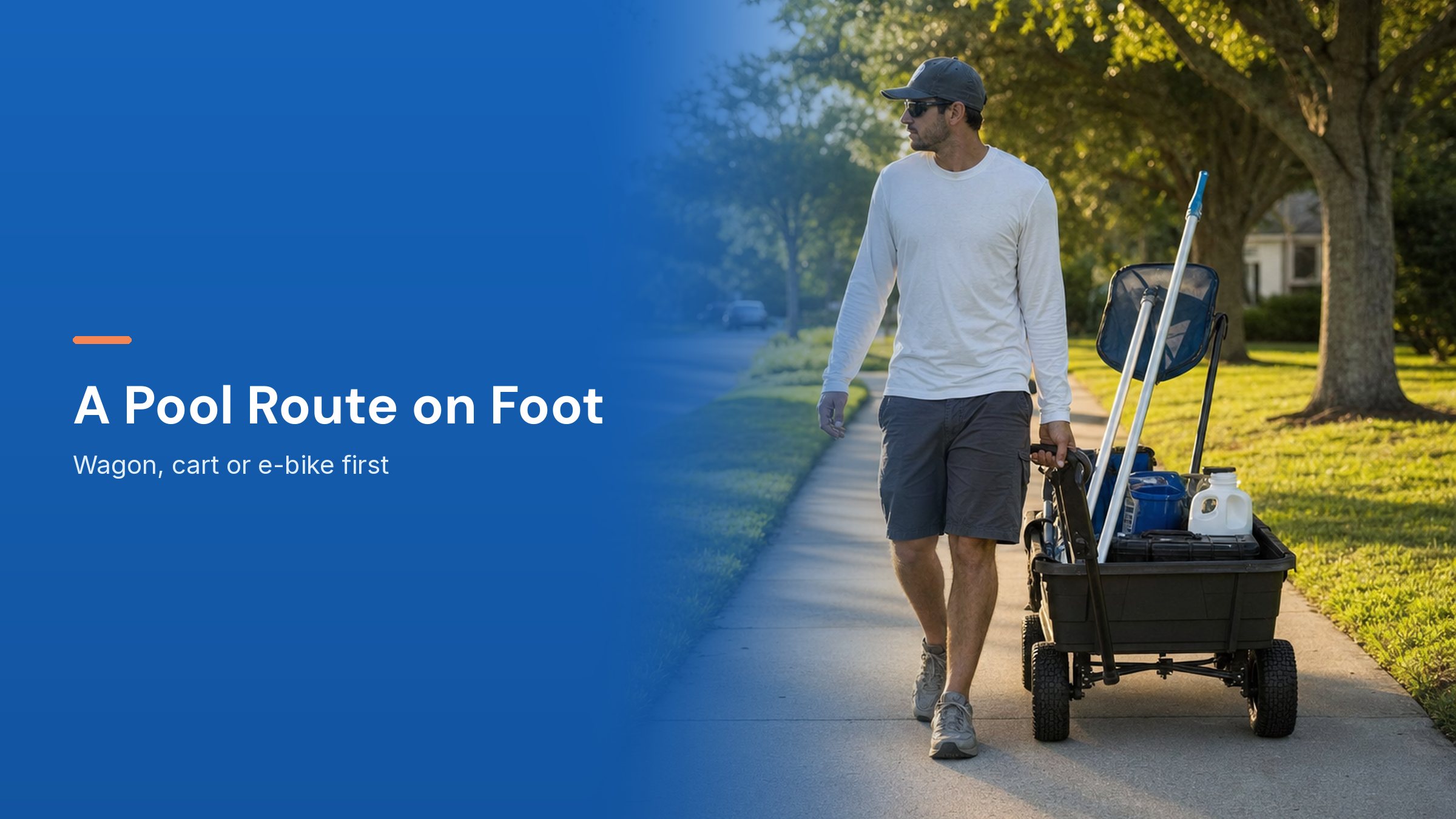
Yes, you can run a pool route on foot. It works for weekly cleaning in one tight neighborhood, a gated community or a condo complex where the pools sit a few doors apart. You load a wagon with a pole, brush, net, test kit and a small amount of chemicals, and you walk from yard to yard.
It has hard limits, though. A wagon will not carry a vacuum cart, a big chemical load or repair parts. You still need insurance, real prices and a safe way to carry chlorine and acid. And once the route spreads out past a short walk, you will want wheels. This guide covers how tight the route has to be, what fits, how to carry chemicals, the options between a wagon and a truck, who covers your pools when you are out, how to find customers on your own blocks, and when to buy the truck.
Key Takeaways
- It works for weekly cleaning in a dense pocket. Think one subdivision, a 55 and older community or a condo complex, with stops a short walk apart.
- A wagon holds the basics. Pole, brush, net, battery vacuum, test kit, tabs and one chemical case at a time. It does not hold a pump cart, DE, acid wash gear or repair stock.
- Chlorine weighs about 10 pounds a gallon. A four-jug case is about 40 pounds before the case itself. Muriatic acid is close behind.[1]HASA: HASACHLOR 12.5% Sodium Hypochlorite Safety Data Sheet (SDS No. 102), revised August 24, 2026: sections 6, 7, 9, 10 and 14. hasa.com[2]HASA: Muriatic Acid Safety Data Sheet (SDS No. 110), revised August 24, 2026: sections 6, 7, 8, 9 and 10. hasa.com
- Carry one liquid chemical per trip. HASA says never put chlorine and acid in the same containment case. A wagon is one small, tippable container, so do a chlorine run and an acid run, or have customers keep their own.[3]HASA: How to Safely Transport HASA Products, two-page transport and handling guide for Sani-Clor, Hasachlor and HASA Muriatic Acid. hasa.com
- Golf carts and low-speed vehicles are the next step up. Federal rules define them, but your state and city decide where you can drive one.[6]eCFR: 49 CFR 571.3, Definitions: low-speed vehicle. ecfr.gov[8]Florida Highway Safety and Motor Vehicles: Low Speed Vehicles, Golf Carts and ATVs fact sheet, read November 26, 2026. flhsmv.gov
- Line up a backup before you need one. Trade coverage with a nearby solo operator, join a trade association that covers sick members, or train a part-timer. A walking route is easy to hand off because no truck is needed.[13]IPSSA: Sick Route Coverage: how chapter members cover a sick or injured member’s route, read November 27, 2026. ipssa.com
- Market the blocks you already walk. Door hangers on pool homes near your stops, neighbor referrals and local neighborhood apps fit a walking route best.
- Buy a truck when the walk eats your day. Spread-out stops, heavy jobs and repair calls are the signs.
Can you run a pool route on foot?
For basic weekly service, yes. The job is the same with or without a truck. You skim, brush, empty baskets, test the water, add chemicals and check the equipment. None of that needs an engine. It needs your tools at the pool.
Most people who start in the trade assume the truck comes first. Grant Baldwin, who bought routes to build his company, said it plainly on Parker's show:
“it was a little bit easier to get started in terms of, you know, just needing a truck and a Skimmer net and maybe a contractor's license if you want to do repairs.”
The truck moves gear between spread-out stops. If your stops are close, you can skip it for a while. A walking route fits:
- Someone starting small who wants a few pools near home before buying a vehicle.
- A tech in a dense subdivision where the truck sits parked most of the day anyway.
- Someone in a gated or age-restricted community with many pools on short streets.
- A condo or HOA pool tech with several pools on one property.
It fits poorly in rural areas, hilly towns with long driveways, and markets where the pools are big, open and need a manual vacuum every week. Read the guide to starting a pool service business for the parts that do not change, like licenses, contracts and getting customers.
How tight does the route need to be?
Density is the whole game. On a walking route, every minute between pools is unpaid. The pools need to be close enough that you can pull the wagon to the next one in a few minutes.
Truck routes care about this too. Nate, who runs a solo route, described a tight one this way:
“I'd say it's five to ten minutes in between pools, and I have a couple of clustered pools. So I have three pools in one community, I have two pools in another community, and then I have a couple of pools that are literally right across the street from each other.”
Five to ten minutes by truck is tight. On foot, aim tighter. A good rule is that every stop on a walking day should be within a few blocks of the last one. If you have to cross a busy road, climb a big hill or walk more than about ten minutes, that stop belongs on a truck day.
How many pools can a walking day hold?
Pros commonly report 15 to 30 minutes per pool for basic weekly service on easy pools, and much more on big or dirty ones. Truck techs report a wide range, from about 10 pools a day on spread-out routes to 20 or more when the pools sit close together. Density moves that number more than anything else, as this pro explains:
“Lowest per day is 17 but that's because of the driving distance. Highest is 24 but lots of those pools are within the same neighborhood.”
On foot, plan lower. You will make a trip home or to a storage spot to reload. You pull weight all day. You lose time when it rains. A fair first target is 6 to 10 pools on a walking day. At four or five days a week, that is roughly 25 to 45 weekly pools. That is a real part-time business, or a starter route you grow into a truck route.
To build density, hang door hangers on the blocks where you already clean a pool, ask happy customers to tell neighbors, and turn down pools outside your zone. Then run your own numbers in the route capacity planner and the pool route calculator, using your real minutes per stop and walk time.
What fits in a wagon, and what does not
A good folding utility wagon with big wheels is the base of the setup. Pick one with a solid floor and sides. Check the rated load on the label before you buy, and stay under it. Some truck techs already use a cheap wagon to roll gear from the curb to the backyard. Here it is the whole system.
| Item | Fits in a wagon? | Notes |
|---|---|---|
| Telescoping pole, brush, leaf net, skimmer net | Yes | Lay the pole along the side or strap it to the handle. |
| Test kit and reagents | Yes | Keep it in a dry box on top, away from chemicals. |
| Battery vacuum (handheld or wand style) | Yes | The best fit for a walking route. No hoses, no pump. |
| Vacuum head and a short hose | Yes | Works when the pool's own pump can vacuum. |
| Tabs, small bags of bicarb or dry acid | Yes | Keep dry products sealed and away from liquids. |
| One case of liquid chlorine or one case of acid | One at a time | Never both on the same wagon trip. See the chemical section below. |
| Basic hand tools, o-rings, lube, gauge | Yes | A small tool bag covers most weekly fixes. |
| Pump-and-filter vacuum cart | No | Too heavy to pull far. Needs power and space. |
| DE by the bag, sand, filter media | No | Too heavy and bulky. Schedule these as truck jobs. |
| Acid wash or drain gear | No | Pumps, hoses and large acid loads need a vehicle. |
| Green-to-clean chemical loads | No | A green pool can take far more chlorine than a wagon can carry. |
| Pumps, motors, heaters, big parts | No | Repairs need parts runs and a vehicle. |
The jobs you hand off or schedule differently
A walking route is a weekly maintenance route. Be honest about what you cannot do on foot:
- Heavy vacuuming. A pool full of dirt or a big leaf dump needs a strong vacuum. A battery unit can handle light work. A storm cleanup may need a truck day.
- Filter cleans. Cartridge cleans can work on site if the customer has a hose and space. DE and sand changes are heavy. Book them as truck jobs or refer them out.
- Acid washes and drains. These are big jobs with pumps, hoses and large amounts of acid. Read how to acid wash a pool and how to drain a pool safely before you take one on, and plan a vehicle for them.
- Green-to-clean. These take big chlorine loads and repeat visits. See green-to-clean and high chlorine demand for what one really uses.
- Repairs. You can spot a bad pump seal or a dead timer. Fixing it takes parts, and some states need a license for equipment work.
A good plan is to partner with a local repair tech or a nearby company. You find the work, and they do the heavy jobs. Some pay a referral fee. You keep the weekly account.
How to carry chlorine and acid without a truck
This is the part to get right. Liquid chlorine and muriatic acid are corrosive, heavy and react with each other. On a walking route, they ride a foot from your legs.
Know the weight
HASA lists its 12.5% liquid chlorine at a specific gravity of 1.2, or about 10 pounds per gallon.[1]HASA: HASACHLOR 12.5% Sodium Hypochlorite Safety Data Sheet (SDS No. 102), revised August 24, 2026: sections 6, 7, 9, 10 and 14. hasa.com Its 31.45% muriatic acid has a specific gravity of 1.16.[2]HASA: Muriatic Acid Safety Data Sheet (SDS No. 110), revised August 24, 2026: sections 6, 7, 8, 9 and 10. hasa.com Water is about 8.3 pounds per gallon, so acid comes out near 9.7 pounds per gallon.
- One gallon of chlorine: about 10 pounds.
- A four-jug case of chlorine: about 40 pounds, plus the jugs and case.
- A four-jug case of acid: about 39 pounds, plus the jugs and case.
Either case is about 40 pounds before any tools. That is plenty to pull up a hill all day. Carry what the day needs, not a week's supply.
Keep them apart, upright and in their cases
HASA's transport guide is written for vehicles, but its rules fit a wagon too. It says to keep chlorine and acid separated at all times. It says never to put the two in the same containment case. Chlorine goes in the yellow case and acid in the red case. It also says not to move single bottles outside the four-bottle case or the original box, and to check that the case bottom is dry, clean and free of cracks.[3]HASA: How to Safely Transport HASA Products, two-page transport and handling guide for Sani-Clor, Hasachlor and HASA Muriatic Acid. hasa.com
HASA's safety blog adds a few more points. Keep bottles upright in their cases, even when empty. Keep caps tight. Keep full and empty acid bottles apart. Never use a chlorine case to carry acid.[4]HASA: Pool Chemical Safety: Proper Handling, Storage and Transport (blog), read November 26, 2026. hasa.com
One liquid chemical per trip
Those rules are written for a truck bed, where the two cases can sit feet apart and be strapped in place. A wagon is different. It is one small, open bin that can tip on a curb or a driveway lip. If it tips with both on board, chlorine and acid can spill together. Mixing them makes chlorine gas, and you would be standing right over it.
So do not put chlorine and acid on the same wagon at the same time. Pick one of these plans instead:
- Split the trips. Most pools need chlorine every week but acid less often. Run your chlorine stops with the chlorine case. Go home, swap it for the acid case, and walk the acid stops after.
- Use dry acid on the wagon. Sealed bags of dry acid (sodium bisulfate) can ride with your tools, kept dry and well away from the chlorine. Follow the label for dosing.
- Have the customer keep the chemicals. The customer stores chlorine and acid at their own pool, and you carry only tools and a test kit. See the customer chemicals section below.
Whichever case is on the wagon:
- Strap it down so it cannot tip on a curb.
- Lay a plastic sheet or tray under it. HASA calls for a protective sheet under cases in a vehicle.[3]HASA: How to Safely Transport HASA Products, two-page transport and handling guide for Sani-Clor, Hasachlor and HASA Muriatic Acid. hasa.com
- Keep the test kit and anything dry well away from the liquid.
Some new techs try to skip the wagon and carry chemicals in a pouch or backpack. Many pros push back on that idea, and for good reason.
“I know I wouldn’t ever want acid hanging out on my back. Mishaps happen, and I rather they not happen on my skin.”
Pre-pouring acid into small bottles is also a bad trade. The CDC says to keep pool chemicals in their original, labeled containers.[5]CDC: Pool Chemical Safety, Healthy Swimming toolkit, read November 26, 2026. cdc.gov An unlabeled bottle of acid in a bag is how accidents start.
Heat and sun
A wagon sits in the sun at every stop. HASA's chlorine SDS says to store it in a cool, shaded spot and keep it in its original vented container. It says chlorine breaks down faster as it heats up, about 3.5 times faster for every 10°C rise in storage temperature.[1]HASA: HASACHLOR 12.5% Sodium Hypochlorite Safety Data Sheet (SDS No. 102), revised August 24, 2026: sections 6, 7, 9, 10 and 14. hasa.com Park the wagon in shade when you can. Do not leave jugs baking on a driveway all afternoon.
Carry a small spill kit
Pack gloves, splash goggles, a bag of baking soda, a small bag of dry sand, a few rags and a trash bag. That covers what the SDS sheets call for on a small spill:
- Chlorine: wipe up a small spill with absorbent material. For a bigger spill, absorb it with vermiculite, dry sand or earth.[1]HASA: HASACHLOR 12.5% Sodium Hypochlorite Safety Data Sheet (SDS No. 102), revised August 24, 2026: sections 6, 7, 9, 10 and 14. hasa.com
- Acid: for a small spill, the SDS says to squeegee it into the pool if you can. If not, absorb it with sand or diatomaceous earth, bag it and put it in the trash.[2]HASA: Muriatic Acid Safety Data Sheet (SDS No. 110), revised August 24, 2026: sections 6, 7, 8, 9 and 10. hasa.com
The acid label also says to wear goggles, old clothes and rubber gloves, and to rinse skin or eyes with water for 15 to 20 minutes after contact.[3]HASA: How to Safely Transport HASA Products, two-page transport and handling guide for Sani-Clor, Hasachlor and HASA Muriatic Acid. hasa.com Keep a full water bottle on the wagon for that reason alone.
What about transport rules?
Truck routes fall under federal hazmat rules for motor vehicles. Our guide to hauling liquid chlorine and the DOT rules explains the limits for trucks. We could not find a federal source that speaks to a hand-pulled wagon or a bike. Do not assume that means no rules apply. Ask your local fire department if you plan to carry chemicals along public sidewalks, and follow the label and SDS every time. Never mix chemicals, and never let chlorine and acid share a container.
Storing chemicals at home
Without a truck, your chemicals live at your house between route days. Treat that spot like a small chemical room, because it is one.
The chlorine SDS says to store it in a cool, shaded outdoor area, or inside only if the space is cool, dry and well ventilated. Keep it in the original vented container, closed, and not next to chemicals that could react with it. It also says to store it locked up.[1]HASA: HASACHLOR 12.5% Sodium Hypochlorite Safety Data Sheet (SDS No. 102), revised August 24, 2026: sections 6, 7, 9, 10 and 14. hasa.com The acid SDS says to store it upright in a clean, dry place, locked up, in a well-ventilated area, and out of reach of children and pets.[2]HASA: Muriatic Acid Safety Data Sheet (SDS No. 110), revised August 24, 2026: sections 6, 7, 8, 9 and 10. hasa.com
HASA's safety blog goes a step further. It says to avoid residential garages and use a ventilated chemical room or outdoor area instead.[4]HASA: Pool Chemical Safety: Proper Handling, Storage and Transport (blog), read November 26, 2026. hasa.com The CDC says to store each chemical separately, keep incompatible ones away from each other, and keep the area secured from children and animals.[5]CDC: Pool Chemical Safety, Healthy Swimming toolkit, read November 26, 2026. cdc.gov
For a home-based walking route, that usually means:
- A locked, shaded outdoor cabinet or shed, with chlorine on one side and acid on the other.
- Dry products like tabs and shock stored apart from liquids, and never below them.
- A small stock, with gloves, goggles and each SDS nearby.
If you rent, live in an HOA or share walls with neighbors, check your lease and HOA rules first. When the stock outgrows a shed, read the pool chemical storage guide for the next step.
The other model: use the customer’s chemicals
One way to cut most of the hauling is to sell labor only. The customer buys chlorine, acid and tabs and keeps them at their own pool. You bring your tools and test kit. You test, dose from their stock and leave a note when they run low.
| Chemicals included | Customer supplies chemicals | |
|---|---|---|
| What you carry | Chlorine, acid, tabs and more | Tools and test kit only |
| Control of products | Full | You use what they bought |
| Running out | Your problem to plan for | Common, and it can hurt the water |
| Chemical margin | Yours | None |
| Storage at the customer's home | Not your concern | Their shed, their risk, but you will be blamed if it goes wrong |
It works best with owners who already buy their own supplies, or for a short time while you build up the route. The weak spots are real. Customers buy the wrong product, let the stock run out, or store acid next to chlorine. Spell it out in writing: what they buy, what strength, where they store it, and what happens when they run out. Check their storage on your first visit and tell them if it is unsafe.
Keep in mind that chemicals are part of how many pool businesses make money. See pool service chemical markup pricing before you give that margin away for good.
Options between a wagon and a truck
You do not have to jump from a wagon straight to a pickup. Each step up carries more and covers more ground.
| Option | What it carries | Rules to check | Best for |
|---|---|---|---|
| Folding utility wagon | Tools plus one chemical case per trip | Rated load on the label | Stops a few blocks apart |
| Bike cargo trailer | Burley's Flatbed is rated for 100 pounds | Trailer and bike limits; local bike laws | Stops a mile or two apart on flat ground |
| Cargo e-bike | Tern's GSD has a max gross vehicle weight of 200 kg (440 lb), counting the bike, rider, cargo and any trailer | State e-bike rules; secure, separate chemical boxes | A wider zone with light loads |
| Golf cart | A cargo box on the back | Florida, for example, allows golf carts on roads designated for them with posted limits of 30 mph or less | Gated and golf-cart communities |
| Low-speed vehicle (LSV) | A small utility bed | Federal equipment rules, plus state title, registration, insurance and road limits | Dense towns with slow streets |
| Used pickup | A full route kit | Insurance, fuel, hazmat limits for trucks | Spread-out stops and heavy jobs |
Sources: Burley trailer rating[10]OutdoorGearLab: Burley Design Flatbed bike cargo trailer review and specifications, read November 26, 2026. outdoorgearlab.com, Tern e-bike limit[9]Tern Bicycles: Max Gross Vehicle Weight (MGVW) explainer, with the GSD figure, read November 26, 2026. ternbicycles.com, federal low-speed vehicle rules[7]eCFR: 49 CFR 571.500, Standard No. 500, Low-speed vehicles: purpose, speed limit and required equipment. ecfr.gov and Florida golf cart and LSV rules.[8]Florida Highway Safety and Motor Vehicles: Low Speed Vehicles, Golf Carts and ATVs fact sheet, read November 26, 2026. flhsmv.gov
Bike trailers and cargo e-bikes
A bike trailer roughly doubles your range over a wagon on flat streets. A cargo e-bike goes further. The catch is weight. On an e-bike, Tern counts the rider in the total.[9]Tern Bicycles: Max Gross Vehicle Weight (MGVW) explainer, with the GSD figure, read November 26, 2026. ternbicycles.com A 200-pound rider on a bike rated for 440 pounds, with the bike's own weight, leaves less for chemicals than you might think. Read your bike's limit and do the math before the first load. Carry one liquid chemical per trip, the same as on a wagon, in a closed, upright case fixed to the bike or trailer.
Golf carts and low-speed vehicles
These two get mixed up, and the difference matters. Federal rules define a low-speed vehicle as four-wheeled, with a top speed above 20 mph and no more than 25 mph, and a gross vehicle weight rating under 3,000 pounds.[6]eCFR: 49 CFR 571.3, Definitions: low-speed vehicle. ecfr.gov An LSV must have headlamps, turn signals, stop lamps, mirrors, a parking brake, a windshield, seat belts and a VIN.[7]eCFR: 49 CFR 571.500, Standard No. 500, Low-speed vehicles: purpose, speed limit and required equipment. ecfr.gov A golf cart is a separate class. Florida defines it as a vehicle made for a golf course that cannot go faster than 20 mph.[8]Florida Highway Safety and Motor Vehicles: Low Speed Vehicles, Golf Carts and ATVs fact sheet, read November 26, 2026. flhsmv.gov
Where you can drive them is up to your state and city. Florida is one example. There, an LSV must be titled, registered and insured, the driver needs a valid license, and it may only run on streets posted at 35 mph or less. Golf carts may use roads designated for them with posted limits of 30 mph or less.[8]Florida Highway Safety and Motor Vehicles: Low Speed Vehicles, Golf Carts and ATVs fact sheet, read November 26, 2026. flhsmv.gov Your state may be very different. Check with your DMV and your city before you buy one for work.
Chemicals on any of these still follow the same rules. HASA says never to carry its chlorine or acid inside the cabin of a passenger vehicle.[3]HASA: How to Safely Transport HASA Products, two-page transport and handling guide for Sani-Clor, Hasachlor and HASA Muriatic Acid. hasa.com Put them in a cargo box or bed, apart and strapped down. A golf cart box is small, so treat it like a wagon and carry one liquid chemical at a time.
Pricing and insurance still apply
Walking does not make it a hobby. You are on someone's property, handling chemicals, near water. Price and insure it like a business.
Price
It is tempting to price low because your costs are low. Do not. On poolrates.fyi, the national average monthly price for weekly service is about $238, and the median is $200, across 190 operator submissions.[11]poolrates.fyi: National pool service price stats from operator submissions (190 prices, monthly), read November 26, 2026. poolrates.fyi Prices swing a lot by market, so check your own area too.
Price for the business you are building. If your prices only work with no truck, you will have to raise them on everyone at once later. Use the service price calculator and the cost per pool calculator, and read how to price your pool service business and the 2026 pricing guide.
Insurance
You need general liability insurance whether you drive or walk. Tell your agent how you get around and what you carry, and ask what the policy covers for chemical spills on a customer's property. If you add a golf cart, LSV or e-bike, ask how it is covered too. See the best insurance for pool service businesses to compare options.
Watch the line between service and repair. Mitchell Baker, who runs a route in Arizona, learned that his state requires a license to install equipment:
“And even though you have insurance, at least with my carrier, I found out that they will not cover any claim that requires that license in order to perform the work.”
Check your state's rules before you take any equipment work, even on a walking route.
Who covers your route when you are sick or away?
A solo route has one weak spot: you. If you get sick, get hurt or want a week off, the pools still turn green. Plan for that before it happens, not the morning you wake up with a fever.
Build time off into your price
Many owner-operators bill a flat monthly rate based on four visits a month. Twelve months of four visits is 48 visits, but a year has 52 weeks. Those four extra weeks become your cushion. A common plan is to take the weeks of Thanksgiving and Christmas off, and save the other two for sick days, bad weather or a short trip.
The key is telling customers up front. Put it in your service agreement and your welcome letter. Pros who do this say almost no one complains, because the customer agreed to it on day one. Send a note a week or two before planned time off.
For a short gap, you can also work ahead. Some solo pros make Saturday the catch-up day for rain and sick days. Others add extra chlorine or leave a floater before a planned week off, so the water holds until they get back. That works for a week in cool weather. It does not work for a long illness in summer.
Trade coverage with another solo operator
The most common plan is a deal with another small operator nearby. You cover their pools when they are out, and they cover yours. Before you shake hands, agree on:
- Pay. A set amount per pool covered, or a straight trade of visits.
- Chemicals. Whose stock gets used, and how it gets paid back.
- Customers. A written promise that neither of you will take the other's accounts.
- Standards. What a covered visit includes, and how the readings and photos get sent to you.
Good places to meet that person are the pro counter at your supply house, and local trade association meetings. Counter staff usually know every small operator in town and who is reliable.
Join a trade association that covers sick members
IPSSA, the Independent Pool and Spa Service Association, builds this into membership. Its Sick Route Coverage works like this: after six months of membership, if a member is hurt or sick, the chapter members split up that member's route and service the pools while the member recovers, at no charge. In return, members are required to cover for others.[13]IPSSA: Sick Route Coverage: how chapter members cover a sick or injured member’s route, read November 27, 2026. ipssa.com IPSSA describes it as a safety net for real illness, injury or emergency, not a vacation plan. Some chapters stretch it to cover things like a new baby or a honeymoon.[13]IPSSA: Sick Route Coverage: how chapter members cover a sick or injured member’s route, read November 27, 2026. ipssa.com
Membership has rules. IPSSA says members must earn more than half their income from pool or spa service, carry at least $1,000,000 in liability insurance and pass its water chemistry exam or an approved certification.[12]IPSSA: Membership Benefits: Tech-4-Tech Route Coverage and member requirements, read November 27, 2026. ipssa.com Its chapters are mostly in California, Arizona, Nevada, Texas, Florida and Georgia. If you live in one of those areas, go to a local chapter meeting before you join. Many pros also say the meetings are a good place to learn repairs and meet people who can cover for you.
Train a part-timer
A walking route has one big edge here. Your backup does not need a truck, a trailer or a commercial auto policy. They need a wagon, a test kit and your notes. That opens the door to people a truck route could not use:
- A retired pool tech who wants a few days of work a year.
- A college student or a trusted neighbor you train yourself.
- A spouse or family member, which is how many small pool businesses handle it.
Pay them per pool. Have them ride along for a few full days. Then have them run a day alone while you are still in town and can check the pools after. Once they can do a full day with good readings and no missed baskets, you have a real backup. Check two things first: whether your state requires a license or a CPO certification for the person doing the work, and whether your insurance covers someone else servicing your pools.
Make your route easy for someone else to run
A backup is only as good as your notes. Keep these where your backup can find them:
- Stop order, gate codes, dog notes and which gate sticks.
- Where the equipment is and anything odd about each pool.
- Where the wagon, test kit, spill kit and chemicals are stored, and how to get into the cabinet.
- Each customer's target readings and what you usually add.
- Who to call if something breaks.
Software helps here. If your route, notes and readings live in an app, you can give a backup access for the week and see each visit as it is done. A paper binder works too, as long as it stays current. Read how to train a new pool tech for a fuller plan if your backup turns into your first hire.
How to market a walking route
Marketing a walking route has one rule that beats all the others: only chase pools you can walk to. A great customer two miles away is a bad customer for you. Every tactic below should aim at the few blocks around the pools you already clean.
Door hangers on the blocks you already walk
You are already on these streets every week, so door hangers cost you almost no extra time. Do not blanket every house. Use satellite maps to find the homes with pools near your stops, and hang only on those. Add a short line saying you already take care of pools on their street. Neighbors trust that more than a generic ad.
Keep your hopes in check. Pros commonly report that most door hangers get no reply, and that it can take hundreds to get a handful of calls. Some homeowners dislike them outright. Hang them neatly, never stuff mailboxes, and keep going for a few months before you judge the results. A small postcard mailed to the same pool homes is another option for the blocks you cannot reach on foot each week.
Ask for referrals, and reward them
Word of mouth is the top source of new accounts in almost every pro conversation about marketing, and it is built for a walking route. Your customers' neighbors are the exact people you want. Tell each happy customer you have room for a few more pools on their street. Many pros offer a free week or a free month of service for each referral that stays on for a few months. One new neighbor on the same block is worth more to you than two across town.
Nextdoor, set up for a walking route
Nextdoor is built around neighborhoods, which is exactly the size of a walking route. Here is how to use it well.
Claim a free Business Page. Nextdoor says the page is free, and that you must be the owner, an employee or another authorized person for the business to claim it.[14]Nextdoor: Create a Free Business Page on Nextdoor, with FAQ on who can claim a page and posting to the neighborhood newsfeed, read November 27, 2026. business.nextdoor.com A verified Business Page can post to the newsfeed in nearby neighborhoods. Nextdoor says people who offer casual services without official business documents should use the "Neighbor Services" option from their member account instead.[14]Nextdoor: Create a Free Business Page on Nextdoor, with FAQ on who can claim a page and posting to the neighborhood newsfeed, read November 27, 2026. business.nextdoor.com Post your business from the Business Page, not your personal profile, and read Nextdoor's current community rules before you post.
Aim your posts at your blocks only. When you post as a business, Nextdoor lets you pick a radius around your business or choose specific neighborhoods.[15]Nextdoor: Business Posts on Nextdoor: posting to the neighborhood newsfeed and choosing the audience, read November 27, 2026. business.nextdoor.com On a walking route, choose only the neighborhoods you can walk. A lead three miles away is one you will have to turn down.
Collect Faves. Nextdoor calls its recommendations "Faves." It says every Fave comes from a verified neighbor who hired or chose you, and that earning Faves helps you show up more on Nextdoor. It tells businesses to ask their best customers for a Fave and to share the Fave link from the dashboard by text, in print or anywhere customers are.[16]Nextdoor: Neighborhood Faves: how businesses earn and ask for Faves, read November 27, 2026. business.nextdoor.com For you, that means a text to each happy customer, and the link or a QR code on your door hangers and wagon sign. Nextdoor also runs yearly Fave Awards, voted by neighbors, with a window sticker and a badge for winners.[17]Nextdoor: Meet the 2026 Fave Award winners, read November 27, 2026. business.nextdoor.com
Act like a neighbor, not an ad. The pros who say Nextdoor works for them describe the same habits:
- Answer pool questions when neighbors post them, even when there is no sale in it.
- Reply fast when someone asks for a pool person. These posts get many replies in the first hour.
- Watch for neighbors who complain that their current pool company skips brushing or misses visits. Those are warm leads. Reply with what you would do differently, and never run down the other company by name.
- Ask happy customers to mention you in a post or a reply when a neighbor asks. A word from someone on the street counts for more than your own post.
- Post on a steady schedule, like a short tip or a before-and-after photo every week or two.
Expect slow, uneven results. Field reports are mixed. Some small pros say their best customers came from Nextdoor. Others in crowded metro markets say months of free posts brought in only one account. It tends to work best in the kind of tight, settled neighborhood a walking route needs. Nextdoor also sells self-serve ads.[18]Nextdoor: Getting started with Nextdoor Ads Manager, self-serve ads, read November 27, 2026. business.nextdoor.com Many pros never pay for them. Start with the free tools and pay only if you can track what each new customer costs.
If you live in the neighborhood, say so in your page and posts. "Your neighbor down the street" is the strongest pitch a walking route has. Our Nextdoor marketing guide for pool service has more on setting up the page.
Gated communities, HOAs and condos
Gated and age-restricted communities are often the best fit for a walking route, because the pools are packed together. Ask whether the community has a newsletter, a bulletin board, a vendor list or a resident email list. Some HOAs also hire someone for the community pool, which can anchor your day there.
Partners who send work
Pool builders, resurfacers, realtors and property managers all get asked for a pool person. Tell them you serve one neighborhood and want every pool in it. Builders sometimes need someone for startups on new pools, and the new owner may keep you for weekly service. Your local supply store staff also get asked for names. Be a regular at the counter. In return, send the jobs you cannot do on foot, like repairs, acid washes and green pools, to the partners who send you work.
Show up online
Set up a free Google Business Profile with your service area set to your neighborhood. Ask happy customers for a review. When someone nearby searches for pool service, a profile with good local reviews is often the first thing they see. A simple one-page website helps too. Paid ads and lead sites can work, but many pros report losing money on them. If you try them, set a small budget, aim them tightly at your zip code and track what each new customer costs you.
Turn your setup into an ad
A pool tech pulling a wagon down the street is unusual, and people notice. Put a small sign with your name and phone number on the wagon, and wear a shirt with your business name. Neighbors who see you every week start to know your face. That is the same trust a truck wrap tries to buy.
Price like a business, not like a favor
Do not use low prices as your main marketing. Pros warn that the cheapest price draws the customers who leave first and pay last. A short new-customer offer, like a free first week, is better than a low monthly rate you will have to raise later. Read pool service marketing strategies for more ideas that work on any route.
When to get a vehicle
A walking route is a fine way to start. For most people it is not the end state. Watch for these signs:
- The walk takes more time than the pools. If you spend more time between stops than at them, you have outgrown the wagon.
- Good customers keep calling from outside your zone. Turning them all away caps your income.
- You keep turning down extra work. Filter cleans, green pools, storm cleanups and repairs pay well, and they need a vehicle.
- Your body is telling you. Pulling 40 pounds or more of chemicals and gear all day, in summer heat, adds up.
- You hire help. A second tech needs a way to carry the same kit.
The first vehicle does not need to be new. Mitchell started with a route he bought from the tech who trained him:
“But yeah, I went out and bought a used 2002 Ford pickup just to get started.”
Run the numbers before you buy. The truck breakeven calculator shows how many added pools pay for the vehicle, and the fuel cost calculator covers the gas. Then read truck vs van for a pool route and the truck setup guide to plan the build.
A starter walking-route checklist
- Pick a zone you can walk end to end in about 15 minutes.
- Price at market rates for weekly service, with chemicals included or clearly not.
- Get general liability insurance and a written service agreement.
- Set up a locked, shaded, outdoor spot to store chlorine and acid apart.
- Carry one liquid chemical per wagon trip, in its case, upright, capped and strapped down.
- Line up a partner with a truck for drains, acid washes, green pools and repairs.
- Line up a backup for sick days, and keep your route notes where they can find them.
- Market only the blocks you can walk: door hangers on pool homes, neighbor referrals and local neighborhood apps.
- Track your minutes per stop and walk time so you know when to buy wheels.
Sources
- [1]HASA, HASACHLOR 12.5% Sodium Hypochlorite Safety Data Sheet (SDS No. 102), revised August 24, 2026: sections 6, 7, 9, 10 and 14. hasa.com (PDF)
- [2]HASA, Muriatic Acid Safety Data Sheet (SDS No. 110), revised August 24, 2026: sections 6, 7, 8, 9 and 10. hasa.com (PDF)
- [3]HASA, How to Safely Transport HASA Products, two-page transport and handling guide for Sani-Clor, Hasachlor and HASA Muriatic Acid. hasa.com (PDF)
- [4]HASA, Pool Chemical Safety: Proper Handling, Storage and Transport (blog), read November 26, 2026. hasa.com
- [5]CDC, Pool Chemical Safety, Healthy Swimming toolkit, read November 26, 2026. cdc.gov
- [6]eCFR, 49 CFR 571.3, Definitions: low-speed vehicle. ecfr.gov
- [7]eCFR, 49 CFR 571.500, Standard No. 500, Low-speed vehicles: purpose, speed limit and required equipment. ecfr.gov
- [8]Florida Highway Safety and Motor Vehicles, Low Speed Vehicles, Golf Carts and ATVs fact sheet, read November 26, 2026. flhsmv.gov (PDF)
- [9]Tern Bicycles, Max Gross Vehicle Weight (MGVW) explainer, with the GSD figure, read November 26, 2026. ternbicycles.com
- [10]OutdoorGearLab, Burley Design Flatbed bike cargo trailer review and specifications, read November 26, 2026. outdoorgearlab.com
- [11]poolrates.fyi, National pool service price stats from operator submissions (190 prices, monthly), read November 26, 2026. poolrates.fyi
- [12]IPSSA, Membership Benefits: Tech-4-Tech Route Coverage and member requirements, read November 27, 2026. ipssa.com
- [13]IPSSA, Sick Route Coverage: how chapter members cover a sick or injured member’s route, read November 27, 2026. ipssa.com
- [14]Nextdoor, Create a Free Business Page on Nextdoor, with FAQ on who can claim a page and posting to the neighborhood newsfeed, read November 27, 2026. business.nextdoor.com
- [15]Nextdoor, Business Posts on Nextdoor: posting to the neighborhood newsfeed and choosing the audience, read November 27, 2026. business.nextdoor.com
- [16]Nextdoor, Neighborhood Faves: how businesses earn and ask for Faves, read November 27, 2026. business.nextdoor.com
- [17]Nextdoor, Meet the 2026 Fave Award winners, read November 27, 2026. business.nextdoor.com
- [18]Nextdoor, Getting started with Nextdoor Ads Manager, self-serve ads, read November 27, 2026. business.nextdoor.com