

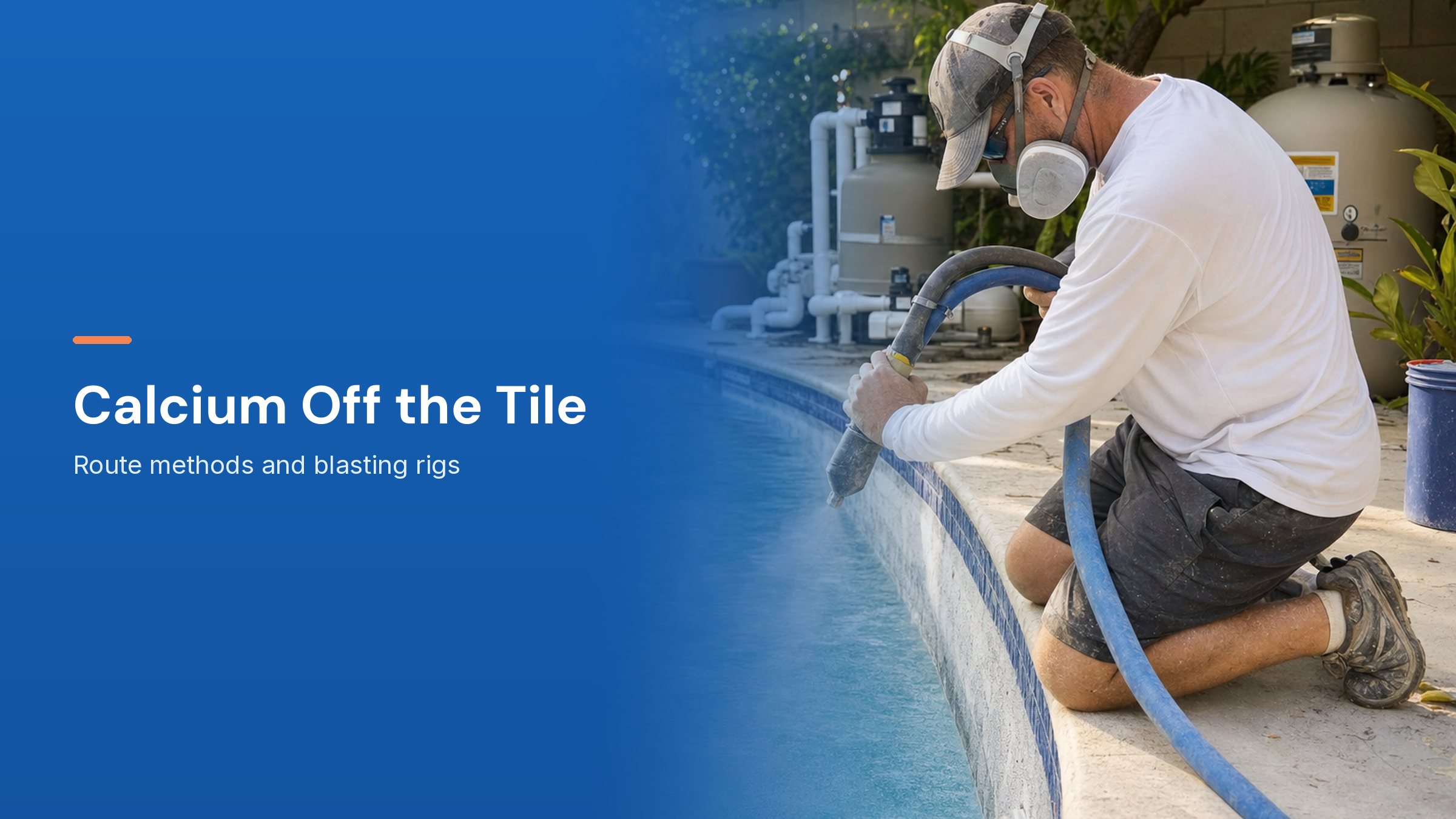
Most white crust on waterline tile is calcium carbonate. On a route, you can often take light scale off with a nylon pad, a scale-removal product and a little time. Heavy scale, scale on glass tile, and the hard gray kind that acid will not touch usually need media blasting.
That second group is why so many pool pros think about adding a blasting service. Customers ask for it all the time, and in many towns nobody local does it. This guide covers both halves: first what works on the route and what scratches tile, then the rig, the media, the safety rules, the cleanup and the price of a tile blasting add-on.
Key Takeaways
- Know the scale first. Calcium carbonate gives way to acid and scale treatments. Calcium silicate seems to shrug off muriatic acid, so it needs blasting or slow, hard scrubbing.[1]Orenda TechnologiesUnderstanding Calcium Carbonate Scale, blog article, read November 28, 2026.blog.orendatech.com
- Go gentle on the route. One tile maker says to skip pumice and wire brushes, use a nylon brush or pad, and keep muriatic acid off the tile.[3]Jeffrey CourtPool Tile Maintenance Guide, October 2021 edition, read November 28, 2026.jeffreycourt.com
- Match the media to the tile. Glass bead is the aggressive end. Baking soda is mild and, per the same maker, safe on glass tile.[3]Jeffrey CourtPool Tile Maintenance Guide, October 2021 edition, read November 28, 2026.jeffreycourt.com
- Size the compressor to the nozzle. A No. 4 nozzle uses about 81 CFM at 100 psi. A No. 5 uses about 137 CFM.[6]Clemco IndustriesCompressed-Air and Abrasive Consumption chart, read November 28, 2026.clemcoindustries.com
- Blasting is a real safety job. OSHA calls for a NIOSH-approved blast respirator, hearing protection and full skin cover.[5]OSHAProtecting Workers from the Hazards of Abrasive Blasting Materials, fact sheet FS-3697, September 2014.osha.gov
- Price the cleanup. Media ends up in the pool and the filter. Put vacuuming, a filter clean and sealing in the quote.
The short answer
Here is how most pros sort a tile line job:
- Thin, fresh white line. Brush it with a nylon pad and a scale-removal product, then bring the water's LSI back to balance so it stops growing.
- Thick or old scale on ceramic or porcelain. Drop the water below the line and work it while it is dry. Some pros use pumice here, but some tile makers warn against it.
- Any scale on glass tile, stone or a spillway. Blast it, or sub it out to someone who does.
- Scale that acid will not touch. Treat it as calcium silicate, where blasting is the honest answer.
The rest of this guide goes through each one, then covers what it takes to offer blasting yourself.
What is actually on the tile?
Not all white crust is the same, and the type tells you which tool will work.
- Calcium carbonate. This is the common one, and Orenda says it forms when water holds more calcium than it can keep dissolved. Above an LSI of about +0.30, scale starts to form.[1]Orenda TechnologiesUnderstanding Calcium Carbonate Scale, blog article, read November 28, 2026.blog.orendatech.com
- Evaporation lines. Orenda points out that splash zones dry over and over. Each time water dries on the tile, the calcium left behind gets more concentrated. That is why a crust can build above the water line even in balanced water.[1]Orenda TechnologiesUnderstanding Calcium Carbonate Scale, blog article, read November 28, 2026.blog.orendatech.com
- Calcium silicate. Orenda says silica scale sometimes forms on cement surfaces and "is apparently immune to muriatic acid." It knows of no chemical that removes it.[1]Orenda TechnologiesUnderstanding Calcium Carbonate Scale, blog article, read November 28, 2026.blog.orendatech.com It tends to look gray, glassy and hard.
- Efflorescence. On stone, spillways and coping, white crust can push out from inside the stone itself. Water soaks in, dries, and leaves minerals on the face, so cleaning it does not stop it. Sealing a stone that is still pushing out salts can trap them and cause haze.
A simple check: scrape off a small flake and drop it in a cup of your pool acid. If it fizzes, it is carbonate, and if nothing happens, plan for silicate. Do this in a cup, away from the tile, with gloves and goggles on.
Also look for dirt or oil under the scale. Orenda notes that tile line scale is often mixed with body oils and other organic waste, which makes it harder to clean.[2]Orenda TechnologiesHow to Soften and Remove Scale in a Swimming Pool or Spa, procedure page, read November 28, 2026.procedures.orendatech.com If the line is gray or black and greasy, see our guide on pool stain identification and removal first.
Route methods that do not need a blaster
These are the tools most techs already carry. They work on light and medium carbonate scale, but they are slow on heavy scale, and most do little on silicate.
| Method | Good for | Risk |
|---|---|---|
| Nylon brush or white or blue nylon pad | Weekly upkeep, fresh scale, scum | Low. This is what one tile maker recommends.[3]Jeffrey CourtPool Tile Maintenance Guide, October 2021 edition, read November 28, 2026.jeffreycourt.com |
| Scale-removal product dosed into the water | Thin carbonate scale over 2 to 3 weeks[2]Orenda TechnologiesHow to Soften and Remove Scale in a Swimming Pool or Spa, procedure page, read November 28, 2026.procedures.orendatech.com | Low, but slow. Some deplete chlorine on the first dose.[2]Orenda TechnologiesHow to Soften and Remove Scale in a Swimming Pool or Spa, procedure page, read November 28, 2026.procedures.orendatech.com |
| Lowering the LSI a little below zero | Letting the water slowly pull light scale back | Do not go below about -0.30, or the water starts eating plaster and grout.[1]Orenda TechnologiesUnderstanding Calcium Carbonate Scale, blog article, read November 28, 2026.blog.orendatech.com |
| Plastic or razor scraper on wet tile | Thick crust on hard glazed tile | Can chip glaze or edges. Test a small spot. |
| Pumice stone, kept wet | Thick scale on plain ceramic or porcelain | Scratches glass, glossy and soft tile. One maker says to avoid it.[3]Jeffrey CourtPool Tile Maintenance Guide, October 2021 edition, read November 28, 2026.jeffreycourt.com |
| Muriatic acid on the tile | Fast removal of carbonate | Can dull glaze and iridescent glass, and attack grout. One maker says keep it off tile.[3]Jeffrey CourtPool Tile Maintenance Guide, October 2021 edition, read November 28, 2026.jeffreycourt.com |
A few points the table cannot hold:
- Work the scale dry. Many pros pull water from the main drain to drop the level a few inches below the tile. Dry scale is easier to see and scrape. When you finish, put the level back and open the skimmers. Do not leave a pump running with the skimmers starved.
- Slow chemical methods take patience. Orenda's process for scale is a large first dose of its product, then a smaller maintenance dose, with brushing, over about 2 to 3 weeks.[2]Orenda TechnologiesHow to Soften and Remove Scale in a Swimming Pool or Spa, procedure page, read November 28, 2026.procedures.orendatech.com Read the label of whatever product you use, because doses differ.
- Sell the slow route honestly. Tell the customer the tile will look a bit better each week, not perfect after one visit.
Some pros also run the water slightly low on the LSI for months to take scale back. That can work on light scale if you keep it in the safe band and track it with the LSI calculator. Our page on the Langelier Saturation Index explains the number.
“It's not going to eat away if you have like a scale on your tile line that's like, you know, it's just like a thick white line of scale. It's not going to take care of that.”
That matches what most pros find: lowering pH helps with a thin film, but it does not take off a thick ridge.
Glass, ceramic, stone and spillways need different care
The same scale on two tiles can need two different jobs, so check what the tile is before you touch it.
- Glass tile. Glass is the easiest to ruin, because pumice and steel will haze it. Hard media can also frost it or crack thin pieces. Jeffrey Court's guide says baking soda or media of a similar hardness can take off scale and is safe for tile, including glass tile.[3]Jeffrey CourtPool Tile Maintenance Guide, October 2021 edition, read November 28, 2026.jeffreycourt.com It also warns that some acids damage iridescent glass.[3]Jeffrey CourtPool Tile Maintenance Guide, October 2021 edition, read November 28, 2026.jeffreycourt.com
- Glazed ceramic and porcelain. These take the most abuse, and many pros still use pumice here. Test a hidden spot first, keep the stone wet, and stop as soon as you see dull marks.
- Natural stone, rock and spillways. Stone is porous, and acid can etch marble, limestone and travertine, and some granites. Rock water features scale fast because they wet and dry all day. Blasting with a mild media and then sealing is the usual fix.
- Grout. Acid eats cement grout. If the grout is soft, cracked or missing, cleaning will not fix the tile line, because that is a regrout or retile job.
When tile is loose, hollow or falling off a spillway, stop. A clean job on bad tile looks great for a month, and then the tile pops and the customer blames you. Quote the repair instead.
If you use acid at the tile line
Many pros still put acid on scale, but tile is where it does the most harm. Jeffrey Court warns that some acids damage tile glaze and iridescent glass, and says to keep muriatic acid from touching the tile at all.[3]Jeffrey CourtPool Tile Maintenance Guide, October 2021 edition, read November 28, 2026.jeffreycourt.com If you use it anyway, keep these points in mind:
- Test a hidden spot first, and look for dull or cloudy patches once it dries.
- Keep it off the grout, because acid eats cement grout and opens gaps behind the tile.
- Keep it off natural stone, since marble, limestone and travertine can etch on contact.
- Rinse well when you finish, so no acid sits in the joints.
The label calls for gloves and eye and face protection.[4]Hasa Inc.Blue Whale Muriatic Acid pH Reducer Safety Data Sheet, SDS No. 123, revised February 21, 2020.hasa.com Our guide on how to acid wash a pool covers the full safety routine.
When it is time to blast
Blasting makes sense when:
- The scale is thick, old or layered.
- Acid does nothing to it.
- The tile is glass, stone or a rock feature.
- The customer wants it gone in one day.
- Route methods would take more of your hours than the job is worth.
Jeffrey Court's guide says heavy calcium deposits and neglected tile may need media blasting, and that it is usually done by tile cleaning specialists with portable gear.[3]Jeffrey CourtPool Tile Maintenance Guide, October 2021 edition, read November 28, 2026.jeffreycourt.com
For most route techs, the real question is not how to blast but whether to buy a rig or keep subbing it out. The rest of this guide is about that choice.
Blasting media: what each one does
Blasting shoots a hard media at the tile with compressed air, or with air and water. The media does the cutting, so pick it for the tile, not for speed.
| Media | Shape and feel | Best fit |
|---|---|---|
| Glass bead | Round. Kramer says beads give a shiny, satin finish.[7]Kramer IndustriesGlass Media Differences: Crushed Glass vs. Glass Beads, read November 28, 2026.kramerindustriesonline.com | Hard ceramic and porcelain. Jeffrey Court calls it the aggressive end.[3]Jeffrey CourtPool Tile Maintenance Guide, October 2021 edition, read November 28, 2026.jeffreycourt.com |
| Crushed glass | Angular. Kramer says it cuts and etches harder than beads.[7]Kramer IndustriesGlass Media Differences: Crushed Glass vs. Glass Beads, read November 28, 2026.kramerindustriesonline.com | Rough work. Risky on glossy tile. |
| Baking soda (sodium bicarbonate) | Soft and mild[3]Jeffrey CourtPool Tile Maintenance Guide, October 2021 edition, read November 28, 2026.jeffreycourt.com | Glass tile and soft surfaces. It also raises alkalinity in the water. |
| Other mild media | OSHA lists dry ice, sponge, walnut shells and water as less toxic options.[5]OSHAProtecting Workers from the Hazards of Abrasive Blasting Materials, fact sheet FS-3697, September 2014.osha.gov | Delicate tile, stone. Dry ice needs special gear. |
Never use silica sand. OSHA says crystalline silica sand can cause silicosis and lung cancer.[5]OSHAProtecting Workers from the Hazards of Abrasive Blasting Materials, fact sheet FS-3697, September 2014.osha.gov Slags can carry trace toxic metals.[5]OSHAProtecting Workers from the Hazards of Abrasive Blasting Materials, fact sheet FS-3697, September 2014.osha.gov Kramer says glass beads have no free silica.[7]Kramer IndustriesGlass Media Differences: Crushed Glass vs. Glass Beads, read November 28, 2026.kramerindustriesonline.com
Many blasters keep two medias on the truck. They use a hard one for porcelain and a soft one for glass and stone. Jeffrey Court says to test any blast media in a hidden spot first.[3]Jeffrey CourtPool Tile Maintenance Guide, October 2021 edition, read November 28, 2026.jeffreycourt.com
The rig: compressor, pot, hose and nozzle
A basic dry blasting setup has five parts:
- An air compressor big enough for your nozzle.
- A blast pot or hopper that feeds media into the air.
- Blast hose and couplings.
- A nozzle, often ceramic or carbide. Nozzles wear and need spares.
- A moisture trap, so wet air does not clog the media.
The compressor is the part people get wrong. Clemco's chart shows how much air each nozzle uses:[6]Clemco IndustriesCompressed-Air and Abrasive Consumption chart, read November 28, 2026.clemcoindustries.com
| Nozzle | Air at 80 psi | Air at 100 psi |
|---|---|---|
| No. 3 (3/16 inch) | 38 CFM | 45 CFM |
| No. 4 (1/4 inch) | 68 CFM | 81 CFM |
| No. 5 (5/16 inch) | 113 CFM | 137 CFM |
Clemco bases these numbers on new nozzles and media weighing about 100 pounds per cubic foot.[6]Clemco IndustriesCompressed-Air and Abrasive Consumption chart, read November 28, 2026.clemcoindustries.com A worn nozzle uses more air, so leave room above the chart. That is why so many tile blasters run a 185 CFM tow-behind compressor. A small shop compressor runs out of air, and the pressure drops halfway down the wall.
Pros tend to fall into three groups:
- Starter kit. A hardware-store hopper and a borrowed or rented compressor. Pros commonly report a few thousand dollars for this. It works for small jobs, but expect to replace hoses and tips often.
- Used trailer rig. This comes with the compressor, pot and hose already mounted. Pros commonly see these for sale around $10,000.
- Full new setup. This means a pro pot, a tow compressor and a trailer, and pros report costs in the $20,000 to $30,000 range.
Some shops rent the compressor for the first few jobs before they buy. That is a cheap way to learn if the work is steady.
“To be in that business you have to come with a compressor that's a $30,000 compressor on the back of your truck you know so he's only doing that.”
Wet blasting is the other path, and it mixes water with the media. OSHA says delivering media with water as a slurry cuts dust.[5]OSHAProtecting Workers from the Hazards of Abrasive Blasting Materials, fact sheet FS-3697, September 2014.osha.gov Some pros like it, while others find the pressure-washer hoppers weak and fussy and go back to dry blasting.
“A buddy of mine recently got a wet blaster hopper and dislikes its performance and maintenance. He’s switching back to dry bead blasting.”
Safety gear for blasting
Blasting is not a pool job with a little dust, and OSHA treats it as its own hazard. Here is what its fact sheet calls for:[5]OSHAProtecting Workers from the Hazards of Abrasive Blasting Materials, fact sheet FS-3697, September 2014.osha.gov
- Breathing. A blasting respirator that covers the head, neck and shoulders. Use only NIOSH-approved models. OSHA names a Type CE supplied-air respirator with a positive pressure helmet.[5]OSHAProtecting Workers from the Hazards of Abrasive Blasting Materials, fact sheet FS-3697, September 2014.osha.gov
- Ears. Blasting is loud enough to cause real hearing loss. Always wear hearing protection.[5]OSHAProtecting Workers from the Hazards of Abrasive Blasting Materials, fact sheet FS-3697, September 2014.osha.gov
- Skin and eyes. Eye and face protection, leather gloves to the forearm, coveralls or an apron, and safety boots.[5]OSHAProtecting Workers from the Hazards of Abrasive Blasting Materials, fact sheet FS-3697, September 2014.osha.gov
- Helpers. Keep other people away from the blaster. Anyone doing cleanup may need a respirator too.[5]OSHAProtecting Workers from the Hazards of Abrasive Blasting Materials, fact sheet FS-3697, September 2014.osha.gov
- Wind. OSHA says avoid blasting in wind, and clean up with wet methods or a HEPA vacuum, not compressed air.[5]OSHAProtecting Workers from the Hazards of Abrasive Blasting Materials, fact sheet FS-3697, September 2014.osha.gov
Read the SDS for every media you buy. OSHA requires makers to put the health hazards there.[5]OSHAProtecting Workers from the Hazards of Abrasive Blasting Materials, fact sheet FS-3697, September 2014.osha.gov If you hire a helper, OSHA rules for employers apply to you.
Cleanup, water and what goes down the drain
Media ends up everywhere. Some lands on the deck and in the planters, and most of it lands in the pool. The cleanup is part of the job, and it is where most bad reviews start.
“If you can sell and price appropriately, while maintaining good relations with the service people who are likely to help clean up your mess - seems like a good business.”
Plan the cleanup before you start:
- Cover first. Tarp the deck, plants and nearby windows, and bag the skimmer openings if you can.
- Get media out of the water. Vacuum it to waste, not through the filter. See how to vacuum a pool to waste for the setup.
- Clean the filter after. Fine media will load a cartridge or DE filter fast. Our filter cleaning price guide helps you price it.
- Test the water. Baking soda media raises alkalinity, so re-test and adjust before you leave.
- Seal stone and grout. Jeffrey Court says to seal and protect tile after blasting.[3]Jeffrey CourtPool Tile Maintenance Guide, October 2021 edition, read November 28, 2026.jeffreycourt.com
Where that waste water goes is not up to you. San Diego, for example, says it is illegal to put pool water, filter backwash, or materials like plaster and cement into its storm drains. Backwash must be pH 7 to 8 and go to the sanitary sewer through a legal connection.[8]City of San DiegoPools, Spas and Fountains stormwater fact sheet, read November 28, 2026.sandiego.gov Rules differ by city, so check yours before you vacuum media to waste in a new town. If you need to lower the water to blast dry, read how to drain a pool safely first.
Tell the customer about all of this up front. A filter clean and a stone seal can add a few hundred dollars, and they are easy to sell before the job but hard to sell after.
How to price tile cleaning and blasting
Most tile blasters price by the linear foot of a standard 6-inch tile band. Taller tile, walls and spillways go by the square foot. A simple way to keep it clean is to count each 6-inch strip as one linear foot, so a wall 10 feet long and 12 inches tall counts as 20 linear feet.
poolrates.fyi does not yet have tile cleaning or blasting prices. In general terms, these are the ranges pros commonly report:
- Waterline blasting: about $10 to $15 per linear foot for a 6-inch band, more in high-cost markets.
- Large areas: often around $20 per square foot.
- Sub rate: pool service companies that sub the work out often pay the blaster several dollars a foot less than they charge, and keep the gap.
Prices swing a lot by town, so use the tile cleaning pricing calculator to work through a quote by length, how bad the scale is, and method.
For contrast, retiling costs far more. Pros on poolrates.fyi report an average of about $57 per square foot just for tile labor.[9]poolrates.fyiRepair and job prices shared by pool pros, January to October 2026. Tile labor per square foot, 13 prices.poolrates.fyi That is the number to show a customer who balks at a blasting quote.
Build every quote from these parts:
- Linear feet of tile, plus spa, spillways and rock.
- A minimum charge. Setup and teardown take the same time on a small spa as on a big pool. The service call minimum calculator helps here.
- Lowering and refilling the water, if you blast dry.
- Vacuum to waste and a filter clean.
- Sealing stone or grout, if needed.
- A scale treatment for the water after, so it does not come right back.
For more on pricing extra work, see the one-time job calculator.
Buy a rig or sub it out?
Many route owners never blast. Instead, they keep a tile guy on speed dial, just like a leak guy or a resurfacer.
“I don't touch structural, so if it's anything to do with pool surface or tile, I have a tile guy.”
Subbing makes sense when:
- You only get a few tile jobs a year.
- Your route is full and you cannot give up a weekday.
- A good local blaster already exists and shows up.
Some blasters pay referral fees to pool service companies, while others let you mark up their price. Ask how they handle it, and get it in writing.
Buying makes sense when:
- Nobody nearby does it, or the local blaster is booked out for months.
- You get steady requests. Pros who bought often say the rig paid for itself fast once the work came in.
- You also build or remodel pools, and do punch-list cleanup on tile, rock and decks.
- You can spare a crew day, or a weekend, for each job.
Before you buy, ride along with a working blaster if you can. The most common mistakes are the wrong compressor, the wrong media and damaged tile on the first few jobs.
“Like anything worth doing, this is very time consuming. I’m not sure a single pole guy can fit these jobs in if you have a full route.”
Insurance, damage and the customer conversation
Blasting can hurt tile. Hard media in the wrong hands can frost glass, cut glaze and blow out weak grout, and once that happens it cannot be undone. Protect yourself before the first job:
- Call your insurance agent. Ask if your general liability policy covers abrasive blasting, damage to the customer's tile, and media that blows onto a neighbor's car. Many pool service policies are written for route work only, so get the answer in writing.
- Check licensing. Some states and cities treat tile work as contractor work, so look up your local rules.
- Take before photos. Shoot every chipped tile, every loose piece and every bad grout line before you start.
- Test a hidden spot. Jeffrey Court says to test in a hidden area first so results meet expectations and do not damage the tile.[3]Jeffrey CourtPool Tile Maintenance Guide, October 2021 edition, read November 28, 2026.jeffreycourt.com
- Write the scope. Say what you will clean, what media you will use, and what you will not fix. Note that scale on old glass or soft tile may leave some shadowing.
Be clear that cleaning does not stop scale from coming back. If the water stays out of balance, the line will be back in a year.
Keeping the line from coming back
The best upsell after a tile job is keeping it clean, and most of that is water chemistry.
- Keep the LSI in range. Orenda aims for a slightly negative LSI, from -0.30 to -0.01, to prevent scale.[2]Orenda TechnologiesHow to Soften and Remove Scale in a Swimming Pool or Spa, procedure page, read November 28, 2026.procedures.orendatech.com Jeffrey Court calls 0.0 to +0.5 acceptable.[3]Jeffrey CourtPool Tile Maintenance Guide, October 2021 edition, read November 28, 2026.jeffreycourt.com Sources differ, but both agree that much above +0.5 builds scale.
- Watch the hardness. In hard-water areas, calcium climbs as water evaporates and you top off. See our page on calcium hardness.
- Brush the tile weekly. Jeffrey Court says to brush or scrub pool tile as part of weekly service.[3]Jeffrey CourtPool Tile Maintenance Guide, October 2021 edition, read November 28, 2026.jeffreycourt.com
- Use a scale treatment. Many pros leave the customer on a monthly scale or stain product after a blast.
- Seal porous stone. Sealing slows how much water soaks into coping and rock.
“But what we're really attacking here is the solids and the hardness, because we have really high calcium hardness in the water here in Arizona.”
When hardness gets that high, a partial drain or a reverse osmosis treatment may be the real fix. Our tile line glossary page covers the basics of the zone itself.
Write down the readings, the photos and the date of every tile job. Next year, that record will show the customer how fast the scale came back and why.
Sources
- [1]Orenda Technologies, Understanding Calcium Carbonate Scale, blog article, read November 28, 2026. blog.orendatech.com
- [2]Orenda Technologies, How to Soften and Remove Scale in a Swimming Pool or Spa, procedure page, read November 28, 2026. procedures.orendatech.com
- [3]Jeffrey Court, Pool Tile Maintenance Guide, October 2021 edition, read November 28, 2026. jeffreycourt.com (PDF)
- [4]Hasa Inc., Blue Whale Muriatic Acid pH Reducer Safety Data Sheet, SDS No. 123, revised February 21, 2020. hasa.com (PDF)
- [5]OSHA, Protecting Workers from the Hazards of Abrasive Blasting Materials, fact sheet FS-3697, September 2014. osha.gov (PDF)
- [6]Clemco Industries, Compressed-Air and Abrasive Consumption chart, read November 28, 2026. clemcoindustries.com (PDF)
- [7]Kramer Industries, Glass Media Differences: Crushed Glass vs. Glass Beads, read November 28, 2026. kramerindustriesonline.com
- [8]City of San Diego, Pools, Spas and Fountains stormwater fact sheet, read November 28, 2026. sandiego.gov (PDF)
- [9]poolrates.fyi, Repair and job prices shared by pool pros, January to October 2026. Tile labor per square foot, 13 prices. poolrates.fyi