


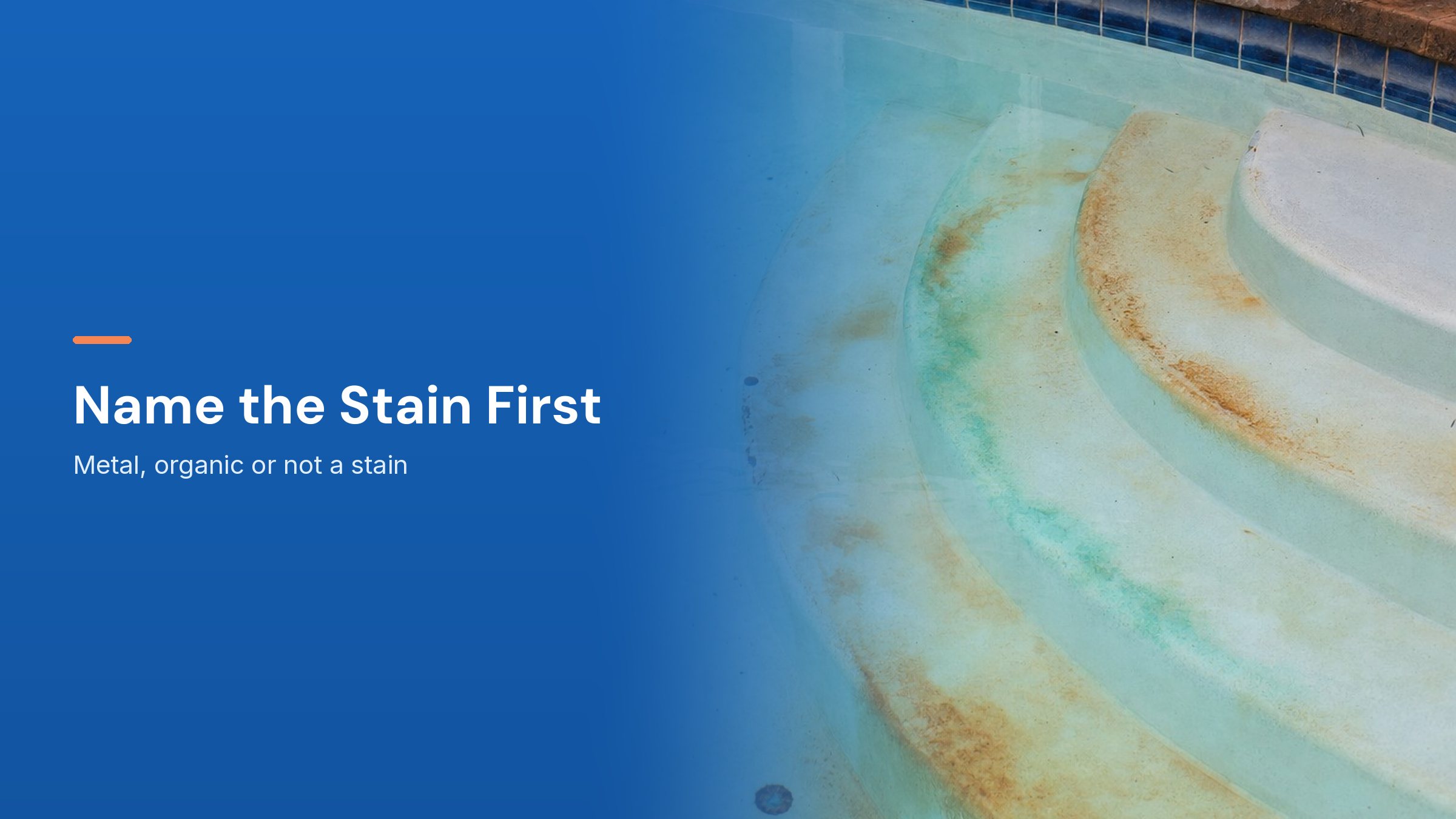
Most pool stains come from one of two things. Either something that was once alive sat on the surface, or metal in the water came out and stuck. You can tell which one you have in about two minutes. Hold chlorine on the stain. Then hold vitamin C on another part of it. The one that makes the stain fade tells you the family.
That small test saves a lot of money, because the cure for a leaf stain can make a metal stain worse. Some marks are not stains at all, so no chemical in the water will ever move them. This guide shows how to name the mark, how to lift it with the pool full, and when to stop and call for a drain or a patch.
Key Takeaways
- Test before you treat. Chlorine fades organic stains. Vitamin C fades iron. Shocking a pool that has metal in it can make the staining worse.[2]Orenda Technologies Help Center"I shocked with chlorine, and the water changed color. Why?" read November 24, 2026.ask.orendatech.com
- Color is a clue, not proof. Iron tends to be orange or brown. Copper tends to be blue or green. Manganese tends to be purple or black.[1]Orenda Technologies"Understanding Heavy Metal Oxidation and Staining," read November 24, 2026.blog.orendatech.com
- Lifting a metal stain does not remove the metal. It moves the metal back into the water. A sequestrant and the filter have to finish the job.[6]Jack's Magic ProductsFrequently Asked Questions page, read November 24, 2026.jacksmagic.com
- Some marks are not stains. Black algae, plaster mottling, rusting rebar and cobalt spots in fiberglass each need a different fix.
- Find the source or the stain comes back. Check the fill water, the heater, the algaecide and anything metal near the pool.
The short answer
Run two spot tests on the stain. If chlorine fades it, it is organic. Raise the chlorine, brush, and give it time. If vitamin C fades it, it is most likely iron. Lower the chlorine, treat with an ascorbic acid product, add a sequestrant, and clean the filter. If neither one moves it, think copper, scale, or a mark that is in the finish and not on it.
Most surface stains can be lifted without draining, so a drain and acid wash is the last step and not the first. A rust spot that keeps coming back in the same place may be steel inside the shell, which no water treatment can fix.
The two families of stains, plus scale
Organic stains come from things that were alive. Leaves, acorns, berries, pine needles, worms and algae all leave color behind. Plants hold natural dyes called tannins. When the plant rots, the dye bleeds onto the surface under it. That is why some stains are the exact shape of a leaf.[3]Orenda Technologies"Tannins and Organic Staining in Pools," read November 24, 2026.blog.orendatech.com These stains are most often brown, tan or dull green.
Metal stains come from metal that was dissolved in the water, where you cannot see it. Chlorine reacts with it, and at a high enough pH the metal drops out of the water and lands on the walls and floor.[1]Orenda Technologies"Understanding Heavy Metal Oxidation and Staining," read November 24, 2026.blog.orendatech.com The three metals pros see most are iron, copper and manganese.
Scale is a third thing. It is a rough white or gray crust of calcium that forms when the water is out of balance. Many pros find that a stain is often sitting in a thin layer of scale and not in the finish itself, so the color leaves when the scale does. If the surface feels rough, check the balance with the LSI calculator and read the LSI balance guide before you blame metal.
Four things that look like stains but are not
- Black algae. It grows in small dark dots with a raised head. Chlorine held on a dot will lighten it. Vitamin C will not. See the black algae guide for how to treat it.
- Plaster mottling. These are blotchy gray clouds in the plaster. The National Plasterers Council says normal mottling comes from how the cement cured. It is not a defect and often fades with time.[14]National Plasterers Council"Interior Finish Tolerances" white paper, color variation (mottling) section.npconline.org No stain product will remove it.
- Rebar rust. Steel inside the pool shell can rust and bleed up through the finish.[11]Pool and Spa News"How to Repair Rebar Stains," April 17, 2015.poolspanews.com The spot may lighten when treated, then return in the same place.
- Cobalt spots in fiberglass. These are dark or black spots caused by a reaction under the gelcoat. Brushing and vitamin C do not remove them.[13]River Pools"How to Remove Stains From a Fiberglass Pool," updated April 9, 2026.riverpoolsandspas.com
What the color and the place tell you
Use this chart to make a first guess, then prove the guess with a spot test.
| What you see | Where it shows up | Likely cause |
|---|---|---|
| Brown or tan marks, some shaped like leaves | Floor and steps, under trees, after a winter cover comes off | Organic stain from leaves, acorns or berries[3]Orenda Technologies"Tannins and Organic Staining in Pools," read November 24, 2026.blog.orendatech.com |
| Orange, rust-brown or tan film | Spread over walls and floor, often in pools filled from a well | Iron[1]Orenda Technologies"Understanding Heavy Metal Oxidation and Staining," read November 24, 2026.blog.orendatech.com[8]Penn State Extension"Iron and Manganese in Private Water Systems," updated May 29, 2025.extension.psu.edu |
| Blue, green or turquoise. It can also turn gray or nearly black | Plaster in pools with a heater, an ionizer or copper algaecide | Copper[1]Orenda Technologies"Understanding Heavy Metal Oxidation and Staining," read November 24, 2026.blog.orendatech.com[7]PentairMasterTemp 125 Pool and Spa Heater Installation and User's Guide, Rev. C, water chemistry section.pentair.com |
| Purple or black | The water line, spillways, tile and walls | Manganese, or copper bonded with very high stabilizer[2]Orenda Technologies Help Center"I shocked with chlorine, and the water changed color. Why?" read November 24, 2026.ask.orendatech.com |
| One small rust spot that returns in the same place | Floor, walls, steps, benches, tight curves | A metal object that sat there, or steel in the shell[11]Pool and Spa News"How to Repair Rebar Stains," April 17, 2015.poolspanews.com |
| Small rust-colored dots, sometimes with a tail | Floor near lawns and planters | Fertilizer grains that landed in the pool |
| White or gray crust that feels rough | Tile line, walls, spillways | Calcium scale |
| Blotchy gray clouds in the finish | All over plaster, most often in newer pools | Mottling. Not a stain[14]National Plasterers Council"Interior Finish Tolerances" white paper, color variation (mottling) section.npconline.org |
| Dark dots with a raised head | Rough plaster, shady walls, corners | Black algae. Not a stain |
| Dark spots that sit under the surface | Fiberglass pools | Cobalt spotting. Not a surface stain[13]River Pools"How to Remove Stains From a Fiberglass Pool," updated April 9, 2026.riverpoolsandspas.com |
One warning about water tests. A pool can have a metal stain and still test at zero for metal, because the metal is on the wall now and not in the sample. Test the fill water too, and trust the spot test on the stain.
The spot tests pros run at the pool
Turn the pump off, let the water go still, and pick a small part of the stain on a step if you can reach one. Then try these in order.
Test 1: chlorine for organic stains
On plaster, many pros hold a chlorine tablet on the stain for a minute, or set a pinch of granular chlorine on it. If the spot gets lighter the stain is organic, and if it gets darker, think metal. Go easy, because trichlor tablets are acidic and rubbing one hard on plaster can mark it.[3]Orenda Technologies"Tannins and Organic Staining in Pools," read November 24, 2026.blog.orendatech.com Do not do this test on a vinyl liner. Chlorine that sits on a liner can bleach it.[12]Pool and Spa News"Preventing Stains in Vinyl Liners," December 11, 2013.poolspanews.com
Test 2: vitamin C for iron
Hold a plain vitamin C tablet on a fresh part of the stain. You can also put ascorbic acid powder in a thin sock and press it on the spot. Ascorbic acid is just the chemical name for vitamin C. It pulls metal off the surface and back into the water.[10]Pool and Spa News"Stain Detection," February 10, 2012.poolspanews.com Iron stains often fade in a minute or less.
“I’d test one spot with a vitamin C tablet or a little ascorbic acid held directly on it for 30-60 seconds. If it lightens or disappears, that pretty much confirms iron. I’d also start looking for the source, like fill water, irrigation overspray, fertilizer, rusty debris, or something metallic getting into the pool.”
What copper and manganese do
Copper is harder. It often does not fade much with vitamin C, and pros argue about what works best on it. Stain product makers treat it as its own problem. Jack's Magic, for example, sells one stain product for iron and cobalt and a different one for copper and scale.[5]Jack's Magic ProductsStain ID Kit Procedures and the Stain Program product list, read November 24, 2026.jacksmagic.com So if a blue, green or gray stain shrugs off both chlorine and vitamin C, copper is a strong guess.
Manganese shows up as purple, dark blue or black. A purple film at the water line or on a spillway can also be copper that has bonded with very high stabilizer.[2]Orenda Technologies Help Center"I shocked with chlorine, and the water changed color. Why?" read November 24, 2026.ask.orendatech.com Both point back to the water, so test the fill water and the stabilizer level.
Test 3: a stain ID kit
If the first two tests leave you guessing, use a stain ID kit. The Jack's Magic kit has four small tests. You put a little of each product on a different part of the stain and wait 30 to 45 seconds. The one that clears the stain best is the treatment to use.[5]Jack's Magic ProductsStain ID Kit Procedures and the Stain Program product list, read November 24, 2026.jacksmagic.com The maker says vitamin C can hint that a stain is from a mineral, but it cannot tell you which of their products to use.[6]Jack's Magic ProductsFrequently Asked Questions page, read November 24, 2026.jacksmagic.com
If nothing in the kit moves the mark, it is most likely in the finish, which means you can stop buying chemicals.
Where the metal comes from
A metal stain is a sign that metal is getting into the water, so find out how or you will be back in a month. These are the usual sources.
- Well water. Well water can look clear and still hold iron and manganese. The stains show up once the water meets air or chlorine. Penn State found too much iron in 17 percent of the private water supplies it tested in its state.[8]Penn State Extension"Iron and Manganese in Private Water Systems," updated May 29, 2025.extension.psu.edu The iron and well water guide covers how to manage these pools.
- The heater. Most gas heaters have copper tubes inside. Pentair's heater manual warns that low pH corrodes those tubes. It also says corroded metal parts can leave brown, blue, green or almost black stains on plaster.[7]PentairMasterTemp 125 Pool and Spa Heater Installation and User's Guide, Rev. C, water chemistry section.pentair.com
- Copper algaecide and mineral systems. These put copper in the water on purpose. Add chlorine shock on top and the copper can drop out fast.[1]Orenda Technologies"Understanding Heavy Metal Oxidation and Staining," read November 24, 2026.blog.orendatech.com The copper algaecide entry explains the risk.
- Fertilizer. Jack's Magic lists fertilizer as a cause of stains. Pros often see rust-colored dots where grains landed in the pool.[6]Jack's Magic ProductsFrequently Asked Questions page, read November 24, 2026.jacksmagic.com
- Metal objects. Hair pins, toy cars, screws from a screen cage, cheap hooks, worn steel fittings and furniture set in the pool before a storm all rust.
How to remove organic stains
Organic stains are the easy family. Get the leaves and debris out, then use chlorine, a brush and time.
- Clean first. Net and vacuum everything off the floor. Rotting debris keeps making new stains and eats chlorine.[3]Orenda Technologies"Tannins and Organic Staining in Pools," read November 24, 2026.blog.orendatech.com
- Raise the chlorine. Chlorine breaks down tannins. Keep it higher than normal for several days, and follow the label on your chlorine for how much to add.
- Brush every day. Brushing opens the stain so the chlorine can reach it.
- Add an enzyme if the stain is stubborn. Orenda says enzymes break down tannins and work all through the pool, not just at one spot.[3]Orenda Technologies"Tannins and Organic Staining in Pools," read November 24, 2026.blog.orendatech.com
- Wait. River Pools says many organic stains fade by themselves within a few weeks to a couple of months.[13]River Pools"How to Remove Stains From a Fiberglass Pool," updated April 9, 2026.riverpoolsandspas.com
A common mistake is dumping a pile of granular shock on the stain and walking away. That can bleach colored plaster and mark a new finish, so on fresh plaster ask the plaster company first. The plaster startup checklist explains why the first weeks matter.
How to remove metal stains without draining
A metal stain treatment has four parts: lower the chlorine, lift the stain, catch the metal, and bring the chlorine back slowly.
Step 1: lower the chlorine and pH first
Ascorbic acid and chlorine cancel each other out. A Forest Service study found that it takes about 2.5 parts of ascorbic acid to use up 1 part of chlorine.[9]USDA Forest Service"Using Vitamin C To Neutralize Chlorine in Water Systems," Tech Tips, April 2005.fs.usda.gov So if the chlorine is high, the stain product gets wasted on the chlorine and never reaches the stain. Chlorine also pushes dissolved metal back out of the water.[1]Orenda Technologies"Understanding Heavy Metal Oxidation and Staining," read November 24, 2026.blog.orendatech.com
The Jack's Magic procedure for iron stains calls for chlorine below 1 ppm and pH at 7.2 or lower before you start. It also says the water must be above 65 degrees. Salt systems get turned off, and ionizers, mineral systems and chemical feeders come out of the loop.[4]Jack's Magic ProductsStain Solution #1 Treatment procedure sheet, revised March 29, 2019.jacksmagic.com Your product may ask for different numbers. Read its label and use those.
Step 2: lift the stain
For iron, the stain product is ascorbic acid or citric acid.[1]Orenda Technologies"Understanding Heavy Metal Oxidation and Staining," read November 24, 2026.blog.orendatech.com Most labels have you add a sequestrant first, then spread the stain product over the stained areas with the pump running. Dose by the label for your pool's gallons. Do not guess, and do not add extra. Add each product on its own. Never mix pool chemicals together.
Iron stains can fade while you watch, but old or heavy stains can take days. For copper, use the product that won your spot test, which may not be vitamin C.
Step 3: catch the metal
This is the step people skip. The stain is gone, but the metal is back in the water and waiting.
“You need to come in with a metal stain preventer after lifting the stains. Bioguard’s product is called Pool Magnet Plus. Once you’ve lifted the metals off of the surface of the pool they’re In the water again.”
A sequestrant grabs the loose metal and clumps it so the filter can catch it.[6]Jack's Magic ProductsFrequently Asked Questions page, read November 24, 2026.jacksmagic.com Run the pump nonstop and clean the filter when the label says to. The Jack's Magic sheet calls for 48 hours of running, then a filter clean.[4]Jack's Magic ProductsStain Solution #1 Treatment procedure sheet, revised March 29, 2019.jacksmagic.com Cleaning the filter is what takes the metal out of the pool for good.
Step 4: bring chlorine back slowly
The pool has little or no chlorine during the treatment, so no one should swim. When the stains are gone, raise chlorine a little at a time. Jack's Magic says not to shock for at least a week, because that can stain the pool again with metal still in the water.[4]Jack's Magic ProductsStain Solution #1 Treatment procedure sheet, revised March 29, 2019.jacksmagic.com Watch for algae in warm weather while the chlorine is low.
For one or two small spots, a full treatment is too much. A vitamin C tablet or a sock of ascorbic acid held on the spot is often enough. A stain eraser on a pole also works on small marks, as long as you buy the one labeled for your surface.
Is one dose enough, or do you keep adding it?
You keep adding it. A sequestrant does not destroy metal. It only holds it, and the hold wears off. Orenda says sequestering agents are temporary because chlorine breaks them down over time, and so does sunlight.[1]Orenda Technologies"Understanding Heavy Metal Oxidation and Staining," read November 24, 2026.blog.orendatech.com When the product wears out, the metal is free to stain again.
That is why the labels call for a first dose and then a small dose every week. The Jack's Magic sheet says to keep dosing weekly for at least three weeks after a stain treatment.[4]Jack's Magic ProductsStain Solution #1 Treatment procedure sheet, revised March 29, 2019.jacksmagic.com A pool on well water, or one with a copper source that cannot be fixed, may need it all season. Pool and Spa News quotes a chemical trainer who says it is very rare for a pool to stain once and never stain again.[10]Pool and Spa News"Stain Detection," February 10, 2012.poolspanews.com
Pros disagree on which brand is best, but the type of product and the upkeep matter more:
- Sequestrants clump metal into bits that a filter can partly trap, but they fade and need weekly doses.[1]Orenda Technologies"Understanding Heavy Metal Oxidation and Staining," read November 24, 2026.blog.orendatech.com
- Chelants hold metal one bit at a time and keep it dissolved. Orenda says they last longer but the metal tends to pass through the filter.[1]Orenda Technologies"Understanding Heavy Metal Oxidation and Staining," read November 24, 2026.blog.orendatech.com
- Metal-trapping filters take metal out of the water, and one on the fill hose stops it before it gets in.
Many sequestrants are made with phosphate, so the phosphate reading can climb while you use them.[1]Orenda Technologies"Understanding Heavy Metal Oxidation and Staining," read November 24, 2026.blog.orendatech.com The one real cure is to stop the metal at the source.
Rust spots on plaster and pebble
A rust spot has two possible stories. Something metal sat on the surface, or steel inside the shell is rusting.
Rust from an object is a surface stain. Take the object out, vacuum up any loose metal bits, then treat the spot with vitamin C or a stain eraser. Pebble is harder than smooth plaster because rust settles down between the stones. Some pros spot treat stubborn marks with acid, which takes training and safety gear and can etch the finish. If the gentle methods fail, hire someone who does it often.
Rust from inside the shell is a repair, not a stain. Pool and Spa News lists the usual causes. The steel may be too close to the surface. There may be gaps in the concrete around it. A tie wire may have been left sticking out, or the ground behind the wall may stay soaked.[11]Pool and Spa News"How to Repair Rebar Stains," April 17, 2015.poolspanews.com Signs that point to steel in the shell:
- The spot fades when treated, then comes back in the same place.
- The spot has a dark center, a crack, or a small hole.
- It sits on a step, a bench or a tight curve, where steel is often closest to the surface.
The fix is a spot repair. A plaster or dive crew chips out the stain and follows the rust along the bar until they reach clean steel. They cut out the bad piece, fill the hole with cement and patch the plaster. The work can often be done underwater with the pool still full, but the patch is hard to color match and its color may change over time.[11]Pool and Spa News"How to Repair Rebar Stains," April 17, 2015.poolspanews.com A patch also fixes only that one spot, so new spots can show up later if other steel is close to the surface.
If rust spots are showing up all over an old pool, that pool needs a new finish and not a patch. The guide to hiring a plaster expert can help you decide.
Why stains come back
Stains come back for four plain reasons:
- The metal never left. The stain was lifted but the filter was not cleaned and no sequestrant was kept up.
- Someone shocked the pool too soon. A big dose of chlorine can knock the metal right back out of the water.
- The source is still there. The well, the heater or the algaecide keeps adding metal. Jack's Magic says stain programs often treat the symptom, and the problem returns when the source is not found.[6]Jack's Magic ProductsFrequently Asked Questions page, read November 24, 2026.jacksmagic.com
- The water is out of balance. Metal stains faster at a higher pH.[1]Orenda Technologies"Understanding Heavy Metal Oxidation and Staining," read November 24, 2026.blog.orendatech.com Low pH eats copper out of the heater.[7]PentairMasterTemp 125 Pool and Spa Heater Installation and User's Guide, Rev. C, water chemistry section.pentair.com
“The stains were gone and pool look crystal clear. I started to bring chlorine up in the first 2 days after the treatment. In the third I had a brain fog and forgot not to shock, and added a big dose of liquid chlorine. In less than 1 hour the pool turned green.”
Write "no shock" on the service record after any stain treatment, so the next tech sees it.
Which fixes need a drain or an acid wash
Try the no-drain steps first. Move on to a drain when one of these is true:
- The stains cover most of the pool and a full treatment did not lift them.
- The stain is locked in a heavy layer of scale.
- Metal filings or other debris are ground into the finish.
- The water itself is the problem, with very high stabilizer or metal that keeps coming back.
An acid wash strips a thin layer off the finish to show clean material under it. It works, but it uses up some of the life of the plaster each time, and on old, thin plaster it can make the pool look worse.
“Acid washes can be temperamental depending on the finish. I wouldn't recommend somebody who's never done one to go out alone.”
Two tools on this site help with the choice. The acid wash vs. replaster tool walks through whether the finish can take a wash. The acid wash pricing calculator helps pros price the job. Mottling, worn-out plaster and rusting steel will not come out with any wash.
Special cautions for vinyl liners and fiberglass
Vinyl liners
- Keep solid chlorine off the liner. Tablets and grains that sit on vinyl can bleach it.[12]Pool and Spa News"Preventing Stains in Vinyl Liners," December 11, 2013.poolspanews.com Skip the chlorine tablet test.
- Be careful with acid. Pool and Spa News warns that strong doses of muriatic acid can attack the printed pattern.[12]Pool and Spa News"Preventing Stains in Vinyl Liners," December 11, 2013.poolspanews.com
- Use vitamin C for rust marks. Powder in a sock held on the spot is the gentle way to lift rust from hooks, toys and pins.
- Look behind the liner. If nothing touches a stain, it may be mold or bacteria growing on the back side, where no product in the water will reach it.[12]Pool and Spa News"Preventing Stains in Vinyl Liners," December 11, 2013.poolspanews.com
Fiberglass
- No rough tools. River Pools warns that hard scrubbing and harsh chemicals can damage the gelcoat.[13]River Pools"How to Remove Stains From a Fiberglass Pool," updated April 9, 2026.riverpoolsandspas.com Use a soft sponge and products labeled for fiberglass.
- Metal stains still lift. The same steps work: low chlorine, ascorbic acid, then a sequestrant.[13]River Pools"How to Remove Stains From a Fiberglass Pool," updated April 9, 2026.riverpoolsandspas.com
- Cobalt spots will not. They start under the gelcoat. Have a fiberglass pro look at them.[13]River Pools"How to Remove Stains From a Fiberglass Pool," updated April 9, 2026.riverpoolsandspas.com
“On fiberglass I would start with the gentlest pad/gel cleaner you can get away with before touching melamine or anything with bite.”
How to explain a stain that will not come out
Some stains only get lighter and some do not move at all, so say that before you start and not after the bill.
- Promise a test, not a result. Tell the owner you will find out what the mark is, then show them the spot that cleared or the spot that did not.
- Do not own a stain you did not cause. On a new account, take photos of every mark on day one. The photo documentation guide shows how.
“I always tell my people that plaster is a natural product and over time the minerals will react to the water and chemicals, leading to staining/discoloration. I like pebble because it helps camouflage that.”
That line is honest and kind. Plaster is cement and it changes with age, and owners take that news better at the start than at the end.
What pros charge for stain work
We do not have solid price data for no-drain stain treatments yet, so we will not print a number for them. Most pros charge for the test visit, then quote the treatment as its own job that covers the chemicals, the extra visits and the filter cleans. Good quotes say in writing that a second round may be needed and is billed again.
For the bigger jobs, poolrates.fyi has prices that pool pros shared in 2026. An acid wash averaged $1,325 across four prices, with a range of $1,000 to $1,600. A drain and clean averaged $1,538 across 13 prices.[15]poolrates.fyiRepair and one-time job prices shared by pool pros, January to October 2026.poolrates.fyi Those are small samples, so treat them as a rough guide.
Sources
- [1]Orenda Technologies, "Understanding Heavy Metal Oxidation and Staining," read November 24, 2026. blog.orendatech.com
- [2]Orenda Technologies Help Center, "I shocked with chlorine, and the water changed color. Why?" read November 24, 2026. ask.orendatech.com
- [3]Orenda Technologies, "Tannins and Organic Staining in Pools," read November 24, 2026. blog.orendatech.com
- [4]Jack's Magic Products, Stain Solution #1 Treatment procedure sheet, revised March 29, 2019. jacksmagic.com (PDF)
- [5]Jack's Magic Products, Stain ID Kit Procedures and the Stain Program product list, read November 24, 2026. jacksmagic.com (PDF)
- [6]Jack's Magic Products, Frequently Asked Questions page, read November 24, 2026. jacksmagic.com
- [7]Pentair, MasterTemp 125 Pool and Spa Heater Installation and User's Guide, Rev. C, water chemistry section. pentair.com (PDF)
- [8]Penn State Extension, "Iron and Manganese in Private Water Systems," updated May 29, 2025. extension.psu.edu
- [9]USDA Forest Service, "Using Vitamin C To Neutralize Chlorine in Water Systems," Tech Tips, April 2005. fs.usda.gov (PDF)
- [10]Pool and Spa News, "Stain Detection," February 10, 2012. poolspanews.com
- [11]Pool and Spa News, "How to Repair Rebar Stains," April 17, 2015. poolspanews.com
- [12]Pool and Spa News, "Preventing Stains in Vinyl Liners," December 11, 2013. poolspanews.com
- [13]River Pools, "How to Remove Stains From a Fiberglass Pool," updated April 9, 2026. riverpoolsandspas.com
- [14]National Plasterers Council, "Interior Finish Tolerances" white paper, color variation (mottling) section. npconline.org (PDF)
- [15]poolrates.fyi, Repair and one-time job prices shared by pool pros, January to October 2026. poolrates.fyi