
How Long Should a Pool Service Visit Take?


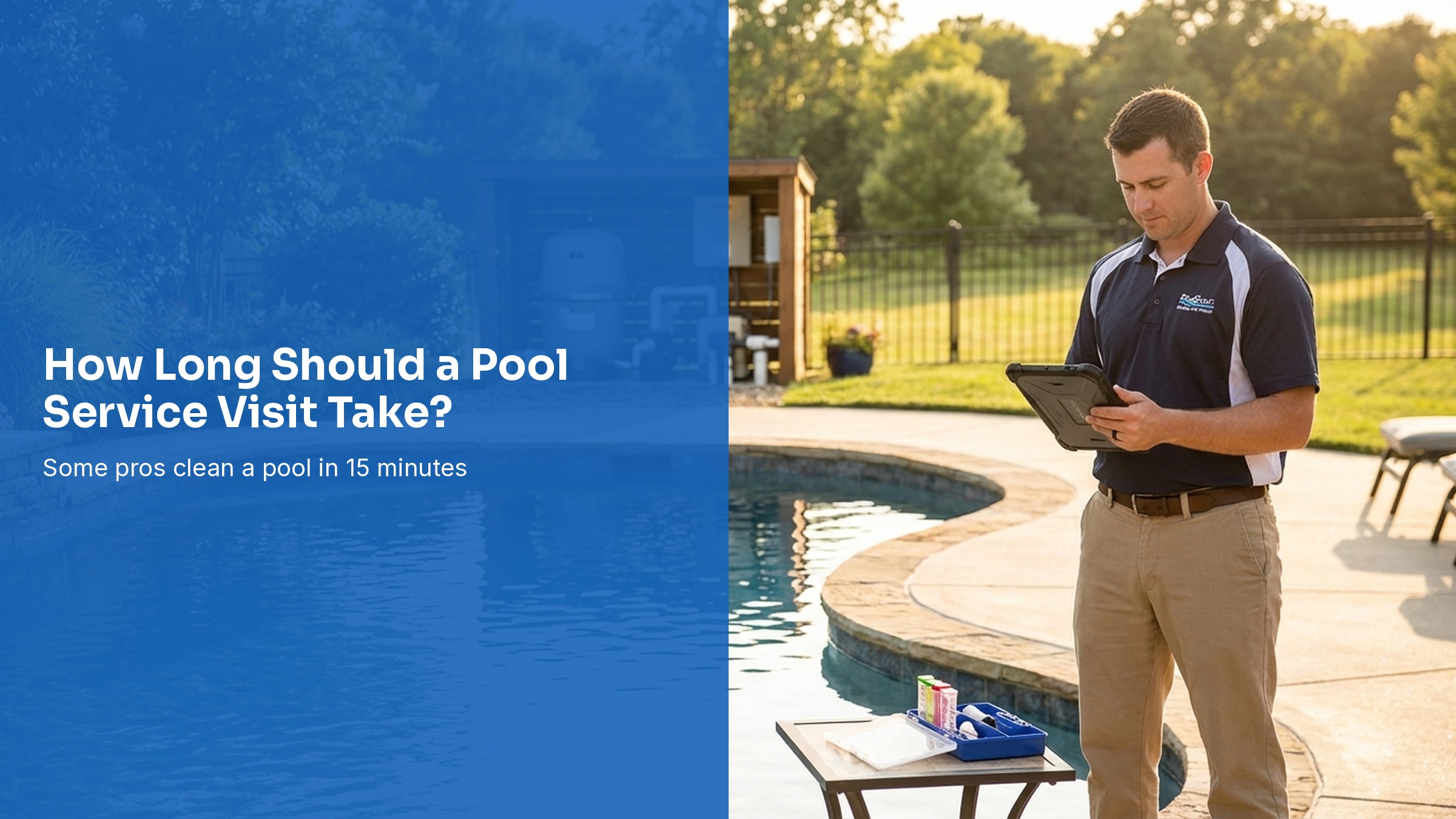
A pool pro asked a question that started a debate: "I see a lot of people here swear by cleaning a pool in 15 minutes average. How is that possible when there are so many things to do?"
The answers split the room. Some pros said 15 minutes is plenty. Others said anything under 30 is cutting corners. Both sides had good points. The truth is that visit time depends on the pool, the climate, the equipment, and how well the route is set up.
What Pros Actually Report
- 10-15 minutes: Desert climates (Arizona), low debris, infloor cleaning systems, salt cells, robotic vacuums.
- 15-25 minutes: Average residential pool with moderate debris and good equipment.
- 30-45 minutes: Pools with heavy tree cover, no automatic cleaner, or older equipment that needs attention.
- 60+ minutes: Large or neglected pools, commercial properties, or pools with ongoing issues.
The 15-Minute Pool Is Real
The pros who clean pools in 15 minutes are not cutting corners. They have set up their pools to be easy to service.
"I've got over 50 pools. Most pools in Arizona have very little trees to drop stuff in. Most infloor systems keep the bottom clean. Other pools have a vacuum robot. 90% of my customers don't even see me because there is nothing to discuss."
— Pool pro via Reddit
In Arizona, the typical residential pool is 10,000 to 14,000 gallons. There are almost no trees. Most pools have either an infloor cleaning system or a robotic vacuum. Salt cells handle chlorine generation. When you show up, the pool is already mostly clean. You test water, adjust chemicals, brush the walls, empty baskets, check equipment, and leave.
Efficiency is about workflow, not rushing. Every move should flow into the next with no wasted steps.
"It's all about efficiency. No wasted steps, no wasted movements. Every task should flow into the next as much as possible. When you kneel down at the skimmer you can empty the basket into your net, scrub the throat if needed, test the water, and start adding chemicals all from one spot."
— Pool pro via Reddit
The 15-Minute Pool Is Not Universal
Not every pool can be serviced in 15 minutes, and claiming otherwise is misleading. Pools in high-debris areas take longer. Period.
"I'm under the impression that half the people here saying they clean in 15 minutes aren't cleaning properly and half-assing everything."
— Pool pro via Reddit
That suspicion is not always wrong. Some pool pros get paid per stop, not per hour. At $30 to $40 per stop, they need to do three or four pools an hour just to make a living wage. That creates pressure to rush through each stop.
"Most pool guys get paid per stop, not by the hour, so they need to do 3 pools an hour to make more than minimum wage."
— Pool pro via Reddit
If you are in a high-debris area with oak trees, or you service pools without automatic cleaners, 15 minutes is not realistic for a thorough visit. One pro in Michigan spends 30 to 45 minutes per pool because the pools are larger, the debris is heavier, and the customers expect a complete clean at every visit.
"My techs are on site an average of 1 hour doing all those things. Even the easiest ones are 30 minutes. I have never understood the 15-minute claim either."
— Pool pro via Reddit
What Determines Visit Time
Several factors explain why the same pool pro might spend 10 minutes at one pool and 45 at the next:
- Automatic cleaners. A pool with an infloor system or a good robotic vacuum needs almost no manual vacuuming. That saves 10 to 15 minutes per visit.
- Trees and landscaping. A pool surrounded by oak trees, crape myrtles, or palms will have heavy debris every single week. That adds 15 to 20 minutes of skimming.
- Pool size. A 10,000 gallon pool brushes faster than a 30,000 gallon pool. More surface area means more time.
- Equipment condition. A well-maintained equipment pad with unions, clean filters, and working valves is fast to check. A pad with corroded pipes, stuck valves, and a leaking pump takes longer.
- Salt vs. manual chlorine. Salt pools maintain their own chlorine between visits. Manual chlorine pools may need more attention to stay balanced.
- Customer expectations. Some customers want the pool vacuumed every visit, even when the robotic cleaner already did it. Others are happy with a visual check.
The Real Number: What to Target
For a typical residential pool in good condition with an automatic cleaner, 15 to 20 minutes is a reasonable target for a weekly visit. That covers:
- Skim the surface (2 minutes)
- Empty skimmer and pump baskets (2 minutes)
- Brush walls and steps (3 minutes)
- Test water chemistry (2 minutes)
- Add chemicals as needed (2 minutes)
- Check equipment, filter pressure, salt cell (3 minutes)
- Log the visit in your service app (1 minute)
That is 15 minutes with no wasted time. On a heavy debris week, add 10 minutes for netting. On a filter clean week, add 15 to 20 minutes. The average across the year is probably 20 to 25 minutes per pool.
If you consistently spend 45 minutes or more on pools that should take 20, look at what is eating your time. Is the customer talking to you for 15 minutes? Is the equipment broken? Is the pool chemistry consistently off because the customer is adding their own chemicals? Fix the root cause and your route times will drop. See the complete pool service visit guide for the full checklist.
Customer Conversation Time Counts Too
One hidden time leak is not brushing, netting, or testing. It is the friendly customer who comes outside every week and wants to talk while you work.
"I feel like some days im just inching back to the truck to take off."
— Pool pro via Reddit
That is not a customer service problem. It is a route-management problem. A five-minute chat at one stop is fine. A 15-minute chat at four stops can erase an hour of production. In summer heat, that hour matters.
"Sir/Mame...i just want to clean the pool and move on. Am I the only one with these customers? Its 100 degrees here. Ain't got time for all that"
— Pool pro via Reddit
The best answer from other pros was not to be rude. It was to keep moving, keep working, and close the conversation clearly when the visit is done.
"Just keep moving. Then, if they keep talking when you’re done, say you hate to be rude but you have a busy day. Simple"
— Pool pro via Reddit
A better version is friendly and direct:
"It’s been great catching up but I have to get going. Have a lot more pools to get to, have a great day."
— Pool pro via Reddit
Scripts That Keep the Route Moving
- When you are still working: "I can talk while I test, but I need to keep moving today."
- When the visit is done: "I have to get to the next pool, but I will send notes in the service report."
- When they need a longer answer: "That is worth a real conversation. I will call you from the truck later."
- When it keeps happening: "I want to make sure I give every pool the right time, so I have to stay on schedule."
Some pros solve the problem with pricing. If a customer wants consulting time every visit, they make sure that time is paid.
"I bill by the hour time starts when truck goes in park, time stops when it’s in drive, $2.00 a minute"
— Pool pro via Reddit
You do not need to bill every residential customer by the minute. But you should know what those minutes cost. If your target is 12 stops per day and conversation time drops you to 9, that is not harmless. It changes your pricing, your route capacity, and your take-home pay.
Why This Matters for Your Income
Visit time directly affects how many pools you can fit in a day. At 20 minutes per pool with 5 minutes of drive time, you can do 12 pools in a 5-hour day. At 45 minutes per pool, that drops to 5 or 6.
The pros earning the most per hour are the ones who have optimized their pools. They install robotic vacuums. They recommend salt cells. They drop high-debris pools that take twice as long for the same revenue. And they keep their route tight so drive time is minimal. Use the cost per pool calculator and fuel cost calculator to see how time and distance affect your margins.
"I have pools that take me 15 minutes and I have pools that take me an hour. Every pool is different."
— Pool pro via Reddit
The goal is not to make every pool a 15-minute stop. The goal is to make sure every minute you spend at a pool is productive, and every pool on your route is worth the time it takes. For more on building an efficient route, see the route density guide and the solo operator guide.
Track Time Per Stop Automatically
PoolDial logs arrival and departure times with GPS so you know exactly how long each stop takes. Spot inefficiencies and optimize your route.
Start Your Free Trial