
The Solo Pool Service Operator Guide: How to Run 60+ Pools by Yourself


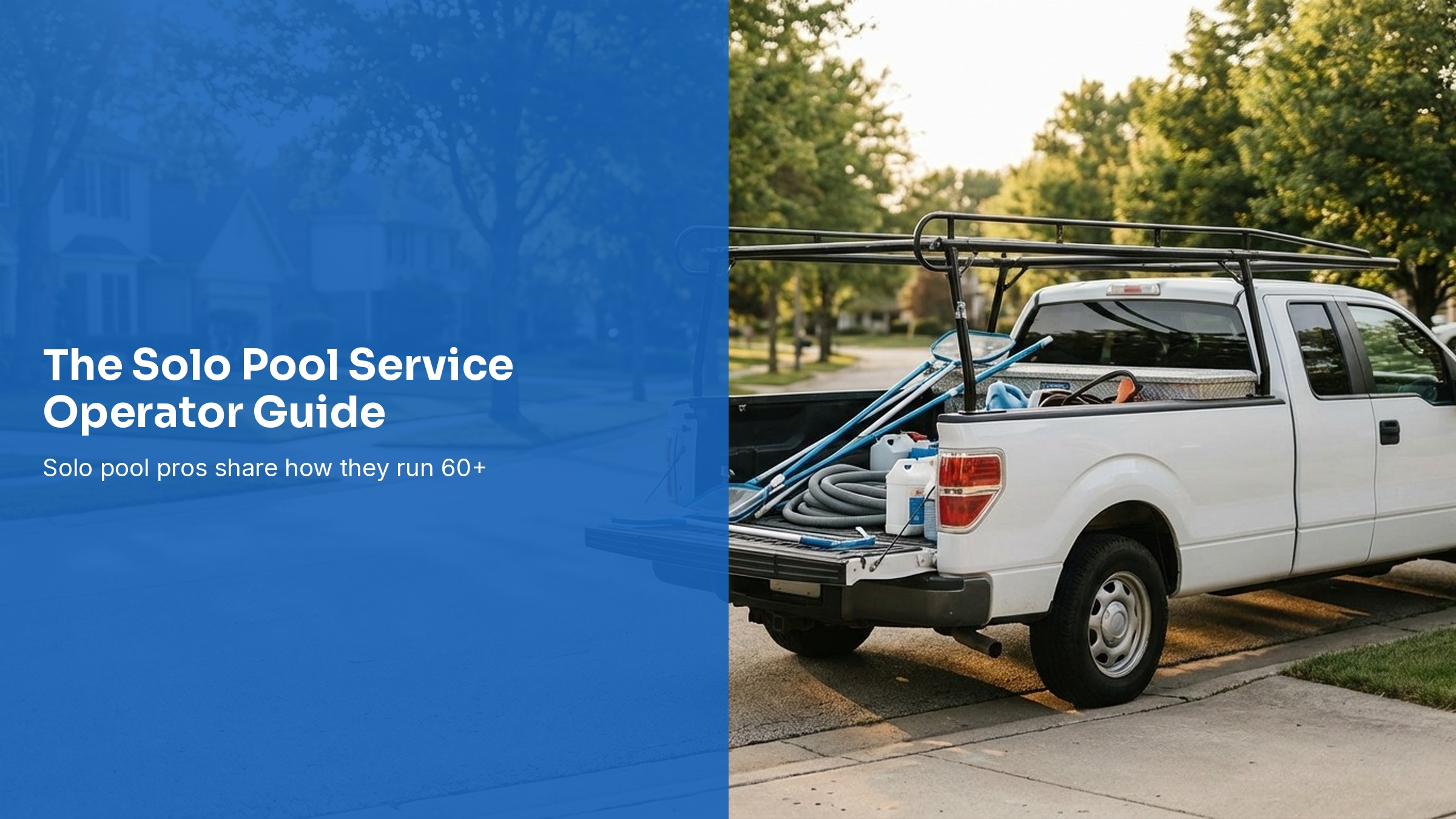
Most pool service businesses in the United States are one-person operations. A truck, a pole, a test kit, and a route. No employees. No office. Just you and 50 to 80 pools that need attention every week.
Running solo is the best job in the world when it works. You set your own hours. You keep every dollar you earn. You answer to nobody. But it can also grind you down if you build the wrong route, charge too little, or take on customers who steal your peace of mind.
We asked solo pool pros what they have learned. The advice was surprisingly consistent.
Key Takeaways
- Drop bad accounts. Every experienced solo operator says this is the single most important thing you can do.
- Price for the whole job. Service rates must cover field time, drive time, chemicals, admin, taxes, insurance, and profit.
- Tighten your route. A solo pro in Utah does 12 pools a day and finishes by 11 AM because every pool is close together.
- Set company boundaries. Use business contact channels, written service terms, and defined response hours.
- Get admin help before you hire a tech. A part-time admin frees you to make money in the field.
Should You Work for Yourself or a Pool Company?
A recent PoolPros discussion showed why this is not simply a question of whether solo work pays more. Ownership trades an employer's guardrails and predictable paycheck for control over pricing, scheduling, customers, and risk.
"In almost every way it’s better to work for yourself. You make way more money and choose how much to work and who you work for."
— Pool pro via Reddit
That upside is real, but it is not guaranteed. Revenue is not take-home pay, and one operator's route economics do not transfer automatically to another market. A solo owner absorbs slow collections, chemical swings, truck repairs, callbacks, insurance, unpaid admin time, and mistakes. The IRS says self-employed people generally owe both income tax and self-employment tax and may need estimated tax payments. Its self-employed tax center is the starting point, followed by advice from a qualified tax professional who knows your state and business.
"Be prepared to never clock out mentally."
— Pool pro via Reddit
Employment can be the better choice when you value paid time off, benefits, technical mentorship, supplied tools, steady volume, or a clean end to the workday. One experienced technician summarized that side plainly:
"I love my job but it's my job, not my entire life."
— Pool pro via Reddit
Before going solo, run a 90-day readiness test. Track whether you complete field notes and invoices without reminders, return calls on schedule, reconcile every payment and expense, reserve cash for taxes and equipment failures, and keep a weekly maintenance calendar. Also price health coverage, disability coverage, commercial auto, general liability, licensing, software, professional help, and time off. If the route only works when none of those costs exist, it does not work yet.
Choose the legal and tax setup deliberately. The SBA's business-structure guide explains that structure affects taxes, paperwork, and personal liability, but state rules differ. An LLC is not a substitute for insurance, safe practices, contracts, or clean separation between business and personal finances. Use an attorney, insurance professional, and tax adviser for decisions specific to your operation.
A practical middle path is to remain employed while building technical depth, savings, and business systems, provided your employment agreement and local rules allow side work. Do not solicit your employer's customers, use company equipment, copy company records, or assume your employer's insurance covers independent jobs. The best launch date is not the first day you feel frustrated with a boss. It is the day your numbers, permissions, habits, and operating systems can support consistent service.
The Solo Operator Sweet Spot
How many pools can one person handle? The answer depends on your route, your market, and how much you want to work. Here is what real solo operators report.
One solo pro in Utah runs 60 accounts. He finishes his route by 11 AM most days. He does not work weekends. His phone barely rings because he catches problems before customers notice them.
"I do about 12 pools a day and I'm done in 5 hours tops because all my pools have covers, vacuums, salt systems and close to each other. It's the easiest job I've ever had. I don't work weekends. You need to find a balance with your lifestyle."
— Pool pro via Reddit
That is the goal. Not 80 pools spread across two counties. Not 100 pools where half of them are problem accounts. Sixty clean pools, close together, paying well. The math works better when you have fewer pools at higher rates than more pools at lower rates.
Drop the Bad Accounts
This came up more than any other piece of advice. Every experienced solo operator said the same thing: get rid of the customers who make your life worse.
"Drop the problem accounts. Can't emphasize this enough. Drop em."
— Pool pro via Reddit
Bad accounts come in several forms. Late payers. Customers who call you every week with complaints. Pools that are too far from the rest of your route. Pools with broken equipment the owner refuses to fix. Customers who hover while you work and question everything you do.
These accounts cost more than they pay. The stress alone is worth the lost revenue. And the slot always gets filled with someone better.
"Every time I would fight to keep a client I would always regret it. Then you finally get rid of them and they are replaced so quickly with a good client."
— Pool pro via Reddit
One father-son team runs over 200 pools. Their advice is the same: once you are big enough, stop accepting difficult work.
"The biggest and most important thing is that when you scale large enough, start to get rid of the problem accounts, and only take on easy accounts. Sometimes you just gotta stop doing the pain in the ass repairs or the really time consuming ones."
— Pool pro via Reddit
The practical approach is simple. Rank your accounts from best to worst. Every time you add a new pool, drop your worst one. Over time, your route improves without ever shrinking. Use your customer management system to track which accounts generate complaints and which ones pay on time without a word.
How to Drop a Customer Without Drama
This is the part that makes solo operators nervous. How do you tell someone you do not want their business?
There are three approaches that work:
- The professional exit. "I'm restructuring my route and will no longer be able to service your pool. I can continue for the next two weeks while you find a replacement."
- The redirect. "I'm shifting to focus on commercial accounts" or "I'm downsizing my residential route." A white lie, but it avoids the confrontation.
- The price-out. Raise their rate to a number that makes the headache worth it. If they pay it, great. If they leave, also great.
That last approach sometimes backfires. One pro raised a difficult customer to $110 per week plus chemicals. The customer did not quit but expected even more attention for the higher price. Be prepared for that.
Charge at the Top of the Market
Solo operators often undercharge because they feel like a "small" operation. That is backwards. You are the owner, the tech, the chemist, and the customer service department. You are more skilled than most employees at larger companies. Price accordingly.
"Raise your prices to near top of market. You know you are better than 90% of those out there, so charge for it. Don't be scared about losing customers. Those who leave you probably didn't want anyway."
— Pool pro via Reddit
Here is the math that makes this obvious. Say you have 50 pools at $150 per month. That is $7,500 per month. If you raise prices 25% to $187.50 and lose 5 customers, you now have 45 pools at $187.50. That is $8,437 per month. You make almost $1,000 more while servicing 5 fewer pools.
Use the service price calculator to model your own numbers. And check what other pros in your area charge at poolrates.fyi so you know where you stand.
Tighten Your Route
Drive time is the enemy of solo operators. Every minute between pools is a minute you are not earning money. The pros who finish early have one thing in common: a tight geographic route.
The Utah pro who finishes by 11 AM did not get there by accident. All his pools have covers, robotic vacuums, and salt systems. They are close together. Each stop takes 15 to 20 minutes. That is 12 pools in 5 hours with minimal drive time.
To tighten your route:
- Stop accepting pools that are 15+ minutes from your nearest cluster
- When you drop a bad account, replace it with a pool in an area you already serve
- Use route optimization tools to sequence your stops and cut drive time
- Calculate your fuel costs for outlier pools. The number will shock you.
Read the full route density guide for a deeper look at how geographic concentration affects your bottom line.
Do Not Advertise That You Are Solo
This one surprised us, but multiple pros agreed. Do not tell customers you are a one-person operation.
"Don't tell clients that you are a single pole operation. They don't need to know that, and it can make them think that you will come look at things for free. Charge for everything! Be friendly, but you're not friends."
— Pool pro via Reddit
When customers know you are solo, they treat you differently. They call your personal phone at 8 PM. They expect you to "pop by" for free when something looks off. They assume your time is flexible because you are your own boss.
Present yourself as a company, not a freelancer. Use a business name. Get a professional website. Set up a separate business phone line. Use an AI receptionist to answer calls when you are on a pool so you never miss a lead but also never have to stop working to pick up the phone.
Fix Broken Equipment or Drop the Pool
Solo operators lose money by working around problems instead of fixing them. A pump that will not prime costs you an extra 10 minutes every visit. A broken skimmer weir means more debris in the basket. A cracked valve means you are manually adjusting flow every week.
"Don't tolerate pools that are in disrepair. I tend to make do with pools that have minor issues like pumps that won't prime, and it eats away at my profit margin because I'm always spending extra time. Just have the customer pay for you to fix them."
— Pool pro via Reddit
Give the customer two options: pay for the repair, or find a new pool service. You cannot afford to donate 10 minutes per visit to broken equipment. At 5 pools with that problem, you are losing almost an hour per day.
Cut Your Chemical Costs
When you are solo, every dollar matters. Several pros shared sourcing tips that cut chemical costs significantly:
- Sodium bicarbonate (baking soda) costs a third of the price at animal feed stores compared to pool supply shops
- Calcium chloride is the same product sold as de-icing salt at hardware stores
- Ascorbic acid (vitamin C) is the active ingredient in most pool metal removers
These are the exact same chemicals. The pool industry just packages and prices them differently. Use the chemical margin calculator to see how much you can save by switching suppliers, and check our guide on what pool pros pay for liquid chlorine by state.
Get Admin Help Before You Hire a Tech
The first hire most solo operators think about is another tech. But several pros said the smarter first hire is a part-time admin.
"Just because you're a single pole operator, you don't have to be a one man show. Get an admin person so you can spend more time bringing in money."
— Pool pro via Reddit
An admin handles scheduling, invoicing, answering the phone, and responding to emails. That frees you to spend more time in the field where you actually make money. You can also use automated billing and an AI receptionist to handle many of these tasks without a human hire.
"Having someone in your corner to help determine what's urgent and delegate accordingly will do wonders for your longevity."
— Pool pro via Reddit
Structure Your Day for Profit
Solo pros who earn the most split their day into two parts: service in the morning, repairs in the afternoon.
"Right now I start early and finish early, like 11 AM. Then I go and do repairs afterwards. Sometimes I'll go do repairs first before it gets too hot, then I'll go service pools."
— Pool pro via Reddit
Service is your base income. Repairs are where the real margin is. If you can finish your route by noon and do one or two repair calls in the afternoon, you have a strong income without working past 3 PM. Track your cost per pool to make sure your service stops are profitable on their own, not just break-even.
The Long View
It is easy to get stuck in the daily grind and forget that you are building something. One pro who started with a 1993 Dodge Dakota and a single pole now runs 25 trucks and employs 50 people.
"Started with a '93 Dodge Dakota and a single pole back in 1999. Today we have 25 trucks and 50 employees. My number one tip: stick with it. It's worth it."
— Pool pro via Reddit
Not everyone wants to grow that big. Many solo operators are happy with 60 pools, short days, and no employees. That is a valid path. The point is that the pool business rewards consistency. Whether you stay solo or scale up, the same principles apply: tight route, good customers, fair prices, and peace of mind.
For more on growing beyond solo, read the four phases of pool business growth and the complete guide to starting a pool service business.
Run Your Solo Operation Like a Pro
PoolDial handles billing, route planning, customer notes, and even answers your phone with an AI receptionist. Everything you need to run 60+ pools from your phone.
Start Your Free Trial