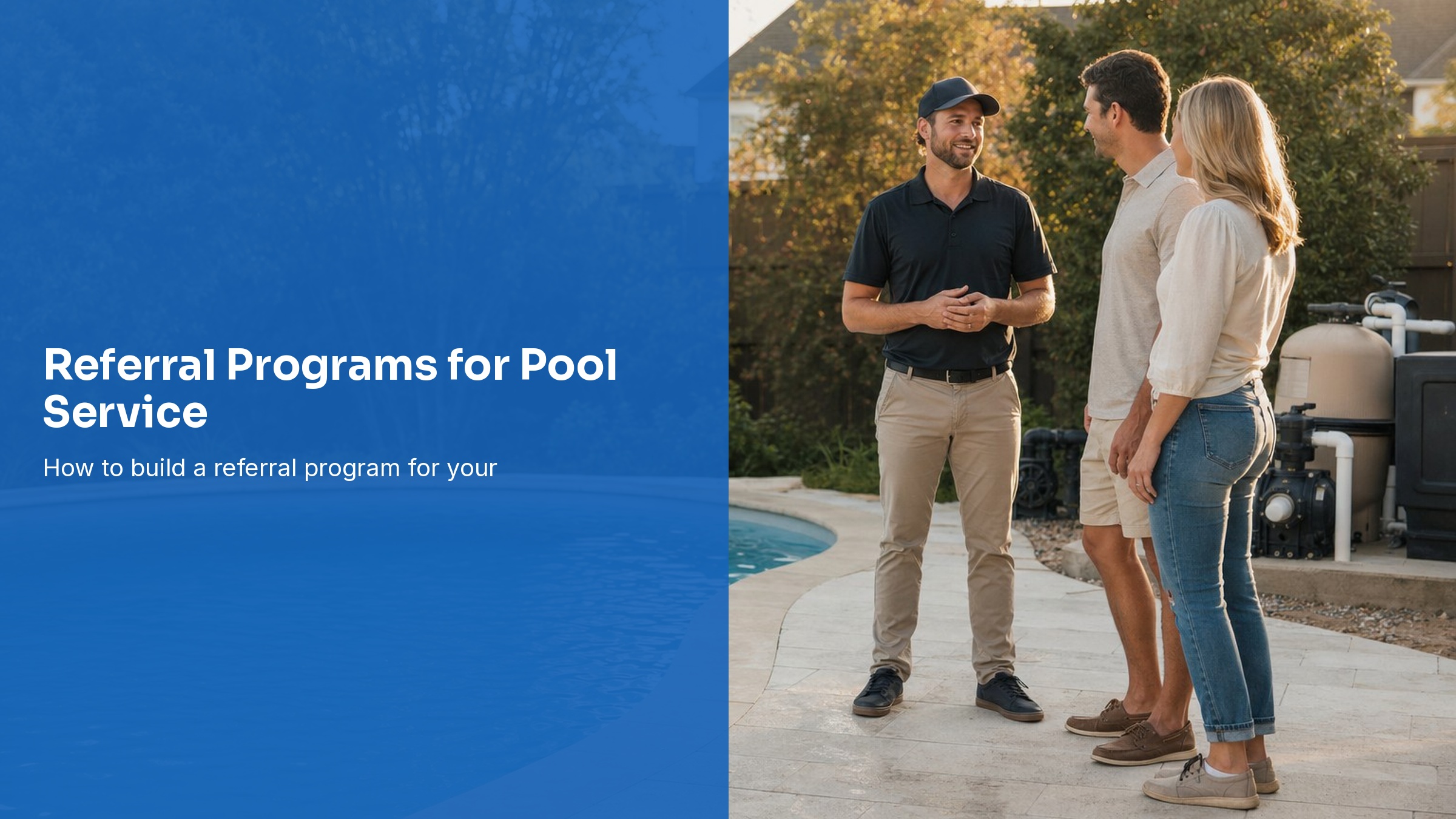
Referral Programs for Pool Service: How to Turn Happy Customers Into Your Best Salespeople


Most pool service businesses grow through word of mouth. You do great work. A happy customer tells their neighbor. That neighbor calls you. It works — but it's passive. You're waiting for customers to talk.
A referral program makes it active. You give customers a reason to talk now, a simple way to spread the word, and a reward when it works. The best pool pros use it to add accounts without spending a dollar on ads.
This guide covers how to build a referral program that works, what to offer, when to ask, and how to track it.
Key Takeaways
- Word of mouth converts better — Referred customers close at much higher rates than cold leads
- Ask at the right time — The best moment is right after a win, not at random
- Free month incentives work — One pool pro hit 50 accounts in six months using this method
- Track every referral source — One pro in Australia gets 97% of customers from recommendations
- Referrals alone aren't enough — Combine them with other channels to grow faster
Why Referrals Are the #1 Growth Channel for Pool Service
Pool service is a trust business. When a homeowner lets you into their backyard every week, they need to believe you're reliable and honest. That trust is hard to build from an ad. It's easy to borrow from a friend.
When a neighbor says, "My pool guy is great, you should call him," that's a warm introduction. The new customer already trusts you before you've met. They're not comparing you to every other company online. They're ready to hire.
"Word of mouth from loyal customers drives five times more sales than any other ads that you could do. And when your customers become your brand ambassadors, that's when you know you're doing something right."
— Edgar De Jesus, Pool Nation Podcast
Some pool pros have built entire businesses without spending a single dollar on marketing.
"I'm proud to say I've never spent that one dollar on any marketing for my business. Everything's just come through referrals and holding myself with integrity and building compassion for the people that I'm working for and building trust with people. That's my motto within the business."
— James Broderick, JB's Pool Care (Pool Nation 30 Under 40)
That kind of growth is real. But it takes time. A referral program gives you more control over the speed. You're still growing through trust — you're just making it easier for customers to help.
The Numbers: Word of Mouth vs. Paid Marketing
Not all leads are the same. A referred customer is easier to close, stays longer, and is more likely to refer others. Here's how the channels stack up for pool service:
Referral Leads
- High trust before first contact
- Lower resistance to your price
- Higher close rate
- Tend to stay longer as customers
- More likely to refer others in turn
- Low cost to acquire
Paid Ad Leads
- No existing trust
- Price-sensitive and comparison shopping
- Lower close rate
- Higher churn risk
- Ongoing cost to maintain
- Can scale faster when needed
The cost-per-acquisition for a referred customer is usually just the incentive you offer — a free month of service, a gift card, or a small credit. Compare that to the cost of Google Ads or Local Service Ads, where you might pay $30–$100 per lead before you've even spoken to anyone.
Use the customer lifetime value calculator to see what one new account is actually worth over time. When a customer sticks around for three years at $150/month, that's $5,400 in revenue. A free month to bring them in is a great deal.
How to Build a Referral Program That Works
A good referral program has three parts: you know when to ask, you know how to ask, and you offer something worth talking about.
When to Ask (Timing Matters)
The worst time to ask for a referral is randomly. The best time is right after a moment where the customer is happy with you.
Good moments to ask:
- After a green-to-clean. You fixed a problem they didn't think was fixable. They're thrilled.
- After they compliment you. If a customer says "You do such a great job," that's your cue.
- After their first month of service. They've had a chance to see what you do. Everything is fresh and clean.
- At the start of swim season. They're excited about their pool. So are their neighbors.
- When you fix a repair quickly. Reliability is rare. When you prove you can be counted on, customers want to talk.
Don't ask when things are rocky. If you've had a mix-up, a missed visit, or a billing issue, fix that first. Ask only when you know the customer is happy.
How to Ask (Scripts and Templates)
Most pool pros don't ask for referrals because they don't know what to say. Here are simple scripts that work.
In Person (After a Compliment)
"Thank you, I really appreciate that. Hey, I'm always looking for good customers like you. If you know anyone in the neighborhood who needs pool service, send them my way — I'll give you a free month for every new account you send me."
Text Message (After First Month)
"Hi [Name], hope the pool's looking great! Now that you've had a chance to see how we work, we'd love to meet more great customers like you. Know anyone who needs a reliable pool pro? Send them our number and we'll give you a free month of service once they sign up."
Email (Seasonal Campaign)
"Summer is here and pools are filling up fast. If you know a neighbor or friend who needs pool service, we'd love the introduction. We're offering [current customers] a free month of service for every new customer you refer. Just tell them to mention your name when they call."
Keep it simple. One clear offer. One clear action. Don't overthink it.
PoolDial's broadcast messaging lets you send a referral offer to all your customers at once. One message, your whole route. You can do it in minutes.
What to Offer (Incentives That Work)
The incentive needs to feel valuable to the customer, but it also needs to make financial sense for you. Here are the most common options pool pros use:
Free Month of Service
The most popular option. Easy to understand. High perceived value. Your cost is just the labor and chemicals for one visit — much less than the month's bill. Works best for residential customers on monthly plans.
Account Credit
Offer $50–$75 off their next invoice. Easier to track than a free month. Good for customers who pay per service. Can be applied automatically through your billing software.
Gift Card
A $25–$50 gift card to a local restaurant or Amazon. Feels like a real bonus. Good for customers who might not value a service credit. Slightly higher cost, but strong motivator.
Cash Referral Fee
$25–$100 cash for each new customer. Straightforward and universally appealing. Check your state's contractor laws — some states restrict cash referral fees for licensed contractors.
The free month approach has a track record in pool service. One pool pro on Reddit shared his referral approach: he offers existing customers a free month of service for every successful referral. He hit 50 accounts in six months using this method combined with flyers.
That's roughly 8 new accounts per month from a simple word-of-mouth program. At $150/month per account, that's $1,200 in new monthly recurring revenue. The cost was a handful of free service months.
Referral Program Structures That Pool Pros Use
There's no single right way to structure a referral program. Here are four models, with the pros and cons of each:
Simple One-Sided Reward
You reward the customer who refers. The new customer gets nothing extra. Easy to run. Customers who already like you are motivated. The new customer signs up because they trust the referral, not the incentive. Best for: solo operators just starting out.
Two-Sided Reward
Both the existing customer and the new customer get a reward. Example: existing customer gets a free month, new customer gets their first visit free. Higher cost per acquisition, but removes friction for the new customer. Best for: competitive markets where new customers comparison-shop.
Seasonal Referral Campaign
Run a referral offer for 60–90 days, usually before swim season. Promotes urgency. Lets you control when you grow (spring is best for pool service). Send via text or email blast to all current customers. Best for: established businesses with 30+ accounts.
Ongoing "Always On" Program
The referral offer is always available. You mention it when onboarding new customers. It's printed on invoices. Customers know the deal any time they're ready to refer. Best for: operators who want a low-maintenance program running in the background year-round.
Many pool pros combine structures. They run a seasonal campaign in spring to generate a burst of growth, then keep an ongoing offer for the rest of the year as a fallback. This is the approach described in our customer retention guide.
Tracking Your Referrals
If you don't track where customers come from, you can't improve your referral program. You also can't reward customers correctly — which kills trust fast.
"I keep track of where customers come from and get 97% of recommendation. About 2% stumbled across the website I think it is and about 1% see one of our vehicles."
— Peter, Talking Pools Podcast (Monday's Down Under)
Peter's numbers are remarkable. 97% from recommendations. But the key detail is that he tracks it. He knows because he asks every new customer. That's the habit you need to build.
How to Track Referral Sources
When a new customer calls or fills out your contact form, ask one question: "How did you hear about us?" Write it down. Log it in your customer record.
Referral Tracking Checklist
- Ask every new customer how they found you — on the first call or in the onboarding form
- Log the referral source in your customer record (PoolDial lets you add notes to each customer profile)
- Note the referring customer's name so you can apply their reward
- Apply the reward as soon as the new customer completes their first paid service
- Send a thank-you message to the customer who referred — even a quick text goes a long way
- Review your referral sources monthly to see what's working
Over time, this data tells you a lot. Which customers refer the most? Which neighborhoods are your best source of word-of-mouth? Are your referral campaigns actually moving the needle?
You can see the lifetime value of referred customers vs. non-referred ones using the LTV calculator. If referred customers stay 40% longer on average, that's a number worth knowing.
When Word of Mouth Isn't Enough
Referrals are powerful. But they have real limits. And the pool pros who rely on them exclusively are leaving growth on the table.
"So many folks in the industry are like, 'Oh, I don't need to pay for marketing because I get a lot of referrals word of mouth business.' And that's true that you can grow your business that way, but you can grow it so much more quickly if you are spending a little bit of marketing."
— Skimmer State of Pool Service Report
"Because most of the industry is still not doing [digital marketing], there's a real chance to kind of take advantage of that and be the first mover."
— Jack Nelson, CEO of Skimmer
Word of mouth also has a ceiling tied to your current customer base. If you have 20 accounts and each refers one person per year, you're adding 20 accounts annually at best. That's fine steady growth. But if you want to scale faster, you need other channels feeding the funnel too.
There's also a risk that referral-only businesses don't think about: economic downturns.
"Word of mouth marketing doesn't work so hot if we were to enter another recession... it is definitely advantageous to be known as the local expert heading into a situation like that."
— Rudy Stankowitz, Talking Pools Podcast
When budgets tighten, referral volume drops because customers cut spending and talk less about services. If you have no digital presence to fall back on, growth stalls. The pool pros who stay busy in a recession are the ones who invested in their visibility before they needed it.
Combining Referrals With Other Channels
The goal is to have multiple channels working together. Referrals give you warm leads. Other channels give you volume and visibility. Together they create a business that grows even when word of mouth slows down.
Vehicle Wraps
Your truck drives through your service area every day. A branded wrap turns every stop into an impression. Neighbors see your truck at a friend's house and remember the name when they need pool service. Read our vehicle wraps and branding guide to learn what works.
Google Business Profile
When a homeowner searches "pool service near me," your Google Business Profile is what shows up. A strong profile with photos, reviews, and your service area can generate a steady flow of inbound leads. We cover the full setup in our GBP guide.
Reviews
Reviews are the bridge between referrals and digital marketing. When a friend recommends you, the first thing a new customer does is look you up online. If they see 30 five-star reviews, you've already won them over before they call. If they see nothing, doubt creeps in.
"Even if I'm asking a friend for a recommendation... the first thing I do is go online and look for reviews."
— Rudy Stankowitz, Talking Pools Podcast
This means reviews aren't separate from your referral program — they're part of it. Ask for reviews right after you ask for referrals. One conversation, two asks.
Broadcast Messaging
PoolDial's broadcast messaging lets you send a message to your entire customer list with one tap. Use it to launch a seasonal referral campaign, remind customers about your referral program, or ask for reviews. It's one of the most efficient tools for growing through your existing customer base.
Customer Portal
Give customers a way to manage their account online and they feel more connected to your business. Happy customers who can see their service history, pay invoices, and communicate with you easily are more likely to refer. PoolDial's customer portal handles all of this automatically.
Turning Happy Customers Into Online Reviews
Referrals and reviews work the same way. Both rely on a happy customer telling someone else. The only difference is scale. A referral reaches one neighbor. A review on Google reaches everyone who searches.
The best time to ask for a review is the same as the best time to ask for a referral: right after a win. After a green-to-clean, after you fix a tricky repair, after the first month of service when everything looks great.
Here's a simple approach:
Ask in person or by text
"We're trying to grow our business through customer reviews. Would you mind leaving us a quick Google review? It makes a big difference." Then send a direct link to your Google review page. Don't make them hunt for it.
Make it easy
Use PoolDial's review request generator to create a simple review link. Send it via text or include it in your invoice emails. The fewer steps between "sure" and submitting, the more reviews you'll get.
Respond to every review
Google rewards businesses that respond to reviews. It also shows prospective customers that you're attentive. Thank positive reviewers. Address negative ones calmly and professionally — how you handle complaints says a lot.
Build it into your onboarding
After a new customer completes their first month, send a review request as part of your standard follow-up. Automate it so it happens every time. Consistent asks create consistent reviews.
For deeper tips on keeping customers loyal so they want to refer and review, see our guides on customer retention strategies and customer communication tips.
Don't Offer Incentives for Reviews
Google's policy prohibits offering rewards in exchange for reviews. Ask customers to leave reviews, but don't tie the review to your referral reward. Keep the two programs separate. Violating this policy can get your listing penalized.
Getting Started: Your Referral Program in One Week
You don't need software or a big budget to launch a referral program. You just need a simple offer and a habit of asking.
Launch Your Referral Program This Week
- Day 1: Decide on your offer. Free month? $50 credit? Pick one and commit to it.
- Day 2: Write your referral script. Keep it to two sentences. Practice it until it feels natural.
- Day 3: Send a broadcast message to your current customers announcing the program.
- Day 4: Add a referral reminder to your invoice emails or service reports.
- Day 5: Start asking in person at every stop where the customer seems happy.
- Ongoing: Track every new customer source. Apply rewards quickly. Say thank you every time.
If you're just starting your business and don't have a customer base yet, focus on getting your first 10–20 accounts first. Our pool service startup guide covers that from scratch. Once you have happy customers, come back and launch the referral program.
For a broader look at marketing channels beyond referrals, read our pool service marketing strategies guide. And if you're thinking about the long-term value of every customer you bring in, start tracking it with the LTV calculator.
"When your customers become your brand ambassadors, that's when you know you're doing something right."
— Edgar De Jesus, Pool Nation Podcast
That's the goal. Not just customers who pay you — customers who sell for you. The referral program is how you get there. Build it now. The sooner you start asking, the sooner the accounts start coming in.
Make It Easy to Grow Through Referrals
PoolDial's broadcast messaging and customer portal help you run your referral program without extra work. Send your offer to every customer in one tap, track where new accounts come from, and give customers a reason to brag about you.
Start Free TrialRelated Reading
- How to Start a Pool Service Business — The complete startup guide
- Pool Service Marketing Strategies — Every channel explained
- Vehicle Wraps and Branding for Pool Service — Make your truck work harder
- Google Business Profile for Pool Service — Get found online
- James Broderick Case Study — How JB's Pool Care grew on referrals alone
- Pool Customer Retention Strategies — Keep the customers you have
- Customer Communication Tips — Build loyalty through great communication