
Should Pool Service Companies Charge Extra for Customers With Dogs?


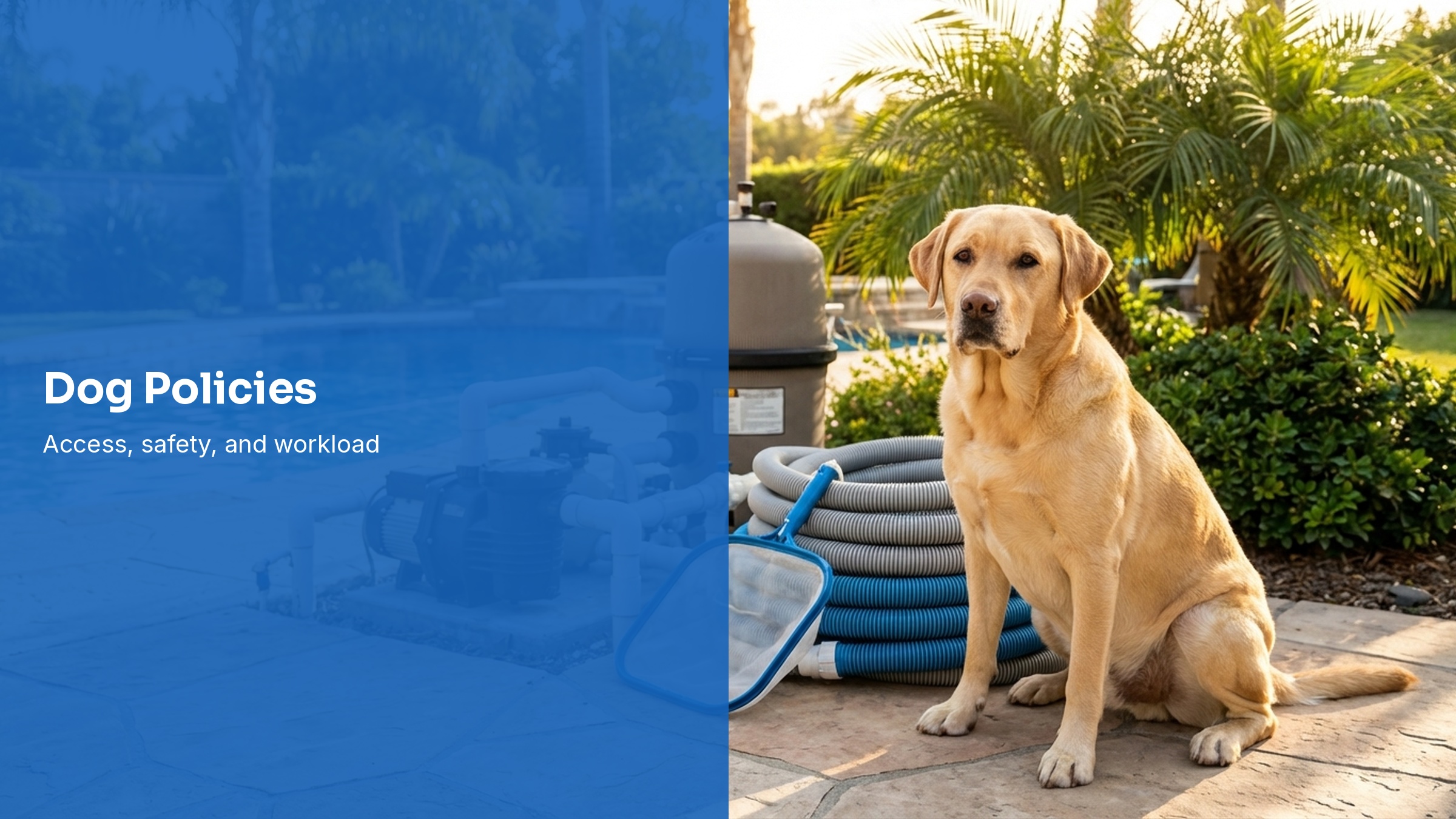
A customer having a dog is not automatically a reason to charge more.
A customer having an unsafe dog in the yard, or dogs that swim every day and load the pool with hair, dirt, and organics, is a different problem.
That distinction matters. A good dog policy should not punish pet ownership. It should separate access and safety from the extra pool workload that some dogs create.
Key Takeaways
- Do not surcharge every customer just because they own a dog.
- Loose, aggressive, or unrestrained dogs are an access and safety issue.
- Dogs that swim can create real chemical, filter, and cleaning workload.
- A swimming-dog surcharge, such as $30/month or more, can make sense when the work is measurable.
- Use clear text-ahead, skipped-visit, and base-charge language before the first visit.
There Are Two Dog Problems
Pool companies get into trouble when they treat every dog account the same.
Dogs create two different business problems:
| Issue | What It Means | Best Policy |
|---|---|---|
| Access and safety | The tech cannot safely enter the yard because a dog is loose, aggressive, or blocking access. | Require the dog to be restrained before service. If access is unsafe, skip the stop and bill according to the agreement. |
| Pool-load economics | Dogs swim in the pool and increase hair, dirt, organics, chlorine demand, phosphates, enzymes, and filter-cleaning frequency. | Price the account higher, add a swimming-dog surcharge, or use base-plus-chemicals pricing. |
The first problem is about technician safety and route reliability. The second problem is about time, chemicals, filters, and account profitability.
When No Surcharge Is Needed
Many dog accounts are ordinary accounts.
If the dog is friendly, restrained, does not block access, and does not swim in the pool, there may be no reason to charge more. Some pool techs see dogs every day and have no issue as long as the customer controls access.
A no-surcharge dog account usually looks like this:
- the customer keeps the dog inside or separated during service
- the gate code works
- the dog does not jump into the pool
- the pool does not require unusual chemical or filter labor
- the tech can complete the normal visit safely
In that case, the policy is not "dogs cost extra." The policy is "customers are responsible for safe access."
When a Surcharge Makes Sense
A surcharge makes more sense when dogs are part of the pool load.
Swimming dogs can add hair, dirt, oils, saliva, sunscreen transfer from owners, and organic load to the water. They can also increase chlorine demand, phosphate treatment, enzyme use, skimming, vacuuming, and filter cleaning.
In the operator research behind this article, one concrete benchmark was a minimum of $30/month more when dogs swim in the pool. That is not a universal rule. It is a useful starting point for thinking about the added work.
Charge more when the dog changes the work, not merely when the customer owns a pet.
Three Pricing Models for Dog-Heavy Pools
1. Built-In Quote Adjustment
The cleanest option is to ask about dogs during the initial quote. If dogs swim, price the account higher from day one.
This avoids a later awkward conversation where the customer feels punished after they already signed up.
2. Monthly Swimming-Dog Surcharge
A separate surcharge can work when the workload is obvious and consistent. For example, an account with two large dogs that swim daily may need more chemicals and filter attention than a similar pool without swimming dogs.
Keep the label practical. "Swimming dog surcharge" is clearer than "dog fee."
3. Base Plus Chemicals
Some operators prefer base-plus-chemicals pricing for high-load accounts. The customer pays a fixed service base, then pays for the actual chemical demand.
This can be fair when the dog load changes month to month. It also avoids guessing whether a flat surcharge is too high or too low.
Text-Ahead and Skip Policies
Access rules need to be simple enough for customers to follow and strong enough for techs to trust.
A common system is:
- send an "on my way" text before arrival
- ask the customer to secure dogs before the tech arrives
- skip service if the dog is loose and access is unsafe
- bill the base service rate if the stop was missed because the customer did not provide safe access
- document the skipped reason in the customer record
The key is consistency. If one tech enters with the dog out and another skips, the customer will not know what to expect.
For more safety-specific guidance, see Dogs on Your Pool Route: A Pool Tech's Guide to Staying Safe.
Sample Pet and Access Language
Use this as a starting point and adapt it to your own service terms:
Customers are responsible for providing safe access to the pool area on service day. Dogs must be secured before arrival. If our technician cannot safely access the pool because of a loose or aggressive animal, the visit may be marked as attempted and billed as scheduled.
Dogs that regularly swim in the pool may require additional chemicals, cleaning time, or filter service. Swimming-dog workload may be priced into the monthly rate or billed as an additional charge.
Please let us know during signup if pets swim in the pool or have access to the service area. This helps us quote the account correctly and avoid surprise charges later.
Dog Policy Quote Checklist
Ask these questions before quoting or renewing an account:
- How many dogs are on the property?
- Are they loose in the yard during the day?
- Do they swim in the pool?
- How often do they swim?
- Are they friendly, reactive, or unknown around service workers?
- Can the customer reliably secure them before arrival?
- Does the pool already show high hair, debris, phosphate, or filter load?
- Are chemicals included, billed separately, or passed through?
- Should the account have a higher base price from the start?
Those answers tell you whether this is a normal pet account, an access-risk account, or a high-load pool that needs different pricing.
How Pool Dial Helps
Dog policies only work if the field team sees them before arriving at the stop.
Pool Dial can store pet notes, access instructions, skipped-stop reasons, customer messages, service history, chemical notes, and account-specific pricing context. That helps the office and the tech avoid guessing each week.
Keep Pet Notes on the Account
Pool Dial helps pool service companies track access rules, customer notes, skipped stops, and chemical workload in one place.
See Customer NotesFAQ
Should pool companies charge extra for every dog?
No. Dog ownership alone is not the issue. Charge more only when the dog affects safe access, service time, chemical demand, filter cleaning, or pool condition.
How much extra should pool companies charge for swimming dogs?
Some operators use $30/month or more as a starting point for swimming dogs, but the right number depends on pool size, dog count, swim frequency, chemical model, and filter workload.
Can a pool tech skip service if a dog is loose?
Yes, if the company policy says unsafe access leads to an attempted or skipped visit. The customer should receive that policy before service starts.
Do dogs affect pool chemistry?
Dogs can increase organic load, dirt, hair, chlorine demand, and filter cleaning. The effect depends on how often they swim and how much debris they bring into the pool.
Bottom Line
A good pool service dog policy does not treat every pet as a problem.
Separate access and safety from pool-load economics. Secure dogs before service. Skip unsafe stops according to written terms. Price swimming-dog accounts for the extra work they actually create.
That is fair to the customer, safer for the tech, and better for the business.