


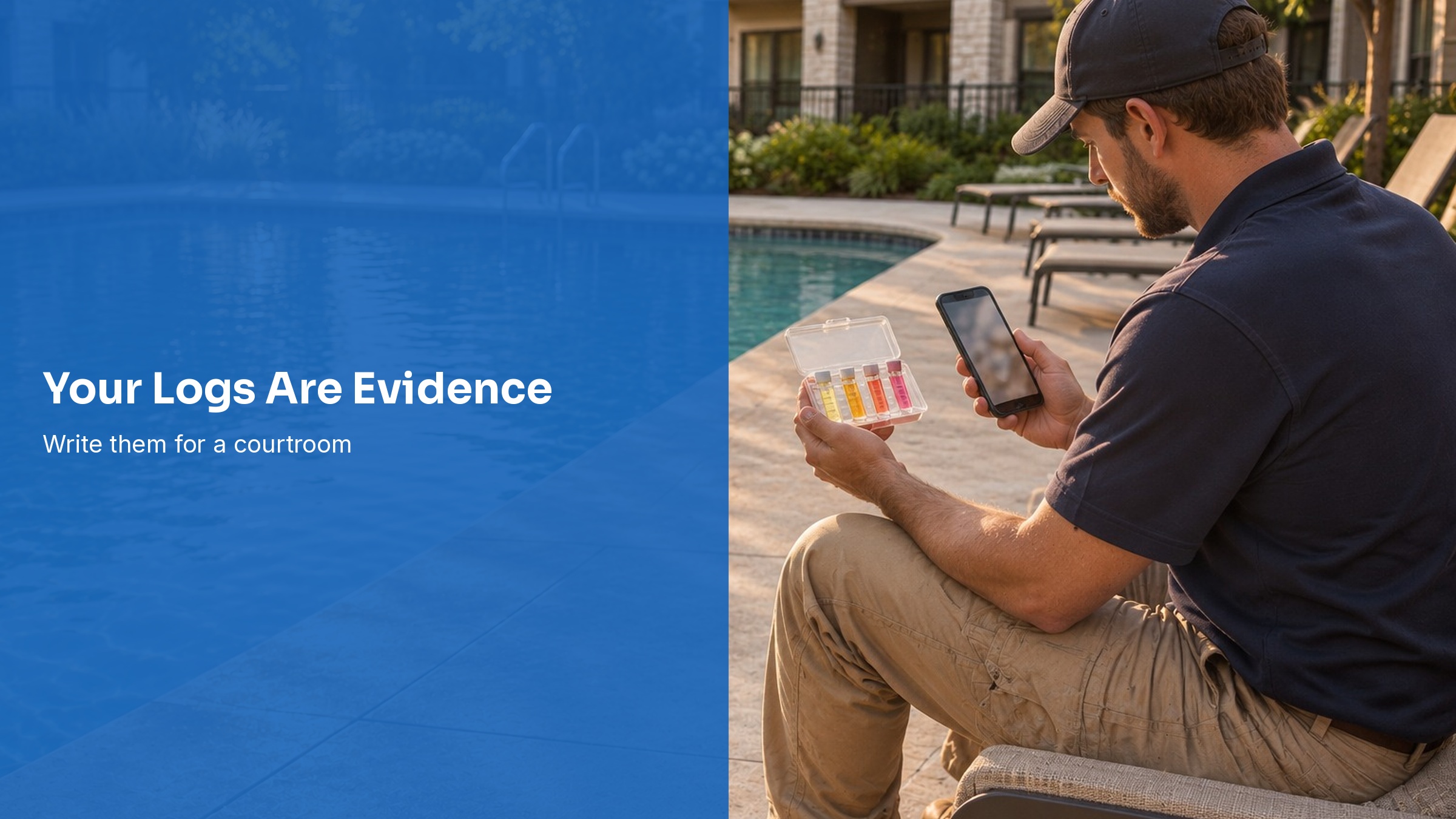
Most techs think of the chemical log as busywork. You test, you write it down, you move on. But when someone gets hurt in a pool, that log can become the most important piece of paper in the case.
A good log can show you did your job. A bad log, or a fake one, can turn a bad day into a business-ending one. This article walks through real cases where pool records mattered, then shows you how to keep logs that will hold up.
Key Takeaways
- $26 million: what a Myrtle Beach resort and its insurers agreed to pay after a 3-year-old was burned in an over-chlorinated pool. The log showed normal readings.[1]ABC News 4 (WCIV)Family of chlorine burn victim to receive $26M in settlement with Myrtle Beach hotel, Jan. 29, 2024abcnews4.com
- Forgery charge: the pool operator was charged after he said in a deposition that he filled in logs for days he did not work.[2]The Sun News (Myrtle Beach), via Yahoo NewsMan accused of forging pool records, causing child to get burned at Myrtle Beach hotel, Mar. 23, 2023yahoo.com
- Defense win: a Cook County condo and its manager won summary judgment after the pool vendor testified the water was tested twice that day and was in a safe range.[4]Litchfield Cavo LLPIllinois attorneys secure summary judgment in premises liability case (Circuit Court of Cook County, Nov. 2022), defense firm news releaselitchfieldcavo.com
- 3 years: how long the CDC's model pool code says public pool records should be kept.[7]CDC, Model Aquatic Health Code, 5th Edition (2024)Sections 6.4.1.2.1 (Record Maintenance) and 6.4.1.6 (Daily Water Monitoring and Testing Records)cdc.gov
Same kind of record, two different endings
A pool chemical log is a simple thing. It says what the water tested at, when, and what was added. In a lawsuit, it does one job: it shows what really happened at the pool.
That can work for you or against you. In the cases below, the same kind of record helped one side win and helped bring a $26 million payout against another. The difference was not the form or the app. The difference was whether the record was true and made at the time.
Case 1: The log said the pool was fine
What happened. Over Memorial Day weekend in 2020, a family from North Carolina stayed at the Caribbean Resort & Villas in Myrtle Beach, South Carolina. Their 3-year-old son swam in a resort pool and got chemical burns. He was treated at the UNC Burn Center and has permanent scars.[1]ABC News 4 (WCIV)Family of chlorine burn victim to receive $26M in settlement with Myrtle Beach hotel, Jan. 29, 2024abcnews4.com
The family called the state health agency, DHEC, while the boy was in the burn unit. When DHEC tested the pool, the chlorine was too high for its test kit to measure. DHEC shut the pool down.[1]ABC News 4 (WCIV)Family of chlorine burn victim to receive $26M in settlement with Myrtle Beach hotel, Jan. 29, 2024abcnews4.com
What the log showed. The resort's pool logbook showed normal levels on both days the boy swam. According to the family's lawsuit, the employee filled in data for days he was not working, including the day of the injury.[3]Simmons Law FirmSouth Carolina resort to pay $26 million to child burned in pool (summary of the lawsuit), Apr. 23, 2024simmonslawfirm.com
The pool operator, Juan Arocho Rivera, was charged with forgery in March 2023 after an investigation by DHEC's office of criminal investigations. A news report said that in a deposition (sworn questioning before trial), he testified he did not work on May 24 and 25, 2020, and that he filled in the logs on May 26. His employer's records also showed he was off those days.[2]The Sun News (Myrtle Beach), via Yahoo NewsMan accused of forging pool records, causing child to get burned at Myrtle Beach hotel, Mar. 23, 2023yahoo.com
A charge is not a conviction. We could not find a public record of how the forgery charge ended.
What it cost. In January 2024, the family's lawyers announced that the resort company and its insurers would pay $26 million to settle the case before a jury trial.[1]ABC News 4 (WCIV)Family of chlorine burn victim to receive $26M in settlement with Myrtle Beach hotel, Jan. 29, 2024abcnews4.com
The lesson. A log that shows perfect numbers is worthless if it was written later. Once a lawyer proves one entry was made up, nobody trusts any of the others. A law firm's summary of the lawsuit says the records the resort gave DHEC had been falsified for many years.[3]Simmons Law FirmSouth Carolina resort to pay $26 million to child burned in pool (summary of the lawsuit), Apr. 23, 2024simmonslawfirm.com A blank line would have been bad. A fake line was far worse.
Case 2: The water was tested twice that day
What happened. A condo resident in Cook County, Illinois, said she hurt her eye after swimming in the building's pool. She sued the condo association and its property management company. She blamed the water chemistry and the chlorine level.[4]Litchfield Cavo LLPIllinois attorneys secure summary judgment in premises liability case (Circuit Court of Cook County, Nov. 2022), defense firm news releaselitchfieldcavo.com
What the records showed. The condo had hired a pool company to care for the water. According to the defense firm's summary, the pool vendor testified that chlorine and pH were tested twice on the day she said she was hurt, and both readings were in the safe range. Her own medical evidence also tied her eye problem to an unrelated condition.[4]Litchfield Cavo LLPIllinois attorneys secure summary judgment in premises liability case (Circuit Court of Cook County, Nov. 2022), defense firm news releaselitchfieldcavo.com
The result. In November 2022, the court granted summary judgment for the condo and its manager.[4]Litchfield Cavo LLPIllinois attorneys secure summary judgment in premises liability case (Circuit Court of Cook County, Nov. 2022), defense firm news releaselitchfieldcavo.com Summary judgment means the judge ended the case without a trial because the facts did not support the claim.
The lesson. Two tests on the right day, with numbers in range, helped shut the case down. That is the flip side of Case 1. When the testing is real and on time, your record of it is one of the best things you can bring to court.
“What I wanted to share for you guys is to document what you do, have contracts, and save communication making sure it's all in writing.”
Case 3: The broken parts went in the trash
Logs are not the only records that matter. Sometimes the evidence is the broken part itself.
What happened. In September 2008, two people using a spa at a Southern California condo complex got chemical burns. One was hospitalized with burns from his knees to his ankles. The spa had a peristaltic chlorine feeder. The plaintiffs said it acted as if it was stuck on and kept pumping liquid chlorine. Up to 5 gallons reportedly went into a spa of about 800 gallons.[5]Pool & Spa NewsChlorinator suit stirs concerns, Dec. 31, 2010poolspanews.com
What went missing. According to the feeder maker's attorney, the service tech threw away the feeder's switch and potentiometer (the dial that sets the feed). Those parts could have shown why it kept feeding. Without them, nobody could prove the cause.[5]Pool & Spa NewsChlorinator suit stirs concerns, Dec. 31, 2010poolspanews.com
The result. All the defendants denied blame. Both lawsuits settled, and the amounts were not made public. The feeder maker's lawyer said the missing evidence was part of why: she did not like trying cases where the best evidence was a guess.[5]Pool & Spa NewsChlorinator suit stirs concerns, Dec. 31, 2010poolspanews.com
The lesson. When equipment fails and someone is hurt, do not toss the old part. Bag it, label it with the date and pool, and take photos of the settings before you touch anything. Then call your insurance agent.
Do health codes require pool chemical logs?
For public and semi-public pools (hotels, apartments, HOAs, gyms), usually yes. The exact rules come from your state, county, or city. Backyard pools are usually not covered, but your customer, their lawyer, or your insurer can still ask for your records.
Many local codes borrow from the CDC's Model Aquatic Health Code (MAHC). It is a model, so it only has force where a state or county adopts it. The 2024 edition says pool records should be kept for at least 3 years and shown to the health department on request. It lists what daily testing records should include, such as pH, disinfectant levels, combined chlorine, and CYA if used.[7]CDC, Model Aquatic Health Code, 5th Edition (2024)Sections 6.4.1.2.1 (Record Maintenance) and 6.4.1.6 (Daily Water Monitoring and Testing Records)cdc.gov
Missing an entry can be a violation by itself, even if the water was fine. In Ontario, Canada, Peel Region's public list of pool convictions shows a gym fined $55 for failing to record free chlorine at least 30 minutes before opening. It was fined another $55 for not keeping a daily record of its water meter.[6]Peel Public Health (Region of Peel)Public Pool and Spa Convictions, O. Reg. 565/90, list updated June 9, 2026peelregion.ca
The fines were small. But the gym's name now sits on a public list that anyone can look up. For commercial pools, see our commercial pool log book for what most inspectors look for.
| Case | What the record showed | Outcome |
|---|---|---|
| Myrtle Beach resort, SC (2020 injury) | Normal readings, allegedly written for days the operator was not working | $26M settlement; pool operator charged with forgery |
| Cook County condo, IL (2022 ruling) | Vendor testified to two tests that day, both in range | Summary judgment for the condo and manager |
| Southern California condo spa (2008 injury) | Failed feeder parts thrown away | Cause never proven; settled for undisclosed amounts |
| Peel Region gym, Ontario (2025 offence) | No free chlorine record before opening | $55 fine on a public conviction list |
What makes a pool log hold up
A lawyer reading your log will ask one question: can I trust this? Here is what makes the answer yes.
- Written at the pool, at the time. Record readings right after you test, not in the truck at the end of the day. Never fill in a day you were not there.
- Timestamped. Each entry needs the date and the time. "Tuesday" is not enough when the injury happened Tuesday afternoon.
- Shows who did it. Every entry should name the tech who tested. In Case 1, work records showing who was on duty exposed the fake entries.
- Readings and what you added. Write down chlorine, pH, and the other numbers you tested. Also write what you added and how much. "Added 1 gal liquid chlorine" tells a clear story.
- No backfilling. If you missed a visit, leave it blank and write why. A blank with a reason looks honest. A perfect row from a day off looks like fraud.
- Corrections shown, not erased. On paper, draw one line through a mistake, write the right number, and initial it. Never use white-out or tear out pages.
- Photos when something is off. Snap the test kit, the feeder setting, or a broken part. Phone photos save their own date and time.
Our guide on how to log pool chemical readings covers the field steps in more detail. For backyard pools, the residential pool log book is a free printable you can leave with the customer.
“It's never been easier to document stuff... Like take, take some pictures on your phone. Maybe you never do anything with it, but you see something bad or take a picture before and after.”
Paper vs digital logs
Both can hold up in court. Both can be faked. What matters is whether the record shows when it was made and who made it.
Paper is cheap and works with no signal. But a pen does not stamp the time, and anyone can write any date. A paper log also lives in one place. If it is lost, wet, or left in a pump room, it cannot help you.
Digital logs can save the time and the user for each entry on their own. They also keep a backup off-site, so your records survive a lost phone or a flooded truck. A digital log is only as honest as the person using it, though. Typing in numbers you did not test is still faking a record.
We compare the two in more depth in digital vs paper pool service logs.
In PoolDial, each visit saves the tech who did it, when they arrived and finished, the readings, the chemicals added, photos, and notes. That history stays on the customer's profile, so you can pull up any past visit. See chemical tracking and service logs for how it works.
A simple log routine for your route
- Test first, then log. Enter readings at the pool before you add anything.
- Log what you add. Product and amount, every time.
- Retest when it matters. After a big dose, or at a commercial pool before it opens, test again and log it.
- Photo anything strange. High readings, a stuck feeder, a cloudy pool, a broken lid.
- Report unsafe water in writing. If the water is not safe to swim, tell the customer or manager, and log who you told and when.
- Save failed parts. If anyone might be hurt, bag the part and call your insurer before you throw anything out.
- Keep records for years. Keep at least 3 years, or longer if your local code says so. Claims can come in long after the visit.
- Put it in your contract. A service agreement can spell out what you test, how often, and what the customer must do between visits.
Last, check that your general liability insurance covers chemical injury claims. Good logs help you win a case. Insurance pays for the lawyer while you do.
Sources
- [1]ABC News 4 (WCIV), Family of chlorine burn victim to receive $26M in settlement with Myrtle Beach hotel, Jan. 29, 2024. abcnews4.com
- [2]The Sun News (Myrtle Beach), via Yahoo News, Man accused of forging pool records, causing child to get burned at Myrtle Beach hotel, Mar. 23, 2023. yahoo.com
- [3]Simmons Law Firm, South Carolina resort to pay $26 million to child burned in pool (summary of the lawsuit), Apr. 23, 2024. simmonslawfirm.com
- [4]Litchfield Cavo LLP, Illinois attorneys secure summary judgment in premises liability case (Circuit Court of Cook County, Nov. 2022), defense firm news release. litchfieldcavo.com
- [5]Pool & Spa News, Chlorinator suit stirs concerns, Dec. 31, 2010. poolspanews.com
- [6]Peel Public Health (Region of Peel), Public Pool and Spa Convictions, O. Reg. 565/90, list updated June 9, 2026. peelregion.ca
- [7]CDC, Model Aquatic Health Code, 5th Edition (2024), Sections 6.4.1.2.1 (Record Maintenance) and 6.4.1.6 (Daily Water Monitoring and Testing Records). cdc.gov