


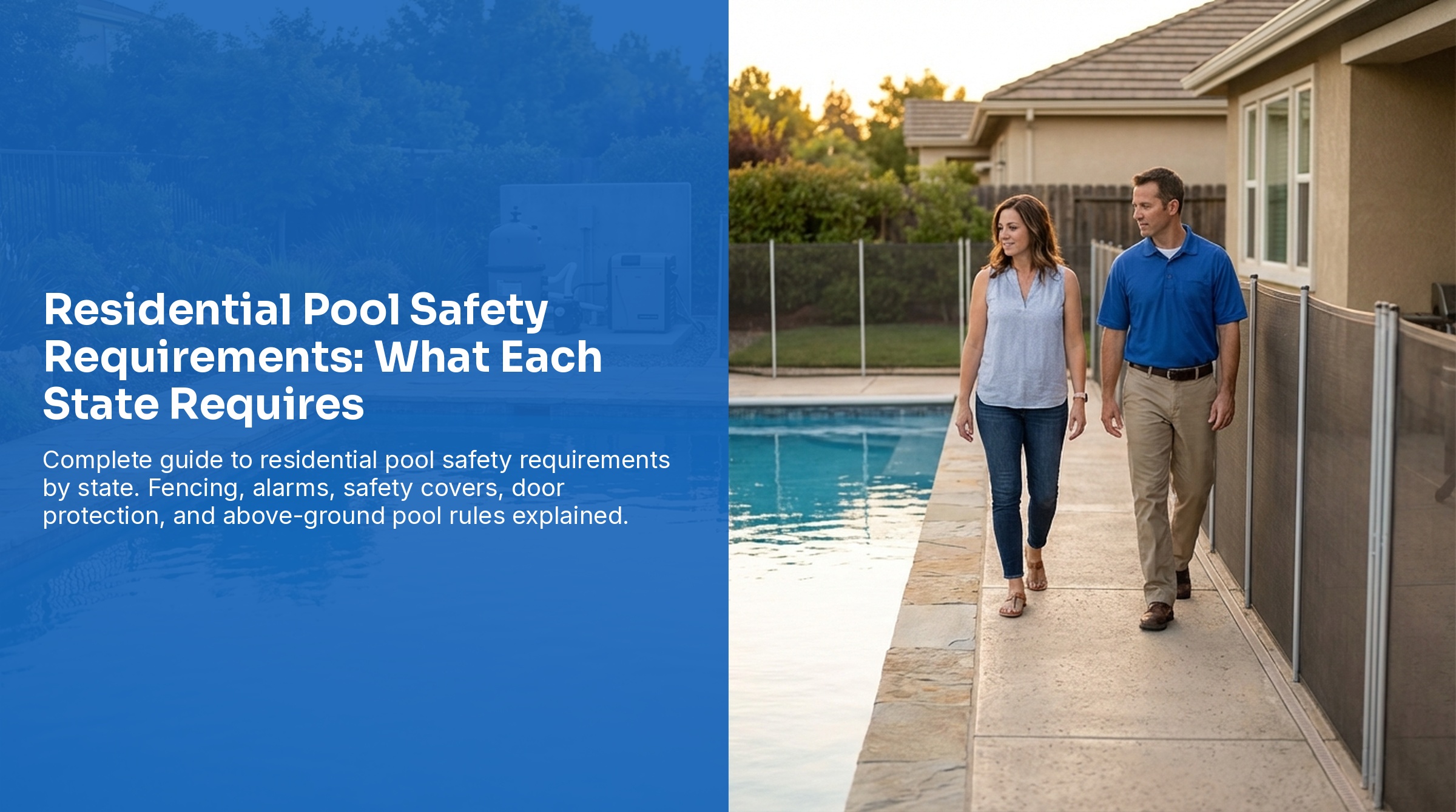
Residential pool safety goes beyond just fencing. States require a combination of barriers, alarms, safety covers, and door protection to create multiple layers of defense against child drowning.[1]CDC MMWR Vital SignsDrowning prevention recommendationscdc.gov
This guide covers the four main categories of residential pool safety requirements: fencing, alarms, safety covers, and door/window protection. We'll explain what each state requires and how these systems work together.
Key Safety Requirements
- Four-sided fencing — Research shows isolation fencing is the most effective barrier [1]CDC MMWR Vital SignsFour-sided isolation fencing recommendationcdc.gov
- Pool alarms — Must sound at 50+ decibels when 15+ lb object enters water (Tennessee law) [2]Signs.com Pool Fence LawsKatie Beth's Law requirementssigns.com
- Safety covers — Must meet ASTM F1346 to substitute for fencing [2]Signs.com Pool Fence LawsSafety cover standardssigns.com
- Door alarms — UL 2017 standard required when house is part of barrier [3]WaterSmartFLFlorida pool safety requirementswatersmartfl.com
The Four Categories of Pool Safety Requirements
State pool safety laws typically address four main areas. Most states require at least one, while stricter jurisdictions like Clark County, Nevada require multiple layers of protection.
minimum fence height
(Tennessee standard)
to trigger pool alarm
Source: Signs.com Pool Fence Laws
Fencing Requirements
Fencing is the most common pool safety requirement. Research shows that four-sided isolation fencing—meaning the fence completely surrounds the pool without using the house as one wall—is the most effective barrier.[1]CDC MMWR Vital SignsFour-sided isolation fencing effectivenesscdc.gov
However, most states allow the house wall to serve as the "fourth side" of the pool enclosure. When this is the case, additional requirements typically apply to doors and windows that open to the pool area.
Key fencing requirements across states:
- Height: Minimum 4-6 feet depending on state (4 feet most common)
- Openings: No gap larger than 4 inches (the sphere test)
- Gates: Self-closing and self-latching, opening away from pool
- Climbing prevention: No handholds or footholds on exterior
Pool Alarm Requirements
Pool alarms detect when someone or something enters the water. Tennessee's "Katie Beth's Law" set a benchmark that many states follow: alarms must sound at least 50 decibels when an object weighing 15 pounds or more enters the water.[2]Signs.com Pool Fence LawsKatie Beth's Law requirementssigns.com
Clark County, Nevada goes further, requiring door and window alarms to sound at 85 decibels at 10 feet—loud enough to be heard throughout most homes.
The 15-pound threshold: Pool alarms are calibrated to detect objects weighing at least 15 pounds to avoid false alarms from toys, leaves, or small animals while still detecting a toddler entering the water.
There are two main types of pool alarms:
- Surface wave alarms: Float on the water and detect disturbances
- Sub-surface alarms: Mounted below the water line, detect pressure changes
Safety Cover Requirements
Some states allow motorized safety covers as an alternative to fencing. To qualify, covers must meet the ASTM F1346 standard, which ensures the cover can support the weight of a child or adult without allowing access to the water.[2]Signs.com Pool Fence LawsASTM F1346 safety cover standardsigns.com
States that accept safety covers as a fencing alternative:
- Indiana: Motorized covers meeting ASTM F1346 allowed
- Nevada (Clark County): Power safety covers accepted as secondary barrier
- Florida: Approved safety covers accepted as one of four options
- Arizona: Safety covers allowed when residence is part of enclosure
Solar covers are NOT safety covers. Standard solar blankets and winter covers do not meet ASTM F1346 and can actually increase drowning risk by concealing a child who falls in. Only motorized, ASTM-compliant covers qualify as safety devices.
Door and Window Protection
When the house wall serves as part of the pool barrier (the "fourth wall"), states require protection on any doors or windows that provide direct access to the pool area. This is often the most critical safety point—and the most commonly failed.[3]WaterSmartFLDoor and window requirements when house is barrierwatersmartfl.com
Common door/window requirements include:
- Door alarms: Must meet UL 2017 standard, sound when door is opened
- Self-closing doors: Doors must close and latch automatically
- High release mechanisms: Door releases must be at least 54 inches above floor (Florida)
- Window locks: Windows providing pool access must have approved locks
State-by-State Comparison
The following table shows which safety features are required or accepted in major pool states. Note that "required" means mandatory, while "accepted" means the feature can substitute for another requirement.
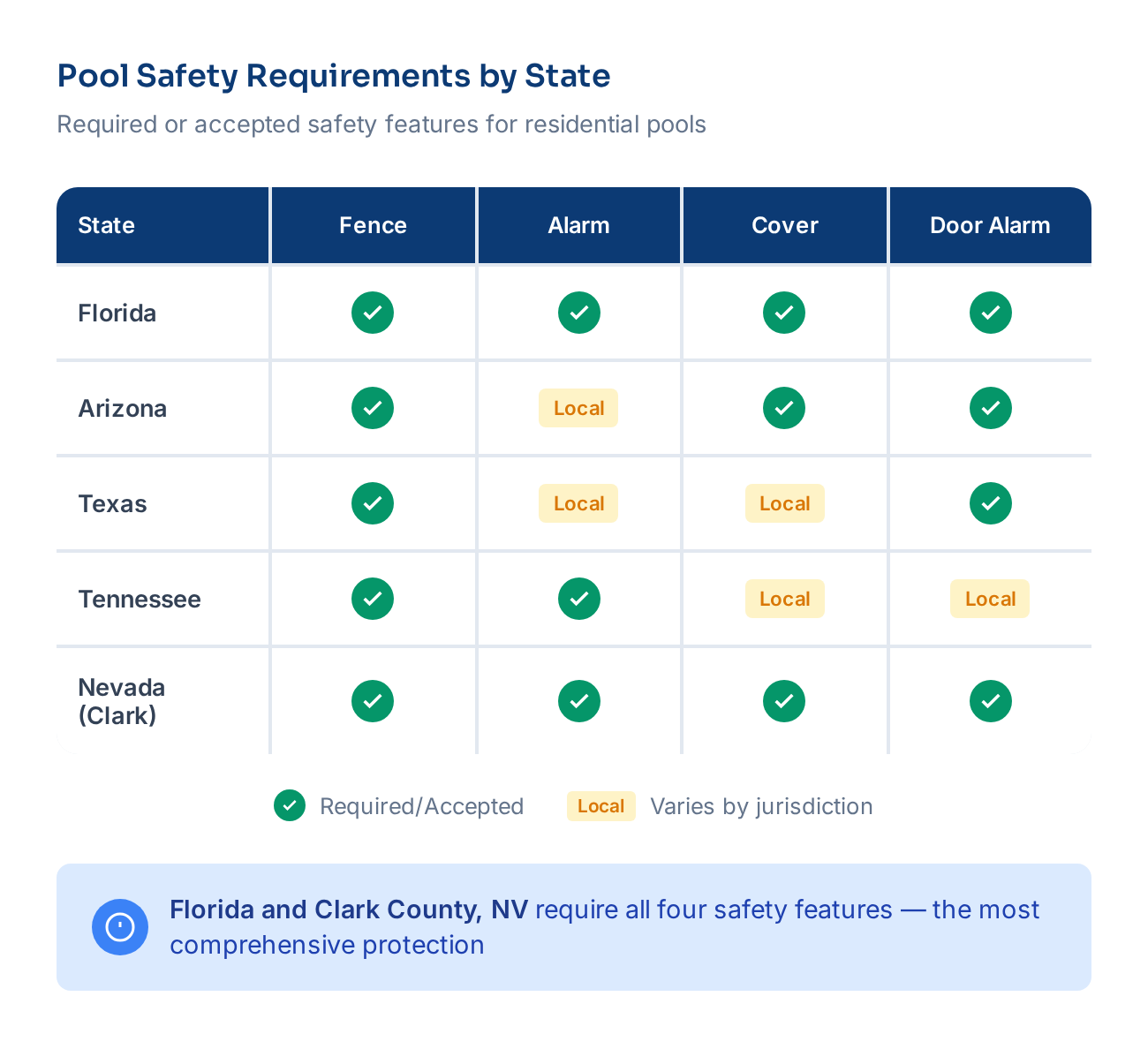
| State | Fence | Pool Alarm | Safety Cover | Door Alarms |
|---|---|---|---|---|
| Florida | Yes | Yes | Yes | Yes |
| Arizona | Yes | Local* | Yes | Yes |
| Texas | Yes | Local* | Local* | Yes |
| Tennessee | Yes | Yes | Local* | Local* |
| Nevada (Clark Co.) | Yes (6ft) | Yes | Yes | Yes (85dB) |
| Indiana | Yes | Local* | Yes | Local* |
*Requires local verification. Source: Signs.com
Above-Ground Pool Requirements
Above-ground pools have different requirements in most states. When the pool structure itself is at least 4 feet tall with vertical, non-climbable sides, it may serve as its own barrier.[2]Signs.com Pool Fence LawsAbove-ground pool requirementssigns.com
However, this only applies if:
- Ladder access: Pool ladders must be lockable, removable, or have a barrier preventing unauthorized climbing
- Deck access: If a deck provides access to the pool, it must be enclosed with standard fencing
- Non-climbable sides: The pool walls must not have handholds or footholds
The "Fourth Wall" Problem
The most common point of barrier failure is the house itself when it serves as part of the pool enclosure. Children often access pools through sliding glass doors, back doors, or windows that adults forget to lock or alarm.[4]CPSC Safety Barrier GuidelinesBarrier failure scenarioscpsc.gov
This is why states increasingly mandate UL 2017 door alarms for any home opening to a pool. These alarms provide an audible warning when a door is opened, giving caregivers critical seconds to respond.
For pool professionals: When documenting customer pools, note the condition of door alarms, gate latches, and any gaps in the barrier system. This information can be valuable for both safety consultations and liability documentation.
The Layers of Protection Approach
No single safety feature is foolproof. The most effective approach is layered protection—multiple barriers that a child must bypass to reach the water. Clark County, Nevada exemplifies this by requiring both a primary fence AND a secondary device.[2]Signs.com Pool Fence LawsClark County double barrier requirementsigns.com
A typical layered approach includes:
- Primary barrier: Fence around the pool or yard
- Secondary barrier: Mesh fence, door alarms, or safety cover
- Notification: Pool alarm to alert when water is disturbed
- Supervision: Active watching (not a substitute for barriers)
Sources
- [1] CDC Morbidity and Mortality Weekly Report, "Vital Signs: Drowning — United States, 1999–2022," MMWR 2024. Four-sided isolation fencing recommendation. cdc.gov
- [2] Signs.com, "Pool Fence Laws by State" — Comprehensive state-by-state compilation including alarm requirements, safety cover standards, and local variations. signs.com
- [3] WaterSmartFL, Florida Residential Swimming Pool Safety Act information and door/window requirements. watersmartfl.com
- [4] U.S. Consumer Product Safety Commission, "Safety Barrier Guidelines for Residential Pools." cpsc.gov