


Florida leads the country in drowning deaths for children ages 1-4, while rural counties across all states show consistently higher drowning rates than urban areas.[1]WaterSmartFLFlorida child drowning leadershipwatersmartfl.com Understanding geographic patterns in pool drowning data helps identify where prevention efforts matter most.
For pool service professionals, state-by-state data provides context for local safety conversations and helps explain why fence laws and barrier requirements vary so significantly across the country.
Key Statistics at a Glance
- 1.31 — National drowning rate per 100,000 people (age-adjusted, 2018-2021)[2]CDC Drowning FactsNational age-adjusted ratecdc.gov
- Florida — Leads U.S. in drowning deaths for children ages 1-4[1]WaterSmartFLState leadership in child drowningwatersmartfl.com
- Rural > Urban — Rural counties consistently show higher drowning rates[3]CDC Data Brief #413Rural vs. urban drowning rates, 1999-2019cdc.gov
- Sunbelt states — Drowning is leading cause of accidental death at home for children under 5[4]CPSC Safety Barrier GuidelinesRegional drowning patternscpsc.gov
The National Drowning Rate
The CDC reports a national age-adjusted drowning death rate of 1.31 per 100,000 people for 2018-2021.[2]CDC Drowning FactsNational drowning ratecdc.gov This includes all drowning types—pools, natural bodies of water, bathtubs—so the pool-specific rate is lower.
State-specific rates vary based on several factors:
- Climate: Warmer states have longer swimming seasons and more pool exposure
- Pool density: States with more residential pools see more pool-specific drownings
- Water access: Coastal states and lake regions have mixed drowning sources
- Regulations: Stricter fence laws may reduce residential pool incidents
Why Florida Leads in Child Drownings
Florida consistently leads the nation in drowning deaths for children ages 1-4.[1]WaterSmartFLFlorida drowning statisticswatersmartfl.com Several factors contribute to this:
Source: WaterSmartFL, CPSC Pool Reports
Florida's Residential Swimming Pool Safety Act (Chapter 515) took effect in October 2000, requiring new pools to have at least one of four safety features. However, over 90% of Florida's pools were built before this law—meaning most residential pools in the state have no legal requirement for barriers.[1]WaterSmartFLGrandfathering of older poolswatersmartfl.com
The grandfathering problem: In Florida and many other states, pools built before modern safety laws took effect aren't required to comply with current barrier standards unless the home is sold or significantly renovated. This creates millions of pools with no legal safety requirements.
The Rural vs. Urban Gap
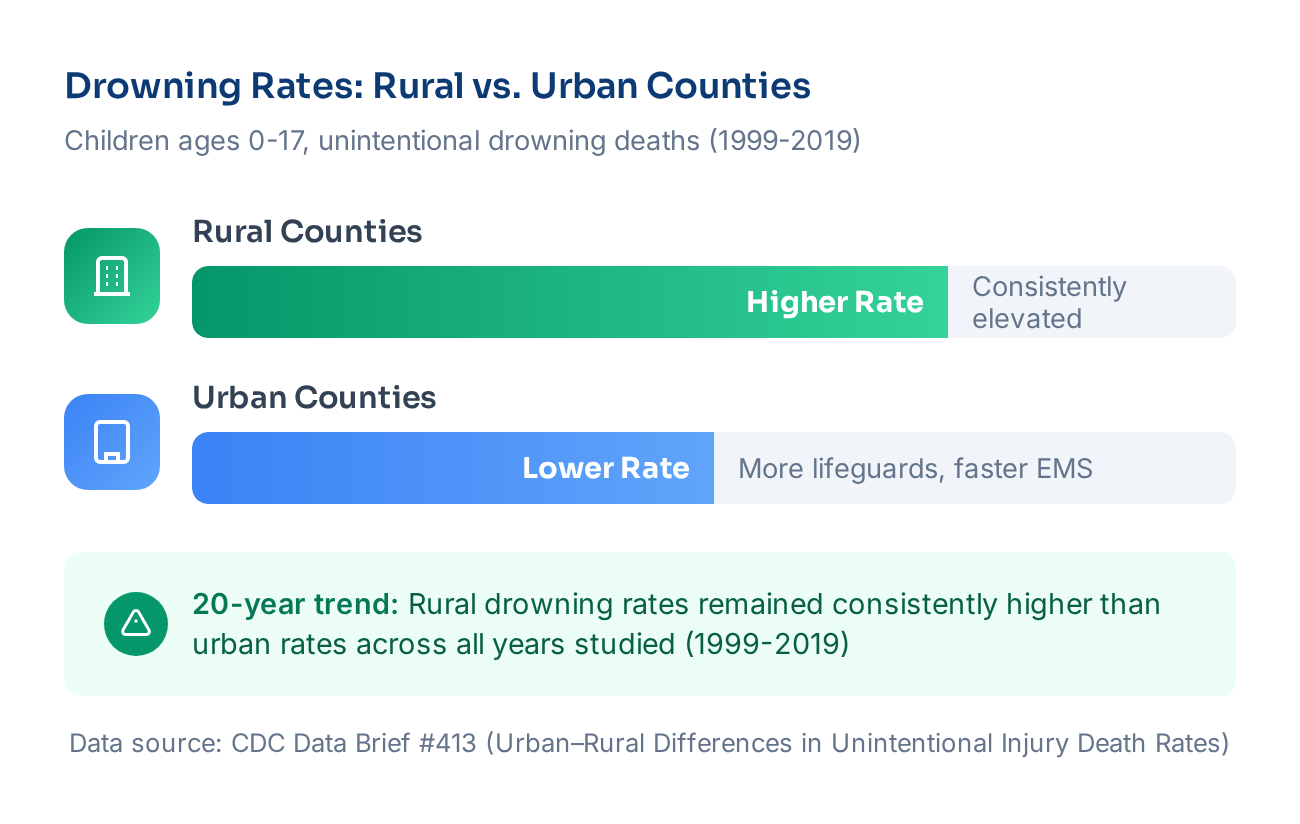
One of the most consistent findings in drowning research: rural counties have higher drowning rates than urban counties.[3]CDC Data Brief #413Rural-urban mortality differencescdc.gov This pattern held steady from 1999-2019 across age groups.
Why rural areas face higher drowning risk:
- Less supervision: Fewer public pools with lifeguards; more unsupervised natural water
- Delayed emergency response: Longer EMS response times in rural areas
- Farm ponds and irrigation: Agricultural water sources add drowning hazards
- Less swim instruction: Fewer swimming lesson programs in rural communities
Sunbelt States: Higher Pool Exposure, Higher Risk
In warm-weather states—Florida, Arizona, Texas, California—drowning is the leading cause of accidental death in the home for children under 5.[4]CPSC Safety Barrier GuidelinesLeading cause in warm statescpsc.gov
This concentration reflects several factors unique to the Sunbelt:
- Pool density: Four states (Florida, California, Texas, Arizona) contain 54% of all U.S. pools
- Year-round season: Unlike northern states, pools remain accessible in winter
- Backyard culture: More homes with pools as standard features
- Migration patterns: Population growth brings families to pool-dense regions
How State Laws Affect Drowning Rates
State pool fence requirements vary dramatically:
- Nevada (Clark County): 6-foot fence + secondary barrier required
- Arizona: 5-foot fence required when child under 6 lives at home
- Florida: 4-foot fence OR safety cover OR alarms OR self-closing doors (one of four)
- Texas: 4-foot fence, chain link banned for pools after 1994
Research consistently shows that four-sided isolation fencing—where the fence completely surrounds the pool without using the house as a barrier—is the most effective prevention measure.[4]CPSC Safety Barrier GuidelinesFour-sided fencing effectivenesscpsc.gov
Data limitation: Complete 50-state drowning rankings for pool-only deaths aren't available. CDC data often includes all drowning types (pools, lakes, oceans, bathtubs), making pool-specific state comparisons difficult.
What This Means for Pool Service Professionals
State-level drowning data provides context for local safety work:
- Know your state's laws: Be familiar with local fence requirements so you can answer customer questions
- Recognize high-risk regions: Florida, Arizona, Texas, and California pools need extra safety attention
- Rural service areas: Clients in rural areas may face higher baseline risk—barriers matter more
- Older pools: Pre-2000 pools (especially in Florida) often lack required safety features
For state-specific fence requirements, see our guides on Arizona pool fence laws, Florida pool fence laws, Texas pool fence laws, and Nevada pool fence laws.
Document Safety Features by Region
PoolDial helps you track barrier status, fence conditions, and safety equipment across your service area—keeping every pool's safety profile visible.
Start Your Free TrialSources
- [1] WaterSmartFL, Florida Department of Health Water Safety Initiative. watersmartfl.com
- [2] Centers for Disease Control and Prevention, "Drowning Facts," 2024. cdc.gov
- [3] CDC National Center for Health Statistics, "Data Brief No. 413: Urban–Rural Differences in Unintentional Injury Death Rates Among Children Aged 0–17 Years." cdc.gov
- [4] U.S. Consumer Product Safety Commission, "Safety Barrier Guidelines for Residential Pools." cpsc.gov
- [5] U.S. Consumer Product Safety Commission, "Pool or Spa Submersions: Estimated Nonfatal and Reported Fatal Drownings, 2025 Report." cpsc.gov