
Should You Install Customer-Supplied Parts? How Pool Pros Handle It


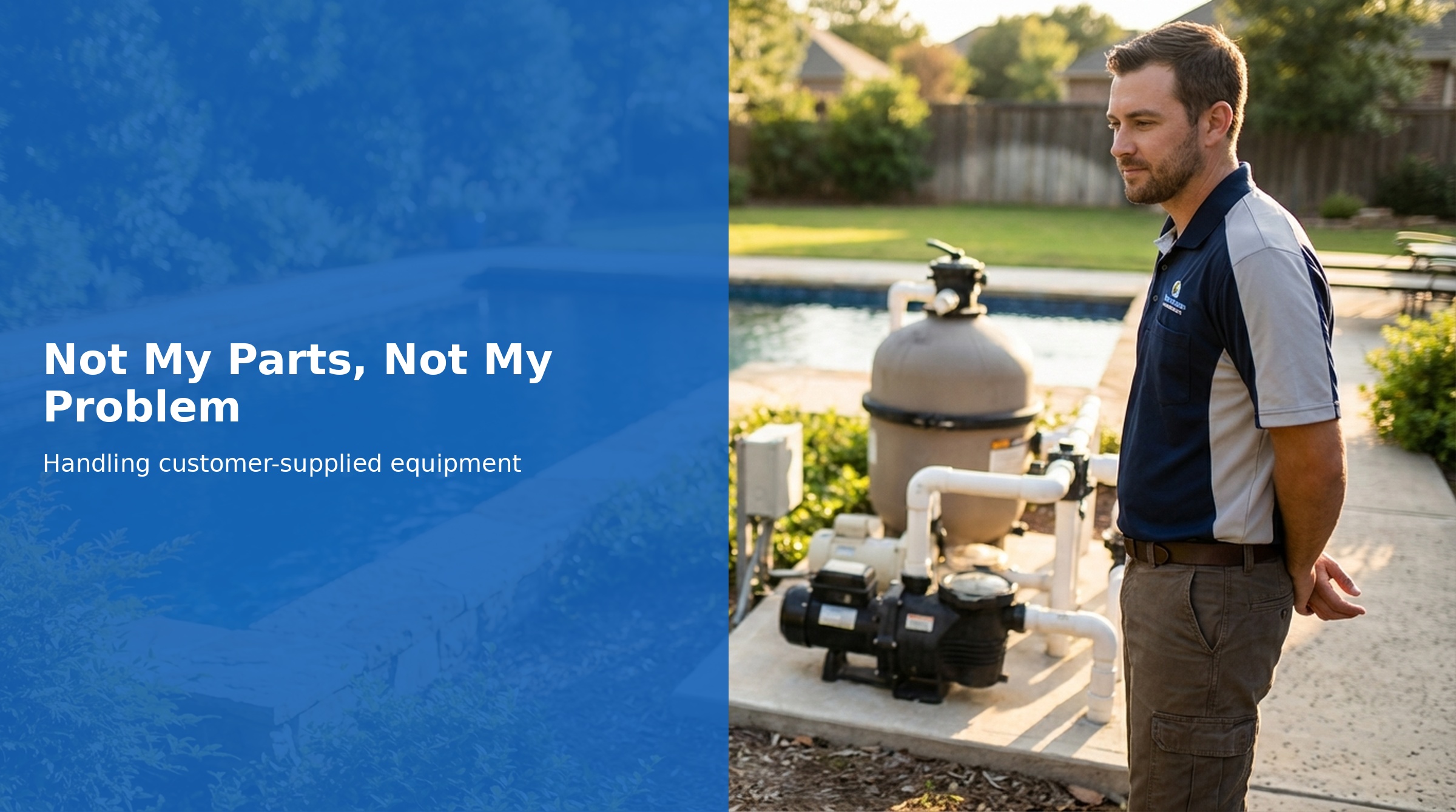
A customer gets your bid, says thank you, then disappears for two weeks. They come back with a pump they bought on Amazon and ask if you'll install it. Or worse — they hired a handyman to do it, the handyman got halfway through, and now they want you to finish the job. What do you do?
This comes up constantly in pool service. The customer thinks they're saving money. You know you're inheriting risk. Here's how experienced pool pros handle it — from the ones who refuse every time to the ones who'll take the work under very specific conditions.
Key Takeaways
- Most pros won't install parts they didn't supply — the warranty and liability risk isn't worth it
- If you do take the work: 1.5-2x labor rate, no warranty on parts or labor, written disclaimer signed
- Treat it as a brand new service call — not a continuation of the old bid
- Document everything with photos before you touch it
- The best framing: "You don't bring your own fries to a restaurant"
The Default Position: Just Say No
The majority of experienced pool service professionals refuse customer-supplied parts entirely. It's the cleanest, simplest policy, and it protects you from almost every downside scenario.
The logic is straightforward. When you supply the part, you control the entire chain. You know it's the right part for the application. You know it came from an authorized distributor, not a gray-market seller. You can honor the warranty because you have a relationship with the manufacturer's rep. And if something goes wrong, you own the fix from top to bottom — no finger-pointing about whether the part was defective or the install was bad.
When the customer supplies the part, every one of those protections disappears. They might have ordered the wrong model. It might be a refurbished unit sold as new. It might be missing components. And when it fails three months later, you're the one getting the angry phone call — even though you didn't choose the part.
This analogy resonates because it reframes the situation in terms the customer already understands. You're not just selling parts — you're selling a complete service that includes sourcing, warranty, and accountability. The markup on parts isn't pure profit. It covers your time sourcing the right equipment, your relationship with distributors, your warranty support, and the risk you absorb if something doesn't work.
The Professional Way to Say No
Refusing customer-supplied parts doesn't mean being confrontational. The best pros deliver the "no" in a way that actually builds trust.
Notice what this script does: it frames your policy around the customer's benefit, not your profit margin. You're not saying "I need to make money on parts." You're saying "I need to be able to stand behind my work."
A few tips for the conversation:
- Don't be hostile about it. Some customers genuinely don't understand how the industry works. They're not trying to scam you — they just thought they were being resourceful
- Explain the warranty difference. "When I supply the pump, you get a 3-year warranty through me. If you buy it on Amazon, you get 90 days and you're calling Amazon's support line, not mine"
- Be firm but brief. Don't over-explain or apologize. State the policy, explain the benefit, and move on
- Offer to requote with your parts. Many customers will say yes once they understand the trade-offs
Many customers actually respect this boundary. It signals that you're a professional who takes accountability seriously — which is exactly the kind of service provider they want working on their equipment.
When You Might Say Yes
Not every pro has a hard-line policy. There are situations where taking the work makes sense, as long as you protect yourself:
- Business is slow and techs need hours. During the off-season or a dry spell, billable hours matter more than ideal working conditions. Labor-only work is still revenue
- It's a simple job with clear boundaries. Wiring a pump someone else plumbed. Connecting automation to existing equipment. Jobs where your scope is narrow and well-defined
- The customer is a good long-term client. If they've been with you for years and this is the first time they've asked, the relationship may be worth the accommodation
But even in these situations, you should never take the work without conditions. The moment you touch customer-supplied equipment without a clear agreement, you've accepted liability for everything that happens next.
The Conditions for Taking the Work
If you decide to accept a job with customer-supplied parts, here's what experienced pros require:
Non-Negotiable Conditions
- 1.5-2x normal labor rate. You're taking on extra risk and giving up parts margin. Your labor rate should reflect that
- No warranty on parts OR labor — in writing, signed. The customer needs to understand that if the part fails, they own the replacement and pay you again for the labor
- Full diagnostic fee before touching anything. You need to evaluate what's already been done, verify the part is correct, and assess the overall condition of the equipment pad
- Photos and videos before and after. Document the state of everything before you start. If there's a crack in the plumbing or a corroded union that wasn't your doing, you need proof
- $500 minimum. This isn't a favor — it's a service call with elevated risk. Price it accordingly
- Treat it as a completely new service call. Not a continuation of the original bid. New scope, new pricing, new timeline
Create a work order that clearly documents the customer-supplied part, including make, model, and serial number. Note that the part was not sourced by your company. This protects you if there's a dispute later about who's responsible for what.
The "Finish My Handyman's Job" Problem
This scenario is worse than customer-supplied parts, and it deserves its own section. A customer hired someone else — a handyman, a neighbor, a "pool guy" from Craigslist — and that person got partway through the job before abandoning it or getting stuck. Now the customer wants you to come finish it.
The danger here is that you're inheriting work you can't verify. You don't know if:
- The plumbing is bonded properly
- Unions are tight and aligned
- Electrical connections are to code
- The right sealant was used (or any sealant at all)
- The equipment is oriented correctly for proper flow
- Anything was pressure-tested
If you take this work, start from scratch in your assessment. Charge a full diagnostic fee to evaluate everything that's been done. Assume nothing is correct until you've verified it yourself. And make it crystal clear in writing that you're not the installer of record for the work that was already completed.
Track what you find using your equipment tracking system — log the make, model, install date, and who actually installed it. When the customer calls in six months with an issue, you'll know immediately whether it's related to your work or the handyman's.
The Written Disclaimer
If you take the work, a written disclaimer is non-negotiable. This isn't about being adversarial — it's about making sure both parties have the same expectations documented in advance.
Your disclaimer should state:
- No warranty on customer-supplied parts. If the part fails, the customer is responsible for replacement cost and additional labor
- No warranty on labor related to customer-supplied parts. Your work is only as good as the equipment it's installed on. If a defective part causes a failure, you're not covering the reinstall for free
- You are not the installer of record. The customer sourced the equipment independently. You provided installation labor only
- Customer acknowledges they sourced the equipment independently. This prevents any future claim that you sold them a defective part
Text message agreements are legally binding in most jurisdictions, but a signed document is better. Have the customer sign before you start the work, not after. A signature on a work order with these terms clearly stated is ideal.
Why This Keeps Happening
Understanding why customers buy their own parts helps you have a better conversation about it. The short answer: the internet made wholesale pricing visible to everyone.
VSP (variable speed pump) requirements have made pool equipment more expensive. A customer who used to pay $400 for a single-speed pump replacement now sees $1,200+ for a variable-speed unit on their bid. Naturally, they Google the model number and find it for $400 less on Amazon or eBay.
The conversation that usually wins the argument:
- "Through me, you get a 3-year warranty." Most manufacturers honor extended warranties only through authorized dealers and installers. That Amazon pump? 90 days, maybe
- "If it fails, I handle everything." One call. You show up, diagnose, file the warranty claim, install the replacement. No back-and-forth with Amazon support trying to explain what a variable speed drive is
- "I've seen 'new' Amazon pumps arrive damaged or refurbished." Third-party sellers on Amazon aren't always selling new, genuine products. You've seen it. Share the story
- "The $400 you save now could cost you $800 later." If the Amazon pump fails outside its 90-day window, they're buying a second pump plus paying you for a second install. That's not saving money — it's deferring cost
Most customers, when presented with this math clearly, will go with your parts. The ones who still insist on Amazon parts after hearing the warranty explanation are telling you something about their priorities — and that's useful information for how you manage the relationship going forward.
Document every install, every part, every warranty
PoolDial tracks equipment make, model, install date, and warranty status so there's never a question about who supplied what. Full service history at every property, accessible from the field.
Start Your Free Trial