How to Price One-Time Pool Opening Cleanings Without Guessing


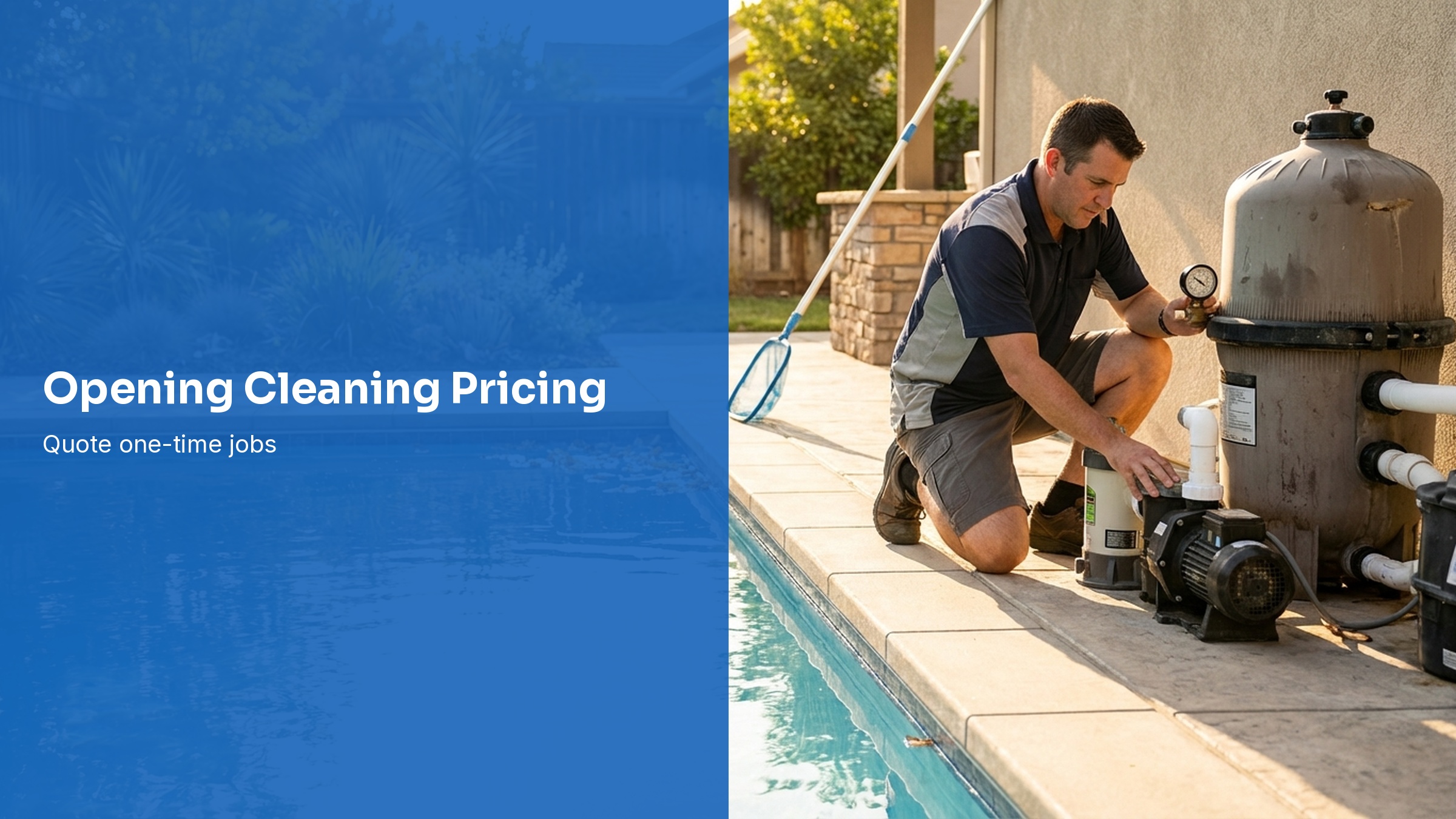
A one-time pool opening cleaning is not the same as a weekly stop.
That is where new operators get into trouble. A weekly route stop has a rhythm. You know the pool. You know the equipment. You know the drive time. An opening cleaning can be anything from a quick power-vac job after a cover comes off to a multi-day green recovery with a clogged filter, heavy debris, and a customer who thinks everything should be included.
One pool pro asked how to grow a power-vac cleaning service after pool openings. They already had five clients scheduled and wanted to know what to charge hourly. That is a useful question, but hourly price alone is not enough. The better question is: what pricing structure protects the job when the pool is worse than expected?
Key Takeaways
- Price opening cleanings by condition, not by a single generic hourly rate.
- Use photos, filter type, debris load, water condition, and access notes before quoting.
- Separate normal opening work from green pool recovery, filter cleaning, chemicals, and return visits.
- For unknown or green pools, use a deposit plus hourly labor and chemicals instead of a loose flat quote.
- Treat one-time opening jobs as lead sources for weekly service, but do not discount them so hard that the first job loses money.
Why Opening Cleanings Are Hard to Quote
Opening cleanings are unpredictable because the customer is often calling before you have seen the pool. They may say it is "not that bad." They may not understand the difference between a cartridge filter and a DE filter. They may think a robotic cleaner will finish what your vacuum started. They may not know how much debris is under cloudy water.
"Not worth trying to guesstimate."
Pool pro via Reddit
That short line is the core lesson. Guessing is not a pricing strategy. It is a way to donate time.
Opening work usually has four unknowns:
- Water condition: clear, cloudy, green, black, or full of fine dead algae.
- Debris load: leaves, sand, pollen, cover sludge, fine sediment, or construction dust.
- Equipment condition: filter pressure, pump prime, valves, salt system, heater bypass, and cleaner compatibility.
- Customer expectation: one visit, same-day swim ready, or a staged recovery over several visits.
If any of those are unknown, your quote needs room to move.
The Simple Pricing Formula
Start with a formula that separates the parts of the job. Do not hide everything inside one flat number unless the pool is already inspected and the scope is tight.
Opening Cleaning Price
Your target hourly rate is not your personal wage. It has to cover payroll or owner time, truck cost, equipment wear, insurance, admin time, quote time, and profit. If you are not sure what your real hourly target should be, use the service price calculator and the cost per pool calculator to back into it.
For example, a one-hour power-vac job that is ten minutes from your route is not the same as a two-hour cleanup that needs a follow-up, a filter clean, and another chemical check. The first can be a simple minimum charge. The second should be scoped as a project.
Use Tiers Instead of One Price
Most opening cleanings fit into one of these tiers.
| Tier | Best Pricing Structure | What to Include |
|---|---|---|
| Clean opening | Flat minimum plus chemicals | Basic startup, skim, brush, test, light vacuum, equipment check, and customer report. |
| Dirty opening | Flat first visit plus hourly overage | Power-vac, heavier debris removal, water test, basic chemicals, and clear limits on time included. |
| Green opening | Deposit plus hourly labor and chemicals | Shock plan, brushing, vacuum-to-waste if needed, return visits, filter cleaning, and no same-day clarity promise. |
| Unknown condition | Inspection or paid diagnostic first | Photos, equipment check, filter pressure, water condition, access notes, and written estimate after inspection. |
This lets you quote quickly without pretending every pool is the same. It also gives customers a clear reason why a clean covered pool costs less than a neglected green pool.
What to Ask Before You Quote
Before you give a number, ask for photos. Photos are not perfect, but they prevent the worst surprises.
"Please send me some photos."
Talking Pools Podcast
Ask for these five things:
- A wide photo of the whole pool.
- A close photo of the deepest visible water.
- A photo of the equipment pad.
- The filter type and last known filter cleaning date.
- Whether the pool is expected to be swim ready by a specific date.
If the customer will not send photos, raise the uncertainty in the quote. A customer who avoids photos may simply be busy, but it can also mean the job is bigger than they are describing.
Do Not Bundle Green Recovery Into a Normal Opening
A normal pool opening and a green pool recovery are different services. The opening gets the pool uncovered, started, cleaned, tested, and moving. Green recovery is treatment work. It may require multiple visits, high chlorine demand, brushing, filtration time, vacuum-to-waste, filter cleaning, and extra chemicals.
That difference should show up on the estimate.
Customer Language
Our opening cleaning includes startup, testing, light cleaning, and one vacuum pass within the included time. If the pool is green, heavily clouded, or has heavy debris, we treat that as a recovery job. Recovery work is billed separately because the number of visits, chemicals, and filter cleanings depends on the pool condition.
This kind of language prevents the common argument: "I paid for an opening, so why is the pool not perfect?" It also protects the business when the customer needs two more visits.
For chemical planning, use the chemical dosage calculator. For severe green recoveries, the green pool recovery calculator can help estimate the treatment load before you promise a timeline.
When Hourly Pricing Makes Sense
Hourly pricing works when the condition is unknown or the job can expand. It is especially useful for green pools, neglected pools, heavy leaf cleanups, and pools where the equipment condition is questionable.
But hourly pricing still needs a structure. Do not say "I charge by the hour" and leave it there. Tell the customer:
- Your minimum charge.
- What time block is included.
- Your hourly rate after the first block.
- Whether chemicals are included or separate.
- Whether filter cleaning is included or separate.
- Whether follow-up visits are included or separate.
If the job is green or uncertain, collect a deposit before scheduling. That deposit should cover at least the first visit and materials you expect to use. If the customer will not pay a deposit on a one-time cleanup, that is useful information.
How to Turn One-Time Jobs Into Weekly Service
Opening cleanings can be good lead sources. The customer already has a problem. You are already at the property. If you document the work well and communicate clearly, the one-time job can turn into recurring service.
The mistake is discounting the cleanup because you hope to win the route later. Do the opposite. Price the one-time job profitably, then make the recurring offer simple.
| After the Cleanup | What to Say |
|---|---|
| Pool is clean and balanced | "I can keep it from getting back to this point with weekly service. Your monthly price would be..." |
| Filter was overloaded | "The filter needed more attention than normal. I recommend a scheduled filter cleaning plan so the pool stays clear." |
| Customer wants to DIY | "No problem. I can also do monthly checkups or one-time cleanings when the pool gets away from you." |
| Pool needs another visit | "The first phase is done. The next visit is required to finish the cleanup and is billed separately at the rate we agreed to." |
Track these jobs separately from weekly route work. PoolDial's work orders help keep one-time jobs, photos, notes, and invoices in one place. The one-time job tracking guide goes deeper on how to keep those jobs from getting lost.
A Practical Quote Template
Here is a simple structure you can adapt.
Opening Cleaning Quote
Thanks for reaching out. Based on the photos, this looks like a [clean opening / dirty opening / green recovery]. Our opening cleaning starts at $___ and includes up to ___ minutes on site. Additional labor is $___ per ___ minutes. Chemicals, filter cleaning, and return visits are billed separately if needed. If the water is green or visibility is poor, we do not guarantee same-day swim-ready water because the pool may need staged treatment and filtration time.
The blanks matter. Fill them in from your own costs and market. A cheaper competitor can always throw out a lower number. Your job is to quote in a way that protects your time, explains the scope, and gives the customer confidence that you know what you are doing.
The Bottom Line
One-time pool opening cleanings are valuable work when they are priced correctly. They can fill schedule gaps, introduce you to new customers, and create recurring accounts. They can also wreck a day if you quote a clean opening and arrive at a swamp.
Do not guess. Get photos. Separate opening work from recovery work. Charge for chemicals and follow-ups. Put the terms in writing. Then use the finished job as a clean handoff into weekly service.
Keep One-Time Jobs From Getting Lost
PoolDial helps pool service companies schedule one-time cleanings, attach photos, bill separately, and convert good one-time customers into recurring accounts.