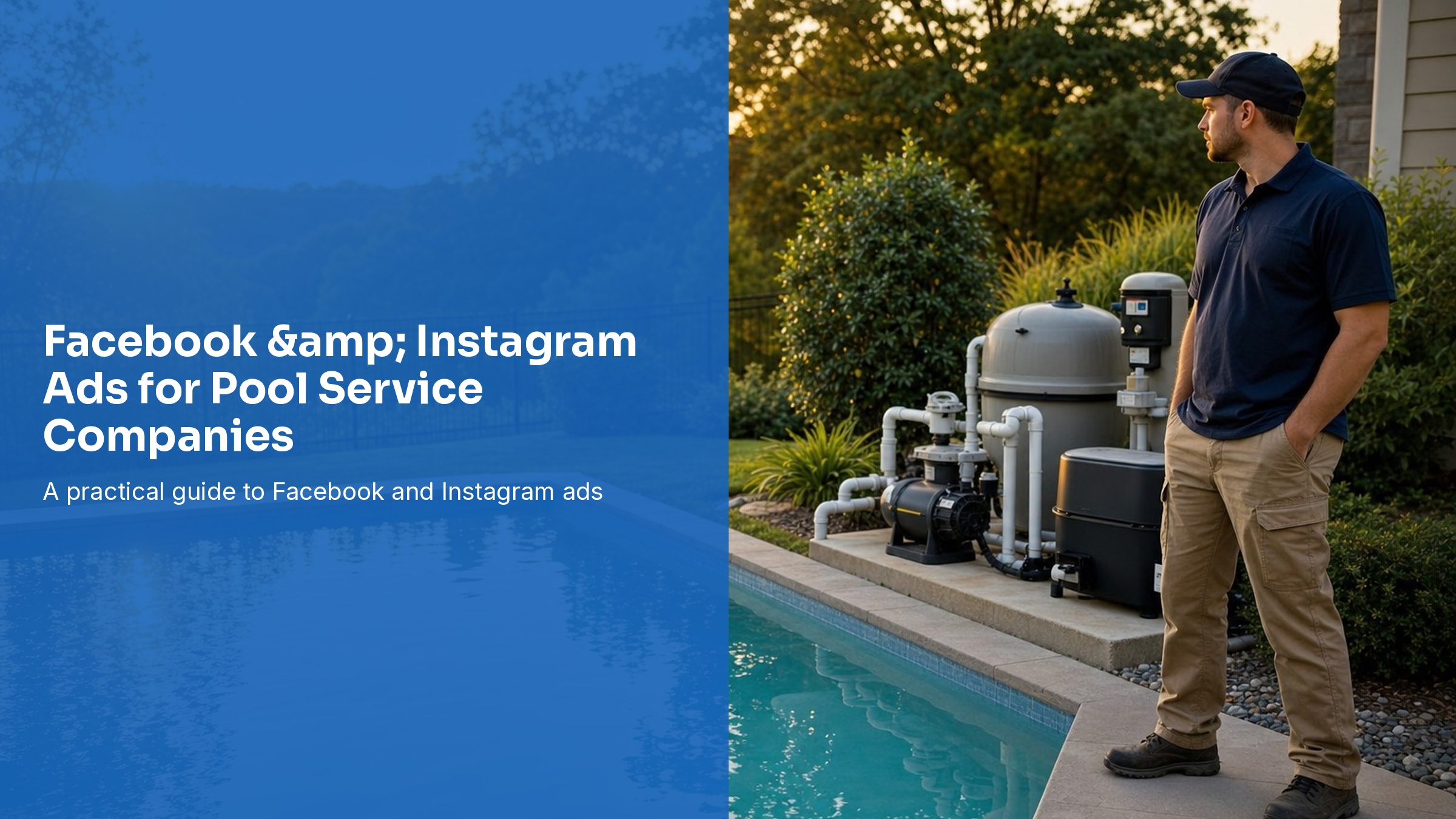
Facebook & Instagram Ads for Pool Service Companies: A Practical Guide


Most pool service companies get their customers from referrals. That's great. But referrals are slow. They come in when someone else decides to send them.
Facebook and Instagram let you turn that around. You pick who sees your business. You pick when. And you only pay when people click. For a local pool service company, that's a big deal.
This guide covers everything: what to post for free, how to run your first ad, how much to spend, and how to know if it's working.
Key Takeaways
- Facebook lets you target by zip code, home value, and homeowner status — so your ad only reaches the people who can actually hire you
- Before-and-after photos are the best-performing content for pool service — no ad budget needed to get started
- $200–$500/month is enough to generate real leads in most markets
- Cost per lead (CPL) is the number to watch — if it's over $100, something needs to change
- Most pool companies don't advertise — which means the ones that do have a big edge
Why Facebook & Instagram Work for Pool Service
Pool service is a local business. Your customers live within 20 miles of you. They own homes. They have pools. Facebook knows all of this — and it lets you use it.
"Facebook's another incredibly important way to market your business from a local level standpoint. You can get extremely targeted. If I want to reach homeowners within 10 miles of my location who own a home valued above a certain amount, Facebook lets me do that. And the cost is incredibly accessible even for a small pool service company."
— ASP Franchise Representative
The other big reason to use these platforms: most of your competition isn't. The Skimmer State of Pool Service Report found that the majority of pool companies still rely entirely on referrals and do nothing paid.
"So many folks in the industry are like, 'I don't need to pay for marketing because I get a lot of referrals.' And that's true, but you can grow it so much more quickly if you are spending a little bit on marketing. And because most of the industry is still not doing it, there's a real chance to be the first mover."
— Skimmer State of Pool Service Report
Being first in your market on paid social is a real advantage. Once you build brand recognition and a following, it's hard for a competitor to undo.
Before you spend a dollar, though, let's talk about free content — because organic posts and paid ads work together.
Organic vs. Paid: What's the Difference?
You have two ways to use Facebook and Instagram. Free posts (organic) and paid ads. They serve different purposes.
Organic (Free) Posts
- Seen by people who already follow you
- Builds trust and credibility over time
- Before-and-afters, tips, team photos
- No cost — just your time
- Slow to grow without paid support
- Great for reputation and referrals
Paid Ads
- Reaches people who don't know you yet
- You control who sees it (zip, age, home value)
- Generates leads faster
- Costs money — but you set the budget
- Measurable: you see exactly what you spent and got
- Best for new customers and seasonal pushes
The smartest approach: do both. Post organic content every week to build your presence. Run ads during peak season (spring) or when you want to fill open route spots fast. Your organic content also makes your ads perform better — people who see an ad and then check your page want to see a real, active business.
Content That Works (Organic)
You don't need a professional camera or a marketing team. The best-performing pool service content on social media is simple and real.
"Social media is not just for big companies. For a pool service business, you can actually show your work. Before-and-afters are massive. Show a green pool turning blue. Show an equipment pad transformation. That content — that authentic, real, organic content — outperforms a polished ad almost every time because people trust what they can see."
— Laci Davis, President, Grit Game Marketing
Here's what to post:
Best Organic Content for Pool Service
- Before-and-after photos — Green pool to sparkling blue. This is your best content, full stop. Take photos at the start and end of every green-to-clean.
- Equipment transformations — A dirty equipment pad cleaned up. A rusted pump replaced. People love seeing the "after."
- Water chemistry tips — Short, simple posts like "Why your pool turns green in the summer" build credibility fast.
- Team photos — Put a face to the business. People hire people, not logos.
- Customer shout-outs — With permission, share a happy customer's pool. Tag the neighborhood if not the person.
- Seasonal reminders — "Is your pool ready for summer?" posts get strong engagement in April and May.
- Short Reels — A 30-second timelapse of a green pool going clear is free content that can reach thousands.
Aim for 2–3 posts per week. Consistency matters more than perfection. A blurry before-and-after photo posted every week will outperform a polished graphic posted once a month.
Use the free before-and-after maker to format your photos for social media with your logo and branding.
"Facebook is great for community building and targeted advertising. It's versatile. It has features like groups, events, and a robust ad platform that you can use to target specific demographics... Instagram is great for visual storytelling. Use it to showcase your services through photos and videos."
— Rudy Stankowitz
Setting Up Your First Facebook Ad
Running an ad on Facebook is simpler than it looks. Here's how to do it step by step.
Choose Your Objective
Facebook asks what you want. For most pool service companies, pick Leads (to get contact form submissions) or Traffic (to send people to your website). If you just want more people to know your name, pick Awareness. Match this to your actual goal — don't pick Awareness if you need phone calls this week.
Set Your Audience
This is the most powerful part. Target by zip code (use the zips you want to serve), age (homeowners skew 35+), and homeowner status. You can also layer in "home value" interests or target people who have shown interest in home improvement. Start with a radius of 10–15 miles around your service area.
Set Your Budget
Start small. $10–$20 per day is enough to test. That's $200–$400 per month. Set a daily budget, not a lifetime budget — it gives you more control. You can pause or increase anytime. Let an ad run for at least 7 days before judging it.
Create Your Ad
Use a before-and-after photo or a short video. Write a clear headline: "Is Your Pool Ready for Summer?" or "Green Pool? We Fix That." Add a call to action button — "Get Quote" or "Call Now." Keep the copy short. Two or three sentences max. Tell people what you do, where you do it, and how to reach you.
Track Your Results
Use a unique phone number just for this campaign (Google Voice works). Or use a campaign-specific landing page. Write down how many calls or form fills you get each week. Divide your spend by leads to get your cost per lead. That number tells you everything.
Facebook's Ads Manager can be overwhelming at first. But you don't need to use every feature. Start with one ad, one audience, one budget. Learn what works. Then scale.
Targeting for Pool Service
Targeting is what makes Facebook ads so effective for local pool service. You're not spraying your ad at everyone in town. You're putting it in front of the exact people who are likely to hire you.
"Paid advertising can significantly boost your reach and drive targeted traffic to your website. You want to define your objective. Choose something that aligns with your business goals such as brand awareness, traffic, or conversions. Use demographic, geographic, and interest-based targeting to reach your ideal customers."
— Rudy Stankowitz
Here's how to layer your targeting for pool service:
- Location: Target the specific zip codes you want to serve. Don't go too wide — you can't efficiently service pools 30 miles away. Focus on your ideal route density zones.
- Homeowner status: Facebook lets you target people who own (not rent) their home. Renters don't hire pool service companies.
- Age: Homeowners with pools skew 35–65. Start there and adjust based on results.
- Home value: You can target by estimated household income and home value. Pool owners tend to be in medium-to-high income brackets.
- Interests: "Swimming pools," "home improvement," "outdoor living," and "backyard living" are strong interest layers.
- Pool-dense neighborhoods: Use Facebook's map tool to draw custom areas around the neighborhoods you see pools in on Google satellite view.
A well-targeted audience of 10,000–50,000 people in your service area is better than a broad audience of 200,000. Smaller, more targeted audiences use your budget more efficiently.
Ad Creative That Converts
You can have perfect targeting and still waste money if your ad looks bad. Here's what works.
The single best creative for pool service: a side-by-side before-and-after photo. Green water on the left. Crystal blue on the right. You don't need text on the image — the visual does the work. But if you add text, keep it simple: "Before & After. We fix green pools fast."
"Social media is not just for big companies. For a pool service business, you can actually show your work. Before-and-afters are massive. Show a green pool turning blue. Show an equipment pad transformation. That content — that authentic, real, organic content — outperforms a polished ad almost every time because people trust what they can see."
— Laci Davis, President, Grit Game Marketing
Other creative formats that work well:
- Short video (15–30 seconds): A timelapse of a green-to-clean. A quick walk-around of a clean equipment pad. No professional production needed — a phone works fine.
- Your face: A 30-second video of you talking directly to camera ("Hi, I'm [Name], I run [Company] in [City]. If your pool turned green this spring, here's how we can help...") builds more trust than any graphic.
- Customer testimonials: A screenshot of a 5-star Google review with your logo and pool photo in the background.
- Seasonal urgency: "Summer is 6 weeks away. Is your pool ready?" with a photo of a clean blue pool.
Test two or three different images with the same ad copy. Let Facebook show them all, and after 7–10 days, pause the ones that aren't getting clicks. Put your budget behind what's working.
Need professional-looking banners? Try the logo generator to get your brand mark set up first. Then use your logo on every ad so people start to recognize your company.
How Much Should You Spend?
You don't need a big budget to get results. But you do need to be realistic about what different budgets can get you.
These are rough estimates. Costs vary a lot by market. Phoenix and Dallas are competitive — expect to pay more per lead. Smaller markets or less saturated areas will often get cheaper leads.
The best advice: start at $200/month. Track every lead. After 60 days, you'll know your cost per lead. If the math works (a new pool route customer is worth $1,500–$3,000 in annual revenue), then spend more.
Don't Set It and Forget It
Running an ad without checking it is like leaving the hose running overnight. Log in at least once a week. Check your cost per lead, click-through rate, and reach. If something looks off, pause and adjust. Facebook will spend your money whether your ad is working or not.
Tracking Your Results
The only way to know if your ads are working is to track them. This sounds obvious, but most small businesses don't do it. They run an ad, get a few calls, and have no idea if the ad caused them.
"If you spend $500 on Facebook ads and got 10 leads, your CPL is $50. Easy math. But if you're not tracking that, then you have no idea if your campaign was a slam dunk or a flaming pile of shit. Track it with unique identifiers — a separate phone number for each campaign, campaign-specific landing pages, promo codes tied to mailers or door hangers."
— Rudy Stankowitz
Here's what to track and how:
Cost Per Lead
Divide your total ad spend by the number of leads you got. $300 spent, 6 leads = $50 CPL. A good CPL for pool service is $30–$75. If you're over $100, your targeting or creative needs work.
Click-Through Rate
The percentage of people who saw your ad and clicked it. Facebook shows you this in Ads Manager. A good CTR for local service ads is 1–3%. Below 0.5% means your creative or copy isn't connecting.
Unique Tracking Phone Number
Get a free Google Voice number just for your Facebook ads. When someone calls that number, you know it came from your ad. It costs nothing and tells you exactly where leads are coming from.
Revenue Attributed
When a lead becomes a customer, note where they came from. After 6 months, add up the revenue from customers who came through Facebook ads. Compare that to what you spent. That's your ROI.
Once you have leads, you need to respond fast. A missed call is a lost customer. The PoolDial AI receptionist answers every call when you're on a pool — so you never miss a Facebook lead that took $50 to generate.
Instagram-Specific Tips
Instagram and Facebook share the same ad platform (Meta Ads Manager), so you can run the same ad on both with one campaign. But Instagram has its own culture, and what works there is slightly different.
Instagram is more visual. People scroll fast. You have about one second to stop them. Here's how to make it work:
- Use Reels for organic reach. Short videos (15–60 seconds) get the most reach on Instagram right now. A green-to-clean timelapse, an equipment install, or a quick water chemistry tip — all perform well as Reels.
- Stories for limited-time offers. "Book a spring startup this week and get your first service free" works well in Stories because it feels urgent and personal.
- Square or vertical photos for the feed. Landscape (horizontal) photos get cropped awkwardly. Shoot pool photos vertically or square so they fill the screen.
- Hashtags still help. Use local hashtags like #DallasPoolService or #PhoenixPools along with industry ones like #poolservice #poolpro. It extends your organic reach at no cost.
- Tag your location. When you post a before-and-after, tag the neighborhood or city. People browsing local posts will find you.
- Link in bio. Instagram doesn't allow links in posts. Put your website or booking link in your bio and say "Link in bio" at the end of your captions.
For paid ads on Instagram, before-and-after photos and short Reels both perform well. Use the same creative from your Facebook campaigns and let Meta's algorithm figure out where to show each piece.
Facebook Groups: Free Marketing Gold
Facebook Groups are one of the most underused tools in local service marketing. There are thousands of neighborhood groups, HOA groups, and local community pages where people ask for service recommendations every single day.
"Monitor neighborhood Facebook groups. Ask new customers why they switched. That's competitive insight hiding in plain sight."
— Rudy Stankowitz
Here's how to use groups without being spammy:
- Join every neighborhood group in your service area. Search "[City] neighborhood," "[Subdivision name]," or "[City] community" on Facebook. Join them all.
- Answer questions about pools. When someone posts "my pool turned green, what do I do?" — answer it helpfully. Don't pitch immediately. Just help. You'll get private messages.
- Share useful tips (where allowed). Some groups allow business posts on certain days ("Business Fridays"). Check the rules before posting promotions.
- Respond to "Who do you recommend for pool service?" These posts appear constantly. Be there, be helpful, be professional.
- Watch what people complain about. If people keep posting about a competitor leaving pools dirty or not showing up, that's a gap you can fill — and a message for your ads.
Groups don't cost a dollar. They cost time. But showing up consistently in your local community online builds the same trust as a referral network — just faster.
Get a Professional Presence Before Running Ads
When someone clicks your ad, they check your website. If it looks outdated or amateurish, they leave. PoolDial's website builder creates a professional site for your pool business in minutes — so every ad dollar actually converts.
Start Free TrialCommon Mistakes to Avoid
These are the most common ways pool service companies waste money on Facebook and Instagram ads.
Too Wide an Audience
Targeting all of Phoenix or all of Tampa sounds like more reach. But you can't service pools across an entire metro. Target the zip codes you actually want to work in. Tight targeting = lower cost per lead.
No Tracking at All
Running ads without tracking is like driving with no mirrors. You'll have no idea what's working. Set up a unique phone number. Use a landing page. At minimum, ask every new customer how they found you.
Sending People to a Bad Website
If your ad generates a click but your website looks bad or has no phone number visible, you wasted that click. Your landing page needs to be clean, fast, and have a clear way to contact you. See building your online presence.
Giving Up Too Fast
Facebook ads take time to optimize. The algorithm needs data. If you run an ad for 3 days and get no calls, that doesn't mean it doesn't work. Give each campaign at least 7–14 days before making changes.
Slow Follow-Up
Someone sees your ad at 7 PM and fills out a contact form. If you call them back two days later, they've already hired someone else. Speed is everything with inbound leads. Aim to follow up within an hour.
Only Running Ads in Peak Season
Running ads only in May and June means you're competing with every other pool company doing the same thing. Ads in late winter and early fall are cheaper and can lock in customers before the rush.
Bringing It All Together
Facebook and Instagram aren't magic. They won't fix bad service or poor pricing. But for a pool service company that does good work and wants to grow faster, they're one of the best tools available.
Start simple. Post three before-and-afters this week. Join the neighborhood Facebook groups in your service area. Then run one $10/day ad targeting homeowners in your zip codes with your best before-and-after photo.
Track every lead. Adjust what isn't working. Double down on what is.
Most of your competitors aren't doing this. That means the homeowner who sees your ad and nobody else's is already halfway to hiring you.
For more on marketing your pool business across every channel, read the full pool service marketing strategies guide. And if you want to understand how to combine Facebook with Google Business Profile, referral programs, and vehicle wraps, those guides cover each one in detail.
Ready to Turn Leads Into Customers?
PoolDial's AI receptionist answers every call you miss — so the leads your ads generate actually become customers. Built for pool service companies. No tech skills needed.
Start Your Free Trial