
Pool Industry Myths That Even Pros Believe


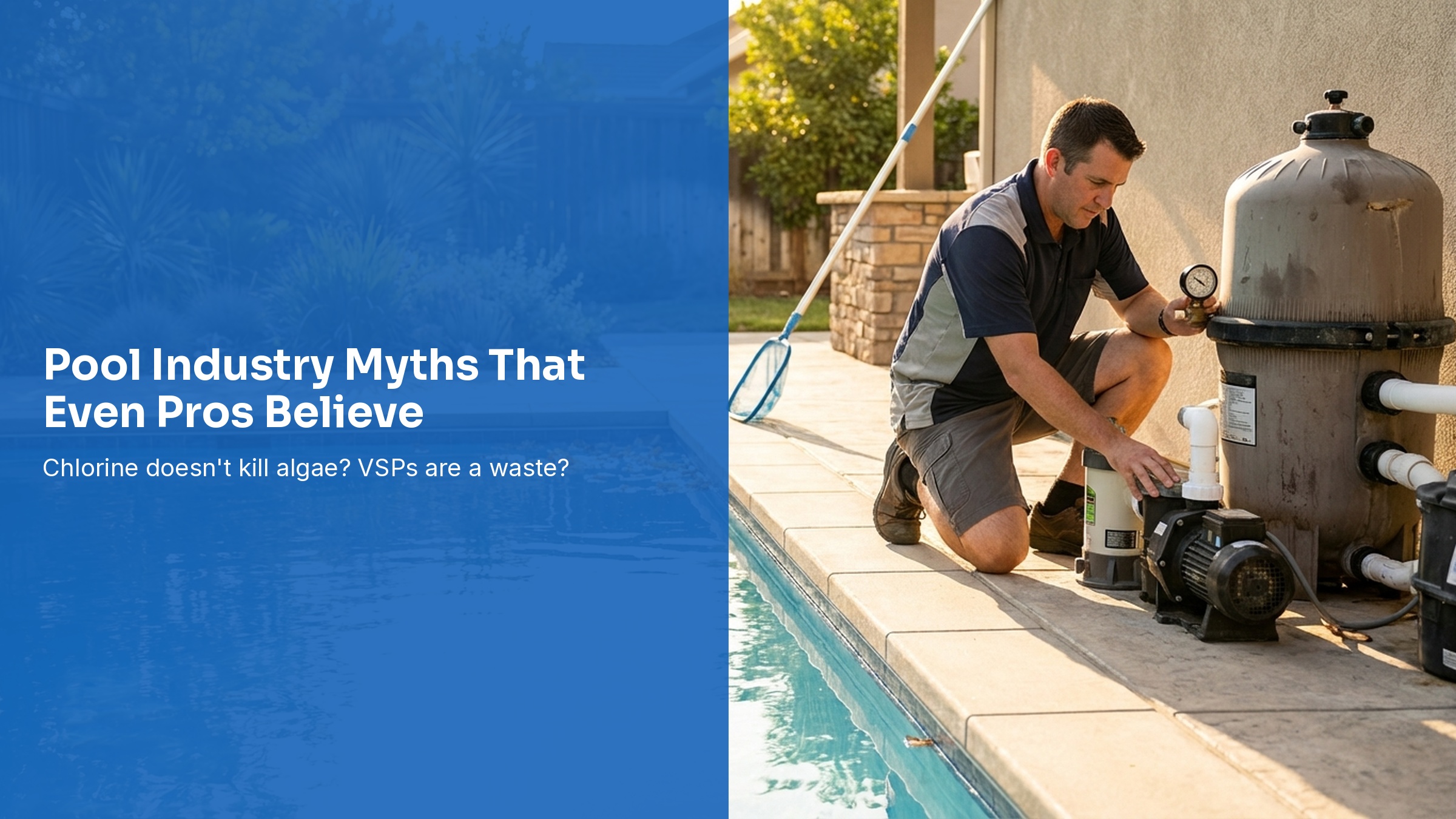
You would think that experienced pool professionals would know better. But some myths have been repeated so many times that even veterans believe them. These are not homeowner misconceptions. These are ideas that pool pros share with each other in supply houses, Facebook groups, and on job sites.
One frustrated pro put it this way after hearing the same bad advice three times in one week:
"I've now heard for the 3rd time this week reputable pros saying chlorine doesn't actually kill algae. Where does this myth come from? Chlorine is an algaecide."
— Pool pro via Reddit
Here are the most common myths still circulating in the pool industry, and the truth behind each one.
Myths Covered in This Article
- "Chlorine doesn't kill algae"
- "Variable speed pumps are a waste of money"
- "The LSI doesn't work"
- "Salt pools don't have chlorine"
- "You don't need to measure chemicals"
- "Filter pressure should always be under 30 PSI"
Myth 1: Chlorine Doesn't Kill Algae
This myth persists because some types of algae are harder to kill than others. Yellow (mustard) algae is more resistant to chlorine than green algae. It takes higher free chlorine levels and longer contact time to eliminate it. That leads some pros to believe chlorine "doesn't work" on algae, when the real issue is that they are not using enough of it.
One pro in Missouri described the challenge with mustard algae in his region:
"The level of free chlorine required to prevent mustard algae is higher due to its resistance to chlorine. So either you keep chlorine levels so high that the pool is really not safe to swim in, or you treat the yellow when it pops up."
— Pool pro via Reddit
Salt pools tend to see less yellow algae. The theory is that a salt chlorine generator produces pure chlorine gas dissolved directly into the water, which is more effective at lower concentrations than the chlorine compounds in cal hypo, liquid chlorine, or trichlor. The chemical dosage calculator can help you figure out how much chlorine you actually need based on pool volume and current levels.
Myth 2: Variable Speed Pumps Are a Waste of Money
"I have other pros that tell me that variable speed pumps are a waste of money and don't actually work right and should be set to run high speed only all the time. We have lots of stupid colleagues who make our industry look bad."
— Pool pro via Reddit
This myth usually comes from pros who install VSPs but never learn how to program them. The customer calls to complain that the spa jets are weak or the cleaner is not moving. Instead of setting up schedules with different speeds for different tasks, the tech just cranks it to high and leaves. The customer sees no energy savings and tells the next pool guy that VSPs are a scam.
The fix is simple. Set the pump to run at low speed for filtration (usually 1,200 to 1,800 RPM) for 8 to 12 hours per day. Program a high-speed cycle for the cleaner. Use the Quick Clean button when the customer wants spa jets. The pump run time calculator and pump energy cost calculator show the exact savings at different speeds.
The real challenge is customer education. Some homeowners do not want to deal with multiple speeds. They want to push one button. But that is a training problem, not a product problem.
Myth 3: The LSI Doesn't Work
"I've heard for years from other pros that the LSI is a myth and doesn't make sense. People believe what they want regardless of the science."
— Pool pro via Reddit
The pros who dismiss LSI are usually the same ones replacing filter cartridges and grids every year because their water is eating the equipment. Scaled surfaces, corroded metals, and etched plaster are all signs of water that is out of LSI balance.
"It's usually the same guys whose pools have completely scaled surfaces or corroded metal and have to replace their filter carts and grids every year."
— Pool pro via Reddit
You do not have to be a chemistry expert to use the LSI. Our LSI calculator does the math for you. Plug in your pH, temperature, calcium hardness, alkalinity, and CYA. It tells you whether the water is balanced, scaling, or corrosive. For a deeper understanding, read the complete LSI balance guide.
Myth 4: Salt Pools Don't Have Chlorine
This myth is mostly a homeowner problem, but plenty of pool pros fail to correct it. Some even encourage it because "chemical-free" is an easier sell than explaining electrolysis.
The danger is real. When a customer believes their pool has no chlorine, they resist adding liquid chlorine during a leak or a salt cell failure. The pool goes green and they blame the tech.
The words are printed right on the equipment: Salt Water Chlorine Generator. Walk the customer to the equipment pad and point at it. Use the salt calculator to show them how salt levels affect chlorine output.
Myth 5: You Don't Need to Measure Chemicals
"I met a guy that refused to use a measuring cup because the pool is too big."
— Pool pro via Reddit
This one is hard to argue with when the pro has been doing it for 20 years and their pools look fine. But "looks fine" is not the same as "is balanced." You cannot see pH drift, rising CYA, or low calcium hardness. You can only test for them.
A good drop-based test kit (Taylor K-2006 is the industry standard) takes two minutes and removes all guesswork. Log the results in your chemical tracking system so you can spot trends before they become problems. Read our guide on logging chemical readings in the field for the full workflow.
Myth 6: High Filter Pressure Always Means a Dirty Filter
With variable speed pumps, filter pressure changes throughout the day as the pump shifts between speeds. A customer who only checks pressure when the pump is on high speed for the spa will always think the filter is dirty.
The rule is simple: clean the filter when pressure rises 8 to 10 PSI above the clean starting pressure at the same pump speed. If your clean baseline is 12 PSI at filtration speed, clean at 20 to 22 PSI. If the customer complains about "high pressure" during spa mode, explain that this is normal and expected.
Why These Myths Persist
Pool service is a trade learned mostly on the job. There is no required degree. Certification is optional in most states. Many pros learn from whoever trained them, and if that person believed the myth, it gets passed down.
Social media makes it worse. A confident-sounding pro on TikTok or YouTube can spread a myth to thousands of homeowners and techs in a single video. By the time someone corrects it, the damage is done.
The antidote is simple: test your assumptions. If someone tells you chlorine does not kill algae, ask them what algaecide does that chlorine does not. If someone says the LSI is fake, ask them why their plaster is etched. The science is not complicated. It just needs to be applied.
For more on water chemistry fundamentals, check the pool terminology glossary and our guides on tracking chemical trends.
Track Chemistry the Right Way
PoolDial logs chemical readings, calculates dosing, and tracks trends over time so you catch problems before they become myths. Start your free trial.
Start Your Free Trial