
What Pool Pros Actually Charge for Equipment Installs in 2026


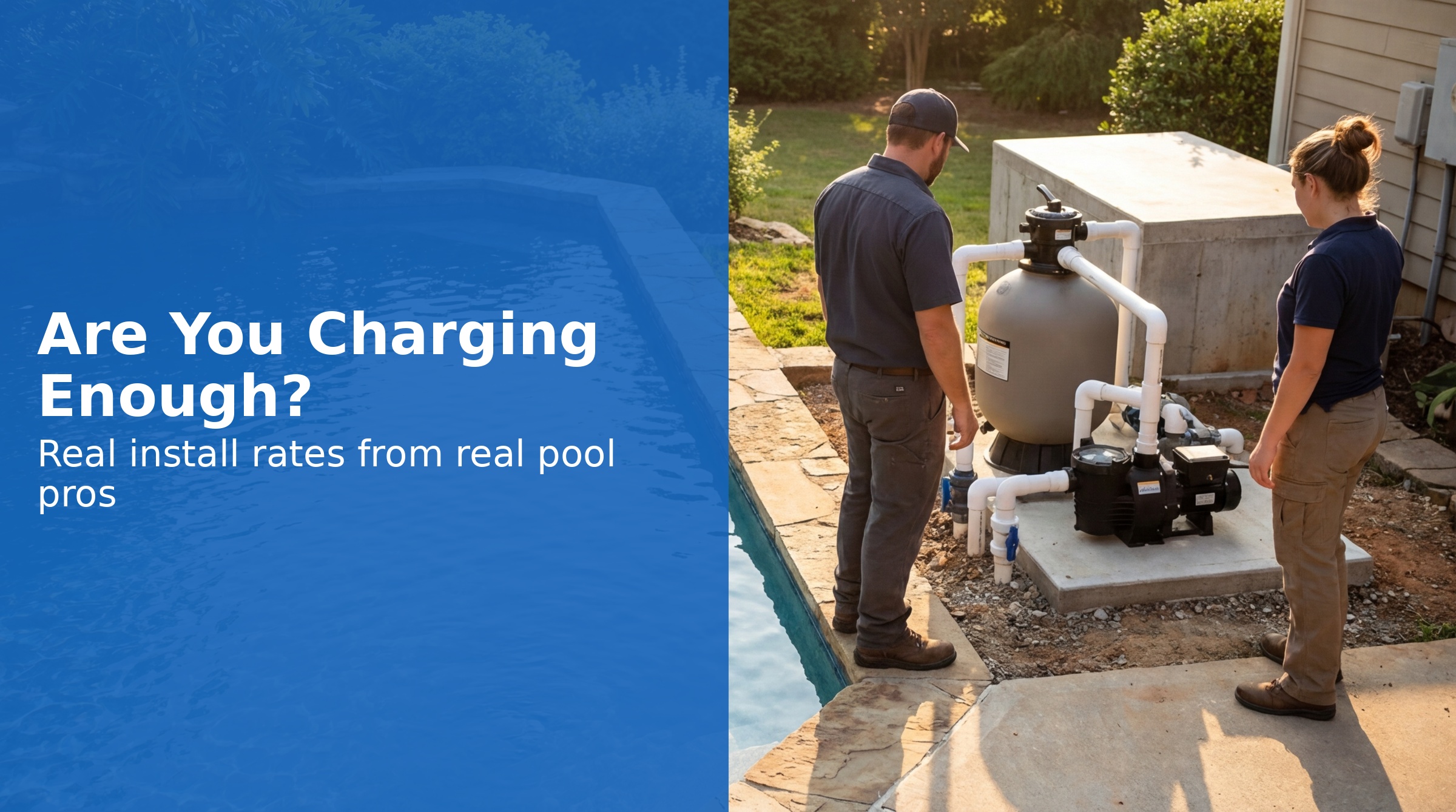
One of the most common questions in the pool service industry is deceptively simple: What should I charge for equipment installs? The answer depends on your region, your customer base, your markup strategy, and whether you're doing a direct swap or a full replumb. But the one thing nearly every pro agrees on is this: most of us started out charging too little.
We pulled real numbers from working pool service professionals across the country to give you a practical reference point. These aren't theoretical — they're what people are actually charging and getting paid.
Key Takeaways
- $250–$575 — Typical labor range for pump and filter installs, depending on media, disposal, and swap complexity
- $650–$1,000+ — Typical labor range for heater installs
- $150–$220/hr — Hourly rates reported by pros who bill by time
- Flat rate pricing is the most popular model — easier to quote, easier to sell
- Maintenance customers usually get a discount on install labor
Real Labor Rates by Equipment Type
Here's what pros reported charging for labor on the most common equipment installs. These figures are labor only — parts and equipment markup are separate.
| Equipment | Labor Range | Notes |
|---|---|---|
| Pump motor swap | $250–$350 | 30–45 min typical; motor markup 15–40% |
| Full pump install | $300–$450 | Direct swap; add $100–200 if replumbing needed |
| Filter install | $400–$575 | Direct swaps can still include media, disposal, pickup, and setup time |
| Heater install | $650–$1,000+ | Rarely a direct swap; gas line, venting, plumbing adjustments common |
| Automation install | $1,500–$2,000+ | Higher complexity; target $2,000+ clean margin |
Several pros noted that heater installs almost never end up being a simple swap. Something always needs adjustment — gas lines, venting, plumbing — which is why the labor range is wider and most experienced techs price heaters significantly higher than pumps or filters.
How to Price a Same-Model Sand Filter Swap
A direct sand filter replacement looks simple on paper, especially when there is no plumbing work. But it is still more than setting a tank in place. You are handling pickup, haul-off, sand or glass media, disposal, startup, leak checks, and the risk that an old pad or multiport valve makes the job slower than expected.
One recent PoolPros thread framed the exact question this way:
The useful answer was not a national benchmark. It was a pricing model:
That gives you a clean way to quote the job without pretending the install is free because the plumbing lines up. If the filter takes 300 lb of sand, the sand-change portion at $1.25/lb is $375. Add the $200 swap premium and you are at $575 before parts, tax, travel, unusual disposal costs, or any extra plumbing. If your local labor cost is higher, or if you use glass media, the same formula still works. Change the inputs, not the logic.
For customers, explain it as a media change plus equipment replacement labor. For your own books, track it as total margin per man-hour. A same-model sand filter swap should still beat your normal service work on margin, or it is pulling skilled labor off the route for too little return. If you need to test the number against your labor, fuel, and overhead, run it through the service price calculator before you quote.
Three Pricing Models That Work
The pros we heard from use three main approaches to pricing equipment installs. Each has trade-offs, but flat rate is the most popular by a wide margin.
Flat Rate Per Job
Quote a single labor price for the entire install. Most customers prefer this because there are no surprises. You absorb the risk if it takes longer, but you also benefit when jobs go fast.
Filter swap: $400 labor
Heater: $650–$1,000 labor
Hourly Rate
Charge by the hour plus a trip/service call fee. Works well for unpredictable jobs like troubleshooting or complex replumbs. Reported rates range from $150 to $220/hr.
Labor: $150–$220/hr
+ parts at markup
Multiplier on Parts
Multiply your landed cost of equipment by a fixed factor (commonly 2.0–2.2x). This bundles labor and markup into one number. Quick to calculate, but can feel expensive to customers who price-check parts online.
× 2.185 = $1,748 total
(~40% gross margin)
The Online Price Comparison Problem
One of the biggest challenges in 2026 is customers Googling the equipment price before you even hand them the quote. Several pros raised this issue.
One experienced tech's solution: keep equipment markup modest (10–20% over landed cost) and make your money on labor instead. His approach separates the bill into clear line items:
- Equipment at a modest markup customers can live with
- Labor at $150–$200/hr including pickup, installation, replumbing, and configuration
- Plumbing materials billed separately
- Walkthrough time — minimum 30 minutes to show the customer how to use the new equipment
This approach gets less pushback because the equipment price looks reasonable compared to Amazon, and the labor is clearly justified by the scope of work. The key is that the total margin — equipment + labor + materials — still hits your target. You're just redistributing where the profit lives.
Should Maintenance Customers Get a Discount?
Most pros said yes, but the approach varies.
The logic is straightforward: maintenance customers represent recurring revenue. A $30/hr discount on install labor is worth it if it keeps a customer on your route for another 3–5 years. You can use a customer lifetime value calculator to see exactly how much that recurring revenue is worth — it usually dwarfs the install discount.
Common discount structures from the pros we surveyed:
- Reduced hourly rate — $145/hr vs. $175/hr for non-customers
- Percentage off equipment — 5–10% discount on parts
- Free add-ons — Filter cleanings, salt cell cleanings included
- Double labor for customer-supplied parts — If a non-customer buys their own equipment, labor rate doubles to compensate for lost margin and warranty headaches
Regional Pricing: It's Not Just Cost of Living
One of the most important points raised in the discussion: you can't benchmark your prices against someone in a completely different market.
In seasonal markets (Northeast, Midwest), you have 6–7 months to earn what year-round markets earn in 12. That means your per-job rates need to be higher to hit the same annual revenue. A $100/week maintenance visit in New Jersey is not overpriced — it's what a 28-week season demands.
Here's a snapshot of what weekly maintenance runs by region, based on the discussion:
| Region | Weekly Rate | Notes |
|---|---|---|
| South Jersey / Shore | $100–$180/week | Plus chems and tax; service calls $125 |
| Upstate New York / CNY | $100/visit | Short season, 28 weeks |
| South Florida | Lower per-visit | Competitive market; 52-week season compensates |
One New Jersey tech noted that when he started 12 years ago, weekly maintenance was $55. Today the same route commands $100–$175. That's not just inflation — it reflects the rising cost of insurance, fuel, chemicals, and the reality that skilled labor is harder to find. If you haven't raised your rates recently, the price increase calculator can model the impact on your revenue.
The Real Metric: Total Margin Per Man-Hour
Regardless of which pricing model you use, the number that actually matters is your total margin divided by man-hours. A $450 flat-rate install that takes 3 hours and earns $300 in margin is a $100/hr job. A $650 heater install that takes 6 hours with the same margin is only $50/hr.
This is why experienced pros price heater installs higher — they know from experience that "direct swap" heaters are rare. Most jobs involve additional plumbing, gas line work, or configuration time that turns a 2-hour estimate into a 5-hour job.
Track your actual time on installs for a few months and you'll quickly see which jobs are profitable and which ones you're underpricing. If you're logging service time in your work order system, this data is already there — you just need to look at it.
How to Set Your Install Rates
If you're starting out or suspect you're undercharging, here's a practical framework based on what the pros in this article are doing:
- Calculate your hourly cost — Include your salary, insurance, vehicle, fuel, and overhead. Use the cost per pool calculator to get a baseline
- Set your target margin — Most pros target $1,000+ clean margin on major equipment installs, $2,000+ on automation
- Time your jobs — Track actual hours on the next 10 installs. Your gut estimate is probably 30–50% too low
- Separate equipment from labor on the invoice — Keep equipment markup modest (10–20%) and charge fair labor rates ($150–$220/hr)
- Offer a maintenance customer discount — It pays for itself in retention
- Raise prices annually — A cost of living adjustment every April keeps you from falling behind
The single biggest mistake in pricing equipment installs isn't charging too much. It's charging too little, realizing it a year later, and then having to make a jarring jump to catch up. Incremental, annual increases are easier for everyone.
Know your numbers before you quote
PoolDial tracks job time, equipment costs, and customer history so you can price installs with confidence instead of guesswork.
Start Your Free Trial