
Most Common Pool Pump Failures in 2026: Search Data Report


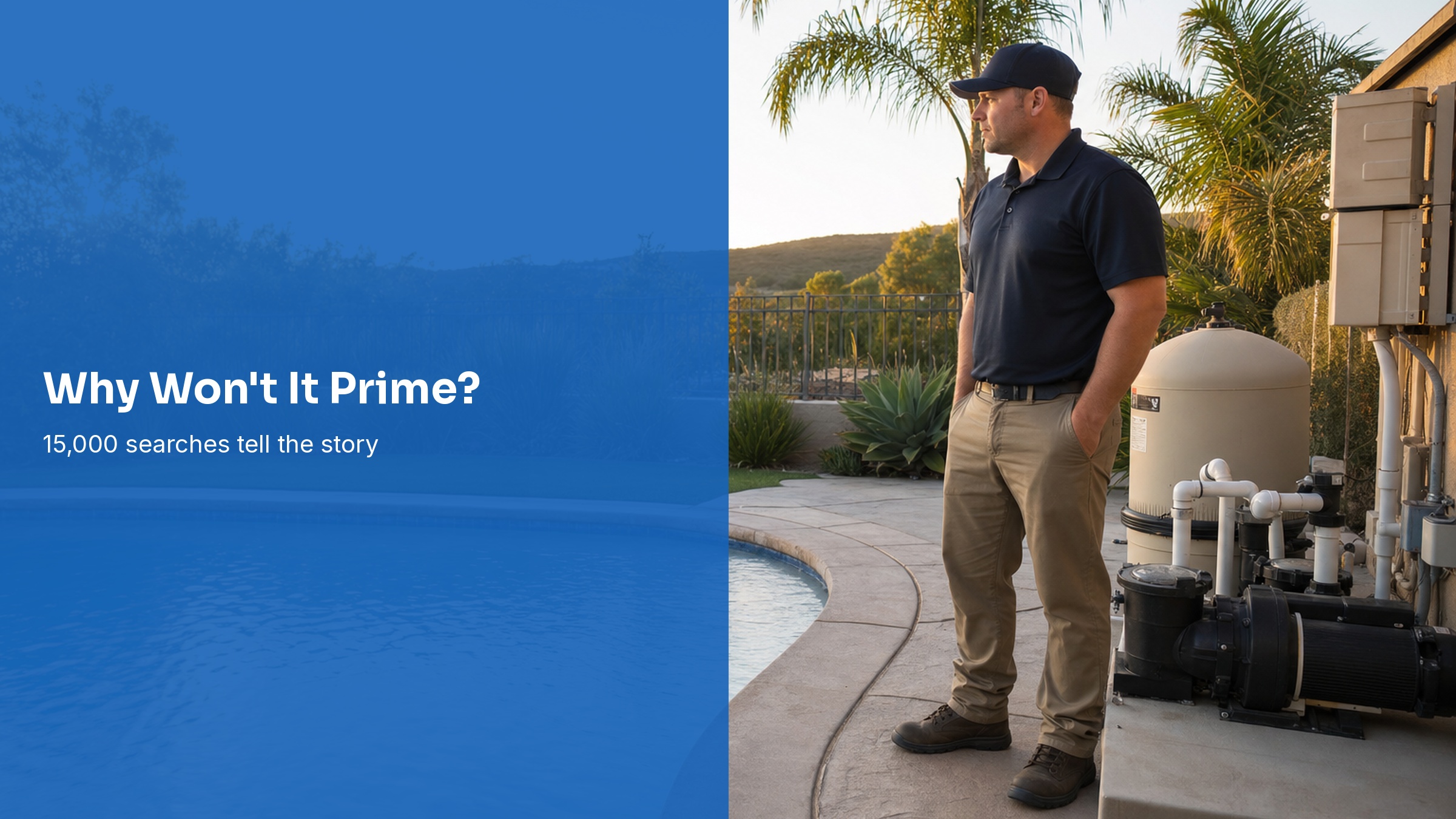
Variable-speed pumps changed pool hydraulics, controls, and diagnostics. Running an appropriately sized pump more slowly can reduce energy use, while drives and automation add fault codes, communication paths, and software-controlled shutdowns. Federal efficiency requirements apply to covered dedicated-purpose pool pumps and motors by product class and compliance date; they are not a blanket statement that every new pump installation must use the same control. See our DOE pool-pump rule guide and the current Department of Energy motor standards page.
We analyzed over 15,000 pump troubleshooting searches on PoolDial from February through May 2026. The data covers 10 pump models across Pentair and Hayward. Here is what pool techs search for most when a pump stops working.
Important: this is search-impression data, not manufacturer warranty data, installed-base data, or a sample of confirmed field diagnoses. “Failure” in the headline means the problem a searcher was trying to troubleshoot. The rankings cannot establish a product's failure rate, brand reliability, or the actual cause of any individual symptom.
Pool pumps are the most searched equipment category after salt chlorinators. Unlike heaters, which concentrate searches on a handful of specific error codes, pump searches spread across a wider range of problems. Priming issues, overcurrent faults, flow problems, noise, and communication errors each represent a significant share of the total.
Top 15 Pool Pump Failures by Search Volume
We ranked every pump problem by how often pool techs searched for it. Priming failures lead by a wide margin.
| Rank | Problem | Equipment | What It Means | Searches |
|---|---|---|---|---|
| 1 | Priming failure | Pentair IntelliFlo | Pump cannot establish prime within timeout | 1,607 |
| 2 | Won't start | Pentair SuperFlo VS | Pump does not turn on or respond | 1,399 |
| 3 | Over current | Pentair IntelliFlo | Motor drawing too many amps | 1,336 |
| 4 | Timer programming | Hayward Super Pump VS 700 | Schedule setup and programming issues | 1,291 |
| 5 | Low flow | Hayward TriStar VS 950 | Poor circulation, weak jets | 857 |
| 6 | Not starting | Hayward Super Pump VS 700 | Pump fails to start or immediately stops | 808 |
| 7 | Priming failure | Hayward Super Pump VS 700 | Cannot establish prime | 789 |
| 8 | Communication error | Hayward Super Pump VS 700 | OmniLogic or automation cannot reach pump | 729 |
| 9 | Pressure limit | Pentair IntelliFlo | System pressure exceeded safe threshold | 725 |
| 10 | Priming failure | Pentair SuperFlo VS | Cannot establish prime | 673 |
| 11 | Flow limit | Pentair IntelliFlo | Flow rate below minimum threshold | 617 |
| 12 | General troubleshooting | Hayward TriStar VS 900 | Multiple failure modes | 606 |
| 13 | Fault 21 | Pentair SuperFlo VS | Motor stall or overload | 384 |
| 14 | Noisy / cavitation | Hayward TriStar VS 950 | Loud operation, air in system | 386 |
| 15 | Internal error | Pentair IntelliFlo | Drive board or firmware failure | 340 |
Three of the top 10 pump problems are priming failures across different models. Add them up and priming is the single biggest reason pool techs search for pump help. It is the same basic problem on every pump, but techs search by model name because each brand handles it differently.
The #1 Problem: Priming Failures
Priming failures account for roughly 20% of all pump troubleshooting searches. Three models dominate:
Priming failures on variable speed pumps are different from old single speed pumps. A single speed pump either primes or it does not. A VS pump runs a priming routine at high speed for a set time, then throws a fault if it does not detect flow. The most common causes are air leaks on the suction side, a clogged impeller, or a pump basket lid that is not sealed.
IntelliFlo pages lead priming impressions in this dataset. Product history, installed base, page coverage, and search ranking may all contribute, but this analysis does not separate those effects or provide the age and diagnosis of the pumps involved.
Pentair vs Hayward: Brand Search Share
The pump troubleshooting split is closer than any other equipment category. Pentair takes 55% of searches and Hayward takes 45%.
This near-even split describes search impressions to PoolDial pages, not pump sales or installed market share. It shows that both Pentair and Hayward troubleshooting content is important for the site's audience. Reliable market-share conclusions would require independent shipment or installed-base data.
Pentair Pump Models: Search Breakdown
The IntelliFlo accounts for more than half of all Pentair pump searches. This is partly installed base (it has been in production since 2006) and partly complexity. The IntelliFlo has more fault codes and configurable parameters than any other residential pool pump. For the full list of codes, see our IntelliFlo Troubleshooter.
Hayward Pump Models: Search Breakdown
The Super Pump VS 700 leads Hayward page impressions in this analysis, while TriStar VS 950 content receives substantial visibility for low-flow and noise queries. This does not establish either model's installed base or failure rate. See our Super Pump VS 700 Troubleshooter and TriStar VS 950 Troubleshooter.
Failure Categories: What Goes Wrong Most
Grouping all 15,000+ pump searches by problem type shows five distinct failure categories.
Pump Problems by Category
- Priming / air leaks (28%) — Priming failure, won't prime, air in system. The most common pump problem across all brands and models
- Won't start / no power (22%) — Pump won't start, not starting, no response. Electrical supply, drive board, and capacitor issues
- Flow / pressure (19%) — Low flow, pressure limit, flow limit. Often caused by dirty filters or incorrect speed settings, not the pump
- Electrical faults (16%) — Over current, overheat, internal error, tripping breaker. Motor and drive board failures
- Communication / programming (10%) — Communication error, timer programming, automation integration. Unique to VS pumps connected to automation systems
- Noise / mechanical (5%) — Noisy operation, cavitation, shaft seal leaks. Physical wear and tear
The biggest takeaway from this site's query mix is that nearly half of the impressions involved priming or flow/pressure symptoms rather than explicit electrical faults. Those symptoms justify checking hydraulics before condemning electronics, but the search data does not reveal the final diagnosis or repair.
Noisy Motor: Diagnose Before Quoting Bearings
A recent pump-noise thread began with a ten-year-old Pentair motor that had become loud at startup. A video can help document a symptom, but sound alone does not confirm a failed bearing. Debris at the impeller, cavitation, suction air, loose mounting, unsupported plumbing, a damaged cooling fan, shaft or impeller contact, electrical problems, and bearing wear can overlap.
Pentair's own pump troubleshooting tables list both a bad bearing and an impeller locked by debris as possible reasons a motor will not turn. Other official Pentair pump material lists foreign material, binding, shaft wear, mounting, piping support, and cavitation among possible sources of noise or vibration. Use the manual for the exact pump and motor, because a general sound clip cannot distinguish all of those conditions.
Start with safety. If there is smoke, an electrical odor, arcing, a hot connection, repeated breaker trips, visible water at the motor, or severe vibration, shut the system down. Before opening a motor, drive, junction box, or pump, switch off every power source, prevent automatic or remote restart, verify de-energization with appropriate test equipment, and follow the manufacturer's procedure. Electrical and bonding work belongs to a qualified person under the applicable code. CPSC's pool electrical-safety guidance underscores that wet surfaces increase shock risk.
Document the symptom before disassembly: exact model and motor label, speed or startup stage when noise begins, flow and filter pressure, air in the pump basket or returns, leak location, vibration, drive fault history, supply-voltage observations by a qualified person, and whether the noise changes after baskets and hydraulics are corrected. Do not repeatedly reset a breaker or keep running a grinding motor to “see if it clears.”
"Real, I got a client who has spent $1200 3 times / $3600 in 3 years keeping the same single speed running when I’ve quoted them a FloPro 2.7 for $3200 each time"
— Pool pro via Reddit
That is one technician's story, not a repair-price benchmark or a reason to replace every old motor. Build two written options when both are technically valid. A motor repair or motor-only replacement should include the correct frame and flange, total horsepower, voltage, speed/control type, shaft, enclosure, duty, seals, gaskets, installation labor, electrical work, and warranty. Inspect the wet end, seal plate, impeller, diffuser, housing, unions, and mounting before promising that a motor will give the entire assembly a new service life.
"Not to mention the energy savings!"
— Pool pro via Reddit
Energy belongs in the comparison, but not as an unsupported percentage. Estimate annual use from the proposed hydraulic schedule, measured or manufacturer power data, local utility rate, and seasonal runtime. Also check the current DOE requirements for a replacement dedicated-purpose pool-pump motor. As of 2026, compliance dates and variable-speed-control requirements differ by motor total horsepower, and DOE has issued a specific enforcement policy for some small-size motors. A compliant replacement decision may therefore depend on the motor class and manufacture or distribution date.
Present repair, motor replacement, and complete pump replacement with the same decision columns: installed price, code and efficiency compliance, remaining wet-end condition, expected downtime, parts availability, warranty, automation compatibility, hydraulic fit, and estimated operating cost. Let the customer approve a documented scope instead of diagnosing by pitch or selling from fear.
VS Pump vs Single Speed: The Search Shift
Every pump page represented in this top-15 query table is a variable-speed model. That reflects PoolDial's page inventory and search visibility as well as user demand; it does not show that single-speed pumps have disappeared from the installed base. Current DOE efficiency regulations apply by covered product and compliance date.
But VS pumps bring new failure modes that single speed pumps never had:
- Communication errors between the pump and automation systems (729 searches for Super Pump VS 700 alone)
- Timer programming confusion (1,291 searches). Single speed pumps used simple mechanical timers. VS pumps have multi-speed schedules that require programming
- Fault codes like "Fault 21" that require looking up what the number means
- Speed-dependent problems where the pump works at one speed but not another
These are not hardware failures. They are complexity problems. Pool techs trained on single speed pumps have to learn a new diagnostic approach for VS models. This is why pump troubleshooting searches remain high even as the equipment gets more reliable.
Surprising Findings
The most common pump "failure" is not a pump problem
Priming failures and flow issues together make up 47% of this dataset's pump troubleshooting impressions. The possible causes include suction-side air leaks, clogged baskets or impellers, dirty filters, valve position, water level, speed settings, seals, plumbing restrictions, and pump faults. Inspect the hydraulic system methodically before replacing a motor or drive, while recognizing that search impressions alone cannot tell how many cases ended with a plumbing repair.
VS pumps add communication and programming questions
Communication errors and programming confusion account for 10% of the dataset. VS pumps connected to automation systems can have RS-485 wiring, addressing, configuration, schedule, firmware, controller, or drive issues in addition to traditional hydraulic and power problems. The Super Pump VS 700 communication page generated 729 impressions. Some cases may be integration problems and others may involve failed hardware, so techs need both electrical qualification and product-specific controls training.
Pump search share is closer than other PoolDial categories
PoolDial search impressions split 55% Pentair to 45% Hayward for the pages in this analysis. That makes both brands important training topics for this site's audience, but it does not prove industry market share, installed base, or comparative reliability.
IntelliFlo pages still lead Pentair pump impressions
The Pentair IntelliFlo accounts for more than half of Pentair impressions in this dataset. Older units remain in service, but the query data does not provide age, condition, diagnosis, repair price, or failure rate. Use the nameplate, fault history, electrical and hydraulic tests, current parts availability, and customer-approved scope to choose repair or replacement.
When the First Repair Does Not Solve the Symptom
A green-pool intake report combined a pump that would not prime, low filter pressure, and very little return flow. That is a system symptom, not a reason to replace another set of filter grids without measurements.
A leaking pump is not automatically a failed shaft seal. One WhisperFlo field report described two seal-kit attempts followed by a heavy leak at the seal-plate, housing, and motor area. The technician also found brittle plastic at an outer bolt.
"Used the Aladdin Go Kit, which didn't solve the issue, so went back yesterday with the actual Pentair Seal Kit and swapped everything back out again."
— Pool pro via Reddit
When the same repair fails twice, stop repeating the parts swap. Clean and dry the assembly, confirm the exact leak origin during operation, inspect the mating surfaces and fasteners, verify the correct parts for the pump revision, and document any damaged housing or seal plate. A refund promise does not fix an uncertain diagnosis; a written finding and a clear replace-versus-repair quote does.
Site Geometry Belongs in the Priming Diagnosis
A separate priming report involved equipment 40 to 50 yards uphill from the pool. Record lift, run length, pipe size, valve layout, check valves, and the event that introduced air before treating it like an ordinary pad-side prime. Likewise, repeated booster-pump failures such as those raised in a recent PB4SQ discussion should be compared against installation history, supply, flow, and duty cycle before being described as a model-wide defect.
What This Means for Pool Service Companies
Fix the Plumbing Before Blaming the Pump
Priming and flow symptoms make up 47% of this site's pump impressions. Before pulling a pump apart, follow the exact manual and check water level, baskets, filter condition and pressure, valve positions, suction-side air, lid seal, flow restrictions, speed settings, and fault history. The result of those checks determines whether the cause is hydraulic, electrical, mechanical, or a combination.
Stock Parts From Your Own Repair History
Electrical-fault queries account for 16% of the dataset, but search impressions do not show which part was defective. Use your completed work orders to decide which manufacturer-approved parts justify inventory. Protect electronic parts from heat, moisture, chemicals, and impact, verify compatibility by exact revision, and reserve drive, capacitor, and line-voltage diagnosis for qualified personnel following the service manual.
Train on Automation Integration
Communication errors between VS pumps and automation systems (OmniLogic, IntelliCenter, ScreenLogic) are a growing search category. These are wiring and configuration problems, not pump failures. A tech who can troubleshoot RS-485 communication between a pump and an automation panel will close calls that other companies have to escalate.
Use the Right Tools
Our Pump Run Time Calculator helps set optimal schedules. The Pump Energy Cost Calculator shows customers the savings from correct speed settings. And the Pump Horsepower Calculator makes sure the pump is sized right for the plumbing.
Track Pump Installations and Service History
PoolDial logs pump model, install date, fault codes, and repairs for every customer. Know what broke last time before you show up.
Start Your Free TrialMethodology
How We Calculated This
This report is based on Google Search Console data from pooldial.com covering February 19 through May 18, 2026 (3 months). We aggregated search impressions across all pump troubleshooting pages, combining www and non-www traffic for the same URLs.
"Search volume" in this report refers to the number of Google search impressions our pump troubleshooting pages received. It serves as a proxy for how often pool professionals search for specific pump problems.
The 10 pump models tracked are: Pentair IntelliFlo, IntelliFlo3 VSF, IntelliFlo VS-SVRS, SuperFlo VS, WhisperFlo VST, Hayward Super Pump VS 700, TriStar VS 900, TriStar VS 950, MaxFlo VS, and EcoStar.
This data reflects what pool professionals search for when troubleshooting. It does not measure actual failure rates, which would require field service data from manufacturers.