


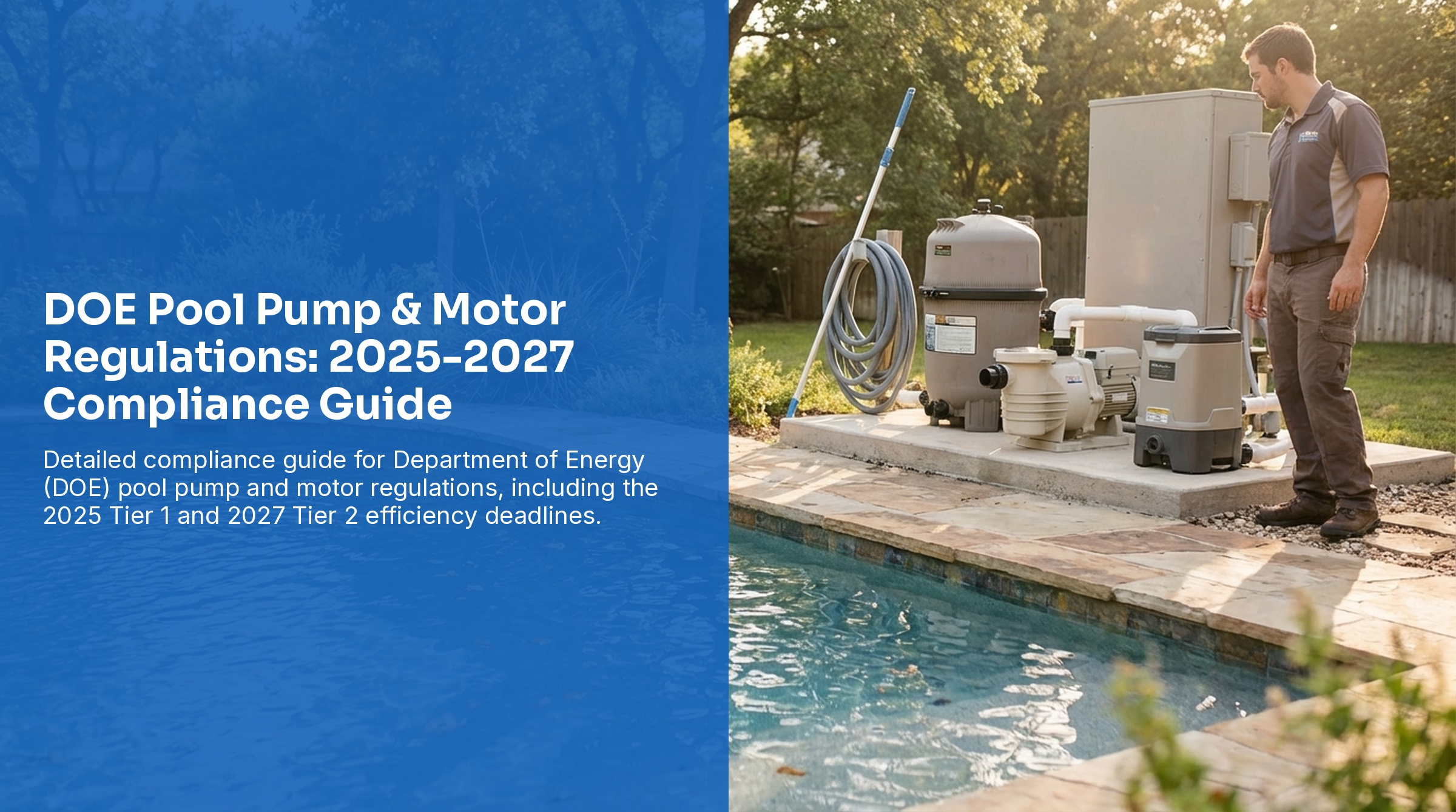
The U.S. Department of Energy (DOE) has introduced transformative energy efficiency standards for dedicated-purpose pool pump (DPPP) motors, significantly altering the equipment landscape for the pool industry. These regulations, promulgated under the Energy Policy and Conservation Act (EPCA), aim to reduce national energy consumption by mandating higher full-load efficiency and variable-speed control for the majority of pool pump motors in the U.S. market. For pool service businesses, these rules dictate what equipment can be manufactured, imported, or installed as replacements for existing systems.[2]DOE 2023 DPPP Motor Rule88 FR 66966federalregister.gov
Key Takeaways
- Tier 1 Deadline — Effective September 29, 2025, for extra-small (<0.5 THP) and standard-size (1.15 to 5 THP) motors [2]DOE 2023 RuleTier 1 compliance datefederalregister.gov
- Tier 2 Deadline — Effective September 28, 2027, for small-size motors (0.5 to <1.15 THP) [2]DOE 2023 RuleTier 2 compliance datefederalregister.gov
- Variable-Speed Mandate — All motors rated between 0.5 THP and 5 THP must feature variable-speed control capability [2]DOE 2023 RuleVariable-speed requirementfederalregister.gov
- Efficiency Threshold — Motors under 0.5 THP must meet a minimum full-load efficiency rating of 69% [2]DOE 2023 RuleEfficiency minimumfederalregister.gov
- Freeze Protection Controls — Compliance requires specific factory default settings for motors shipped with freeze protection [2]DOE 2023 RuleFreeze protection defaultsfederalregister.gov
- Replacement Rule — The regulations apply to all covered DPPP motors, whether sold as a component of a new pump or as a standalone replacement motor [3]DOE DPPP MotorsReplacement motor coverageenergy.gov
2021 Dedicated-Purpose Pool Pump Rule
The current regulatory framework for pool energy efficiency began with the 2021 Dedicated-Purpose Pool Pump (DPPP) Rule, which established the "Weighted Energy Factor" (WEF) as the primary metric for pump efficiency. This rule, which went into effect on July 19, 2021, set performance standards for self-priming filter pumps, non-self-priming filter pumps, waterfall pumps, and pressure cleaner booster pumps. The WEF metric essentially measures the volume of water pumped per kilowatt-hour of electricity consumed, requiring manufacturers to optimize both hydraulic and motor efficiency.[1]DOE 2021 DPPP Rule86 FR 5765, January 2021federalregister.gov
Under this 2021 standard, standard-size self-priming pool filter pumps (those with a hydraulic horsepower of 0.711 or greater) effectively required variable-speed technology to meet the mandatory WEF score. However, the 2021 rule focused on the entire pump assembly, creating a regulatory gap where less efficient motors could still be sold as standalone replacements for existing pumps. The upcoming 2025 and 2027 motor regulations were designed specifically to close this gap by ensuring that replacement motors meet the same high standards as those in new, energy-efficient pumps.[2]DOE 2023 RuleClosing the replacement motor gapfederalregister.gov
"The DPPP motor standard focuses on just the motor aspect and is meant to complement the DPPP standard by ensuring the replacement motors are at least as efficient as originally intended by the DPPP manufacturer in the DPPP design." — 88 FR 66976
The implementation of the WEF standard also introduced critical design requirements for other pump types. For example, integral cartridge-filter and sand-filter pumps must now be distributed with a pool pump timer to reduce unnecessary run-time. Furthermore, any pool pump sold with freeze protection controls must now follow strict default settings to prevent energy waste during cold weather.[1]DOE 2021 DPPP RuleTimer and freeze protection requirementsfederalregister.gov
2025 and 2027 Pool Pump Motor Rules
The most recent DOE final rule, published in September 2023, establishes the next phase of efficiency through specific motor-level requirements. This rule divides dedicated-purpose pool pump motors into three classes based on total horsepower (THP): "extra-small-size" covers motors under 0.5 THP, "small-size" covers motors from 0.5 to less than 1.15 THP, and "standard-size" covers motors from 1.15 to 5 THP.[4]10 CFR §431 Subpart YMotor class definitionsecfr.gov
For the extra-small and standard-size classes, the compliance date is September 29, 2025. Motors in the extra-small category must achieve a full-load efficiency of at least 69%, while standard-size motors must be variable-speed. The DOE provided an extended compliance lead time for the "small-size" class, pushing its effective date to September 28, 2027. Once this deadline arrives, these motors—which are ubiquitous in small self-priming pumps and pressure cleaner booster pumps—must also feature variable-speed control.[2]DOE 2023 Rule88 FR 66966, compliance dates and requirementsfederalregister.gov
"Compliance with the new standards established for dedicated purpose pool pump motors with motor total horsepower >=0.5 THP and <1.15 THP in this final rule is required on and after September 28, 2027." — 10 CFR §431.485(c)
In addition to speed and efficiency, the rule mandates factory defaults for freeze protection. Motors with these controls must be shipped either with the feature disabled or with specific user-adjustable defaults: the air temperature setting must be no greater than 40°F, the run time no more than 1 hour before rechecking, and the motor speed in freeze mode no more than half of its maximum speed. These requirements ensure that safety features do not inadvertently compromise the energy savings intended by the move to variable-speed technology.[2]DOE 2023 RuleFreeze protection specificationsfederalregister.gov
Implications for Pool Service Businesses
The shifting regulatory landscape has immediate practical implications for pool service professionals. The transition to variable-speed motors for the small-size class (0.5 to 1.15 THP) is perhaps the most significant change, as this power range represents a high volume of current single-speed installations. By September 2027, service pros will no longer be able to source standard single-speed replacement motors in this range, necessitating a shift toward more complex, electronically commutated motors (ECMs).[2]DOE 2023 RuleMarket impact analysisfederalregister.gov
While the upfront cost for variable-speed motors is higher, the DOE analysis indicates that consumers will realize positive life-cycle cost (LCC) savings across all equipment classes. For standard-size motors, the average LCC savings are estimated at $236, with a simple payback period of just 1.3 years. Even for small-size motors, which have a longer payback period of 3.4 years, the savings are achieved within the motor's average 4.5-year lifetime.[2]DOE 2023 RuleLife-cycle cost analysisfederalregister.gov
"The DPPP motor standard for both motors sold in DPPPs and sold alone for replacement purposes... ensures the efficiencies that consumers expect when purchasing their DPPPs are maintained when replacing the motor." — 88 FR 66976
Furthermore, the regulations are designed to be "drop-in" compatible. The DOE concluded that standard wet ends of pumps can be paired with variable-speed motors without significant mechanical adaptation, meaning fit issues should not generally prevent a service pro from upgrading a customer's motor to a compliant, high-efficiency model. For businesses, this requires updating inventory and educating customers on the long-term electricity savings that offset the higher initial equipment cost of compliant motors.[2]DOE 2023 RuleDrop-in compatibilityfederalregister.gov
Summary Table
| Equipment Class | THP Range | Compliance Date | Requirement |
|---|---|---|---|
| Extra-Small-Size | < 0.5 THP | Sept. 29, 2025 | 69% Full-Load Efficiency |
| Small-Size | 0.5 ≤ THP < 1.15 | Sept. 28, 2027 | Variable-Speed Control |
| Standard-Size | 1.15 ≤ THP ≤ 5 | Sept. 29, 2025 | Variable-Speed Control |
| Freeze Protection | All Classes | Sept. 2025/2027 | Default: ≤40°F, ≤1 hr run |
Sources
- [1] U.S. Department of Energy, "Energy Conservation Program: Energy Conservation Standards for Dedicated-Purpose Pool Pumps," 86 FR 5765, January 19, 2021. federalregister.gov
- [2] U.S. Department of Energy, "Energy Conservation Program: Energy Conservation Standards for Dedicated-Purpose Pool Pump Motors," 88 FR 66966, September 28, 2023. federalregister.gov
- [3] U.S. Department of Energy, Office of Energy Efficiency & Renewable Energy, "Dedicated-Purpose Pool Pump Motors." energy.gov
- [4] Electronic Code of Federal Regulations, 10 CFR Part 431, Subpart Y—Dedicated-Purpose Pool Pumps. ecfr.gov