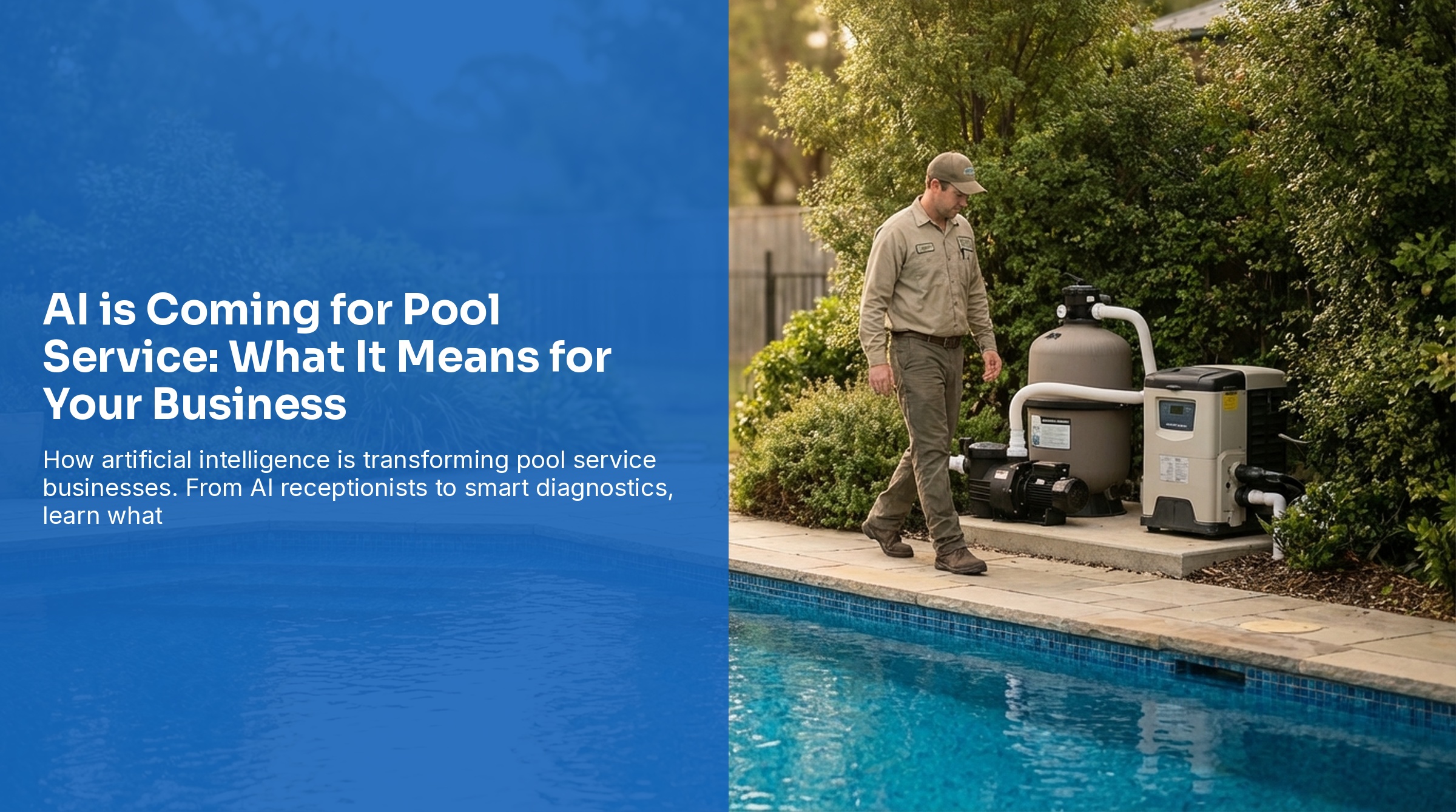
AI is Coming for Pool Service: What It Means for Your Business


If you have been paying attention to the news, you have probably heard a lot about artificial intelligence. ChatGPT, self-driving cars, AI-generated images. It can feel like science fiction. But here is what most pool service owners do not realize: AI is not coming for your industry. It is already here.
The question is not whether AI will change pool service. The question is whether you will be one of the early adopters who uses it to grow, or one of the businesses that gets left behind wondering what happened.
This guide breaks down exactly what AI technology is available right now for pool service businesses, what is coming in the next few years, what AI will never replace, and how to prepare your business for the AI-powered future.
Key Takeaways
- AI receptionists, route optimization, and smart chemical dosing are available today
- Photo-based diagnostics and voice logging are 2-3 years away from mainstream adoption
- AI enhances human skills but will not replace relationship-building, complex repairs, or judgment calls
- Starting with an AI receptionist is the lowest barrier, highest ROI entry point
- Early adopters will build significant competitive advantages over the next 3-5 years
The AI Revolution Has Arrived
Let us be clear: this is not a future prediction. This is happening now.
In 2024, over 65% of small businesses reported using at least one AI tool in their operations. By 2025, that number climbed to 78%. The field service industry, including pool service, is rapidly adopting AI technologies that were science fiction just five years ago.
The pool service professionals who understand this shift are already gaining advantages. They are capturing more leads, running more efficient routes, and spending less time on administrative tasks. The ones who dismiss AI as "not relevant to my business" are falling behind without realizing it.
But not everyone is convinced, and that is worth understanding too. A recent thread on r/PoolPros — "Yall using AI in your business yet?" — drew more than 17 responses from working pool professionals. The replies split roughly into two camps: skeptics who see no place for AI in their hands-on trade, and pragmatists who have found narrow but genuinely useful applications. Both perspectives reveal something true about where the industry actually stands right now.
AI That is Already Changing Pool Service
Here are five AI technologies you can implement in your pool service business today. Some are purpose-built for the industry. Others are general tools adapted for field service. All of them work.
AI Receptionists
24/7 phone answering that captures leads, gathers customer information, and never puts callers on hold. PoolDial's AI Receptionist handles calls while you are on route, collecting details like pool type, equipment, and urgency level. No more missed calls or voicemails that never get returned.
Route Optimization
Machine learning algorithms that analyze traffic patterns, stop locations, and service times to build the most efficient routes possible. Some systems save operators 15-25% on drive time, which translates directly to more pools per day or earlier finishes.
Chemical Dosing Calculators
AI-powered tools that factor in pool volume, current chemistry, ambient temperature, bather load, and historical data to recommend precise chemical doses. More accurate than manual calculations and faster than looking up charts. Try our free chemical dosage calculator.
Predictive Equipment Maintenance
Smart sensors and AI analysis that detect equipment issues before they fail. Unusual pump amp draws, declining filter performance, heater inefficiencies. The AI spots patterns humans miss, letting you sell repairs before the equipment breaks down completely.
One important caveat on AI chemical dosing tools: they are only as good as the numbers you feed them, and they can produce dangerous recommendations when used carelessly. A pool pro on r/PoolPros shared a cautionary example from a colleague:
"It told my buddy to add something like 36G of muriatic to a pool that was ~16k to drop alkalinity 100 points. So .........yeah be careful."
— u/LordKai121 on r/PoolPros
Another pro echoed the concern simply: "I have used it and have been fed wrong info so double check." The lesson is not to avoid AI dosing tools, but to treat them as a starting point rather than a final answer — especially on edge cases and large corrections. Experienced techs who know their pools will catch the outliers.
Customer Communication Automation
Beyond the major categories above, AI is handling an increasing amount of customer communication. Automated service reminders sent at the optimal time. Follow-up messages after service visits. Appointment confirmations. Review requests timed for when customers are most likely to respond positively.
These are not basic autoresponders. Modern AI communication tools analyze customer behavior, past interactions, and response patterns to personalize timing and messaging. The result is higher engagement rates without you spending time crafting individual messages.
Pool pros on r/PoolPros reported using AI most for writing — specifically for the uncomfortable messages that are hard to word professionally. As one technician put it:
"I've used it whenever I need to generate a professional email letting customers know about price increases or dropping customers without sounding too brash. Very helpful."
— u/Wonder824 on r/PoolPros
Others have found value in social content and parts identification. The original poster summarized how daily use tends to look in practice: "It's helped me with identifying parts, troubleshooting, how to make a statement sound business professional, with a nice joke if I need a pick up, etc." Another pro added that they use it "occasionally to generate post or caption ideas for our social media accounts." These are not flashy applications — they are practical time-savers that compound across dozens of interactions each week.
The Missed Call Problem
Studies show that 62% of calls to small service businesses go unanswered during business hours, and 80% of callers who reach voicemail never leave a message. For a pool service company, every missed call is potentially $3,000-5,000 in annual revenue walking to a competitor. AI receptionists solve this problem completely.
What is Coming in the Next 2-3 Years
The AI tools available today are impressive. But they are just the beginning. Here is what the next wave of pool service AI technology looks like.
Voice-Activated Service Logging
Instead of typing notes after each stop, simply speak. "Backwashed filter, adjusted pH from 7.2 to 7.4, noticed pump making slight noise, recommend monitoring." AI transcribes, categorizes, and logs everything automatically. Some early versions exist now; mainstream adoption is 12-18 months away.
Photo-Based Pool Diagnostics
Snap a photo of a pool and get instant AI analysis. Water color indicates likely chlorine deficiency. Algae pattern suggests circulation issue. Foam accumulation points to organic contamination. The AI sees what experienced techs see, but instantly and consistently.
Automated Quote Generation
A homeowner uploads photos of their pool, equipment, and yard. AI analyzes the images, estimates pool volume, identifies equipment models, calculates chemical needs, and generates a service quote. No site visit required for basic service pricing.
Smart Equipment Integration
Pool pumps, heaters, and chlorinators that report their own status directly to your software. "Pentair pump at 123 Oak Street running 15% above normal amps for 3 days. Recommend inspection." The equipment becomes your early warning system.
AI-Generated Customer Reports
After each service visit, AI compiles data into professional reports for customers. Water chemistry trends, equipment status, recommended services, and historical comparisons. Automated, branded, and impressive. Builds customer trust without adding to your workload.
Demand Forecasting
AI that predicts when you will be busiest based on weather patterns, seasonal trends, local events, and historical data. Know when to hire temporary help, when to push marketing, and when to schedule vacations. Planning replaces reacting.
These technologies are not theoretical. Companies are actively building them. Some are in beta testing now. The pool service operators who start learning AI tools today will have a significant head start when these advanced features become available.
The Jobs AI Will Not Replace
Here is where we pump the brakes on the AI hype. Despite the impressive capabilities above, there are things AI cannot do. And frankly, probably never will do as well as humans.
Some pool professionals do not just want to slow down on AI adoption — they have no interest in it at all, and their reasoning is worth taking seriously. On r/PoolPros, a highly-upvoted comment captured this view directly:
"Not ever happening with my business. I troubleshoot with my hands, tools, eyes, and experience. AI will never really benefit me as far as my stuff is structured. I am a professional that does not advertise, you have to find me."
— u/liveautonomous on r/PoolPros
Another pro in the same thread elaborated on a similar model: "Same boat. I choose my clients; they do not choose me. I am a bit neurotic so my clients know they have someone who has been autistically absorbing info for the past decade. I only use tech for running formulas (LSI, Borate doses, etc) and keeping records of clients." For high-end referral-only operators with full routes and zero need for lead generation, the calculus really is different. Their competitive moat is craftsmanship and reputation, not operational efficiency. AI does not move the needle for them — and that is a perfectly valid place to be.
The key insight is that AI handles the repetitive, time-consuming tasks so high-volume operators can focus on the high-value human work. If you are already running a tight, referral-only shop, you may not need it. But for businesses that are growing, hiring, or trying to capture more market, the picture changes.
Relationship Building
Customers do not stay loyal to algorithms. They stay loyal to the tech who remembers their dog's name, asks about their kids, and genuinely cares about their backyard. AI can capture leads, but humans build relationships that prevent churn.
Complex Equipment Repairs
AI can diagnose. It cannot turn a wrench. When a heater has a complex issue involving multiple failed components, corroded connections, and access challenges, you need skilled hands and adaptive problem-solving that AI simply cannot provide.
Sales and Upselling
Reading a customer's body language, knowing when to push and when to back off, framing a $3,000 repair as an investment rather than an expense. These are human skills. AI can identify upsell opportunities, but closing requires emotional intelligence.
Training New Technicians
Transferring knowledge, demonstrating technique, providing encouragement, giving constructive feedback. Training involves mentorship and human connection that AI cannot replicate. Your experienced techs remain invaluable for building your team.
Emergency Response Judgment
When a customer calls panicked about a pool emergency, humans assess urgency, calm fears, and make judgment calls about what warrants immediate response versus what can wait. AI can triage, but the final call requires human judgment.
Unique Problem Solving
Every pool is different. Unusual configurations, one-off equipment combinations, strange water sources. When you encounter something AI has never seen, human creativity and adaptability are irreplaceable.
None of these human skills are going away. The best outcome for a growing pool service business is not human vs. AI — it is human plus AI. Let the tools handle the repetitive work so you can spend more energy on the things only you can do.
How to Prepare Your Business for AI
You do not need to become a technology expert overnight. Here is a practical roadmap for integrating AI into your pool service business, starting with the highest-impact, lowest-barrier options.
One pool pro on r/PoolPros offered a useful mental model for how to think about AI tools in general:
"The most important thing to understand when working with AI is it doesn't understand numbers very well... It's a lot like a new employee that you've had for 3 months and really wants to do well... At the end of the day is only really going to be good at either giving you outlines of ways to explain things to customers and employees or vice versa."
— u/worksleep on r/PoolPros
That framing is exactly right. AI is an eager, enthusiastic assistant with broad knowledge but real blind spots — particularly around precise numbers and context it has never encountered before. Treat it like a capable new hire who needs your oversight, and it will save you significant time. Treat it like an oracle, and you will get burned.
Your AI Adoption Roadmap
Start with an AI Receptionist
This is the easiest entry point with the highest immediate ROI. An AI receptionist captures leads 24/7, never takes breaks, and costs a fraction of a human employee. PoolDial includes one with every subscription. No additional software or learning curve required.
Get Comfortable with the Technology
Use AI tools in your personal life. Try ChatGPT for answering questions. Use AI photo editors. Experiment with voice assistants. The more familiar you become with how AI works, the easier it is to spot opportunities in your business.
Train Your Team on AI Tools
Do not just implement AI. Explain why it helps. Show techs how voice logging saves time. Demonstrate how route optimization gets them home earlier. When your team understands the benefits, adoption is smoother and resistance disappears.
Focus on What Humans Do Best
As AI handles more administrative work, double down on relationship building. Invest more time in customer conversations. Focus on training and developing your team. These human skills become more valuable, not less, as AI spreads.
The Bottom Line
AI is not coming to replace pool service technicians. It is coming to make them dramatically more effective.
The businesses that thrive over the next decade will be those that embrace AI as a tool. They will capture more leads with AI receptionists. They will run tighter routes with AI optimization. They will impress customers with AI-generated reports. And they will do all of this while spending more time on the human work that builds loyalty and grows businesses.
The businesses that dismiss AI as "not for my industry" will gradually fall behind. They will lose leads to competitors who answer every call. They will burn more fuel on inefficient routes. They will spend evenings on paperwork that AI could handle in seconds.
The choice is clear. The technology is available. The question is whether you will be an early adopter or a late follower.
The easiest first step is implementing an AI receptionist. It requires zero technical knowledge, delivers immediate ROI through captured leads, and gets you comfortable with AI technology. PoolDial includes an AI receptionist with every subscription, so you can start experiencing the benefits today.
For more on building a profitable pool service business, check out our guides on starting a pool service business, marketing strategies, and route valuation.