


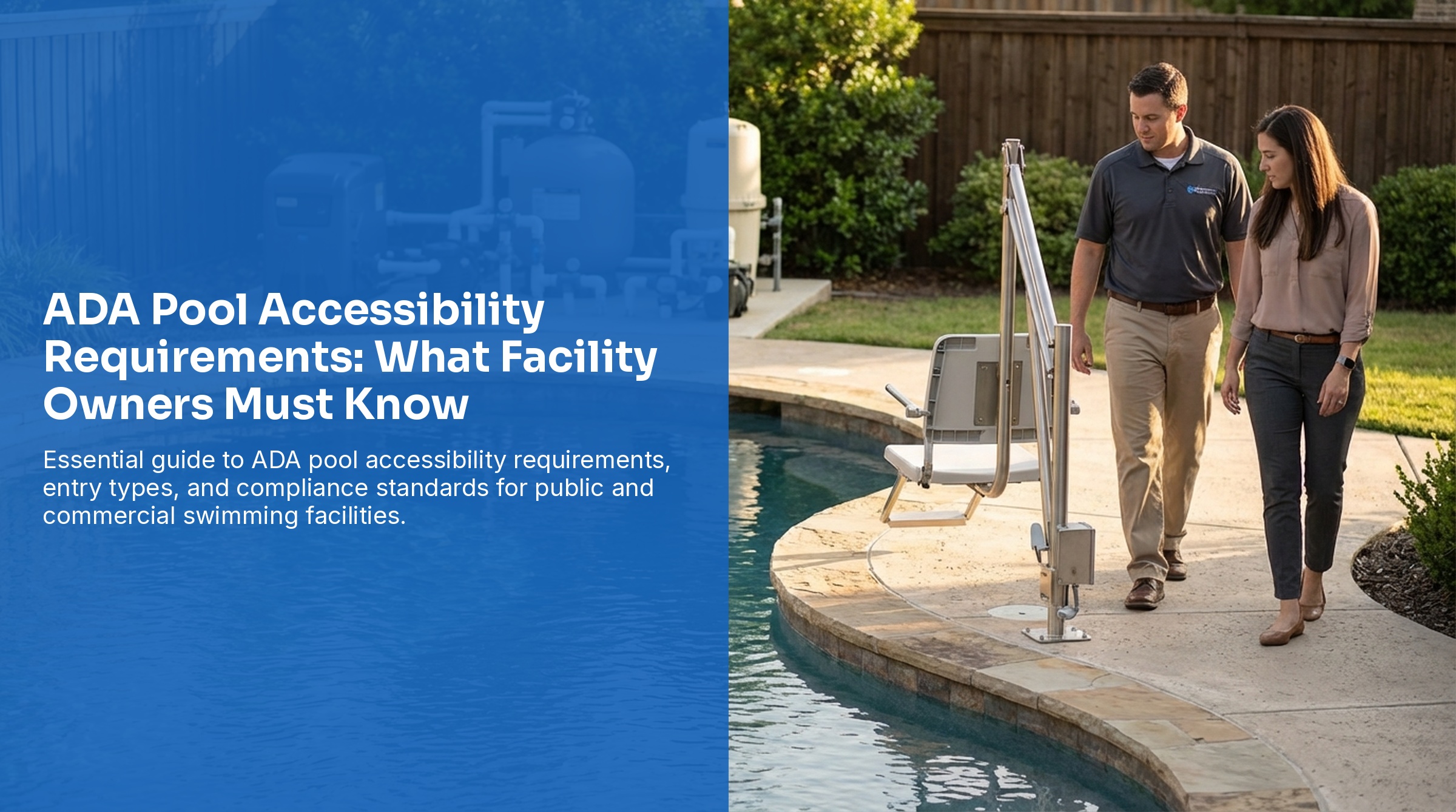
The Americans with Disabilities Act (ADA) mandates that all public and commercial swimming facilities be accessible to individuals with disabilities. Since the adoption of the 2010 ADA Standards for Accessible Design, facility owners have been required to meet specific "scoping" and "technical" requirements to ensure pools and spas are usable by all. For pool professionals and property managers, compliance is not just about avoiding litigation, but about fulfilling a fundamental federal civil right to equal access.[1]2010 ADA StandardsAccessible Design Requirementsada.gov
Key Takeaways
- Universal Compliance — ADA standards apply to all state and local government facilities (Title II) and public accommodations (Title III)
- Accessible Entry Mandate — Large pools (over 300 linear feet) must have at least two accessible means of entry; smaller pools require at least one[1]ADA Standard 242.2Entry requirements by pool sizeada.gov
- Permitted Entry Types — Acceptable methods include pool lifts, sloped entries, transfer walls, transfer systems, and pool stairs
- Lift Requirements — If a pool has only one entry, it must be either a pool lift or a sloped entry
- Spa Accessibility — Spas must provide at least one accessible entry, which must be a lift, transfer wall, or transfer system
- Maintenance of Equipment — Accessible features, such as pool lifts, must be maintained in operable condition and available during all hours the pool is open
Facilities Covered by the ADA
The scope of the ADA's pool accessibility requirements covers a vast array of facilities categorized as either public entities or public accommodations. Title II of the ADA applies to State and local government facilities, including municipal pools, community centers, and public schools. Title III covers public accommodations and commercial facilities, a category that includes hotels, health spas, bowling alleys, and places of exercise or recreation.[2]Americans with Disabilities Act42 U.S.C. §12101 et seq.ada.gov
Crucially, the law excludes private residences, but it does include housing facilities that operate as public accommodations, such as hotels or transient lodging facilities. For these covered entities, discrimination is defined as a failure to design and construct facilities that are readily accessible to and usable by individuals with disabilities. This includes not only the pool itself but the "path of travel" from the entrance or parking lot to the pool area.[1]2010 ADA StandardsPath of travel requirementsada.gov
"The 2010 Standards set minimum requirements – both scoping and technical – for newly designed and constructed or altered State and local government facilities, public accommodations, and commercial facilities to be readily accessible to and usable by individuals with disabilities." — 2010 ADA Standards Introduction
Alterations to existing facilities also trigger ADA compliance. When a facility undertakes an alteration that affects the usability of a "primary function" area—such as a major pool renovation—it must ensure that the path of travel, including restrooms and drinking fountains serving that area, is made accessible. However, these path of travel improvements are deemed "disproportionate" if the cost exceeds 20% of the cost of the original alteration.[1]2010 ADA StandardsAlteration requirementsada.gov
Entry Requirements and Technical Specifications
The 2010 ADA Standards provide clear instructions on the number and type of accessible entries required based on the size of the pool. For "large" pools, defined as those with 300 or more linear feet of pool wall, owners must provide at least two accessible means of entry. At least one of these entries must be a pool lift or a sloped entry. For "small" pools with less than 300 linear feet of wall, only one accessible entry is required, but it must be a pool lift or sloped entry.[1]ADA Standard 242.2Entry requirementsada.gov
Acceptable means of entry are restricted to five specific types: pool lifts, sloped entries (ramps), transfer walls, transfer systems, and pool stairs. While stairs are permitted as a second entry for large pools, they cannot serve as the primary accessible entry because they do not accommodate wheelchair users or those with significant mobility impairments as effectively as a lift or ramp. For spas, at least one entry must be provided, which can be a lift, transfer wall, or transfer system.[1]ADA Standard 242.4Spa entry requirementsada.gov
"At least two accessible means of entry shall be provided for swimming pools... At least one accessible means of entry provided shall comply with 1009.2 [Pool Lifts] or 1009.3 [Sloped Entries]." — ADA Standard 242.2
Technical specifications for these entries are rigorous. Pool lifts, for instance, must have a seat that is at least 16 inches wide and be capable of being independently operated by the user from both the deck and the water. Sloped entries must comply with ramp standards, featuring a running slope no steeper than 1:12. Even "catch pools" used at the base of water slides are subject to these rules, though the slides themselves are exempt from accessible route requirements.[1]ADA Standard 1009.2Pool lift specificationsada.gov
Exemptions and Existing Facilities
Facility owners should be aware of specific exemptions within the ADA standards. Structures directly associated with the process of construction, such as scaffolding or materials storage, are exempt. Similarly, machinery spaces frequented only by service personnel—such as pool pump rooms and transformer vaults—do not need to be accessible. Raised structures used solely for refereeing or judging sports are also excluded from the accessible route requirements.[1]2010 ADA StandardsExemptionsada.gov
For existing facilities (those constructed before the current standards took effect), the ADA requires the removal of "architectural barriers" when such removal is "readily achievable." The law defines readily achievable as "easily accomplishable and able to be carried out without much difficulty or expense." Factors to be considered include the nature and cost of the action, the overall financial resources of the facility, and the impact on the operation of the business.[2]42 U.S.C. §12181(9)Readily achievable definitionada.gov
"The term 'readily achievable' means easily accomplishable and able to be carried out without much difficulty or expense." — 42 U.S.C. §12181(9)
Existing facilities may also be eligible for "historic preservation" exceptions. If providing physical access to an historic property would threaten or destroy its historic significance, alternative methods of access must be provided. For most commercial pool owners, however, the "readily achievable" standard means that at a minimum, a portable or permanent pool lift should be installed if the financial burden is not extreme, as it provides a relatively low-cost solution to a significant access barrier.[1]2010 ADA StandardsHistoric preservation exceptionsada.gov
Summary Table
| Pool Type | Requirement | Permitted Entry Types |
|---|---|---|
| Large Pool (≥300 ft) | 2 Entries | Primary: Lift or Ramp. Secondary: Wall, System, or Stairs |
| Small Pool (<300 ft) | 1 Entry | Lift or Sloped Entry (Ramp) |
| Spa / Hot Tub | 1 Entry | Lift, Transfer Wall, or Transfer System |
| Wading Pool | 1 Entry | Sloped Entry (Ramp) |
| Existing Facility | Barrier Removal | If "Readily Achievable" |