
Texas Pool Fence Requirements: H&S Code Chapter 757 Explained


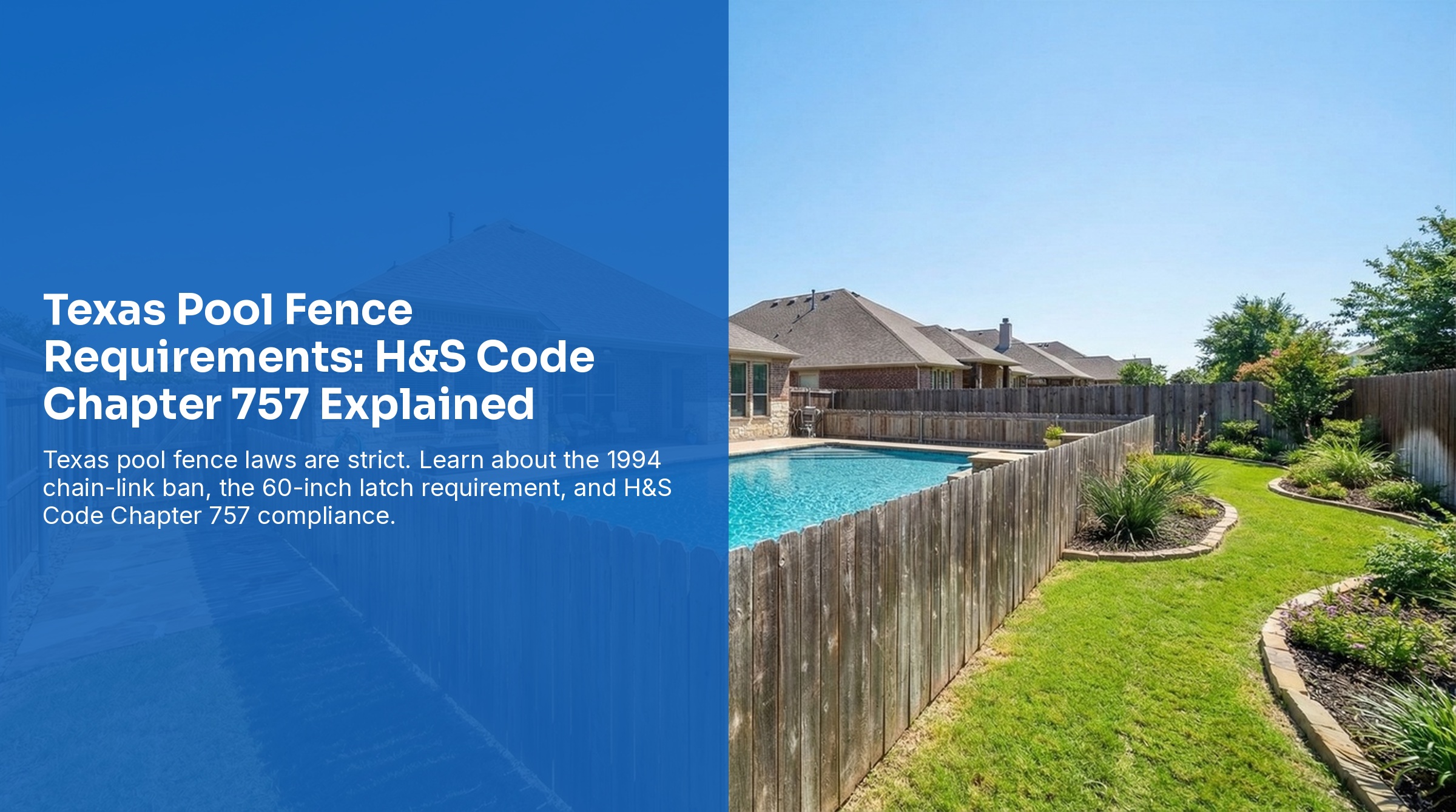
In Texas, pool safety is not just a recommendation; it is a statutory requirement governed primarily by the Texas Health and Safety Code Chapter 757. These laws are designed to create a "child-proof" barrier around pool yards, particularly for multi-unit housing and public facilities. The regulations are specific, addressing everything from the exact height of the fence to the type of material that can be used.[1]H&S Code Chapter 757Swimming Pool Enclosuresstatutes.capitol.texas.gov
Key Takeaways
- 48-Inch Minimum Height — Most pool fences must be at least 4 feet tall[2]25 TAC Chapter 265Public Swimming Pools and Spasdshs.texas.gov
- The Chain-Link Ban — Chain-link is prohibited for any pool built or permitted on or after Sept. 1, 1994[1]H&S Code Chapter 757Swimming Pool Enclosuresstatutes.capitol.texas.gov
- 60-Inch Latch Height — Gate latches must generally be 5 feet high to prevent child access[2]25 TAC Chapter 265Public Swimming Pools and Spasdshs.texas.gov
- Self-Closing Mandate — All gates must be self-closing and self-latching without human assistance[2]25 TAC Chapter 265Public Swimming Pools and Spasdshs.texas.gov
- Passage Limitation — No opening in the fence can allow a 4-inch sphere to pass through[2]25 TAC Chapter 265Public Swimming Pools and Spasdshs.texas.gov
- Indoor Pools — Even pools inside buildings must have compliant entry doors that stay locked[1]H&S Code Chapter 757Swimming Pool Enclosuresstatutes.capitol.texas.gov
The 1994 Chain-Link Ban
One of the most significant and frequently cited aspects of Texas pool law is the prohibition of chain-link fencing. This ban is not universal but is tied to the construction date of the pool. If a building permit was issued on or after September 1, 1994, the pool enclosure cannot be made of chain-link. This is because chain-link is considered an "easily climbable" material that provides ready handholds and footholds for children.[1]H&S Code Chapter 757Swimming Pool Enclosuresstatutes.capitol.texas.gov
"A fence or wall may not be constructed of chain link for a swimming pool or spa for which a building permit was issued on or after September 1, 1994." — Tex. Health & Safety Code Section 757.005(a)
For pools built before this date, chain-link is technically "grandfathered" in, but only until the fence needs replacement. Once a property owner replaces a pre-1994 chain-link fence at a Class C facility, they are prohibited from using chain-link for the new enclosure. This ensures that, over time, all pool barriers in the state transition to safer, non-climbable materials.[1]H&S Code Chapter 757Swimming Pool Enclosuresstatutes.capitol.texas.gov
Gate and Latch Specifications
The gate is often the weakest point in a pool's defenses, and Texas law treats it accordingly. All gates into a pool yard must open outward, away from the pool, and must be equipped with self-closing and self-latching hardware. This ensures that even if a user forgets to close the gate, the mechanism will pull it shut and secure the latch automatically.[2]25 TAC Chapter 265Public Swimming Pools and Spasdshs.texas.gov
The height of the latch is a critical safety threshold. To keep the mechanism out of the reach of small children, Texas requires the latch to be at least 60 inches (5 feet) above the ground. There is a narrow exception: a latch can be as low as 42 inches if the gate is secured by a key, electronic card, or combination lock on both sides. Additionally, the hardware must be positioned so that no opening larger than 1/2 inch exists within 18 inches of the latch, preventing someone from reaching through the fence to trigger the mechanism.[2]25 TAC Chapter 265Public Swimming Pools and Spasdshs.texas.gov
Enforcement and Scope
Chapter 757 primarily targets multi-unit rental complexes (apartments) and property owners associations (HOAs). For these properties, the enclosure must not only be the correct height but must also be free of "horizontal mid-rails" that could serve as a ladder for a child. If a building wall serves as part of the enclosure, any windows in that wall that are lower than 72 inches must be permanently closed or equipped with non-removable screens.[1]H&S Code Chapter 757Swimming Pool Enclosuresstatutes.capitol.texas.gov
Local regulatory authorities, such as city or county health departments, have the right to enter these properties at any reasonable time to inspect for compliance. Failure to maintain a legal enclosure is a violation of the Health and Safety Code and can result in civil suits, injunctive relief, or criminal penalties.[1]H&S Code Chapter 757Swimming Pool Enclosuresstatutes.capitol.texas.gov
Summary Table
| Feature | Requirement | Citation |
|---|---|---|
| Min. Height (Residential/C) | 48 inches | 25 TAC Section 265.184 |
| Min. Height (Public A/B) | 72 inches | 25 TAC Section 265.184 |
| Chain-Link Ban Date | September 1, 1994 | H&S Code Section 757.005 |
| Max Opening/Gap | 4-inch sphere cannot pass | 25 TAC Section 265.184 |
| Gate Direction | Must open outward (away from pool) | 25 TAC Section 265.184 |
| Standard Latch Height | 60 inches | 25 TAC Section 265.184 |
Sources
- [1] Texas Health & Safety Code Chapter 757, Swimming Pool Enclosures. statutes.capitol.texas.gov
- [2] Texas Administrative Code Title 25, Chapter 265 Subchapter L, Public Swimming Pools and Spas. dshs.texas.gov