
Test Strips vs. Reagent Kits: What Pool Pros Actually Use and Why


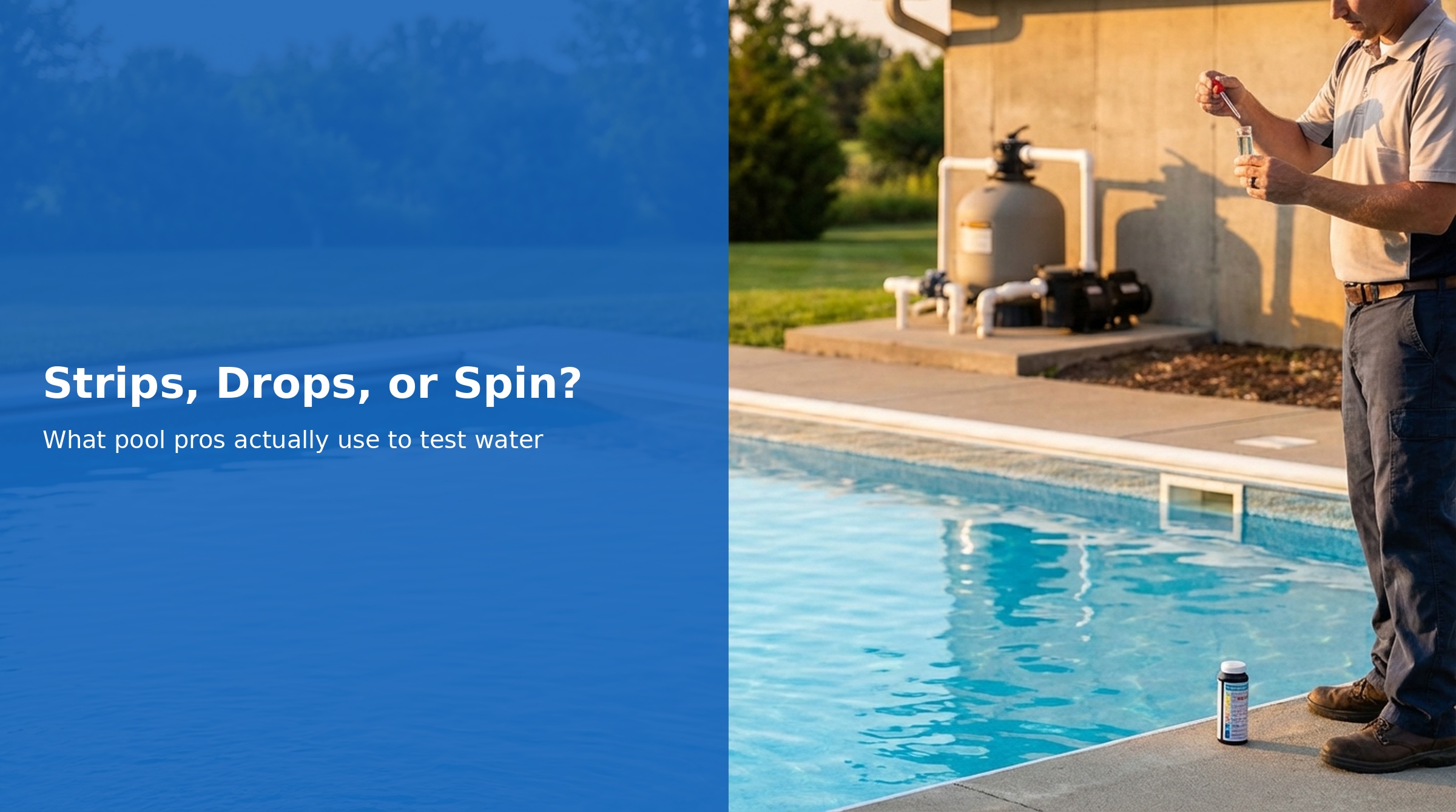
Ask ten pool pros what they use to test water and you'll get twelve opinions. The Taylor K2006C loyalists think strips are a joke. The strip defenders think the Taylor crowd is wasting time. And the spin disk crowd is quietly testing faster than both of them while spending $2.50 per pool to do it.
Here's what pool service professionals actually use, why they use it, and when each testing method makes sense for your business.
Key Takeaways
- Most pros consider reagent kits (Taylor K2005/K2006C) the professional standard — They're the baseline for anyone charging customers to maintain a pool
- Test strips have improved significantly — Aquachek 7-panel strips get close to reagent accuracy when fresh and name-brand
- Many pros use both — Strips for quick daily checks, reagent kit for detailed analysis when something looks off
- Spin disk testers (LaMotte SpinTouch) are the premium option — ~$1,000 upfront plus ~$2.50 per test, with automated readings and app syncing
- The real debate isn't accuracy — It's what standard you hold yourself to as a professional
The Professional Standard: Reagent Drop Kits
The Taylor K2005 and K2006C are what most pool service professionals consider the baseline for water testing. If this is news to you, spend a few minutes in any pool service forum and you'll see why — these kits come up constantly as the minimum standard for professional work.
The K2005 covers the basics: free chlorine, pH, total alkalinity, calcium hardness, and CYA. The K2006C adds the FAS-DPD chlorine test, which gives you a precise FC reading by drop count rather than color matching. That precision matters when you're dosing chemicals based on the results — a reading that's off by 1 ppm of FC can mean the difference between a properly sanitized pool and an algae bloom next week.
These kits run $50-80, and the reagents need replacement roughly once a year (sooner if you're testing 20+ pools per day). The ongoing cost is modest — maybe $80-120 per year in replacement reagents. That's less than the cost of one algae treatment callback.
One thing to watch: reagent shelf life. Taylor reagents have a roughly one-year shelf life once opened. Using expired reagents gives you readings that are worse than strips — at least with strips you know the accuracy range. With degraded reagents, you think you're getting precision you're not. Check your reagent dates regularly and replace them on schedule.
The Case for Test Strips
Not everyone agrees that strips are garbage. The test strip market has improved significantly over the past decade, and certain brands — particularly the Aquachek 7-panel strips — have defenders among experienced technicians.
The key caveats for strip accuracy:
- Must be fresh. Check the expiration date on every bottle. Once opened, use them within 6 months regardless of the printed date. Heat and humidity degrade them fast
- Must be name brand. Aquachek and LaMotte strips are the only ones worth considering. House brands and Amazon generics are genuinely unreliable
- Requires experience to read. Color matching is subjective. Two techs can read the same strip differently. This improves with practice, but it's a real limitation compared to drop-count reagent tests
- Not precise enough for FC. Strips give you a range (e.g., 1-3 ppm). Reagent drop kits give you a specific number. For chemical dosing calculations, specific numbers matter
The practical advantage of strips is speed. A strip test takes 15 seconds. A full Taylor test takes 3-5 minutes. When you're running 25 pools a day, that time difference adds up to over an hour. The question is whether the accuracy trade-off is worth it for routine stops.
The Hybrid Approach
The most common real-world approach among experienced pool pros isn't "strips or reagents" — it's both. Strips for the quick weekly check when everything looks normal, Taylor kit in the truck for when something looks off.
This hybrid approach works because most weekly stops don't require lab-grade precision. If you've been servicing a pool for months, you know its chemistry patterns. A strip that confirms FC is in range and pH hasn't drifted is enough to confidently dose and move on. But when something is wrong — or when you need to establish a baseline — the reagent kit comes out.
Some pros take this a step further and use strips at every pool but do a monthly Taylor test on each one. The monthly reagent test catches any drift that accumulated from strip-based dosing, and it gives you a precise CYA reading that strips are particularly bad at nailing.
Spin Disk Testers: The Premium Option
The LaMotte SpinTouch sits at the top of the testing hierarchy. It's an automated photometer that reads a pre-loaded spin disk — you add the water sample, insert the disk, and the machine reads it with no human color interpretation. Results sync with service apps like Skimmer and PoolBrain.
| Testing Method | Upfront Cost | Per-Test Cost | Time per Test | Accuracy |
|---|---|---|---|---|
| Test strips (Aquachek 7) | $15 – $25 | ~$0.25 | 15 seconds | Good (with caveats) |
| Taylor K2005 | $50 – $65 | ~$0.15 | 3 – 5 minutes | Very good |
| Taylor K2006C (FAS-DPD) | $65 – $80 | ~$0.15 | 4 – 6 minutes | Excellent |
| LaMotte SpinTouch | ~$1,000 | ~$2.50 | 60 seconds | Excellent |
Where the SpinTouch shines is commercial work, startups building credibility, and situations where you need indisputable records. Health departments love printed test results from a calibrated instrument. So do property managers, HOAs, and any customer who has ever questioned your chemical recommendations.
Some pros buy the SpinTouch specifically for new customer onboarding — use it for the first visit to establish a precise baseline, then switch to reagent or hybrid testing for ongoing maintenance. The printed report from the first visit builds trust and justifies your pricing.
The Liquid Chlorine vs. Tabs Connection
One thread that consistently surfaces in the test kit debate: pros who invest in better testing tend to make better chemical decisions, which saves them money in other areas.
The connection is straightforward: accurate testing drives better chemical decisions. When you know your exact FC and CYA levels, you can optimize your chlorine delivery method. When you're guessing based on fuzzy strip readings, you tend to overdose "just to be safe" — which costs more in chemicals and creates its own problems (high CYA from tab overuse being the most common).
Better testing also makes it easier to spot problems before they become expensive. A precise FC reading that's trending down over several visits tells you something is consuming chlorine — maybe phosphates, maybe a developing algae issue, maybe a bather load change. A strip that says "somewhere between 1 and 3 ppm" every week won't catch that trend.
Cold Weather Considerations
Here's a practical factor that rarely comes up in the "strips vs. reagents" debate: temperature.
If you operate in a climate where your truck gets below freezing overnight, this is a legitimate reason to keep strips on hand even if you prefer reagents. Frozen reagents aren't just inconvenient — they may give inaccurate readings even after thawing, depending on which reagents froze and how many freeze-thaw cycles they've been through. You won't necessarily know the readings are wrong.
The workaround some pros use: bring the Taylor kit inside every night during winter and leave strips in the truck as a backup. But if your route starts early and you forget to grab the kit, those strips are your only option. Keep a fresh bottle in the truck at all times.
What Your Testing Method Says About Your Business
The real debate isn't strips vs. drops — it's the standard you set for yourself and your team. Your testing method is a signal to customers, to health inspectors, and to yourself about the level of service you provide.
Multiple pros noted that pulling out a proper test kit in front of a customer immediately differentiates you from the competition. Customers notice when you take testing seriously — and they notice when the last company was dipping a strip and eyeballing it while walking back to the truck.
For commercial pools especially, reagent or spin disk results hold up better during health department inspections. A strip that says "pH looks like it's around 7.4" is not the same as a drop test that reads exactly 7.4. When there's a compliance question, precision matters.
But testing is only one piece of the professionalism equation. Digital logging of your test results — with timestamps, GPS location, and chemical additions recorded — adds another layer regardless of your testing method. A strip reading logged in software with a timestamp is more useful than a Taylor reading that lives only in your head.
If you're managing a team, your testing standard also affects hiring and training. If your company uses Taylor kits, new hires need to learn the FAS-DPD test, understand drop counts, and practice reading color comparators. If you use strips, the training is simpler but the margin for error is higher. The nuances of water chemistry are easier to teach when your testing method gives you clear, precise data to reference.
Log every test, every visit, every pool
PoolDial records your chemical readings with timestamps so you can track trends, justify your chemical decisions, and show customers their pool's history. Works with any testing method — Taylor, strips, or SpinTouch.
Start Your Free Trial