
Florida Pool Technician Certification: FAC 64E-9.018 Requirements


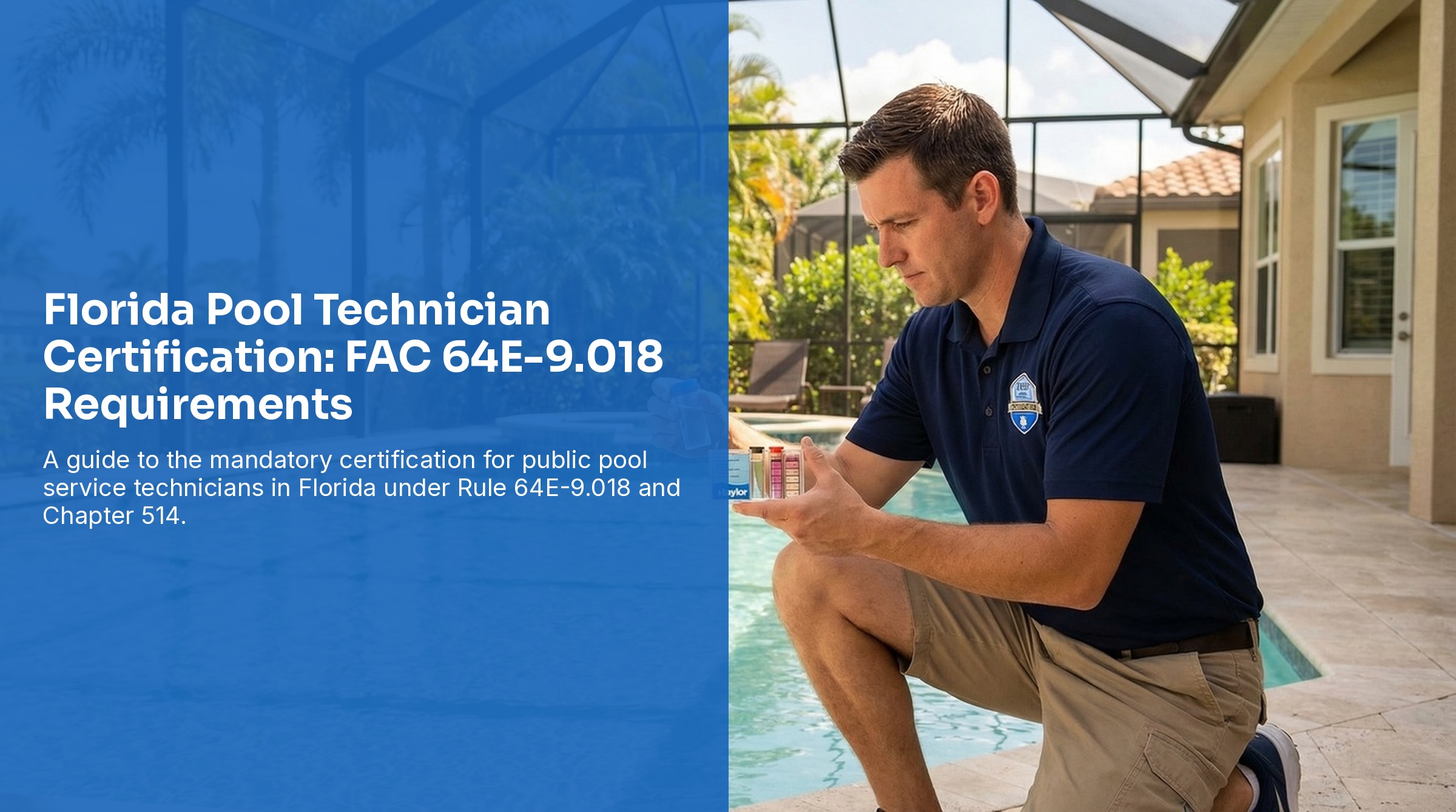
In Florida, maintaining a public swimming pool is a regulated profession that requires specific technical knowledge.[1]FAC 64E-9.008Supervision and Safetyflrules.org The Florida Department of Health mandates that anyone servicing a public pool must be certified, ensuring that the individuals responsible for water chemistry and mechanical systems are properly trained.[2]Chapter 515, Florida StatutesResidential Swimming Pool Safety Actflsenate.gov This requirement protects the health of millions of residents and tourists who use commercial and multi-family pools every year.
Key Takeaways
- Commercial Mandate — Certification is required for anyone servicing "public" pools, which includes those at apartments and hotels[1]FAC 64E-9.008Supervision and Safetyflrules.org
- Department Approval — Training courses must be approved by the Florida Department of Health[2]Chapter 515, Florida StatutesResidential Swimming Pool Safety Actflsenate.gov
- Rule Authority — The specific requirements for certification are detailed in Florida Administrative Code Rule 64E-9.018[3]FAC 64E-9.018Public Pool Service Technician Certificationflrules.org
- Sanitation Focus — Training ensures technicians understand sanitation and safety criteria[4]§514.011, Florida StatutesDefinitionsflsenate.gov
- Legislative Basis — The certification requirement is grounded in Section 514.075 of the Florida Statutes[1]FAC 64E-9.008Supervision and Safetyflrules.org
Who Must Be Certified?
The requirement for certification applies to any person performing service or maintenance on a "public swimming pool."[1]FAC 64E-9.008Supervision and Safetyflrules.org Because Florida's definition of a public pool is broad, this affects a large segment of the pool service industry. Any pool serving a cooperative living project of five or more units—such as an apartment complex, a hotel, or a large townhouse community—is legally classified as a public pool.[5]§514.0315, Florida StatutesRequired Safety Featuresflsenate.gov
Service professionals who only work on private, single-family residential pools are not currently required by state law to hold this specific technician certification. However, for those looking to expand into the commercial or multi-family market, obtaining a certification through an approved provider like the National Swimming Pool Foundation is a critical step for legal compliance.[2]Chapter 515, Florida StatutesResidential Swimming Pool Safety Actflsenate.gov The Department of Health maintains the authority to grant variances for specific training programs, provided they meet the state's educational standards.
"Public pool service technician; certification.—An individual who services a public pool by maintaining the cleanliness, water quality, and chemical balance of the pool shall be certified. The department shall adopt rules to implement this section." — §514.075, Florida Statutes
Training and Educational Standards
The certification process involves completing a comprehensive training course that covers the essential aspects of pool operation.[1]FAC 64E-9.008Supervision and Safetyflrules.org These courses typically focus on water chemistry, filtration systems, and the legal requirements for public pool safety.[4]§514.011, Florida StatutesDefinitionsflsenate.gov The goal is to ensure that technicians can maintain the "sanitation and safety criteria" required by the state to prevent waterborne illnesses and accidents.
Historically, the Florida Administrative Code has been updated to accommodate modern training methods, including a mix of classroom and online instruction.[2]Chapter 515, Florida StatutesResidential Swimming Pool Safety Actflsenate.gov For example, the Department of Health has issued orders regarding the certification of training courses that utilize blended learning models. This flexibility allows service professionals to maintain their credentials while keeping up with the latest developments in pool technology and water quality standards.
Compliance and Enforcement
Operating without the proper certification can lead to significant issues for both the service technician and the property owner.[1]FAC 64E-9.008Supervision and Safetyflrules.org The Florida Department of Health has the authority to deny, suspend, or revoke operating permits for public pools that are not maintained according to state standards. This oversight ensures that the individuals tasked with managing complex pool systems are held accountable for the safety of the public.
The rule governing these technicians, FAC 64E-9.018, has been a cornerstone of Florida's public health strategy since it was first introduced in 1997.[3]FAC 64E-9.018Public Pool Service Technician Certificationflrules.org Since then, it has been amended multiple times to reflect changes in state statutes and advancements in the pool industry. Technicians must stay informed about these updates to ensure their certifications remain valid and that they are following the most current operational requirements.
Summary Table
| Requirement | Details | Citation |
|---|---|---|
| Primary Statute | Mandatory certification for public pool techs | §514.075 F.S. |
| Primary Rule | Public Pool Service Technician Certification | FAC 64E-9.018 |
| Applicability | Pools serving 5+ living units | §514.011(2) F.S. |
| Oversight Agency | Florida Department of Health | §514.011(1) F.S. |
| History | Rule effective since May 24, 2009 (current version) | FAC 64E-9.018 |
Sources
- [1] Florida Administrative Code Rule 64E-9.008, Supervision and Safety. flrules.org
- [2] Chapter 515, Florida Statutes, Residential Swimming Pool Safety Act. flsenate.gov
- [3] Florida Administrative Code Rule 64E-9.018, Public Pool Service Technician Certification. flrules.org
- [4] §514.011, Florida Statutes, Definitions. flsenate.gov
- [5] §514.0315, Florida Statutes, Required Safety Features. flsenate.gov