
California Pool Service Legal Requirements: The Complete Compliance Guide


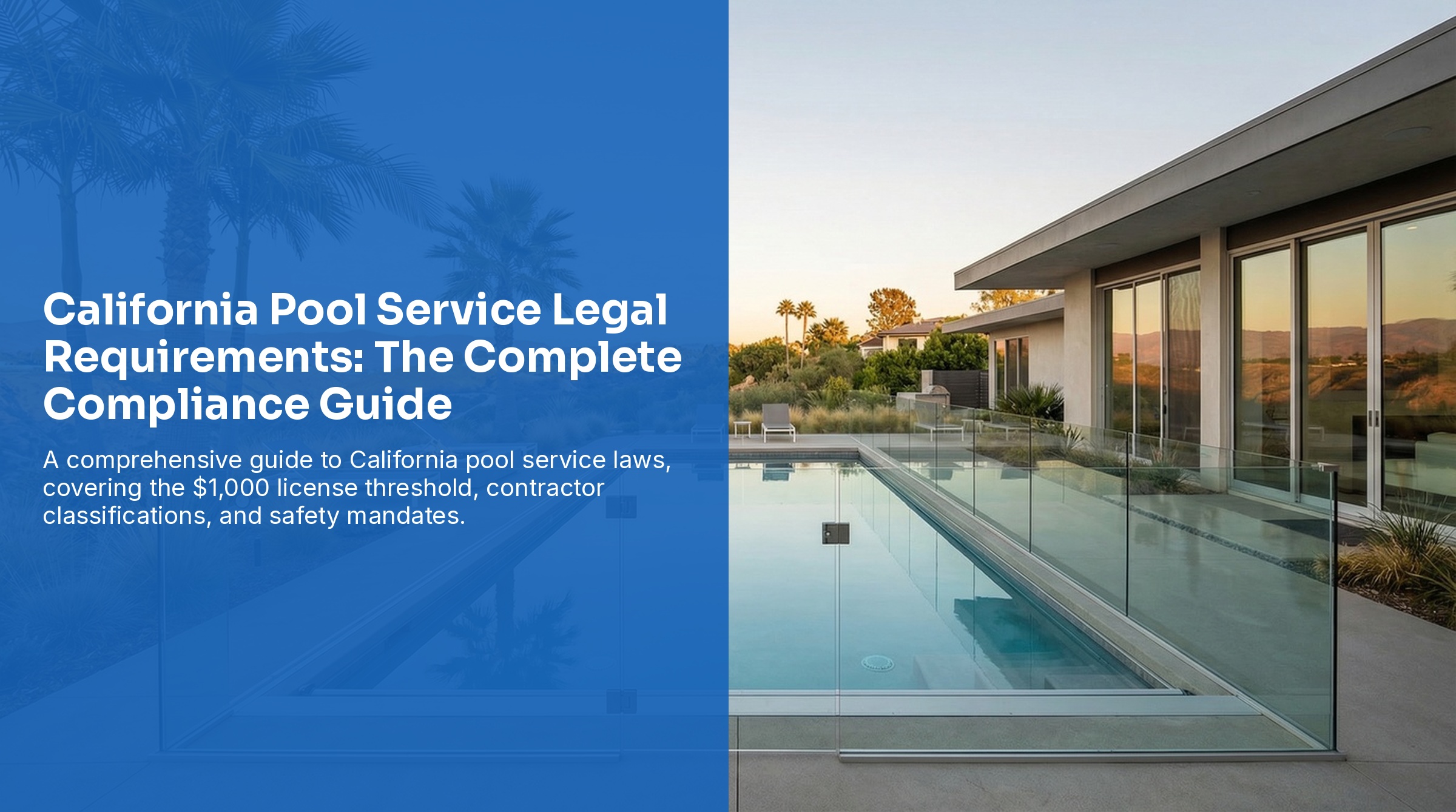
California maintains some of the most rigorous and complex regulations for the pool and spa industry in the United States. For pool service professionals, staying compliant requires navigating a landscape of state-level licensing, energy efficiency standards, and local county certifications. Failure to adhere to these standards can result in significant administrative fines, legal action, and the inability to legally collect payment for work performed.[1]AB 2622 Press ReleaseLicense Threshold Updatecslb.ca.gov
Key Takeaways
- $1,000 License Threshold — Effective 2025, any project exceeding $1,000 (labor and materials) requires a CSLB license[1]AB 2622 Press ReleaseLicense Threshold Updatecslb.ca.gov
- C-53 vs. D-35 Classification — Major construction requires a C-53 license, while maintenance and specific repairs fall under D-35[2]C-53 ClassificationSwimming Pool Contractorcslb.ca.gov
- Mandatory Safety Features — New and remodeled residential pools must have at least two of seven approved drowning prevention features
- Workers' Compensation — Coverage is required for all businesses with at least one employee, with no exemptions[4]DIR Workers' CompensationRequirements for Employersdir.ca.gov
- Title 24 Energy Compliance — New heating systems must comply with 2026 heat pump mandates
- LA County Certification — Technicians in Los Angeles County must obtain a separate local health department certification
Contractor Licensing and the $1,000 Threshold
The legal foundation for pool contractor licensing in California is the Contractors State License Board (CSLB). As of 2025, the legal landscape has shifted, specifically regarding the threshold for unlicensed work and the definitions of maintenance vs. construction.[1]AB 2622 Press ReleaseLicense Threshold Updatecslb.ca.gov
A major regulatory shift occurred on January 1, 2025, with the implementation of Assembly Bill 2622. This law increased the threshold for work requiring a license from $500 to $1,000. An unlicensed person can only perform small projects where the total cost—including labor and materials—is under $1,000, and only if no building permits are required and they do not hire employees.[1]AB 2622 Press ReleaseLicense Threshold Updatecslb.ca.gov
"If an unlicensed person provides a bid greater than $1,000, performs work requiring a permit, or employs any workers, that person is subject to legal action." — CSLB Press Release
Understanding the C-53 and D-35 Classifications
The CSLB categorizes pool-related work into two main specialties. The C-53 Swimming Pool Contractor is the comprehensive construction license. According to the California Code of Regulations, a C-53 contractor "constructs swimming pools, spas or hot tubs, including installation of solar heating equipment using those trades or skills necessary for such construction." This license is required for any professional taking a project from excavation to completion.[2]C-53 ClassificationSwimming Pool Contractorcslb.ca.gov
For professionals focused on the service and repair side of the industry, the C-61/D-35 Pool and Spa Maintenance classification is more appropriate. This license allows for the installation and repair of motors, pumps, filters, and heaters, as well as the application of vinyl liners to existing surfaces. Importantly, a D-35 license is a "limited specialty" license, often requiring a different examination process than the full C-53.[3]D-35 ClassificationPool and Spa Maintenancecslb.ca.gov
Financial and Insurance Obligations
Beyond the license itself, contractors must meet several financial obligations. A significant barrier to entry and a tool for consumer protection is the contractor's bond, currently set at $25,000. Additionally, for projects involving home improvement, contractors are strictly limited in the down payments they can collect.
"Contractors... constructing accessory dwelling units (ADUs), performing home improvement work... shall not receive a down payment of more than $1,000, or 10 percent of the contract price, whichever is less." — CSLB Home Improvement Payment Reminder
Insurance is equally critical. California law requires workers' compensation insurance for all employees. This requirement is absolute; there are no exceptions for family members or part-time help.[4]DIR Workers' CompensationRequirements for Employersdir.ca.gov
Penalties and Enforcement
The CSLB actively enforces licensing laws through undercover stings and consumer complaints. Penalties for unlicensed contracting are severe, including administrative fines of up to $15,000 and jail sentences of up to six months for a first offense. Repeat offenders face even harsher consequences, including a mandatory 90-day jail sentence and fines either of $5,000 or 20% of the contract price, whichever is greater.
Summary Table
| Requirement | Details | Citation |
|---|---|---|
| C-53 License | For pool construction and solar install | 16 CCR SS832.53 |
| D-35 License | For equipment maintenance and liners | 16 CCR SS832.61 |
| License Threshold | Projects over $1,000 require a license | Bus. & Prof. Code SS7048 |
| Max Down Payment | Lower of $1,000 or 10% of total | CSLB Alert |
| Penalty (Unlicensed) | Up to $15,000 fine and jail time | Bus. & Prof. Code SS7028 |
| Workers' Compensation | Required for all employees, no exceptions | Labor Code SS3700 |
Sources
- [1] AB 2622 Press Release, CSLB License Threshold Update. cslb.ca.gov
- [2] C-53 Swimming Pool Contractor Classification. cslb.ca.gov
- [3] D-35 Pool and Spa Maintenance Classification. cslb.ca.gov
- [4] DIR Workers' Compensation Requirements. dir.ca.gov