
California Gas Pool Heater Ban: What You Need to Know Before 2026


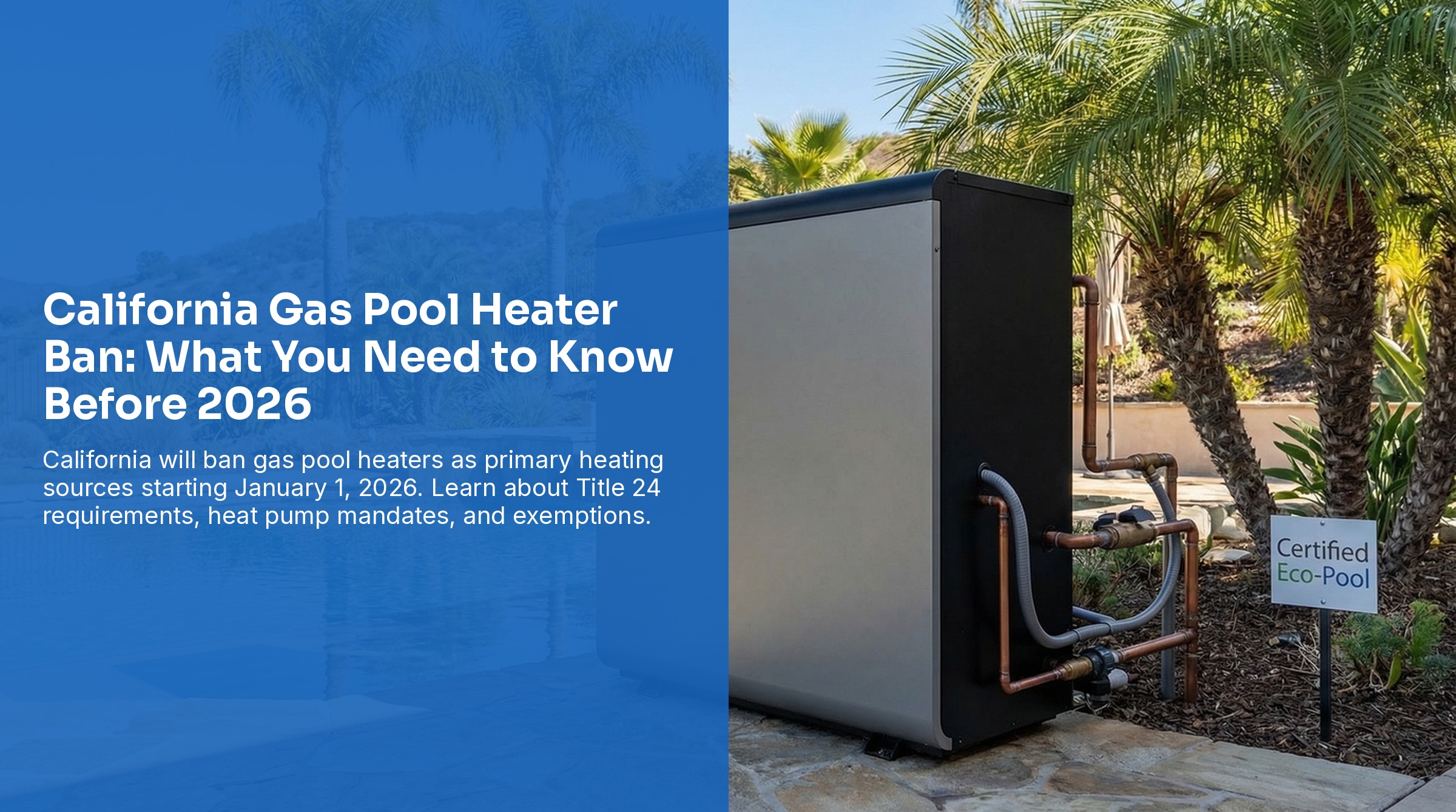
The California Energy Commission has formally adopted the 2025 Building Energy Efficiency Standards, marking a historic shift in how the state's residential and commercial pools are heated.[1]2025 Building Energy Efficiency StandardsCalifornia Energy Commissionenergy.ca.gov Effective January 1, 2026, new regulations will effectively prohibit gas-fired heaters as the primary heating source for newly constructed pools and spas.[2]EnergyCodeAce Pool and Spa Fact SheetPool and Spa Heating Requirementsenergycodeace.com This transition is a cornerstone of California's broader climate strategy, estimated to save 10.2 million therms of natural gas and reduce greenhouse gas emissions by over 57,000 metric tons in its first year alone.[3]Service Industry NewsCEC Adopts 2025 Title 24serviceindustrynews.net
Key Takeaways
- January 1, 2026 Effective Date — Buildings with permit applications submitted on or after this date must comply with the 2025 Energy Code[1]2025 Building Energy Efficiency StandardsCalifornia Energy Commissionenergy.ca.gov
- Heat Pumps or Solar Mandated — New pools must use heat pumps or solar systems as the primary heating method[2]EnergyCodeAce Pool and Spa Fact SheetPool and Spa Heating Requirementsenergycodeace.com
- Gas Heaters Restricted to Supplemental — Gas can no longer be a primary heat source but may serve as a supplemental heater in specific configurations[2]EnergyCodeAce Pool and Spa Fact SheetPool and Spa Heating Requirementsenergycodeace.com
- Existing Pool Exemptions — Alterations to existing pools with existing heating systems are exempt, allowing for like-for-like gas heater replacements[3]Service Industry NewsCEC Adopts 2025 Title 24serviceindustrynews.net
- Sizing Requirements — Heat pump pool heaters (HPPH) must be sized according to manufacturer recommendations or specific Joint Appendix JA16.3 guidelines[2]EnergyCodeAce Pool and Spa Fact SheetPool and Spa Heating Requirementsenergycodeace.com
The 2025 Energy Code Transition
The 2025 Energy Code, specifically Title 24, Part 6, mandates a shift toward high-efficiency electric heating to reduce wasteful energy consumption.[1]2025 Building Energy Efficiency StandardsCalifornia Energy Commissionenergy.ca.gov Under these revised standards, any newly installed pool or spa heating system must utilize one of five specific configurations designed to minimize environmental impact.[2]EnergyCodeAce Pool and Spa Fact SheetPool and Spa Heating Requirementsenergycodeace.com The most common compliant options include solar pool heating systems with a collector area equivalent to at least 60% to 65% of the pool's surface area, or electric heat pump pool heaters.
California's policy goal is to align pool operations with the state's decarbonization targets, as pool heating represents one of the highest natural gas and greenhouse gas savings measures in the 2025 portfolio.[3]Service Industry NewsCEC Adopts 2025 Title 24serviceindustrynews.net While gas heaters have traditionally been the standard for rapid heating, the California Statewide Codes and Standards Enhancement (CASE) Team found that heat pump pool heaters are cost-effective across all California climate zones.
"Pool and spa heating systems shall be heat pump pool heaters or solar pool heating systems..." — Cal. Code Regs. tit. 24, Section 150.0(p)
Definitions and Scope of Enforcement
The regulation is triggered by the submission of a building permit application on or after January 1, 2026.[1]2025 Building Energy Efficiency StandardsCalifornia Energy Commissionenergy.ca.gov It applies strictly to "new construction," which the Energy Commission defines as the building of a new pool or spa, or the addition of a heating system to an existing pool or spa that was previously unheated. This distinction is critical for pool professionals and homeowners to understand: simply replacing an old heater on an already heated pool is considered a "repair" or "alteration" and does not trigger the new heat pump requirement.
Furthermore, the code differentiates between residential and public pools. Public pools include those in multifamily settings (like apartments or HOAs) and commercial facilities like hotels. While the core heating requirements are similar, the documentation and compliance forms vary between single-family residential projects and nonresidential or multifamily installations.[2]EnergyCodeAce Pool and Spa Fact SheetPool and Spa Heating Requirementsenergycodeace.com
Exemptions and Replacement Rules
Significant concessions were secured by industry advocates to ensure flexibility for existing infrastructure. Most notably, Exception 2 of Section 110.4(c) exempts alterations to existing pools or spas that already have heating systems.[3]Service Industry NewsCEC Adopts 2025 Title 24serviceindustrynews.net This means if a multifamily or residential pool has an existing gas connection and gas heater, the owner can replace it with another gas heater when it fails. This acknowledges the technical challenges of retrofitting older equipment areas that may lack the electrical capacity or physical space required for a properly sized heat pump.
Additional exemptions apply to portable electric spas that comply with Title 20 appliance standards, and permanent spas in existing buildings where gas is already available. There is also a "Solar Access Roof Area" (SARA) exception for permanent spas where a solar assessment proves there is inadequate roof space for a solar heating system.[2]EnergyCodeAce Pool and Spa Fact SheetPool and Spa Heating Requirementsenergycodeace.com
"The exception would enable pools in all those settings to be replaced with another gas heater when a replacement or update to the pool or spa heating system is needed." — Service Industry News
Preparing for the Transition
Pool professionals must prepare customers for higher initial equipment costs and different performance characteristics. Unlike gas heaters that provide rapid "on-demand" heating, heat pumps operate most efficiently by maintaining a consistent temperature over longer periods. Contractors must also ensure that all new equipment is certified and listed in the Modernized Appliance Efficiency Database System (MAEDbS).[1]2025 Building Energy Efficiency StandardsCalifornia Energy Commissionenergy.ca.gov
Heat pump pool heaters require proper sizing to meet customer expectations. The Joint Appendix JA16.3 provides specific guidelines for sizing these units based on pool surface area, desired temperature rise, and climate zone. Pool service companies should familiarize themselves with these calculations to provide accurate quotes and set appropriate customer expectations about heating times.
Summary Table
| Requirement | Details | Effective Date | Citation |
|---|---|---|---|
| Primary Heating Source | Must be Heat Pump or Solar | Jan 1, 2026 | Cal. Code Regs. tit. 24, Section 110.4(c) |
| Gas Heater Use | Supplemental only for new pools | Jan 1, 2026 | Cal. Code Regs. tit. 24, Section 110.4(c) |
| Replacement Rule | Gas-to-gas allowed for existing heated pools | Jan 1, 2026 | Cal. Code Regs. tit. 24, Section 110.4(c) Exc. 2 |
| Sizing Mandate | Must follow JA16.3 or manufacturer specs | Jan 1, 2026 | Cal. Code Regs. tit. 24, Section 110.4(c)2 |
| Pilot Lights | Continuously burning pilot lights prohibited | Current | Cal. Code Regs. tit. 24, Section 110.5(c) |
Sources
- [1] 2025 Building Energy Efficiency Standards, California Energy Commission. energy.ca.gov
- [2] EnergyCodeAce Pool and Spa Fact Sheet. energycodeace.com
- [3] Service Industry News: CEC Adopts 2025 Title 24. serviceindustrynews.net