
Arizona Pool Service Legal Requirements: The Complete Compliance Guide


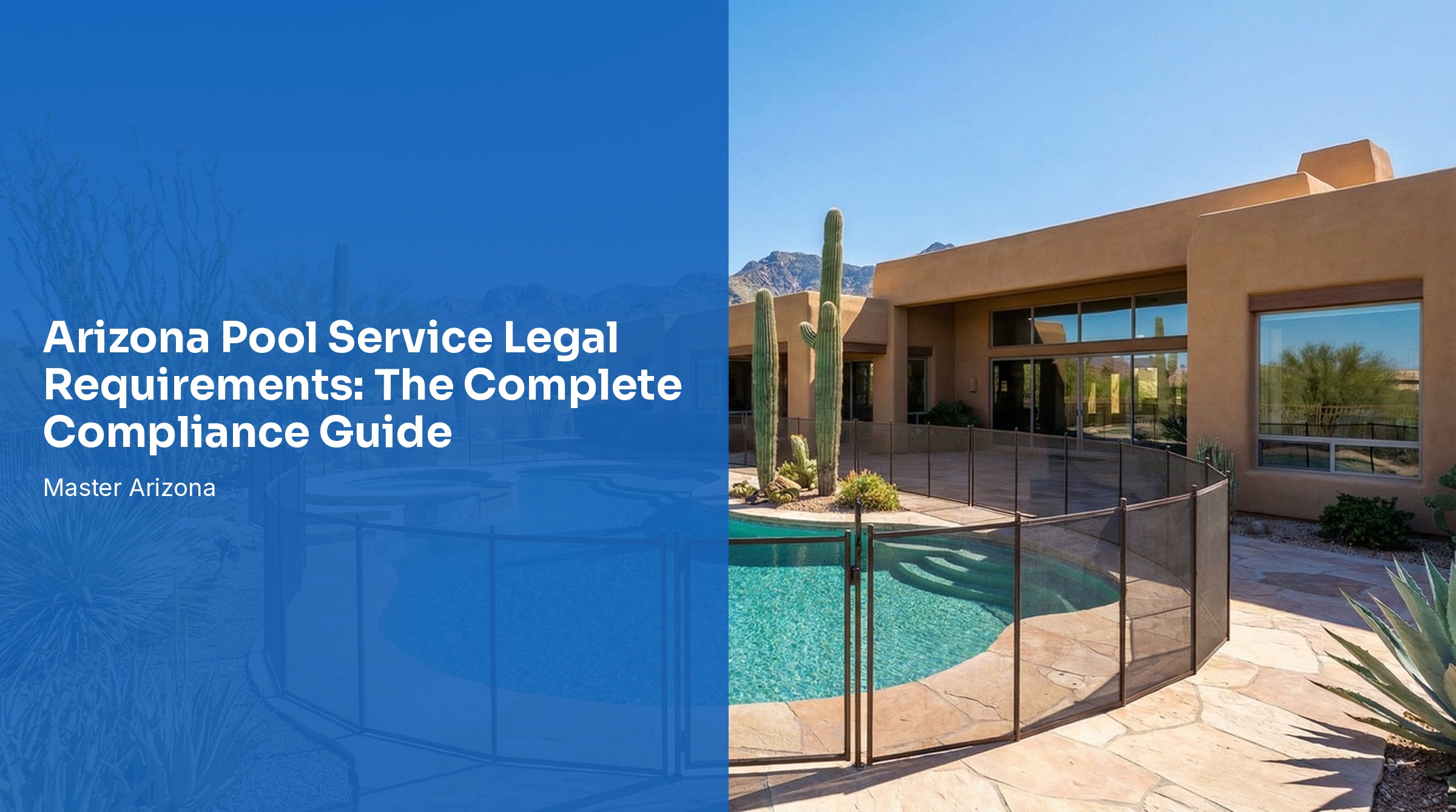
Arizona ranks among the top states for residential pool ownership, driven by its desert climate and year-round swimming season. The state has developed a comprehensive regulatory framework through Arizona Revised Statutes (ARS), Arizona Administrative Code (AAC), and local county health codes. These regulations govern everything from residential pool enclosures to public facility water quality standards, creating a layered compliance landscape for pool service professionals.[1]ARS 36-1681Swimming Pool Enclosures; Definitionsazleg.gov
Key Takeaways
- The 5-Foot Rule — Arizona law requires pool enclosures to be at least five feet high, exceeding the four-foot standard found in many other states[1]ARS 36-1681Swimming Pool Enclosures; Definitionsazleg.gov
- No Cleaning License Required — Unlike many jurisdictions, Arizona does not require a state contractor's license for basic pool cleaning and routine maintenance[2]ARS 32-1101Definitionsazleg.gov
- ROC Construction Thresholds — A license from the Registrar of Contractors (ROC) is mandatory for any pool construction, repair, or structural service involving compensation[3]ARS 32-1122License Required; Postingazleg.gov
- Public Pool Water Quality — Public facilities must maintain a pH between 7.2 and 7.8 and test chemical levels daily[4]AAC Title 9, Chapter 8Public Swimming Pools and Spasazsos.gov
- Maricopa County Permits — In the Phoenix metro area, operating permits are required for all public and semi-public bodies of water, though private residential pools are exempt[5]Maricopa County Public Swimming PoolsPermits and Inspectionsmaricopa.gov
- Strict Gate Standards — All enclosure gates must open outward, be self-closing, and feature a self-latching mechanism[1]ARS 36-1681Swimming Pool Enclosures; Definitionsazleg.gov
- Compliance Penalties — Violations of pool safety statutes are generally classified as petty offenses, though fines may be waived if the hazard is remediated within 45 days[1]ARS 36-1681Swimming Pool Enclosures; Definitionsazleg.gov
Arizona Pool Barrier and Enclosure Laws
Arizona Revised Statutes section 36-1681 establishes the state's pool enclosure requirements. The law mandates that any swimming pool wider than eight feet and deeper than eighteen inches must be protected by an enclosure surrounding the pool area. This requirement applies to both new construction and existing pools that meet these size thresholds.[1]ARS 36-1681Swimming Pool Enclosures; Definitionsazleg.gov
The most notable distinction in Arizona law is the five-foot minimum fence height requirement, measured from the exterior side of the enclosure. This exceeds the four-foot standard commonly found in other states and the International Swimming Pool and Spa Code. Additionally, barriers must not contain handholds or footholds that could enable climbing, must be located at least twenty inches from the water's edge, and openings must be small enough to block passage of a four-inch diameter ball.[1]ARS 36-1681Swimming Pool Enclosures; Definitionsazleg.gov
"A swimming pool... shall be protected by an enclosure surrounding the pool area... [that is] entirely enclosed by at least a five foot wall, fence or other barrier as measured on the exterior side." — ARS 36-1681(A-B)
Contractor Licensing and the Cleaning Exemption
Arizona's contractor licensing framework creates a clear distinction between pool cleaning services and construction-related work. Under ARS Title 32, basic pool cleaning, chemical balancing, and routine maintenance do not require a state contractor's license. This exemption allows entrepreneurs to enter the pool service industry without the regulatory burden of ROC licensing for cleaning-only operations.[2]ARS 32-1101Definitionsazleg.gov
However, the moment services extend into construction territory, licensing requirements apply. Arizona law defines contracting as the act of constructing, altering, repairing, or adding to any pool structure for compensation. This means pump replacements, heater installations, surface patching, and similar mechanical or structural work require an active ROC license. Individuals convicted of unlicensed contracting face a one-year prohibition on obtaining a license.[3]ARS 32-1122License Required; Postingazleg.gov
Public and Semi-Public Pool Regulations
Arizona Administrative Code Title 9, Chapter 8 governs the operation of public and semi-public swimming pools and spas throughout the state. The code distinguishes between semi-public facilities (those serving motels, apartments, and RV parks) and public facilities (those open to the general population or operated by governmental entities). Both categories face stringent operational requirements.[4]AAC Title 9, Chapter 8Public Swimming Pools and Spasazsos.gov
Operators must maintain daily operating logs documenting water chemistry parameters. Free chlorine levels must be maintained between 1.0 and 3.0 parts per million, with pH held between 7.2 and 7.8. Public facilities must also be equipped with Coast Guard-approved ring buoys and maintain specific safety equipment inventories. Testing of chemical disinfection levels, pH, total alkalinity, and temperature must occur at least once daily.[4]AAC Title 9, Chapter 8Public Swimming Pools and Spasazsos.gov
"An operator of a public or semipublic swimming pool or spa shall ensure that... the chemical disinfection level, pH, total alkalinity, and temperature of the water is tested at least once daily." — AAC R9-8-803(A)(5)
Maricopa County and Regional Enforcement
Local building departments serve as the primary enforcement mechanism for Arizona pool regulations. In the Phoenix metropolitan area, Maricopa County Environmental Health Code imposes additional requirements beyond state minimums. The county requires operating permits for all public and semi-public bodies of water, with private residential pools exempt from permitting requirements.[5]Maricopa County Public Swimming PoolsPermits and Inspectionsmaricopa.gov
Notably, Maricopa County requires six-foot fences for public facilities, exceeding the state's five-foot residential standard. The county also offers advisory inspections for a $135 fee, allowing property owners to identify compliance issues before formal enforcement actions. These inspections can help pool service professionals guide their clients toward full regulatory compliance.[6]Maricopa County Health Code Ch 6Section 6 - Public Swimming Poolsmaricopa.gov
Drowning Prevention Requirements
Arizona law includes specific provisions aimed at preventing drowning accidents. When a residential property with a swimming pool is sold or rented, the seller or landlord must provide a written notice of safety responsibilities to the buyer or tenant. This notice requirement underscores the state's emphasis on pool safety awareness and the shared responsibility between property owners, occupants, and service professionals.[7]AZDHS Residential Pool Safety NoticeRequired Safety Disclosureazdhs.gov
Summary Table
| Requirement | Details | Citation |
|---|---|---|
| Minimum Enclosure Height | 5 feet residential; 6 feet Maricopa public | ARS 36-1681 / Maricopa Health Code |
| Cleaning License | Not required for basic maintenance | ARS Title 32 |
| ROC License | Required for construction/alteration/mechanical | ARS 32-1101 |
| Gate Requirements | Self-closing, self-latching, opens outward | ARS 36-1681 |
| Water pH Level | 7.2 to 7.8 | AAC R9-8-803 |
| Testing Frequency | Daily for public/semi-public | AAC R9-8-803 |
| Drowning Prevention | Notice of safety responsibilities at sale/rent | ARS 36-1681(E) |
Sources
- [1] ARS 36-1681, Swimming Pool Enclosures; Definitions. azleg.gov
- [2] ARS 32-1101, Contractor Definitions. azleg.gov
- [3] ARS 32-1122, ROC Licensing Requirements. azleg.gov
- [4] Arizona Administrative Code Title 9, Chapter 8, Public Swimming Pools and Spas. azsos.gov
- [5] Maricopa County Public Swimming Pools, Permits and Inspections. maricopa.gov
- [6] Maricopa County Health Code Chapter 6, Section 6 - Public Swimming Pools. maricopa.gov
- [7] AZDHS Residential Pool Safety Notice. azdhs.gov