
What Does Gallonage Mean in Pool Service? SLANG


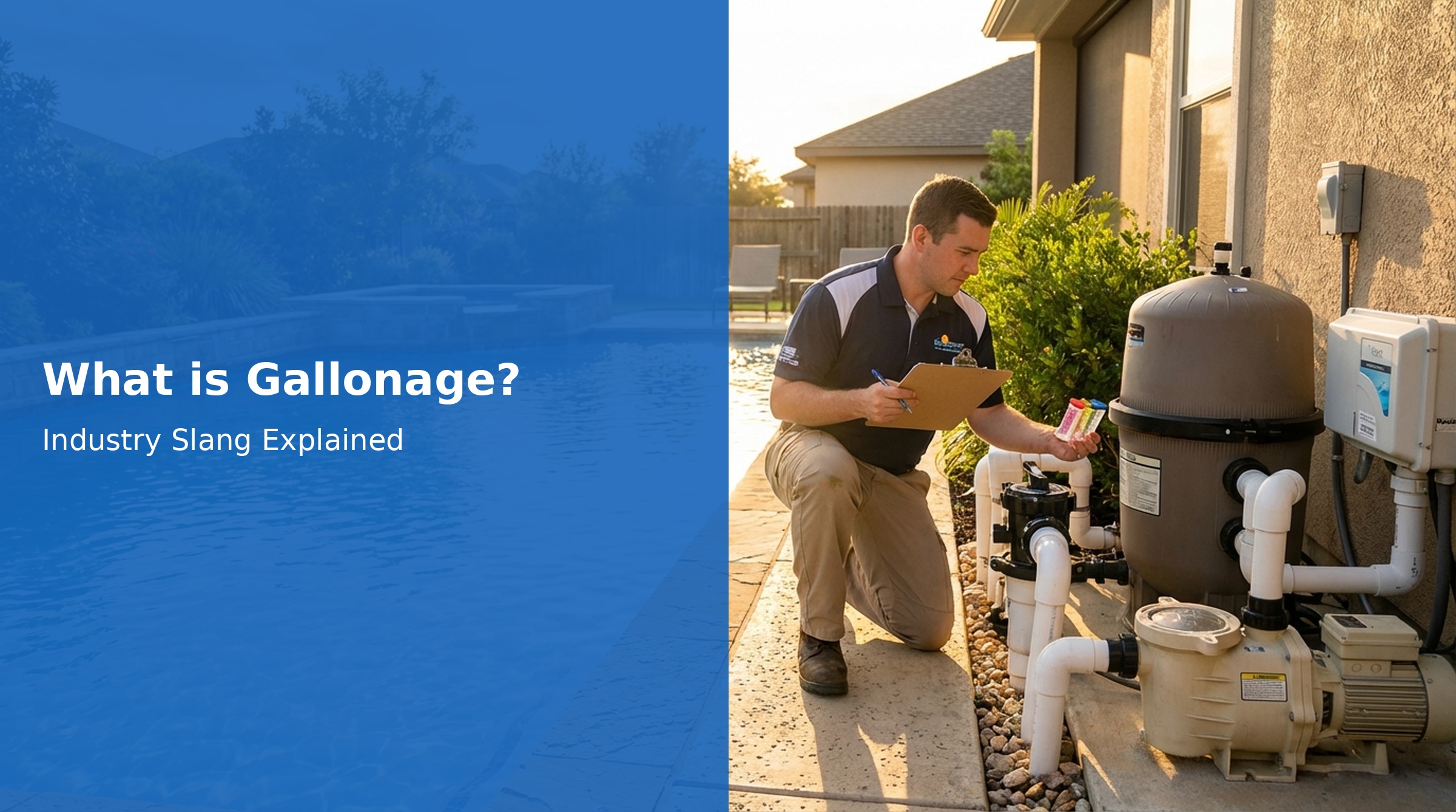
In the pool service industry, precision matters—especially when it comes to chemical treatments, equipment sizing, and maintenance planning. While homeowners might casually refer to their "big pool" or "small pool," professionals need exact measurements. That's where the term "gallonage" comes into play. This industry slang refers to the total volume of water a pool contains, measured in gallons, and it's one of the most critical numbers every pool technician must know.
Key Takeaways
- Gallonage refers to the total water volume in a pool, measured in gallons
- Accurate gallonage is essential for proper chemical dosing and equipment sizing
- Pool shape, depth variations, and features affect total gallonage calculations
- Always verify gallonage calculations rather than relying on customer estimates
- Digital tools and apps can streamline gallonage calculations for complex pool shapes
Understanding Pool Gallonage: More Than Just Numbers
Gallonage isn't just technical jargon—it's the foundation of effective pool service. Every chemical treatment, from basic chlorination to complex pH adjustments, depends on knowing exactly how much water you're treating. When a service tech asks, "What's the gallonage on this pool?" they're gathering the most important piece of data needed to provide professional service.
Unlike simple area measurements that only account for surface space, gallonage represents the actual water volume. This distinction matters because pools rarely have uniform depths, and factors like steps, spas, and unique shapes significantly impact the total volume.
Why Gallonage Accuracy Matters
Incorrect gallonage estimates can lead to serious problems. Underestimating volume results in insufficient chemical treatments, potentially leaving water unsafe or unsanitized. Overestimating leads to chemical waste, increased costs, and possible over-chlorination that can damage equipment or cause swimmer discomfort.
Professional pool technicians know that a 10% error in gallonage calculation can mean the difference between crystal-clear water and a service callback.
Calculating Pool Gallonage: Essential Methods
Accurate gallonage calculation requires understanding basic geometry and applying the right formulas for different pool shapes. Here are the most common scenarios you'll encounter:
Rectangular Pools
For rectangular pools, the formula is straightforward: Length × Width × Average Depth × 7.48 (gallons per cubic foot). The key is determining accurate average depth, especially when dealing with pools that slope from shallow to deep ends.
Example: A 20' × 40' pool with a 3-foot shallow end and 8-foot deep end has an average depth of 5.5 feet. The calculation: 20 × 40 × 5.5 × 7.48 = 32,912 gallons.
Round and Oval Pools
Circular pools use the formula: 3.14 × Radius² × Average Depth × 7.48. For oval pools, you'll need: 3.14 × Length × Width × Average Depth × 7.48 ÷ 4.
Irregular and Freeform Pools
Complex shapes require more sophisticated approaches. Many professionals break irregular pools into geometric sections, calculate each section's volume separately, then sum the totals. Modern pool service apps can streamline this process significantly.
Gallonage and Chemical Treatment
Once you've established accurate gallonage, it becomes the basis for all chemical calculations. Proper chemical dosing depends entirely on water volume, making gallonage the starting point for maintaining balanced, safe pool water.
For instance, raising chlorine levels by 1 ppm requires approximately 0.00013 ounces of chlorine per gallon. In a 20,000-gallon pool, that translates to 2.6 ounces of chlorine. Without accurate gallonage, these calculations become guesswork.
Advanced Chemical Considerations
Professional pool service goes beyond basic chlorination. Cyanuric acid calculations and other advanced chemical adjustments all rely on precise gallonage figures. When dealing with commercial pools or complex residential systems, even small errors in volume calculation can lead to significant chemical imbalances.
Equipment Sizing and Gallonage
Pool equipment selection and sizing directly correlate to gallonage. Pumps, filters, heaters, and salt chlorine generators all have capacity ratings based on gallons of water. Understanding gallonage helps you recommend appropriate equipment upgrades and ensure existing systems can handle the pool's demands.
The industry standard calls for complete water turnover every 8 hours during peak season. A 24,000-gallon pool requires a pump capable of moving 3,000 gallons per hour to meet this standard.
Common Gallonage Challenges
Customer Estimates vs. Reality
Pool owners often provide inaccurate gallonage estimates, sometimes off by thousands of gallons. Professional technicians should always verify these numbers through independent calculations or measurements. When in doubt, conservative estimates and gradual chemical adjustments prevent over-treatment.
Partial Filling and Seasonal Changes
Remember that gallonage can change seasonally. Pools that are partially drained for winter or consistently run at lower water levels require adjusted calculations. Always base treatments on current water levels, not maximum pool capacity.
Spa and Feature Integration
Attached spas, water features, and negative-edge systems affect total system gallonage. When these features share filtration systems with the main pool, include their volume in your calculations.
Professional Tips for Gallonage Management
Experienced pool professionals develop systems for managing gallonage data efficiently. Consider maintaining detailed service records that include verified gallonage for each pool. This eliminates the need to recalculate volumes on every service visit.
Digital tools and smartphone apps can automate complex calculations, but understanding the underlying principles remains essential. Technology should supplement, not replace, fundamental knowledge of pool mathematics.
For complex commercial installations or unusual residential pools, consider consulting with pool engineers or using professional measurement services to establish baseline gallonage figures.
Conclusion
Gallonage represents more than just industry terminology—it's the foundation of professional pool service. From basic industry vocabulary to advanced chemical management, understanding and accurately calculating pool volume separates professional technicians from casual service providers.
Whether you're a seasoned professional or new to the industry, treating gallonage calculations with the precision they deserve will improve service quality, reduce callbacks, and build customer confidence. Remember, every pool tells a story through its numbers, and gallonage is often the first chapter in providing exceptional pool care.