
What Does Flash Testing Mean in Pool Service? SLANG


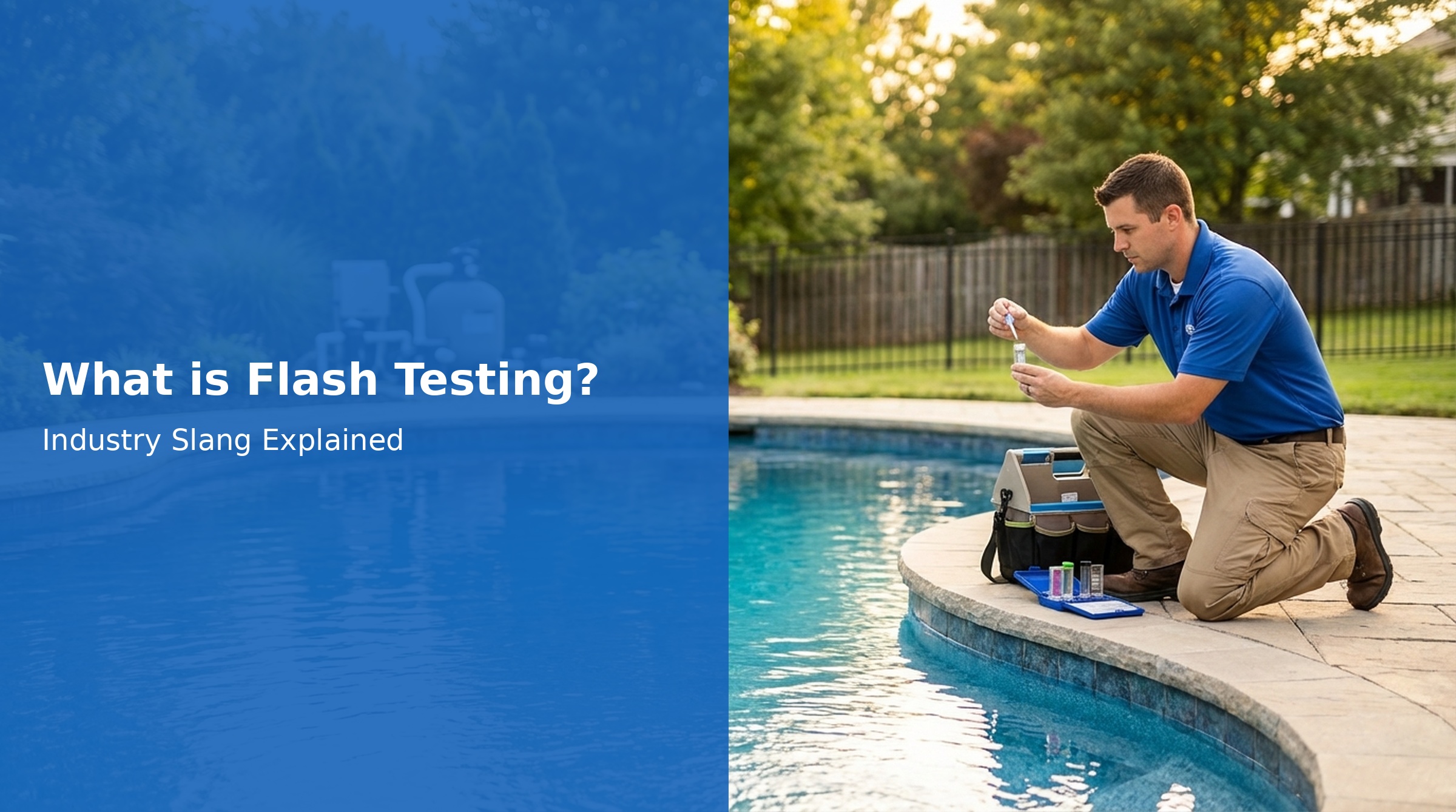
In the pool service industry, shortcuts and outdated testing methods can quickly undermine your professional reputation and compromise water safety. One such practice that continues to plague the industry is "flash testing" – a crude, old-school approach to chlorine testing that prioritizes speed over accuracy. While it might seem like a time-saver, this unprofessional method can lead to serious consequences for both your business and your clients' pool health.
Key Takeaways
- Flash testing involves adding just one drop of reagent to quickly check for chlorine presence, not measure actual levels
- This method is highly inaccurate and unprofessional compared to proper titration testing
- Using flash testing can lead to liability issues, customer complaints, and damaged reputation
- Proper testing methods take only minutes longer but provide crucial accurate measurements
- Professional pool technicians should always use standardized testing protocols for client safety
What Is Flash Testing?
Flash testing is an industry slang term that describes a shortcuts approach to chlorine testing where a pool technician adds only one drop of reagent (typically DPD #1) to a water sample to quickly determine if any chlorine is present. The logic behind this method is simple: if color appears, chlorine is present; if no color appears, there's no chlorine in the water.
This bare-bones approach emerged from busy service routes where technicians felt pressured to test water chemistry as quickly as possible. Rather than following proper titration procedures that involve adding reagent drop by drop until a color change occurs, flash testing attempts to provide a simple yes/no answer about chlorine presence.
However, this method completely ignores the fundamental purpose of water testing: to determine actual chemical levels so you can make informed treatment decisions.
Why Flash Testing Falls Short
Lack of Quantitative Data
The most glaring problem with flash testing is that it provides no measurable data. Knowing that chlorine is "present" tells you virtually nothing about whether levels are adequate, excessive, or dangerously low. A pool might have 0.2 ppm of chlorine (dangerously low) or 2.0 ppm (adequate), and flash testing would give the same positive result for both scenarios.
Inability to Detect Chlorine Demand
Professional pool maintenance requires understanding chlorine demand – how much sanitizer the pool actually needs based on bather load, environmental conditions, and current chemistry. Flash testing provides no insight into whether you need to add 1 pound or 5 pounds of chlorine to achieve proper sanitization levels.
Legal and Liability Concerns
Using inadequate testing methods can expose your business to significant liability. If a health incident occurs and it's discovered that you weren't properly monitoring and maintaining chemical levels, your shortcuts could become evidence of negligence. Professional standards exist for good reason, and deviating from them puts both your clients and your business at risk.
The Professional Alternative: Proper Chlorine Testing
Standard DPD Titration Method
The industry-standard approach involves using a proper test kit with DPD reagents and following titration procedures. This means adding reagent drops one at a time while counting until the pink color completely disappears, giving you an accurate measurement in parts per million (ppm).
This process typically takes less than two minutes – hardly a significant time investment considering the critical information it provides.
Digital Testing Options
For even greater accuracy and efficiency, digital colorimeters and photometers can provide precise readings in seconds. These tools eliminate human error in color interpretation and provide consistent, documented results that can be shared with clients.
Real-World Consequences of Flash Testing
Scenario 1: The Algae Outbreak
A technician using flash testing sees a pink color appear and assumes chlorine levels are adequate. In reality, the pool has only 0.3 ppm of chlorine – far below the 1.0-3.0 ppm range needed for proper sanitization. Within days, algae begins growing, leading to an expensive cleanup and an unhappy client who questions the technician's competence.
Scenario 2: Over-Chlorination Issues
Another common scenario involves pools with excessive chlorine levels (5+ ppm) that would also produce a positive flash test result. Swimmers experience eye and skin irritation, and the client complains about strong chemical odors. Without proper testing, the technician continues adding chlorine, making the problem worse.
Scenario 3: Combined Chlorine Problems
Flash testing cannot distinguish between free chlorine (effective sanitizer) and combined chlorine (chloramines that cause odor and irritation). A pool might test positive for total chlorine while having little to no free chlorine available for sanitization.
Building Professional Testing Protocols
Comprehensive Water Analysis
Professional pool service goes far beyond basic chlorine testing. A complete analysis should include pH, total alkalinity, calcium hardness, and cyanuric acid levels. Use our chemical dosage calculator to determine precise treatment requirements based on your actual test results.
Documentation and Client Communication
Accurate testing enables you to provide detailed service reports showing exact chemical readings, adjustments made, and recommendations for ongoing care. This level of professionalism builds trust and justifies your service fees.
Understanding Water Balance
Proper testing allows you to calculate the Langelier Saturation Index and ensure water balance. Our LSI calculator can help you determine whether water is aggressive or scale-forming based on your complete test results.
Training Your Team
If you manage other technicians, it's crucial to establish and enforce professional testing standards. Provide proper training on testing procedures and explain why shortcuts like flash testing are unacceptable. Consider implementing quality control measures such as periodic re-testing or random audits to ensure standards are maintained.
Make sure your team understands the full pool service terminology and testing procedures to maintain consistency across all service calls.
Moving Forward: Embracing Professional Standards
The pool service industry continues to evolve toward higher professional standards, and clients increasingly expect detailed, accurate service. Flash testing represents an outdated approach that has no place in modern pool maintenance.
Investing in proper testing procedures, quality equipment, and ongoing education pays dividends through improved customer satisfaction, reduced callbacks, and protection from liability issues. The few extra minutes spent on accurate testing can prevent hours of problem-solving later and help build a reputation for excellence in your service area.
Remember that professional pool service is about more than just keeping water clear – it's about ensuring safe, properly balanced water that protects both swimmers and pool equipment. Accurate testing is the foundation of everything else you do, and there's simply no substitute for doing it right.